E. Excretion
 Call Kai
 Learn
Learn Practice Test
 Spaced Repetition
 Match
Match Flashcards
 Knowt Play
1/44

Earn XP
Description and Tags
Proverbs 16:3
Name | Mastery | Learn | Test | Matching | Spaced | Call with Kai | Chat |
|---|
No analytics yet
Send a link to your students to track their progress
45 Terms
excretion
metabolism = initial pathway for elimination
Final pathway for elimination.
a. Metabolism
b. Excretion
c. Distribution
d. Absorption
d. Kidney
Other sites:
• body fluids (breast milk, feces, saliva, sweat)
• enterohepatic circulation
The primary site of drug excretion
a. Breast milk
b. Feces
c. Sweat
d. Kidney
Body fluids (breast milk, feces, saliva, sweat)
Enterohepatic circulation
Other sites of drug excretion [2]
Hydrophilic
Ionized
Polar
Excreted
📌Mnemonic: “HIPE”
The goal of drug excretion
a. Hydrolysis, Ionization, Precipitation, Excretion
b. Hepatic, Intestinal, Pulmonary, Elimination
c. Hydrophilic, Ionized, Polar, Excreted
d. Hepatic, Intestinal, Peripheral, Elimination
b. Zero order kinetics
The kinetics where the:
amount and rate are fixed
concentration independent
a. First order kinetics
b. Zero order kinetics
b. Zero order kinetics
Amount excreted is fixed
a. First order kinetics
b. Zero order kinetics
b. Zero order kinetics
Rate is fixed
a. First order kinetics
b. Zero order kinetics
a. First order kinetics
% excreted is fixed
a. First order kinetics
b. Zero order kinetics
a. First order kinetics
The concentration dependent kinetics
a. First order kinetics
b. Zero order kinetics
a. First order kinetics
Increase concentration = increase elimination
a. First order kinetics
b. Zero order kinetics
Aspirin
Morphine
Phenytoin
Warfarin
Heparin
Ethanol
Theophylline
Tolbutamide
📌Mnemonic: “AMPWHETT”
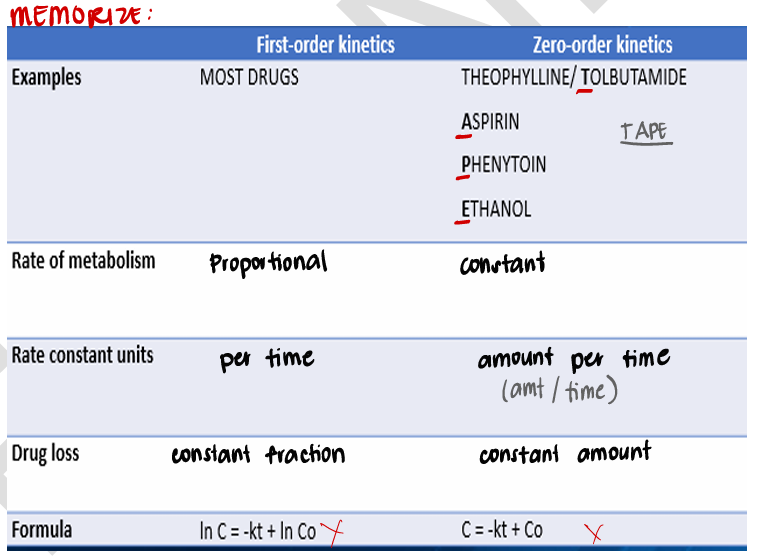
Drugs following Zero Order kinetics [6]
(IPS to)
First order kinetics vs Zero order kinetics:
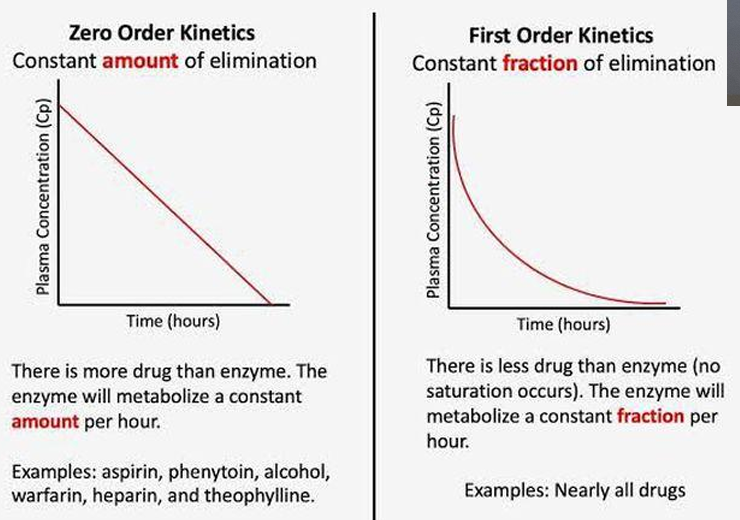
(IPS to)
First order kinetics vs Zero order kinetics:
c. T½ = ln2 × Vd / Cl
time it takes to reduce the initial concentration by half
The half-life formula
a. T½ = ln2 × Cl / Vd
b. T½ = ln2 / (Cl × Vd)
c. T½ = ln2 × Vd / Cl
d. T½ = Vd / (ln2 × Cl)
Intracellular
Extravascular
Longer T½
Longer stay in body
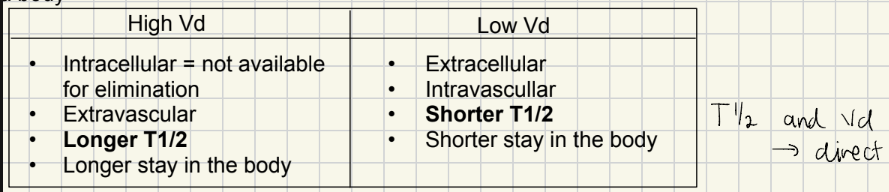
The characteristics of Low Volume of Distribution (Vd)
a. Extracellular, intravascular, shorter T½, shorter stay in body
b. Intracellular, extravascular, longer T½, longer stay in body
c. Intravascular, shorter T½, shorter stay in body
d. Extracellular, shorter T½, not available for elimination
b. Shorter T½ and shorter stay in body

The characteristics of High Clearance
a. Longer T½ and longer stay in body
b. Shorter T½ and shorter stay in body
c. Longer T½ and shorter stay in body
d. Shorter T½ and longer stay in body
Extracellular
Intravascular
Shorter T½
Shorter stay in body
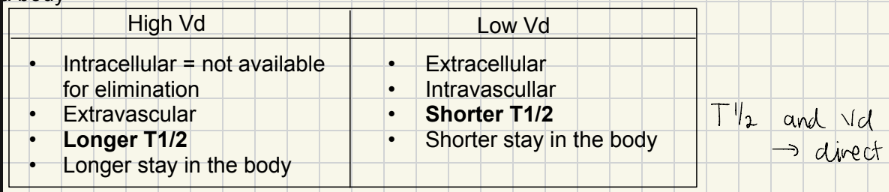
The characteristics of Low Volume of Distribution (Vd)
a. Extracellular, intravascular, shorter T½, shorter stay in body
b. Intracellular, extravascular, longer T½, longer stay in body
c. Intravascular, shorter T½, shorter stay in body
d. Extracellular, shorter T½, not available for elimination
a. Longer T½ and longer stay in body
The characteristics of Low Clearance
a. Longer T½ and longer stay in body
b. Shorter T½ and shorter stay in body
c. Longer T½ and shorter stay in body
d. Shorter T½ and longer stay in body
d. Nephron
The functional unit of the kidney
a. Glomerulus
b. Collecting duct
c. Loop of Henle
d. Nephron
d. Glomerular Filtration Rate
The primary measure of renal function that cannot be measured directly
a. Creatinine clearance
b. Cystatin C
c. Serum creatinine
d. Glomerular Filtration Rate
d. Creatinine
The normal waste product of muscle metabolism used to approximate GFR
a. Urea
b. Uric acid
c. Cystatin C
d. Creatinine
d. Cockcroft-Gault equation
The equation used to calculate Creatinine Clearance
a. CKD-EPI formula
b. Henderson-Hasselbalch equation
c. Arrhenius equation
d. Cockcroft-Gault equation
CrCl=72×serum creatinine(140−age)×(weight in kg)×0.85
🧠NOTE: Male has higher muscle mass
The Cockcroft-Gault equation for female patients
CrCl (mL/min)=72×serum creatinine in mg/dL(140−age in years)×(weight in kg)
The Cockcroft-Gault equation for male patients:
Age
Serum creatinine
African-American ethnicity
The variables used in the CKD-EPI formula [3]
a. Age, serum creatinine, and African-American ethnicity
b. Age, weight, and genetic Polymorphism
c. Age, sex, and serum albumin
d. Age, weight, and body surface area
↑ creatinine = ↓ CrCl = ↓ eGFR ❌
↓ creatinine = ↑ CrCl = ↑ eGFR ✅
Relationship of creatinine, CrCl and eGFR:
d. Cystatin C

The alternative marker used to assess GFR in elderly patients with decreased muscle mass where creatinine clearance is not accurate
a. Serum albumin
b. Uric acid
c. Blood urea nitrogen
d. Cystatin C
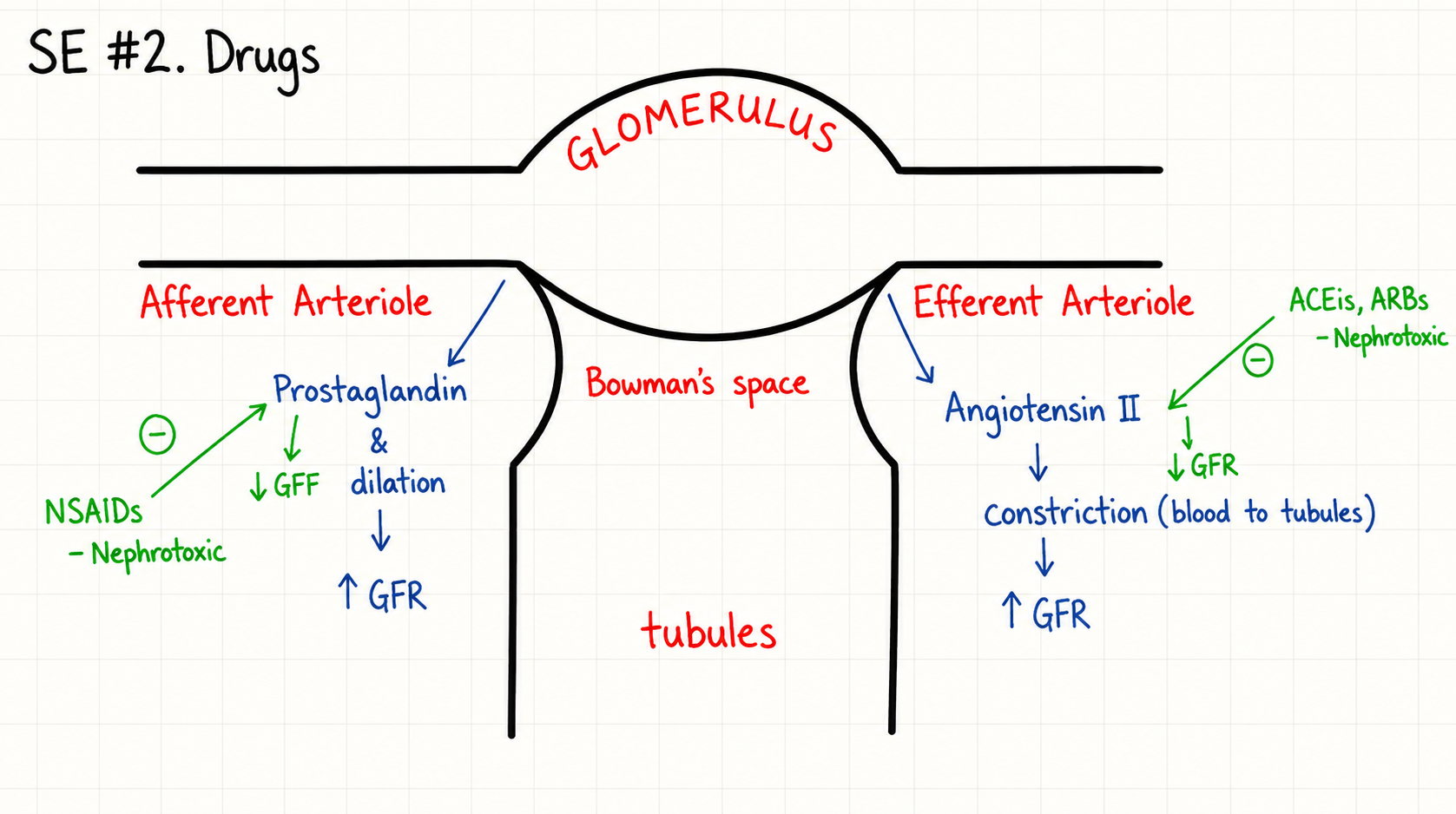
Explain mo nalang Please 🧠
Nephrotoxic MOT of ARBS, ACEIs, and NSAIDs
a. Probenecid inhibits tubular secretion of penicillin → increase levels of penicillin

How does the combination of probenecid + penicillin increase levels of penicillin?
a. Probenecid inhibits tubular secretion of penicillin → increase levels of penicillin
b. Probenecid inhibits hepatic glucuronidation of penicillin → increase levels of penicillin
c. Probenecid displaces penicillin from plasma albumin → increase free levels of penicillin
d. Probenecid decreases the volume of distribution of penicillin → increase plasma levels of penicillin
d. Proximal convoluted tubule
The primary site of tubular reabsorption
a. Distal convoluted tubule
b. Loop of Henle
c. Collecting duct
d. Proximal convoluted tubule

Explain mo nalang Please 🧠
Apply the LUNA and HIPE
Effects of pH in drug elimination:
d. Urinary alkalinizer
Sodium bicarbonate
The treatment for ASA (aspirin) overdose to enhance excretion
a. Urinary acidifier
b. Dialysis
c. Activated charcoal
d. Urinary alkalinizer
a. Urinary acidifier
Vitamin C
Ammonium chloride
The treatment for Amphetamine overdose to enhance excretion
a. Urinary acidifier
b. Dialysis
c. Activated charcoal
d. Urinary alkalinizer
b. Creatinine increase by ≥ 0.3 within 48 hours
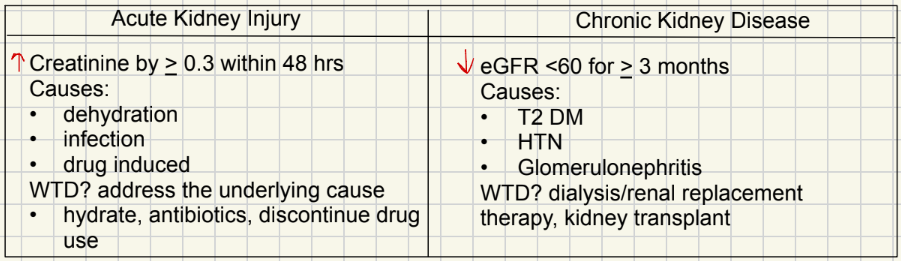
The diagnostic criterion for Acute Kidney Injury
a. eGFR < 60 for ≥ 3 months
b. Creatinine increase by ≥ 0.3 within 48 hours
c. eGFR < 15 (end stage renal disease)
d. Creatinine increase by ≥ 0.5 within 24 hours
a. eGFR < 60 for ≥ 3 months
The diagnostic criterion for CKD
a. eGFR < 60 for ≥ 3 months
b. Creatinine increase by ≥ 0.3 within 48 hours
c. eGFR < 15 (end stage renal disease)
d. Creatinine increase by ≥ 0.5 within 24 hours
Dehydration
Infection
Drug-induced
Causes of Acute Kidney Injury include ______ [3]
a. T2 DM, HTN, and Glomerulonephritis
b. Dehydration, infection, and drug-induced
c. Lupus and chronic hypertension
d. Glomerulonephritis and T2 DM only
Type 2 DM
Hypertension (HTN)
Glomerulonephritis
Causes of Acute Kidney Injury include _____
a. Type 2 DM, Hypertension (HTN), and Glomerulonephritis
b. Dehydration, infection, and drug-induced
c. Lupus and chronic hypertension
d. Glomerulonephritis and T2 DM only
c. Address the underlying cause
dehydration → hydration
infection → antibiotic
drug induced → discontinue drug use
Management of Acute Kidney Injury include _____
a. Dialysis and kidney transplant
b. Renal replacement therapy only
c. Address the underlying cause
d. Kidney transplant
Dialysis / Renal replacement therapy
Kidney transplant
Management of Chronic Kidney Disease (CKD) include _______
a. Hydrate, antibiotics, and discontinue drug use
b. Address the underlying cause only
c. Dialysis/renal replacement therapy and kidney transplant
d. Antibiotics and hydration o
d. > 90
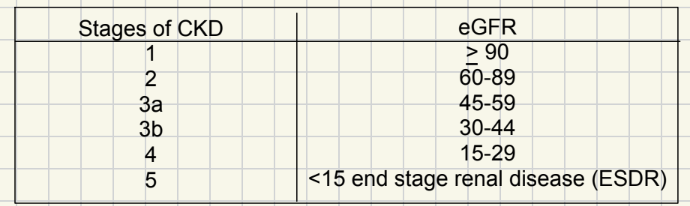
eGFR range for CKD Stage 1
a. 60–89
b. <15
c. 30–44
d. > 90
a. 60–89
eGFR range for CKD Stage 2
a. 60–89
b. <15
c. 30–44
d. > 90
d. 45–59
eGFR range for CKD Stage 3a
a. 30–44
b. 60–89
c. 15–29
d. 45–59
a. 30–44
eGFR range for CKD Stage 3b
a. 30–44
b. 60–89
c. 15–29
d. 45–59
d. 15–29
eGFR range for CKD Stage 4
a. 30–44
b. < 15
c. 45–59
d. 15–29
d. < 15
eGFR value indicating CKD Stage 5 (End Stage Renal Disease)
a. > 90
b. < 10
c. > 100
d. < 15