Church Objects, Vestments, and Liturgical Practices in Catholic Mass
 Call Kai
 Learn
Learn Practice Test
 Spaced Repetition
 Match
Match Flashcards
 Knowt Play
1/48

There's no tags or description
Looks like no tags are added yet.
Name | Mastery | Learn | Test | Matching | Spaced | Call with Kai | Chat |
|---|
No analytics yet
Send a link to your students to track their progress
49 Terms
The chalice
The vessel which holds the wine that becomes the Precious Blood of Christ.
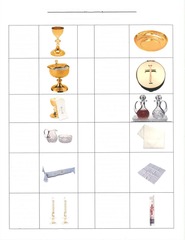
The paten
The golden 'plate' that holds the bread that becomes the Sacred Body of Christ.
The ciborium
A golden vessel with a lid that is used for the distribution and reservation of Hosts.
The pyx
A small, closing golden vessel that is used to bring the Blessed Sacrament to those who cannot come to the church.
The purificator
A small rectangular cloth used for wiping the chalice.
The cruets
Hold the wine and the water that are used at Mass.
The lavabo and pitcher
Used for washing the priest's hands.
The altar cloth
A rectangular white cloth that covers the altar for the celebration of Mass.
The altar candles
Mass must be celebrated with natural candles (more than 51% beeswax), which signify the presence of Christ.
The lavabo towel
Which the priest dries his hands after washing them during the Mass.
The corporal
A square cloth placed on the altar beneath the chalice and paten, folded to catch any particles of the Host that may accidentally fall.
Paschal candle
A new candle prepared and blessed every year at the Easter Vigil, standing near the altar during the Easter Season.
Bells
Rung during the calling down of the Holy Spirit to consecrate the bread and wine.

The sanctuary lamp
A candle, often red, that burns near the tabernacle when the Blessed Sacrament is present there.
The aspersorium
The bucket used to carry holy water for sprinkling.
The aspergillum
The sprinkler for casting holy water on people, places, or objects.
The thurible
Used for carrying and burning incense.
The incense boat
Holds the incense before it is placed in the thurible for burning.
Sacred Oils
Oil of Chrism, Oil of the Sick, Oil of the Catechumens.
The sacrarium
A drain in the sacristy that flows directly into the earth, used for respectfully disposing of holy water, blessed ashes, and the water used to wash the altar clothes.
The Roman Missal
The book containing the ceremonial instructions and prayers for the celebration of Mass.
The Lectionary
The book containing the biblical readings arranged for the celebration of Mass.
The Book of the Gospels
The book from which the Gospel reading is proclaimed.
Ordo
A liturgical aid published to foster the celebration of the liturgy.
The alb
A full-length white garment worn by the priest and deacon.
The stole
A long strip of fabric worn around the neck, matching the color of the day.
The chasuble
Worn by the priest over his other vestments, symbolizing the yoke of Christ and of the priesthood.

The cope
A cape-like vestment that may be worn during processions and liturgical celebrations outside of Mass.
The cincture
Worn around the alb if it does not fit closely to the body.
The dalmatic
The distinctive vestment of the deacon, which has sleeves.
The processional cross
Hearkens back to the days of the Roman army when the standard-bearer would carry the insignia of a particular legion into battle.
The Sanctuary
The elevated portion of the church where the clergy and other ministers perform their proper functions in the worship of God.
The Nave
The main body of the church where the congregation gathers.
The Sacristy
The room where the sacred vestments, vessels, and other items used in the celebration of the liturgy are stored and prepared.
The Altar
The sacred table on which the sacrifice of the Mass is offered to God.
The Ambo
The lectern from which the readings are proclaimed.
The Presider's Chair
The chair on which the priest sits during Mass.
The Credence Table
The table on which objects are kept during the celebration of Mass.
The Tabernacle
The golden container in which the Blessed Sacrament is reserved.
The Ambry
The cabinet in which the three holy oils are kept.
Liturgical Colors
Colors used in the liturgy to symbolize different themes.
Standing
Shows a special level of respect and readiness.
Genuflection
Made by bending the right knee to the ground, given to the Blessed Sacrament.
Kiss
The Book of the Gospels and the altar are customarily venerated with a kiss.
Profound bow
Made to the altar whenever one passes in front of it during Mass.
Bow of the head
Made during Mass at the name of Jesus and other significant names.
Sitting
Signifies attentiveness, especially to the readings from Sacred Scripture.
Kneeling
Signifies adoration of God and humility before him.
Striking the breast
Done during the Confiteor, acknowledging our sinfulness.