Hematocrit
 Call Kai
 Learn
Learn Practice Test
 Spaced Repetition
 Match
Match Flashcards
 Knowt Play
1/43

There's no tags or description
Looks like no tags are added yet.
Name | Mastery | Learn | Test | Matching | Spaced | Call with Kai | Chat |
|---|
No analytics yet
Send a link to your students to track their progress
44 Terms
Packed Cell Volume (PCV)
another vital part of the CBC
also known as the hematocrit (Hct)
an expression of the percentage of the whole blood occupied by RBCs
PCV can be performed with either a microhematocrit or microhematocrit technique
PCV can be performed with either a _______ or microhematocrit _______
microhematocrit method
abbreviated Hct, is the most commonly performed PCV test in veterinary practice
A blood-filled capillary tube is centrifuged for 2 to 5 minutes
The blood separates into a plasma layer, a white buffy coat composed of WBCs and platelets
and a layer of packed red cells. Measuring the RBC layer in the capillary tube determines the PCV
anemia
A low PCV may indicate
blood loss, neoplasia, parasitism, and chronic infection
many causes of anemia
dehydration
splenic contraction in an excited animal
increased PCV also has several possible causes
PCV values may be erroneously high because of clots in the sample, failure to adequately mix the EDTA and blood, and insufficient centrifugation time.
PCV values may be erroneously _____ because of _____ in the sample, _____ to adequately mix the EDTA and blood, and insufficient centrifugation ____.
PCV values may be erroneously low if the microhematocrit tube contains excessive plasma because of inadequate mixing of the sample. Sample dilution because of low blood-to-anticoagulant ratio may also cause a spurious decrease in PCV.
PCV values may be erroneously ____ if the microhematocrit tube contains excessive ______ because of inadequate _______ of the sample. .
Sample dilution because of low blood-to-anticoagulant ratio may also cause a spurious decrease in PCV
Sample dilution because of low _____-to-_______ ratio may also cause a spurious decrease in _____
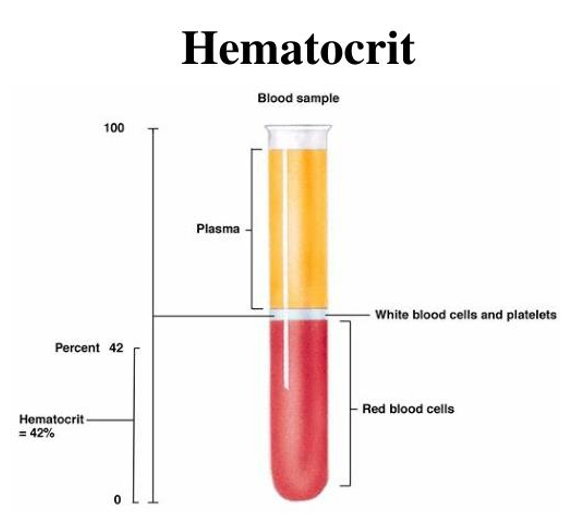
hematocrit
is a part of CBC and is also known as HCT
The hematocrit blood test determines the percentage of red blood cells (RBC's) in the blood
The hematocrit blood test determines the percentage of ____ blood cells (RBC's) in the blood
blood
composed mainly of red blood cells and white blood cells suspended in an almost clear fluid called serum
hematocrit test
indicates the percentage of blood by volume that is composed of red blood cells.
anemia
results from having too few red blood cells
causes a variety of symptoms
hematocrit
basic test that can tell a physician a lot about a person's health.
low hematocrit
the percentage of red blood cells is below the lower limits of normal (see above) for that person's age, sex, or specific condition (for example, pregnancy or high-altitude living)
Bleeding (ulcers, trauma, colon cancer, internal bleeding)
Destruction of red blood cells (sickle cell anemia, enlarged spleen)
Decreased production of red blood cells (bone marrow supression, cancer, drugs)
Nutritional problems (low iron, B 12, folate and malnutrition)
BDDN
Causes of low hematocrit, or anemia, include
high hematocrit
means the percentage of red blood cells in a person's blood is above the upper limits of normal (see above) for that person's age, sex, or specific condition (for example, pregnancy or high altitude living)
Dehydration (heat exhaustion, no available source of fluids)
Low availability of oxygen (smoking, high altitude, pulmonary fibrosis)
Genetic (congenital heart diseases)
Erythrocytosis (over-production of red blood cells by the bone marrow or polycythemia vera)
Cor pulmonale (COPD, chronic sleep apnea, pulmonary embolism
DLGEC
Causes of a high hematocrit include
Erythrocytosis
over-production of red blood cells by the bone marrow or polycythemia vera
1. Allow the tubes to fill about three-quarters full by capillary action.
1. Allow the tubes to fill about _____-quarters full by _____ action.
Speed: 10,000 rpm; Time: 5 minutes
centrifuge speed
Determine the packed cell volume using a microhematocrit reader
Determine the packed cell volume using a ________ reader
1. To estimate the hemoglobin (Hgb) value of the patient, divide the PCV reading by 3.
1. To estimate the hemoglobin (Hgb) value of the patient, divide the PCV reading by _.
erythrocyte volume fraction (EVF).
The hematocrit may also be referred to as Packed Cell Volume (PCV) or ?
•A decrease in the number or size of red cells also decreases the amount of space they occupy, resulting in a lower hematocrit.
•A ______ in the number or size of red cells also decreases the amount of ____ they occupy, resulting in a lower hematocrit.
•An increase in the number or size of red cells increases the amount of space they occupy, resulting in a higher hematocrit.
•An ______ in the number or size of red cells increases the amount of space they occupy, resulting in a higher hematocrit.
hematocrit (Hct) or packed cell volume (PCV)
•Measurement of ? is the most accurate and simplest of all tests in clinical hematology for detecting the presence and degree of anemia or polycythemia. In comparison, hemoglobin estimation is less accurate, and RBC count far less accurate.
PCV objective
•To pack the RBC using the centrifuge force.
•Forcing all red cell below and plasma above, by centrifugal force.
PCV objective
•To _____ the RBC using the centrifuge force.
•Forcing all red cell below and plasma above, by _____ force.
•Microhaematocrit
•Electronic cell counting
Methods of PCV
Microhaematocrit tube (capillary tube)
•which contains heparin and show a red ring at the end of the tube.
•Note that the blood has been separated into 3 layers:
•i. A tall upper layer of clear plasma—amber slightly yellow-colored. It should not be pink or red which would indicate hemolysis of red cells in the sample or within the body in hemolytic diseases.
•ii. A greyish-white, thin layer (about 1 mm thick) the so-called “buffy layer”, consisting of platelets (thrombocytes) above and leukocytes below it.
iii. A tall bottom layer of red cells which have been closely packed together. A greyish red line separates red cell layer from the layer of leukocytes above it
•Note that the blood has been separated into 3 layers:
•i. A tall upper layer of clear ____—amber slightly yellow-colored. It should not be pink or red which would indicate hemolysis of red cells in the sample or within the body in hemolytic diseases.
•ii. A greyish-white, thin layer (about 1 mm thick) the so-called “____ layer”, consisting of platelets (_______) above and _____ below it.
iii. A tall bottom layer of ____ cells which have been closely packed together. A greyish red line separates red cell layer from the layer of leukocytes above it
Acute kidneydisease
lower Erythropoietin production lead to less RBCs production by the bone marrow
pregnant
may lead to women having additional fluid in blood. This could potentially lead to a small drop in hematocrit levels
erythrocytosis
Abnormal increase in red blood cells
polycythemia vera
•causes your body to produce too many red blood cells (in polycythemia it may rise to as high as 70 %).
higher altitudes
, there is a lower oxygen supply in the air and thus hematocrit levels may increase over time
hypoxia
high Hct
Low blood oxygen levels
Lung or heart disease
high Hct
•if the body senses low oxygen levels, it will make more red blood cells in an effort to increase the amount of oxygen in the blood
DEHYDRATION AND BURN
high Hct
______ and
due to loss of plasma
The normal values of PCV vary according to the age and sex of the individuals. The normal ranges are:
Males: 40 %–54 %
Females: 36 %–47 %
Newborns: 55-68 %.
The normal values of PCV vary according to the age and sex of the individuals. The normal ranges are:
Males: __ %–54 %
Females: ___ %–47 %
Newborns: ___-68 %.
Sources of error and comments
1.An increased amount of anti-coagulant decreases the Hct reading as a result of erythrocyte shrinking.
2.Improper sealing of the capillary tube causes a decreased Hct reading as a result of loss of blood during centrifugation. a higher number of erythrocytes are lost in relation to the plasma.
3.The microhematocrit centrifuge should never be forced to stop by applying pressure to the metal cover plate. This will cause the RBC layer to “sling” forward and results in a falsely elevated value.
●
Sources of error and comments
1.An increased amount of anti-_____ decreases the Hct reading as a result of erythrocyte _____.
2.Improper ____ of the capillary tube causes a _____ Hct reading as a result of loss of blood during centrifugation. a higher number of erythrocytes are lost in relation to the plasma.
3.The microhematocrit centrifuge should never be forced to ____ by applying pressure to the metal cover plate. This will cause the RBC layer to “____” forward and results in a falsely elevated value.
Sources of error and comments
7.The buffy coat of the specimen should not be included in the Hct reading, because its inclusion falsely elevates the result.
8.A decrease or increase in the readings may be seen if the microhematocrit reader is not used properly.
9.If too much time elapses between when the centrifuge stops and the capillary tube is removed, the red cells can begin to settle out and cause a false reading of the hematocrit.
Sources of error and comments
7.The ____ coat of the specimen should not be included in the Hct reading, because its inclusion falsely elevates the result.
8.A decrease or increase in the readings may be seen if the microhematocrit ____ is not used properly.
9.If too much time elapses between when the centrifuge ____ and the capillary tube is ______, the red cells can begin to settle out and cause a false reading of the hematocrit.