AQA A-Level Economics Aggregate Demand
 Studied by 0 people
 Call Kai
 Learn
Learn Practice Test
 Spaced Repetition
 Match
Match Flashcards
 Knowt Play
1/26

There's no tags or description
Looks like no tags are added yet.
Name | Mastery | Learn | Test | Matching | Spaced |
|---|
No study sessions yet.
27 Terms
Aggregate Demand
The total level of spending on goods and services produced in an economy during a time period
The aggregate demand curve
Shows the relationship between the price and the real output
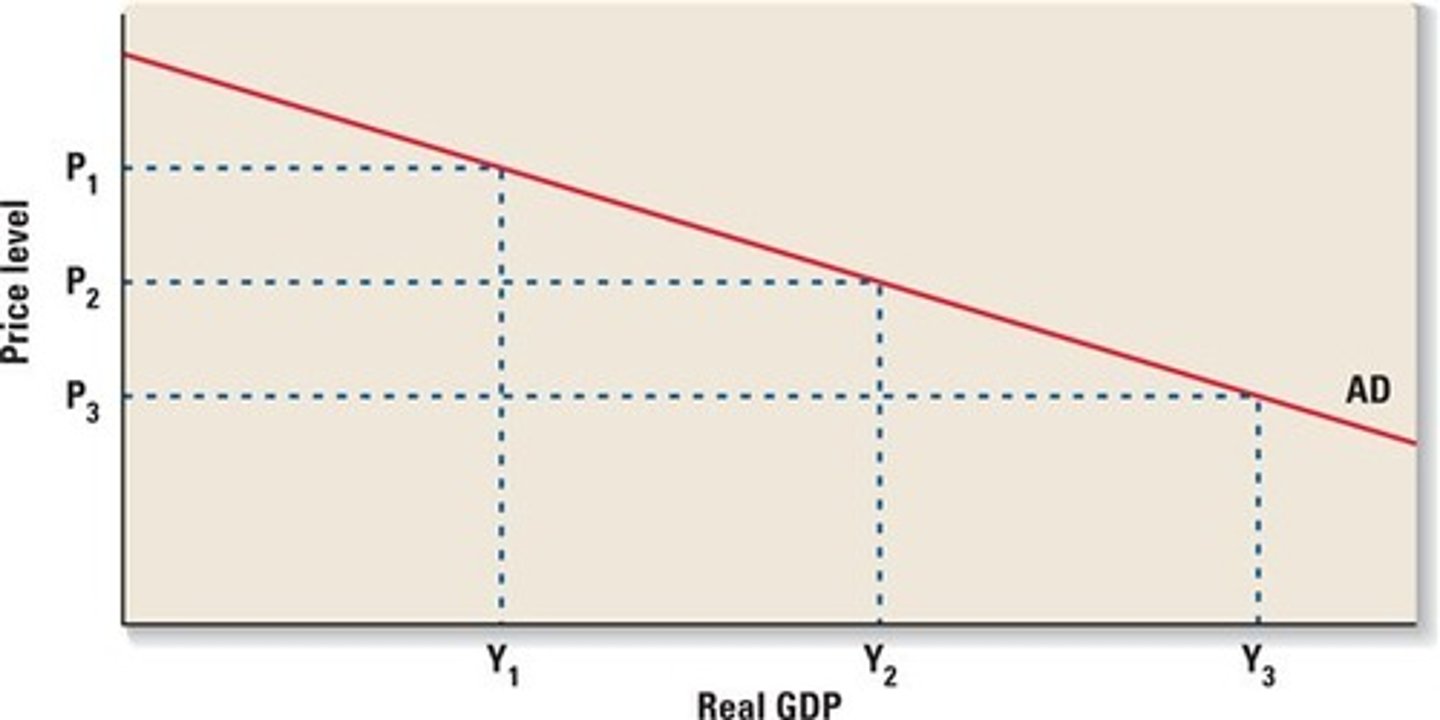
Three factors which affect aggregate demand
Wealth Effect, Interest Effect, Balance or Trade Effect
Wealth
When the price level falls consumers are wealthier and have higher incomes in real terms, encouraging greater consumption
Interest Effect
If the price level is low the interest rate will also be low. This means greater consumption, investment and exports
Balance or Trade Effect
Lower inflation makes domestic goods more competitively priced compared to foreign goods and there will be an improvement in the balance of trade
Consumption
Consumption refers to spending by households on goods and services
Which factors increase consumption spending
Consumer confidence, household wealth, distribution of income, supply of credit
Which factors increase consumption spending
Direct and indirect taxes, interest rates
Investment
Investment refers to spending by firms on capital goods such as plant, equipment and new buildings to produce more consumer goods in the future
Which factors would increase investment
Low interest rates, supply of credit, business confidence
Which factors would decrease investment
Corporate taxes, high investment, risk and uncertainty, regulations
If investment increases
Then Aggregate Demand Curve shifts to the right
If consumption increases
Then the Aggregate Demand Curve shifts to the right
Aggregate Demand Equation
AD (Aggregate Demand) = C (Consumption) + I (Investment) + G (Government Spending) + (X (Exports) -M (Imports))
Government spending
Government spending refers to spending on state provided goods and services including public and merit goods
Merit goods
Goods that are held to be desirable for consumers, but which are underprovided by the market. Reasons for underprovision: Good may have positive externalities, or consumer ignorance about the benefits of the good.
Automatic Stabilisers
Economic policies designed to offset fluctuations in economic activity without individual intervention from the government
Capital Spending
Spending on roads, schools, hostptals etc.
Altering the economic cycle
The government may spend more to boost national income and confidence
A budget deficit will arise if spending exceeds tax revenue
Transfer payments
Pensions, unemployment benefits, business subsidies
Net Exports
Net exports refers to the value of the country's total exports minus imports (X-M)
Exchange rate
A weaker exchange rate means imports become dearer and exports cheaper
Creates a trade surplus, an increase in AD and an injection to the circular flow of income
S.P.I.C.E.D
Strong Pound Imports Cheaper Exports Dear
Protectionism
Economic policy of shielding an economy from imports
Monetary Policy
Government policy that attempts to manage the economy by controlling the money supply and thus interest rates.
Fiscal Policy
Government policy that attempts to manage the economy by controlling taxing and spending.