NEUR200 EXAM 3
 Call Kai
 Learn
Learn Practice Test
 Spaced Repetition
 Match
Match Flashcards
 Knowt Play
1/52

There's no tags or description
Looks like no tags are added yet.
Name | Mastery | Learn | Test | Matching | Spaced | Call with Kai | Chat |
|---|
No analytics yet
Send a link to your students to track their progress
53 Terms
rhythms
biological rhythms tied to the passage of time
circadian rhythm: 24 hour biological cycle influential in the regulation of sleep and other physical responses; the exposure to light readjusts people’s biological clocks by affecting the activity of the hypothalamus
hypothalamus
SCN (suprachiasmatic nucleus)
influenced by light
controls the release of melatonin in the pineal gland (causes sleepiness)
light reaches the SCN directly in mammals (retinohypothalamic pathway)
reticular formation
ascending fibers
influence physiological arousal
locus coeruleus
in the pons
primary source of norepinephrine, regulating arousal, attention, stress responses, and memory
hypothalamus
histamine: promotes wakefulness, arousal, and alertness by increasing neuronal activity in the cortex and inhibiting REM sleep
orexin: needed to stay awake, inhibition of orexin can cause rats to fall asleep quickly > leads to narcolepsy
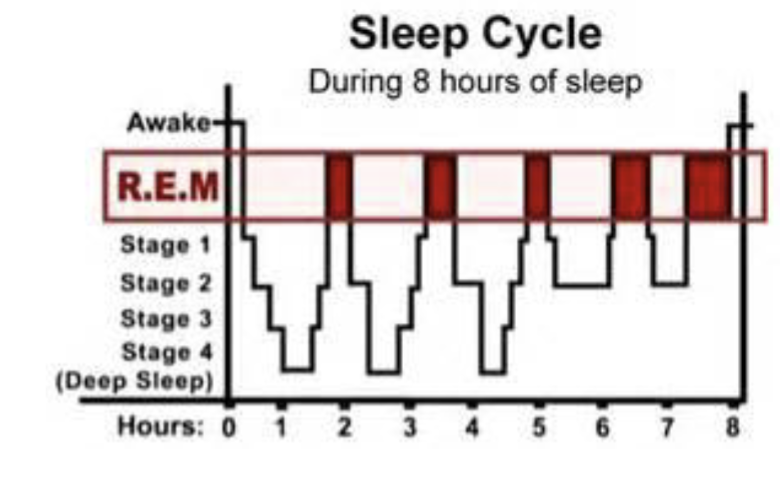
sleep stages, eeg
stage 1: lasts 5 to 10 minutes (THETA WAVES)
stage 2: brief bursts of higher-frequency brain waves
k-complex: sharp waves, temporal inhibition of neuronal firing. happen after sudden interruption in sleeping environment (like noise)
sleep spindles: generated in the thalamus, very brief 500 ms. more sleep spindles in people who napped, they were refreshed to do a learning task
stage 3 and 4: slow-wave sleep; high amplitude, low frequency delta waves become prominent. synchronization of low-waves. reduction of sensory input
stage 5 (REM SLEEP): rapid eye movement. high-frequency beta waves in some areas. dreams (happen during 3 and 4 too)
insomnia
chronic problems in getting enough sleep
causes: anxiety, tension, depression
narcolepsy
irresistible onsets of sleep during normal waking periods
causes: lack of hypothalamic cells that produce orexin, huntington’s (causes nerve cells in the brain to decay overtime)
sleep apnea
frequent, reflexive gasping for air (of a minute) that awakens a person.
causes obesity, genetics, hormones, old-age deterioration of the brain mechanisms that regulate breathing
night terrors
abrupt awakenings from NREM sleep accompanied by intense autonomic arousal and feelings of panic
nightmares
anxiety-arousing dreams that lead to awakening
REM behavior disorder
people who move around vigorously during their REM periods, acting out their dreams (caused by a GABA deficiency)
extra sleep disorders
sleepwalking = motor cortex is awake
lucid dreaming = monitoring areas are awake (frontal)
waking up but not being able to move (sleep paralysis)
fatal familial insomnia
inherited rare disease
onset occurs when a critical amount of protein PrP is converted to PrPres
greater amounts of PrPres than normal in thalamus > degeneration of thalamus
absence of sleep spindles and k-complexes
deep sleep is reduced, REM sleep can happen during waking state
weight loss, elevated sympathetic activation, hallucinations, epileptic seizures, coma, death
energy conservation
sleep conserves energy during inefficient times
autonomic nervous system
analogous to hibernation
differences across species
dishes that don’t sleep. they live in caves with no difference between day and night
humans have changed their sleep habits too (we used to sleep less i think idk)
sleep and memory (EEG)
memories that are more important will be consolidated better during sleep
EEG patterns during sleep resemble those that occur during learning
sleep spindles increase in number after new learning
sleep and memory (learning and memory)
the brain makes adjustments when we learn new things
strengthening new synapses
weakening or removing old synapses that are not used anymore
reactivation process associated with consolidation begins when a memory is formed, but it becomes strong during sleep
steffan gais
high-school students had to learn a list of 24 pairs english-german words
the “sleep” group went to sleep after learning the words (~3 hours max)
the “awake” group didn’t go to sleep until ~10 hours after learning the words
people who didn’t sleep were found to forget more
attention
narrowing or focusing awareness selectively to a part of the sensory environment or to a class of stimuli
primarily a top-down process that selects information from a specific part of the sensory world, such as a point in space or an object
consciousness
is synonymous at a primary level with awareness and at a secondary level with awareness of awareness (first person experience of the events that you are aware of)
consciousness is not that selective, it summarizes all information pertinent to the individual and its environmen
fmri findings
parietal cortex is needed for attention to location
occipital and temporal lobes are more important for feature
the anterior cingulate and prefrontal areas are important for both, attention to location and features, mainly in divided attention tasks
when subjects attend only to auditory or visual stimuli, there is an activation of sensory areas, but not much activation of the frontal lobe. to attend to both modalities, simultaneously requires a recruitment of the dorsolateral prefrontal cortex
alerting network
reticular activating system (RAS) >
locus coeruleus (noradrenaline) >
acts to prepare regions (alertness), especially in prefrontal and posterior parietal cortex, for detecting stimuli rapidly
orienting network
acetylcholine
prioritizes sensory input by selecting a sensory modality or a location in space
dorsal attention system
top-down visuospatial
right-lateralized (neglect syndrome, opposite side of the body)
fronto-parietal executive networks (DLPFC)
default mode network
thinking about one’s past, thinking about the future, or mind wandering (mPFC, PCC, medial temporal areas)
salience network
most active when a behavioral change is needed. if the salience network is not functioning properly, the default network shows excessive activity, leading to lapses in attention (ACC, insula)
dual executive networks
frontoparietal network
thought to relate to task instructions that are transient at the beginning of a new task
cingulo-opercular network
sustained activity across the task
synchrony
the attentional system induces synchrony across a population of neurons that assess some sensory light
importance of temporal positions of action potentials > ie several inputs to a given neuron arrive together
increasing activity in the attention network increases brain synchrony globally
increasing activity in the default network may have the opposite affect - a loss of global synchrony
meditation
meditation reduces activity in DMN and increases in salience and central executive network connectivity
increased activity of anterior cingulate during mediation
working memory
may be two working memory (short-term) systems for spatial and object memory
dorsal and ventral visual pathways from the parietal cortex and from the temporal lobes project to different prefrontal cortical regions and support two kinds of short-term memory
the dorsal stream enable vision for action and the ventral stream, vision for perception
encoding
sensory system to STM
visual objects: right prefrontal and right parahippocampal cortez
words: left prefrontal and parahippocampal cortex
consolidation
into LTM: medial temporal lobe
after further processig that involves the hippocampus, the permanent memory storage may require the outermost layer of the cortex, layer 1, which has few neuronal cell bodies but is packed with synapses
engrams: WHAT pathway (visual cortex for visual objects, auditory cortex for auditory objects)
retrieval
requires attention (frontal areas)
retrieval from LTM makes the memories plastic again and they can be updated - importance for PTSD therapy
long term memory
… pic
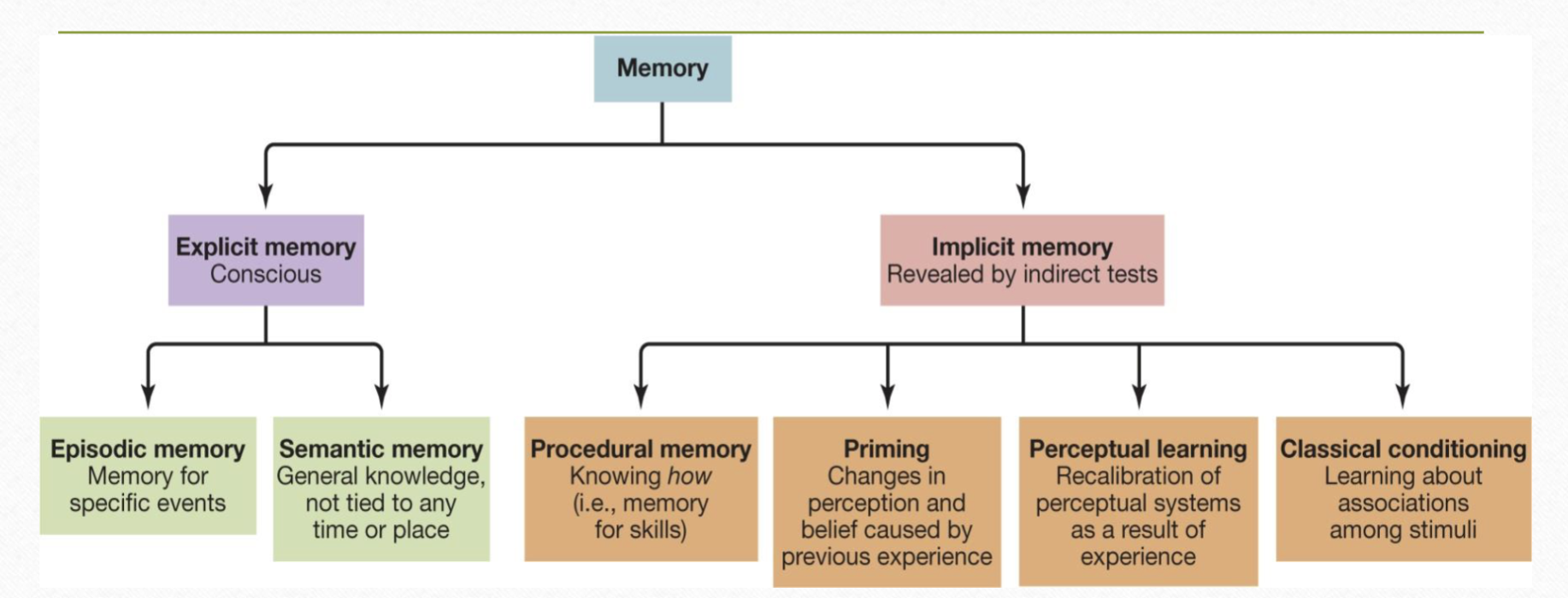
long-term explicit memory: episodic memory
memory of life experiences centered on the person herself
long-term explicit memory: semantic memory
knowledge about the world - nonautobiographical knowledge. ie ability to recognize family, friends, information learned in school
neural substrates
temporal-frontal-lobes
ventral stream
temporal lobe: hippocampus and rhinal cortex mainly
acetylcholine, serotonin, and noradrenaline
long-term memory and hippocampus
explicit memory, specifically episodic
spatial memory; morris water maze (rodents)
hippocampus as a spatial map
london taxi drivers; hippocampus activates more when they answer to spatial questions
contextual memory
the hippocampus brings together representations from various locations and reconstructs the context
long-term implicit memory: fear conditioning, amygdala
damage to the amygdala abolishes emotional memory but has little effect on other types of implicit or explicit memory
long-term implicit memory: procedural learning, basal ganglia
people with parkinson’s disease may have problems with this type of memory
procedural memory and basal ganglia
striatum, globus pallidus, substantia nigra
gradual learning of habits
reinforcement-based teaching (trial and error)
related to procedural memory
this type of learning is less flexible
you may need your frontal cortex at the beginning, otherwise it takes a long time to learn
prefrontal cortex: it is more flexible, switching responses
long-term potentiation
Glutamate receptors: AMPA and NMDA. NMDA receptors are blocked by Magnesium (positive ions). They open after depolarization.
When Calcium (together with sodium) enters through the NMDA channels, it will lead to the release of the protein CREB, that goes to the nucleus and alters genes (gene expression) that can last for months or years.
These effects are modulated by the brain-derived neurotrophic factor (BDNF): Repeated activation will lead to action potentials that back- propagate into dendrites and release BDNF. BDNF can increase NMDA receptor activity.
anterograde amnesia
disruption of memory for experiences after the onset of amnesia
retrograde amnesia
disrupt memory for things learned prior to the event that initiated the amnesia
time-dependent retrograde amnesia
injury severity determines how far back in time the amnesia extends. people usually start remembering with the passage of time and they only end up with an amnesia of a few seconds to minutes for events preceding the injury
amnesia (HM patient)
henry molaison, removed his hippocampus to end with his epilepsy
suffered with anterograde and retrograde amnesia
severe impairment of episodic memory (he could not describe any event that happened after his surgery)
Also, people with amnesia are as impaired at imagining the future as they are at describing the past → Function of episodic memory.
Better implicit than explicit memory.
Intact WM, but as soon as he was distracted, the memory was gone within seconds → Impaired storage of LTM (i.e. he was 27 for the rest of his life).
Intact procedural memory (i.e. videogames).
broca’s area
inferior frontal gyrus (44 and 45 of broadmann’s)
wernike’s area
superior temporal hyrus (22 of broadmann’s)
heschl’s gyrus
primary auditory cortex (41 and 42)
premotor area 6
facial movements (mirror neurons)
the dorsal part of area 6 (SMA) is important for rhythmic mouth movements that articulate sounds
visual areas
left fusiform cortex (important for reading)
cerebellum
wernicke
poor comprehension
paraphasias (the production of unintended syllables, words or phrases during speech ie “pike” instead of “pipe” and anomias
fluent speech and poor repetition
transcortical (sensory)
extrasylvian regions (POT junction)
poor comprehension, paraphasias and anomias
fluent speech and good repetition