Nutrition 2
 Call Kai
 Learn
Learn Practice Test
 Spaced Repetition
 Match
Match Flashcards
 Knowt Play
1/120

There's no tags or description
Looks like no tags are added yet.
Name | Mastery | Learn | Test | Matching | Spaced | Call with Kai | Chat |
|---|
No analytics yet
Send a link to your students to track their progress
121 Terms
Anabolism:
Building of molecules
Catabolism:
Breakdown of molecules
Parts of the cell:
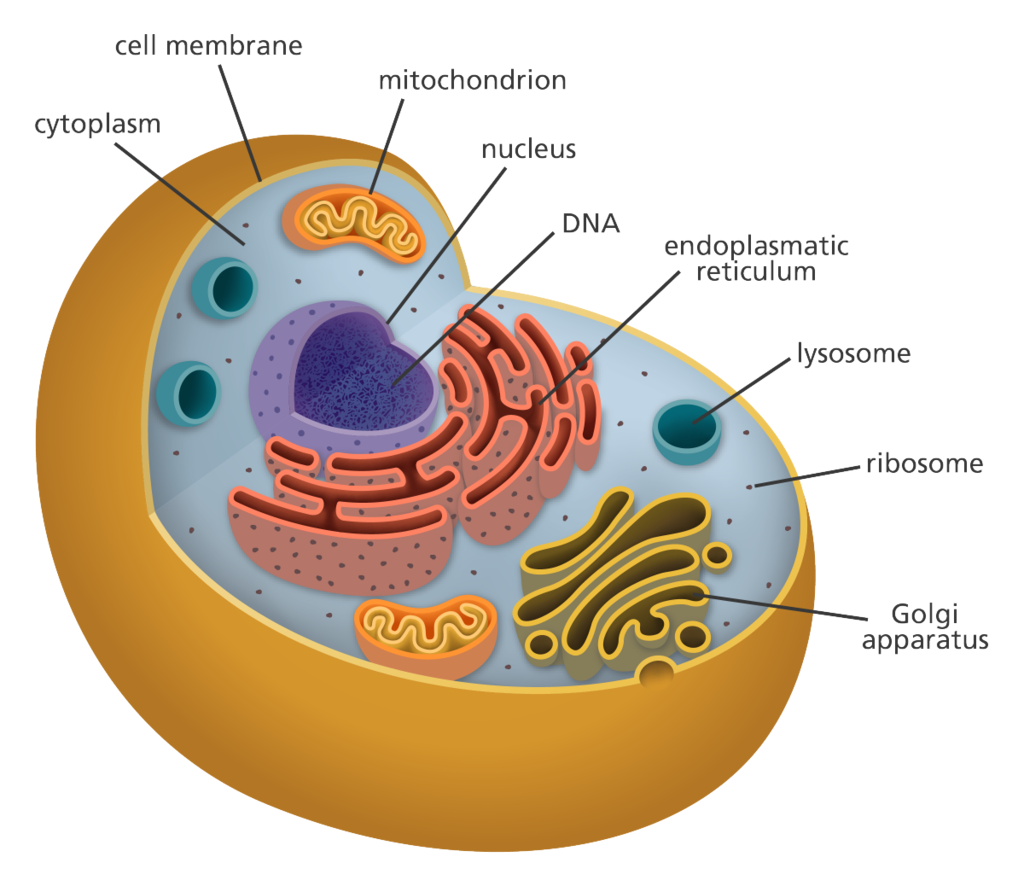
Coenzymes:
Compounds that help an enzyme
Usually vitamins or minerals
Describe the 3 pathways involved in the breakdown of glucose:
Glycolysis - phosphates are added to glucose. The molecules rearrange and split in half. Only, pyruvate. A little ATP is made, but not enough to live on.
Kreb’s cycle - begins with pyruvate then joins with Coenzyme-A to make Acetyl-coA, which joins with oxaloacetic acid to form citric acid, then several reactions occur forming 4 products (oxyloacetic acid, CO2, NADH, and FADH2). A few ATP is made but not enough to live
Electron Transport System - begins with NADH and FADH2 which splits releasing hydrogens and electrons which flow through proteins across membranes releasing energy, which is used to make ATP. Hydrogens and electrons join with oxygen to form water
Cori cycle:
When there is a deficiency of oxygen causes pyruvate to be converted into lactic acid which causes muscle pain and fatigue
When the muscle relaxes, blood circulates through the fibers and carries the lactic acid to the liver. The liver converts the lactic acid back into glucose
Fat metabolism
Glycerol is converted to pyruvate which enters Kreb’s cycle
Beta oxidation occurs
Fatty acids are broken into 2 carbon fragments by beta oxidation and the fragments enter the Kreb’s cycle
Deamination:
The removal of amine to form ammonia and a 2 fragment that enters the Kreb’s cycle
Transamination
Transferring the amine group to another compound then the leftover fragment enters the Kreb’s cycle
Production of ketones:
Carbohydrate deficiency causes oxyloacetic acid to be converted into glucose for the brain
Then fats and proteins are broken down to carbon fragments but then have nothing to join in the Kreb’s cycle so they travel to the liver and the liver converts to ketones to be flushed out in the urine
Alcohol:
Drinking alcohol is called ethanol
CH3CH2OH
It penetrates cell membranes and damages organelles
Alcohol is not digested
Proof:
Percentage of alcohol in a drink
Half the proof number = the percentage
200 proof = 100% alcohol
Absorption and metabolism of alcohol and its effects on the liver:
About 20% is absorbed through the walls off the stomach then alcohol dehydrogenase breaks down some of the remaining 80%
What isn’t broken down enters the intestine and is absorbed and travels through the liver. In the liver, it ties up enzymes that also break down fats, so fatty acids accumulate in the liver
Fasting for even one day causes the liver not to make alcohol dehydrogenase to conserve and make other things, so drinking after not eating is worse
This causes the liver to be unable to activate vitamin D or make bile and causes drugs to last longer
Breakdown produces Acetaldehyde and hydrogen ions which kill cells and denature proteins
The vitamin Niacin then picks up the hydrogen ion which causes a deficiency of niacin in the rest of the body and Acetaldehyde destroys vitamin B6
The liver cells die and become scar tissue (fibrosis) and is reversible
Continued exposure to alcohol causes cirrhosis which is hardening of the liver and is irreversible
Some cells can regenerate and produce more liver causing and even bigger liver (enlarged stomach)
Walking and coughing will not help, sleep it off
Explain the reason behind breathalyzer or urine analysis for drunkenness:
10% of alcohol leaves the body through the breath and urine
That amount is directly proportional to the amount in the blood
The amount in the blood is directly proportional to drunkenness
Effects of alcohol on the brain:
It is a narcotic and depressant
First it depresses the frontal lobe, which controls judgement, reasoning so it seems to be a stimulant
Second, inhibits vision and speech centers
Third, disturbs cerebellum of voluntary muscles
Fourth, affects the brain stem depressing the breathing and heart rates
Persons usually pass out first which is beneficial because depressed brain stem causes death
Also depresses production of ADH, which makes the person more thirsty, urine, and causes the person to drink more alcohol
It is possible to drink so fast you die before passing out
Effects of alcohol on the digestive tract:
Causes stomach to over secrete acid and histamine which irritates the lining causing ulcers and inflammation on other parts of the body
Also causes intestinal cells to stop absorbing B vitamins and causes folate to be released by intestinal cells instead of absorbing it
Long term effects of alcohol:
Affects rods in the eye to process the alcohol instead of vitamin A
Directly toxic to cardiac and skeletal muscle causing deterioration
Increases BP, causes cancer of mouth, throat, esophagus, and lungs
Slows the immune system and production of antibodies
Slows the metabolism of medicines so they can build up and kill
Number of calories in a pound of fat:
3,500 calories
Hunger:
Physiologic need for food
The hypothalamus controls much concerning hunger based on nutrients in the blood, exercise, hormones, sights, smells, climate, and temp.
People override the hypothalamic signals for various reasons
Appetite:
Desire for food
Amylin:
Slows stomach and promotes satiety (full)
Cholecystokinin:
Causes the brain to feel full
Enterostatin:
Causes the brian to reduce fat intake
Ghrelin:
Stimulates hunger and food intake
Glucagon-like peptide 1:
Slows the stomach and reduces appetite
Oxyntomodulin:
Suppresses appetite
Peptide YY:
Reduces appetite and slows the stomach
Proteins:
Made of amino acids
Main functions are fibers, antibodies, hormones, receptors, and channels
Structures are primary
Structure of amino acid:
Used to make neurotransmitters, melanin, thyroxine, and niacin
20 most common amino acids found in humans:
Histidine
Isoleucine
Leucine
Lysine
Methionine
Phenylalanine
Threonine
Tryptophan
Alanine
Arginine
Asparagine
Aspartic acid
Cysteine
Glutamic acid
Glutamine
Glycine
Proline
Serine
9 essential amino acids:
Histidine
Isoleucine
Leucine
Lysine
Methionine
Phenylalanine
Threonine
Tryptophan
Valine
Conditionally essential amino acids:
Require other amino acids in order to be made by the body
Arginine
Asparagine
Glutamine
Glycine
Proline
Serine
Tyrosine
Peptide bond:
Link between the acid group of one amino acid and the amine group of another amino acid
Dipeptide:
Two amino acids joined together
Tripeptide:
3 amino acids joined together
Oligopeptide:
4 - 10 amino acids joined together
Polypeptide:
11 or more amino acids joined together
Chemistry behind protein folding:
Proteins fold so that the hydrophilic groups are on the outside and hydrophobic groups are on the inside
Then the shape and fold are maintained by amino acid interactions like hydrogen bonding and disulfide bridges
Denaturation:
Disruption of a protein’s 3-D shape
Protein digestion and absorption:
Denatured in the stomach by HCl
Then pepsin breaks them down to medium sized pieces
Then enzyme proteases breaks them down into short pieces
Fallacies about protein digestion:
Amino acid supplements are better than whole proteins
If you are lacking an enzyme, just eat it
Protein supplements build muscle
Acid:
Compound that releases hydrogen ions
Proton donor
Base:
Compound that joins a hydrogen ion
Proton acceptor
pH:
Logarithmic measure of the amount of hydrogen ions
Buffer:
Compound that helps maintain a stable pH
Chemistry of protein buffer system:
Protein buffer acids and bases and acids and bases can denature proteins
The main component is any amino acid
Collagen:
Thick, strong protein fiber and connective tissue
Enzymes:
Proteins that cause reactions to occur
Antibodies:
Proteins that attach to antigens as a signal for the immune system to destroy that antigen
Antigens:
Any substance that causes an immune response
Hormones:
Compounds made by a gland released into blood stream to affect other cells
Cell membrane structure:
2 layers of lipids with proteins scattered throughout
Transferrin:
Protein that carries iron through the liver to the bone marrow
Fibrin:
Protein fibers that trap blood cells to form a clot
Opsin:
Protein that makes part of the visual molecule in the retina
Neurotransmitter:
Compound released at the end of a neuron to stimulate the next cell
Complete protein:
Contain all the essential amino acids
From animals (meats)
Incomplete protein:
Do not contain all 9 essential amino acids (vegetables)
Biological value:
Percentage of nitrogen in a protein that is absorbed or retained
PEM:
Protein Energy and Malnutrition
Usually deficiency in protein
Over 500,000,000 children have it
Marasmus:
Starvation
Kwashiokor:
Severe protein deficiency
Because they lack protein, they cannot maintain proper water balance and experience swelling
Dysentry:
Severe diarrhea
Often happens in malnutrition
Aflatoxin:
Mold that inhibits protein synthesis and causes cancer
Found in grains and nuts
Edema:
Swelling
Also happens in several nutritional deficiencies
N balance:
Amount of nitrogen consumed compared to excreted
Recommended protein intake:
10-15% of today’s calories
Problems with high protein diets and amino acid supplements:
Cause heart disease, cancer, osteoporosis, obesity, and kidney stones
Discuss nutritional genomics:
Studies of how nutrients and foods influence gene activity
Neuropeptide Y:
Stimulates the desire to eat
Decreases energy expenditure
Increases fat storage
Thermogenesis:
Generation of heat
Basal metabolism:
Energy needed to maintain life at rest
2/3 of our energy used is basal metabolism
Lean tissue is more active than fat tissue
Thermic effect of food:
The energy required to digest and metabolize food
Usually 10% of the calories
Energy output formula:
weight/2.2 × 24 x gender value (1 for men, .9 women) x activity factor
Calculate the daily energy need of a 10 yr old boy who weighs 66 lbs and sits at school at day and watches TV all night:
66/2.2 × 24 × 1 × 1.3 = 936 calories
Frame size:
The size of a person’s bone and muscles
Body mass index:
weight in kg/ height in m²
Underweight = less than 20
Normal = 20-25
Overweight = 25+
Calculate the body mass index of a man who weighs 220 lbs and is 5’10 and determine if he is at a health risk:
31.6
Overweight
Describe some problems with being overweight:
Diabetes
High BP
Heart disease
Sleep apnea
Disabilities
Infertility
Complications in surgery
What is the minimum recommended body fat percentage?
5% for men
15% for women
Problems with being underweight:
Infertility
Fatigue
Poor concentration and memory
Poor immune system
Anorexia Nervosa:
Self starvation
Consequences: anemia, dry skin, diarrhea, heart failure, insomnia
Bulimia:
Vomiting or using laxatives to loose weight
Consequences: poor immune system, fluid and mineral imbalances, kidney and heart failure
Calculate the energy need of a college female weighing 121 lbs and doing child care every evening:
121/2.2 × 24 x .9 × 1.5 = 1186 calories
Characteristics of fat cells:
Relationship between lipoprotein lipase and weight gain or loss:
Prader Willi syndrome:
White fat and brown fat:
Causes of overweight and obesity:
Issues concerning weight loss:
Cellulite:
Bariatrics:
Sibutramine, meridia:
Orlistat:
Phentermine, diethylpropion:
Off label uses:
Gastric bypass or banding:
Liposuction:
Strategies for weight loss:
Strategies for gaining weight: