CHAPTER 1
 Call Kai
 Learn
Learn Practice Test
 Spaced Repetition
 Match
Match Flashcards
 Knowt Play
1/60

Earn XP
Description and Tags
HOSPITAL & ITS ORGANIZATION
Name | Mastery | Learn | Test | Matching | Spaced | Call with Kai | Chat |
|---|
No analytics yet
Send a link to your students to track their progress
61 Terms
reservoirs of critical sources and knowledge.
HOSPITALS
hospitals can be classified according to the ___, the roles they play in the health system and educational services they offer to the communities in and around them
interventions they provide
hospitals is a ___ which provides short and long term medical care consisting of ___ for persons suffering or suspected to be suffering from a disease or injury
residential establishment
observational, diagnostic, therapeutic, and rehabilitative services
hospitals is an integral part of a___, the function of which is to provide for the population complete health care, both ___, and whose ___ reach out to the family and its home environment
social and medical organization
curative and preventive
outpatient services
hospitals are also a center for the training of ___ and for biosocial research
health workers
biosocial research
Functions of a hospital
• Diagnosis and treatment of illnesses and injuries
• Emergency Care
• Surgery
• Maternity Care
• Rehabilitation
• Research and Education
• Public Health
(5) basic classifications of a hospital based on:
• The type of clinical services offered
• Service capability
• The length of stay
• The ownership/control of hospital
• Bed capacity
Clinical Services Offered
specialized or general
As defined by the ___: a facility that “provides services for all kinds of illnesses, diseases, injuries or deformities”. It is meant to offer broad medical and surgical care, including maternity, newborn, and child care
DOH
General Hospital
Often the first point of contact for patients seeking medical care and provide both ___ and ___ services
General Hospital
inpatient
outpatient
A General Hospital typically have department units that specialize in different areas of medicine, such as ___ (x-rays, blood tests etc.)
general surgery, internal medicine, pediatrics, obstetrics and various diagnostic services
Examples of a General Hospital
Philippine General Hospital (Manila), Davao Doctor’s Hospital, Makati Medical Center
Focuses on providing care for specific medical conditions or patient populations. Often have a highly trained staff that is experienced in treating complex medical cases and they may have advanced medical equipment and technology that is specific to their area of specialization
Specialized Clinical Service
Specialized Clinical Service example
Philippine Heart Center (Quezon City)
National Kidney and Transplant Institute (Quezon City)
Philippine Children’s Medical Center (Quezon City)
types of servuce capability
Primary Care Hospitals (Level 1)
Secondary Care Hospitals (Level 2)
Tertiary Care Hospitals (Level 3)
Equipped with service capabilities needed to support licensed physicians rendering services in Medicine (internal), Pediatrics, Obstetrics and Minor Surgery, may also focus on Preventive Services. Often with ___ beds. Typically serves as ___
Primary Care Hospitals (Level 1)
less than 100
first-contact care
Equipped with the service capabilities needed to support licensed physicians rendering services in the field of medicine, pediatrics, obstetrics and gynecology, general surgery and other ancillary services. Usually ___ beds. May include ___ and ___
Secondary Care Hospitals (Level 2)
50-200
intensive care units (ICUs)
advanced diagnostic capabilities
Fully departmentalized and equipped with the service capabilities needed to support certified Medical Specialists and other licensed physicians rendering services in the field of Medicine, Pediatrics, Obstetrics and Gynecology, Surgery, their subspecialties and ancillary services
• Often serve as ___
• Extensive ___ and ___ (e.g., cardiology, neurosurgery)
• Typically over ___, sometimes ___ beds
• Often handle ___ and ___
Tertiary Care Hospitals (Level 3)
teaching or academic hospitals
technical equipment
highly specialized staff
100-300 beds
500+
complex medical cases
medical education
Under the Philippine Department of Health (DOH) licensing, how many beds at least should each level have?
• Level 1: minimum 10 beds
• Level 2: minimum 50 beds
• Level 3: minimum 100 beds
Example hospitals in each level
• Level 1: Moncada District Hospital (Tarlac), Roxas District Hospital (Capiz)
• Level 2: La Union Medical Center (La Union)
• Level 3: Philippine General Hospital (Manila), St. Lukes Medical Center (Quezon City & BGC)
2 types of Length of Stay
Short Term (acute)
Long Term (chronic)
average length of stay of patient is less than 30 days
Short Term (acute)
length of stay is more than 30 days. Example: psychiatric conditions (severe schizophrenia or bipolar disorder)
Long Term (chronic)
Even for serious illnesses, health care systems increasingly try to minimize prolonged hospital stays due to risk of hospital-acquired infections and is costly. Whenever safe, patients may transition to:
Length of Stay
• Home care
• Outpatient treatment
• Rehab facilities
3 types of Ownership and/or Control
Government
Non Government
Community
this includes those hospitals that are owned and/ or governed by an agency of the central or state government, or other political subdivisions.
Government
Government Ownership and/or Control Examples
• Military hospitals - Philippine Army General Hospital
• Lung Center of the Philippines
2 types of non government Ownership and/or Control
Private (for profit or non profit)
owned by an investor group; are not tax-exempt and are operated for the benefit of the shareholders and/or private owners. Example:
For profit
Makati Medical Center, The Medical City (Pasig City)
charitable organizations and/or foundations and are tax-exempt. Example:
Non Profit
Our Lady of Lourdes Hospital (Manila), St. Claire’s Medical Center
A type of hospital the provides healthcare services to the local community it serves. These hospitals are often smaller in size compared to larger medical centers and teaching hospitals Typically provides a range of medical services and treatments to patients who live in the surrounding area. Example: ___
Community Ownership and/or Control
Biliran Provincial Hospital, Jason Community Hospital
Accreditation in the Philippines:
DOH
Philhealth Accreditation
Is the primary regulatory body responsible for licensing hospitals; before a hospital can even operate, it must obtain a License to Operate (LTO) from the DOH
DOH Accreditation
accredits healthcare providers, including hospitals, to ensure they meet specific quality and service standards required for Philhealth benefit claims
Philhealth Accreditation
• Hospitals are also classified on the basis of accreditation procedure which considers the compliance of ___ of healthcare
• Have undergone a ___ by an independent accrediting organization, such as ___ or the ___
• ___ signifies that the hospital has met a set of nationally recognized standards for quality and safety of care.
Accreditation in the US
specified standards
rigorous evaluation process
The Joint Commission
Healthcare Facilities Accreditation Program (HFAP)
Accreditation
one where clinical instruction is imparted to medical school students. The places where new medical graduates undergo ___ of hospital training and get experience in broader perspective in ___.
Teaching Hospital
one (1) year
clinical care of patients, teaching and research
Hierarchical Structure in Teaching Hospitals
Attending Physicians (Consultants)
Resident Physicians
Interns
Medical Students
board certified specialists who are responsible for the overall care of patients and directly supervise residents and students
Attending Physicians (Consultants)
manage daily patient care under the supervision of attendings. They perform examinations, order tests, and formulate treatment plans
Resident Physicians
assist residents and perform basic patient care tasks
Interns
observe, learn, and assist as directed
Medical Students
Capacity # of beds depends upon ___ but generally:
country, region, state, rural or urban
• Small: can be under 50 or 250
• Medium: can be 50-450
• Large: can be 100-450 and above
Also called as ___ or ___. It is a health facility that is primarily focused on the care of outpatients. They can be privately operated or publicly managed and funded. Typically cover primary care needs. Often associated with general medical practice run by one or several general practitioners. Can be a ___
Clinics
outpatient clinic
ambulatory care clinic
polyclinic
Ambulatory is derived from the Latin word “___” which means “___”
ambulare
to walk
it can house outpatient departments of some medical specialties, such as gynecology, dermatology, ophthalmology, gastrointestinal, etc.
polyclinic
The organization and management of a hospital differs based on the type of hospital and on the ownership and control of hospital
Hospital Organization
fewer administrative positions of associate or assistant directors
In the case of a smaller hospital
the general areas of clinical and administrative services may be further subdivided in units.
In the case of a larger hospital
Hospital Organization requires the presence of
Board of Trustees/Board of Directors
Hospital Organization must consist of
• Governing body of the hospital
• President or Chair, vice-chair, secretary and treasurer
• Where the administrator, director, superintendent, medical director, chief administrative officer must report
Duties of the Governing Board
• Responsible for the selection of competent personnel including the medical staff
• Quality and patient safety
• Control of hospital funds/financial oversight
• Supervision of the physical plant
• Defining and upholding the mission and vision
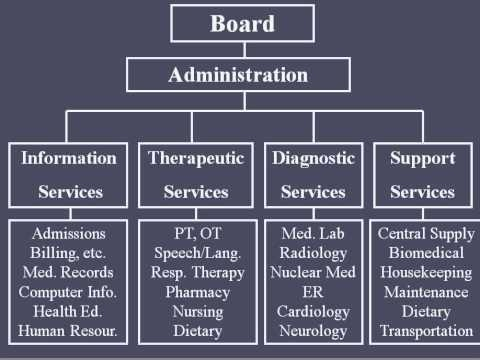
Different Departments in the Hospitals (Common Categorical Grouping):
• Administrative services
• Informational services
• Therapeutics services
• Diagnostic services
• Support services
Board administration
Duties of the Medical Staff
• Provide professional care to sick and injured patients
• To participate in the educational program of the hospital
• To audit their own professional work
• To maintain their own efficiency
• To advise and assist the administrator and governing body regarding medical policies
Medical Staff consists of the following groups:
Honorary staff
Consulting staff
Active staff
Associate staff
Courtesy staff
Resident staff
consists of physicians who are active in the hospital despite having retired; has exceptional contributions to the hospital
Honorary staff
specialists from various faculties
Consulting staff
most “actively” involved in the hospital
Active staff
group of junior or less experienced members
Associate staff
physicians who attend to their own private patients at the hospital; they are not involved in the treatment of other patients in the hospital
Courtesy staff
physicians who are employed and residing in the hospital/campus
Resident staff