Compounding, Med Safety-Management-Ethics, Drug Resources
 Call Kai
 Learn
Learn Practice Test
 Spaced Repetition
 Match
Match Flashcards
 Knowt Play
1/63

There's no tags or description
Looks like no tags are added yet.
Name | Mastery | Learn | Test | Matching | Spaced | Call with Kai | Chat |
|---|
No analytics yet
Send a link to your students to track their progress
64 Terms
Compounding pharmacies are licensed/registered by…
Accreditation →
Compounding pharmacies are licensed/registered by State Board of Pharmacy
Accreditation → Pharmacy Compounding Accreditation Board (PCAB) voluntary
Compounding vs Manufacturing
Compounds:
NOT FDA approved
Prepared for specific patient
Does NOT replicate commercially available drug products
Manufacturing:
FDA approved
Mass produced
Which compounded products MUST be sterile
Injections, inhalations and ophthalmic (eye) ointments must be sterile (otic products dont need to be)
Oral suspension/solution, topicals dont need to be sterile
USP standard ->
Non-sterile -> USP… (use…)
Sterile preparation -> USP…
Hazardous -> USP…
USP standard -> national standards for compounding
Non-sterile -> USP 795 (use purified water)
Sterile preparation -> USP 797
Hazardous -> USP 798
ISO (International Organization of Standardization)
Sterile compounding hood and Biological Safety Cabinets -> ISO class..
Buffer room -> ISO class..
Ante room (btwn common pharmacy area and clean room) -> ISO class..
Sterile compounding hood and Biological Safety Cabinets -> ISO class 5 air
Buffer room -> ISO class 7 air
Ante room (btwn common pharmacy area and clean room) -> ISO class 8 air
Category 1, 2, and 3 CSP all use the same ISO classes, except for immediate use products (ie things that are used in the ER)
Before getting ready to enter clean room
Remove coat, hat, makeup, artificial nails and jewelry
Gowning from dirtiest to cleanest: toe → head → face
Shoes cover, hair cover, facial mask
Wash hands up to elbows
Dry hands with non-shedding disposable towels
Low lint gown
Clean hands again with alcohol based hand rub
Enter clean room, put on gloves (2 sets for chemo
Santizes the gloves with 70% sterile isopropyl alcohol and allow gloves to dry
Chemo agents should be compounded with…like biological safety …-> prevent…
What protection
Red bin ->
Blue bin ->
Yellow bin ->
Black bin ->
Non-hazardous preparations -> horizontal flow
Chemo agents should be compounded with glass shield protecting compounder in vertical flow like biological safety class II cabinets -> prevent bone marrow suppression
Eye protections, double gloves
Hood recertified every 6 months
Red bin -> sharps
Blue bin -> non-hazardous
Yellow bin -> trace hazardous
Black bin -> hazardous
Warfarin, all nicotine products, chemo agents
Estrogen, EPI
Azathioprine, Cyclosporine,
Phentermine, Physostigmine
Any agents containing mercury, heavy metals or m-cresol
Non-hazardous preparations -> horizontal flow
Avoid…with iodine when compounding
Avoid stainless steel spatulas with iodine when compounding
Cream ->
…opaque
Gel ->
Lozenge aka
Elixir has … -> avoid with…
Cream -> opaque and non-greasy to moderately greasy
Cream lotion paste opaque
Gel -> translucent, NOT greasy
Lozenge or torche
Elixir has alcohol -> avoid with Flagyl, Cefotetan and Disulfiram
Emulsion -> …that are normally immiscible
Cream and lotion both…preparations
Cream -> larger…%
Lotion -> larger…%
Emulsion -> liquid-in-liquid that are normally immiscible
Cream and lotion both oil in water preparations
Cream -> larger oil %
Lotion -> larger water %
Solution …mixture -> cannot tell the solid/liquid contents apart
Suspension: …-in-… particles (vs emulsion) -> must…
Solution homogenous mixture -> cannot tell the solid/liquid contents apart
Suspension: solid-in-liquid particles (vs emulsion) -> must shake before use
Eutectic mixture has a…than any of its components
Eutectic mixture has a melting point lower than any of its components
BUD
Category 1 CSPs
…at RT
… in the fridge
Category 2 CSPs
If non-sterile components
RT ->
Fridge ->
If sterile components
RT ->
Fridge ->
Freezer ->
Immediate use CSP must be used within…
Category 1 CSPs
12 hrs at RT
24 hrs in the fridge
Category 2 CSPs
If non-sterile components
RT -> 1 days
Fridge -> 4 days
If sterile components
RT -> 4 days
Fridge -> 10 days
Freezer -> 45 days
Immediate use CSP must be used within 4 hrs
Red book ->
Orange book ->
Yellow book ->
Red book -> prices/packaging info
Orange book -> therapeutic equivalence
Yellow book -> travel vaccinations and health information
Emulsifying agent
Low HLB (…) are more…
-> better for…emulsions
High HLB (….) are more…
-> better for…emulsions
Emulsifying agent
Low HLB (<10) are more oil soluble
-> better for water-in-oil emulsions
High HLB (>10) are more water soluble
-> better for oil-in-water emulsions
Think Low = Lipid
Single dose vials
If used in ISO Class 5 environment -> good for…
If not -> good for…
Multi dose vials
Has…
Good for…
Single dose vials
If used in ISO Class 5 environment -> good for 6 hours
If not -> good for 1 hr
Multi dose vials
Has preservatives
Good for 28 days
Balances must meet…standards
Weights can be picked up by…(never by hand)
If weighing ointment -> use…paper (wont break from all the oil)
Balances must meet national Bureau of Standards
Weights can be picked up by plastic tweezers (never by hand)
If weighing ointment -> use glassine weighting paper (wont break from all the oil)
What is an Autoclave?
…used to sterilize…equipment and heat-resistant compounded products in 15-20 min
Heat…
Pressure…
Destroys…but NOT…
What is an Autoclave?
Steam pressure chamber used to sterilize aqueous solutions equipment and heat resistant compounded products in 15-20 min
Heat 121 C (249 F)
Pressure at 15 PSI
Destroys bacteria, viruses, fungi and spores but NOT endotoxins
Sterilization by filtration uses…micron filter
Can trap…, but NOT…
Must be capable of…
Sterilization by filtration uses 0.22 micron filter
Can trap bacteria and fungi, but NOT viruses or endotoxins
Must be capable of retaining 100% of a culture of 10^7 microorganisms of a strain of Brevundimonas (Pseudomonas) diminutas
Trituration -> Levigation -> Geometric dilution
Trituration (grinding dry powder) -> Levigation (add non-soluble liquid to continue grinding) -> Geometric dilution (adding diluent)
Diluent / filler (3)
Diluent / filler (during geometric dilution step)
Lactulose powder
Starch
Magnesium stearate -> most commonly used as “lubricant” diluent to prevent sticking to machinery
Levigating agents
3 aqueous
3 oily
Levigating agents
Aqueous (for creams -> water based)
Water, glycerin, PEG, PEG 400
Oily (for ointments -> oil based)
Mineral oil, castor oil, cottonseed oil
Suspending agents
Natural hydrocolloids
Semisynthetic hydrocolloids
Synthetic hydrocolloids
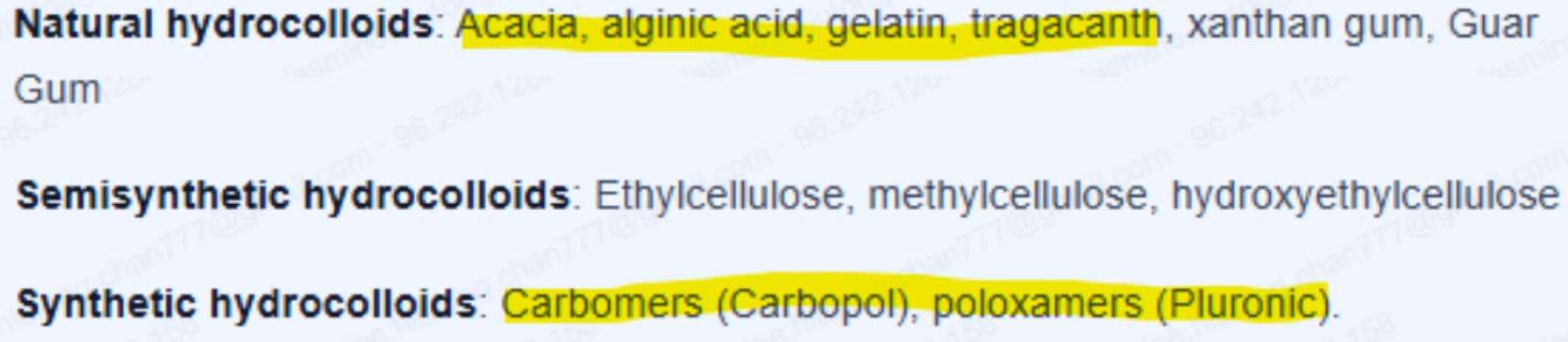
Memory tip -> things with “gum” or “-cellulose” are all suspending agents
Preservatives
(4 lines)
Preservatives
Benzalkonium chloride (BAK) -> Most common preservative in eye drops
Parabens
Benzoic Acid and Sodium Benzoate
Thimerosal, Nitromersal
High efficiency particular air filter -> HEPA filters
Remove particles bigger than…micron with…% efficiency
Require…
High efficiency particular air filter -> HEPA filters
Remove particles bigger than 0.3 micron with 99.97% efficiency
Require ISO 5
Dry-heat sterilization
Generally for glass containers and products not penetrated by hot steam of autoclaving (oils and powders)
Destroys all microbes and also endotoxins (autoclave doesnt hit endotoxins, this methods uses higher heat and longer times)
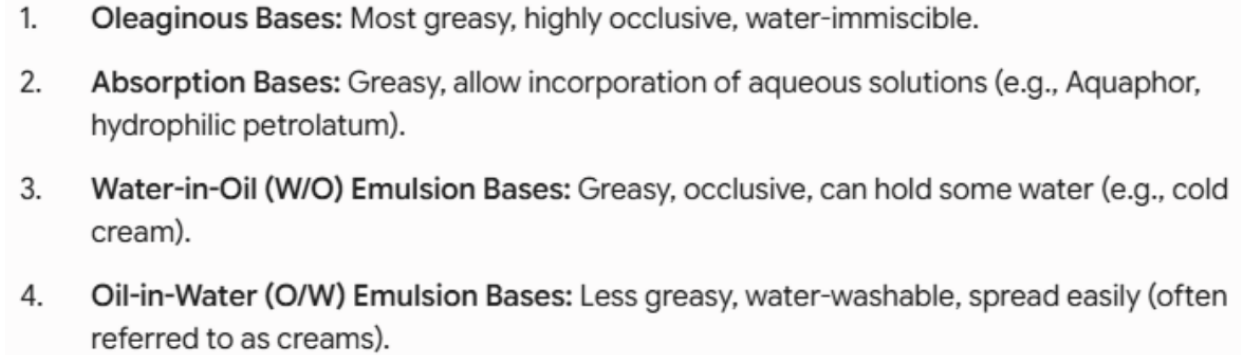
Class of ointment bases from most greasy to least
Gloves and hood surfaces disinfected with…during the process
Gas sterilization ->
Gloves and hood surfaces disinfected with sterile 70% Isopropyl alcohol during the process
Gas sterilization -> Ethylene Oxide
What kind of medium is used to simulate the compounding environment and test for aseptic technique under USP 797 (sterile) guidelines?
Sterile tryptic soy broth
Aseptic technique tested every 6 months
Capsules
Largest 00 → Small 5
Bigger number →
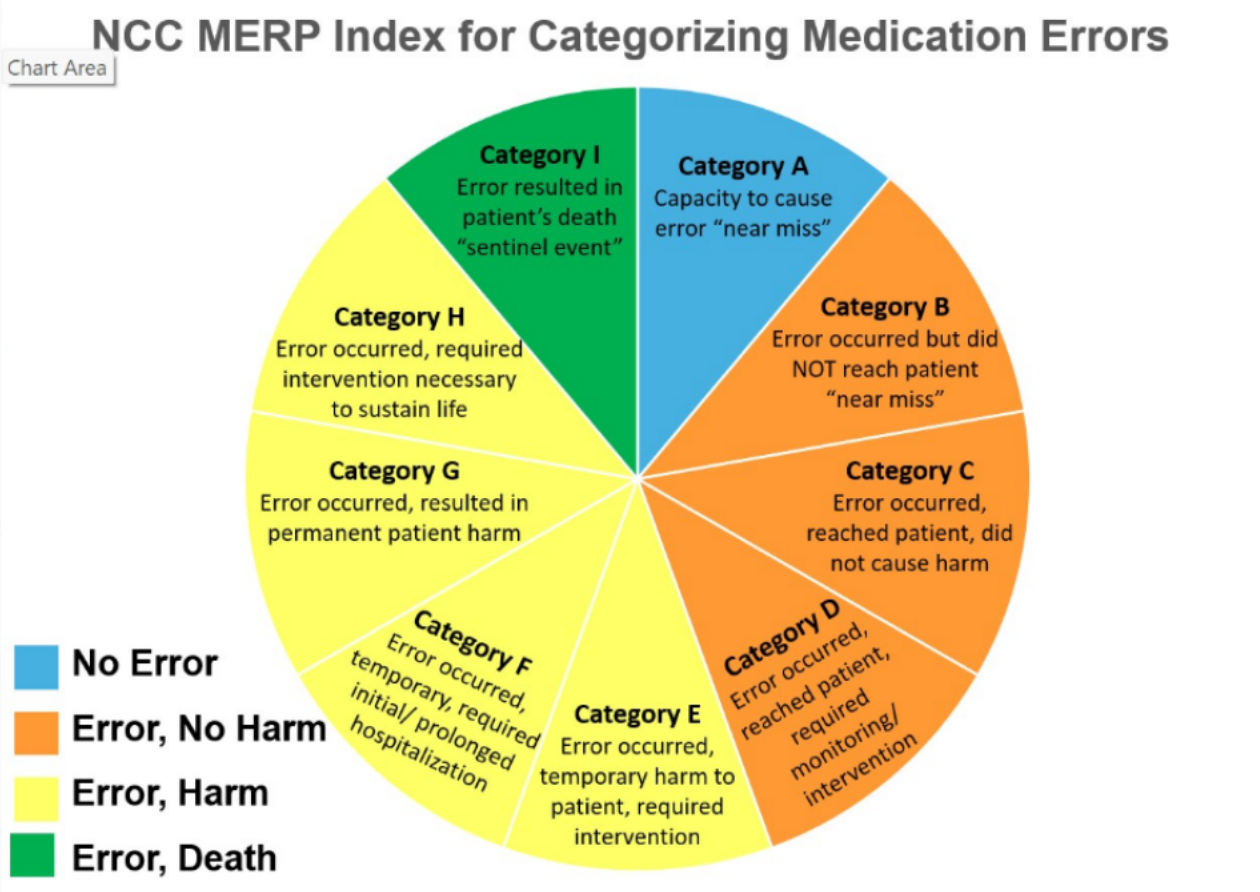
NCC MERP Index for Categorizing Medication Errors
No error
Error, no harm
Error, harm
Error, death
Category A-I
No error
Category A → potential to cause error
Error, No harm
Category B → did not reach patient
Category C → reached patient, no harm
Category D → reached patient, require monitoring
Error, Harm
Category E → intervention needed
Category F → hospitalization needed
Category G → permanent damage
Category H → intervention to sustain life needed
Error, Death
Category I → death
Will define all the categories on the exam but not give you the colors
Need at least…acceptable patients identifiers
Patient family can access patient medication profile if…
(2)
Need at least 2 acceptable patient identifiers
Name, DOB
Medical record #
Exact address or telephone number, SSN
Patient family can access patient medication profile if…
Patient is a minor or mentally incapacitated and family is legal guardian
Family holds healthcare power of attorney
Institute for Safe Medication Practices (ISMP) → set…
The Joint Commsion (TJC) → sets…
Practice 5 rights of med administration (high yield)
Institute for Safe Medication Practices (ISMP) → set guidelines to prevent medication error
The Joint Commission (TJC) → sets National Patient Safety Goals (NPSG)
PMDRT
Right Patient
Right Medication
Right Dosage
Right Route
Right Time
Medication Reconciliation at every…
Comprehensive Medication Review (CMR) vs Targeted Medication Review (TMR)
Error of omission →
Error of commission →
Medication Reconciliation at every transitions of care
Comprehensive Medication Review (CMR) longer than Targeted Medication Review (TMR)
Error of omission → Missing a med they needed
Error of commission → Adding a med they shouldn’t have added
SMART SAFE MEDS MME
SMART
Single dose vials >>> Multi dose vials
Metric system
Avoid abbreviations → QD, OD, QOD etc
Report results on time
Two patient identifiers
SAFE
Separate look/sound alike → tall man lettering, separate them in the pharmacy
Auxiliary labels/alerts
Formulary control → Pharmacy managing crash carts and high alert meds
E-prescribing
Clinical decision support
MEDS
Medication indication on every Rx
Enhance system design (ie proper workflow)
Dont reply on packaging → actual med needs to be verified
Standardized process
MME
Medication reconciliation in every transition of care
Come in → ED → ICU → Med surg → D/C
Medication Therapy Management (CMR → all meds, TMR → only some med)
Education (ie patients, peers)
ISMP High Alert Meds
Pneumonic
Very Sick Patients Need Big Calm Nurses Managing High Risk Meds
Vasopressor / Adrenergics (EPI, BB)
Sedatives (Lorazepam, Midazolam)
Paralytics (neuromuscular blockers)
Narcotics (oopiods)
Blood thinners (anticoags, thrombolytics)
Chemo agents
Nutrition/glucose (insulin, sulfonylureas)
Magnesium + Methotrexate
K potassium (KCl, KPhos)
Hypertonic (NaCl, dextrose)
Meds → Catch All
Inotropes (digoxin, milrinone)
Anesthetics (propfol, ketamine)
Nitroprusside / Flolan
Liposomal drugs
Sterile water
Methotrexate → frequency
Vinca Alkaloids → formulation
Sterile water vs NS → bags
Methotrexate → upside down → Weekly
Vinca Alkaloids → NEVER intrathecal, ONLY IV
Sterile water vs NS → Eliminate all 1 liter bags of sterile water from areas outside the pharmacy and use 2 liter bags or bottles of sterile water to prevent mistaking them for D5W or NS (prevent death from hemolysis)
Insulin
Formulation
…before…
Long-acting insulin prepared…
Pen vs Multi dose vials
Insulin
SQ/IV, don’t give IM
Clear before cloudy
Long-acting insulin prepared by pharmacy (harder to reverse effect)
Pens
1 pen per patients but $$$
Need separate pen needle Rx, use new needle with each injection
Multi dose vials
Can use multi-dose vials for multiple patients and $
Do not leave in the carts/hospital floors
TPN
Simple vs Complex
Filter size (with/without filter)
Trace Elements → Acronym (5)
Electrolytes
Always add →
Never add → (2)
First…then…
Mixing…with lipids cracks emulsion
TPN
Simple → D5W
Complex → D5W, lipids, AA, electrolytes
1.2 filter with lipids
0.22 filter if no lipids
Trace Elements → Acronym (5)
Crazy Cats Munch Zinc Secretly:
Chromium
Copper
Manganese
Zinc
Selenium
Electrolytes
Always add → Na, Cl — K, Mg — Ca, PO4
Never add → HCO3 (precipitates Ca), extra Ca (precipitates PO4)
First phosphate, then Ca
Mixing iron with lipids cracks emulsion
TPN Complications
Short term
(3)
Long term
(4)
Short term
Refeeding syndrome (bc feeding too fast, rapid excretion of insulin) → hypokalemia, hypomagnesium, hypophosphatemia
Hyperglycemia (bc tapered up too fast)
Hypoglycemia (bc tapered down too fast while still secreting insulin)
Volume overload
ADE to lipid emulsions
Catheter related sepsis/pneumothorax
Long term
Vitamin deficiencies
Vit D and Ca deficiency → Osteoporosis, Osteomalacia
Hepatic complications
Cholelithiasis, Cholecystitis (infected gallstones)
Crash cart
(3)
Broselow carts
(2)
Crash cart
Unit dose = single use
Pharmacy is responsible for restocking and check for exp dates on 1st day of each month
Tamper proof
Broselow carts
Pediatric crash cart
Color coded drawers for children with different weights
Which medications flushed down the toilet to dispose of remaining unused meds
Flush Dangerous Meds
F - Fentanyl (Duragesic)
D - Diazepam (Diastat)
M - Methylphenidate (Daytrana patches)
Luer Lock vs Luer Slip
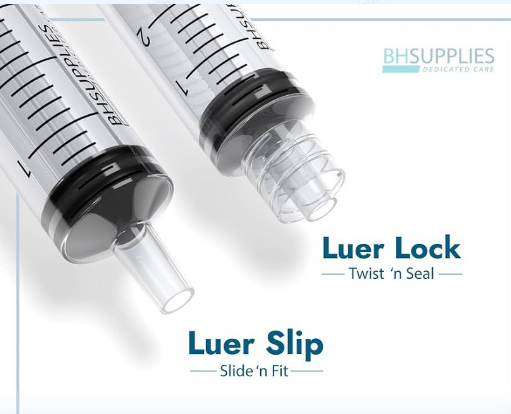
Luer Lock → twists onto any IV line, prevents leakaged
Luer Slip → oral, enteral meds only → NOT compatible with connecting to an IV line
Opioid naive → start off with… (avoid…)
Opioid tolerance → defined as
Tapering in chronic opioid use →
5 As of smoking cessation
Opioid naive → start off with IR (avoid ER, XR, patches)
Opioid tolerance → 60 MME/day + at least 1 week
Tapering in chronic opioid use → slowly, typically 10% per week
5 As of smoking cessation
Ask
Advise to quit
Assess willingness
Assist in quitting
Arrange follow up
Automated dispensing cabinet (ADC)
Blind count →
Profiled vs Non-profiled
Override →
Open Matrix Drawer
Automated dispensing cabinet (ADC)
“Locked and lidded pockets”
Blind count -> user physically count and enter the quantity of the controlled substance before the machine dispenses drug. If user types a number that doesnt match sytem's expected balance, discrepancy is instantly flagged
Profiled (required review/verification of order) vs Non-profile (bypass verification)
Override → removing controlled substance without verified order, strictly for emergent situations where it may impact patient’s health
Open Matrix Drawer
Contains meds with lower risk for harm
Veracity →
Fidelity →
Beneficence and nonmaleficence →
Justice →
Confidentiality →
Autonomy →
Violation of anti-kickback laws →
Veracity → telling the truth, not giving false hope (ie counseling points)
Fidelity → follow thru/up
Beneficence and nonmaleficence → doing good while avoiding harm
Justice → ensuring fairness of resource distribution
Confidentiality → protecting patient privacy and health info
Autonomy → respecting patient’s choices despite counseling
Violation of anti-kickback laws → prohibit offering or receiving payment/remuneration to attract/give services (including samples)
SBAR
SBAR
Situation → Dr wants new insulin Rx
Background → pt is taking…
Assessment → Pharmacist sees metformin can be titrated
Recommendation → pharmacists recommends increasing metformin dose
Know the order if you had to rearrange a question based on SBAR format
Root Cause Analysis (RCA) →
Failure Mode and Effects Analysis (FMEA) →
What if error is discovered?
Root Cause Analysis (RCA) → error already happen
Failure Mode and Effects Analysis (FMEA) → prevent error in the future
What if error is discovered?
Patient and prescirber immediately notified
QA (with date, location, participants, pertinent info and recommended changes)
P&T commitee
Kangaroo pump
Function
Hold the feed with…
Do not crush…
Always…
Helps timing of food to be administered when taking meds
Hold the feed with Phenytoin and Cipro 1-2 hrs before/after giving meds
Do not crush ER or enteric coated pills down tube
Always flush tube before and after any meds
Things that can go down the sink
Fluids without meds (NS, D5W)
Electrolytes
Vitamins
TPN (without meds) or lipids
Any foods such as enteral feeds that dont contains meds
The following must be confirmed prior to Suboxone dispensing (4)
The following must be confirmed prior to Suboxone dispensing (4)
DEA #
Valid patient-prescriber relationship
Dosing is within therapeutic range
Prescription is for opioid use disorder, not pain only
Preceptorship embodies ….
Instructing →
Modeling →
Coaching →
Facilitating →
Mentoring →
Preceptorship embodies beneficence and nonmaleficence
Instructing → Directly teaching specific, structured information (like didactic education on disease states).
Modeling → Demonstrating correct behaviors (like inhaler technique) for the patient to observe and imitate.
Coaching → Providing ongoing guidance, feedback, and motivation to help a patient achieve specific health targets.
Facilitating → Allowing resident to perform independently (after coaching phase)
Mentoring → Offering long-term professional guidance, career support, or developmental advice to junior staff or students.
known the order too, may need to rearrange
Types of leadership
Autocratic →
Transformational →
Laissez-faire →
Autocratic → centralized control without staff input
Transformational → focuses on inspiring and motivating team members to boost morale and achieve shared goals
Laissez-faire → uses hands-off approach with minimal guidance and maximum autonomy for staff
Exclude the following medications from Automated dispensing cabinet
All insulin
Vincristine
Neuromuscular blockers (vecuronium, rocuronium, succinylcholine)
Meds that require multiple dilutions, reconstitution
Highly conc oral liquid, parenteral opioids, electrolytes (esp K)
Droplet Precautions
Organsims →
Use… protection
COVID
Organsims →
Influenza, RSV and other resp viruses
Diphtheria, Pertussis, and Neisseria meningitidis
Use mask and eye protection
COVID transmission precautions recommend contact + droplet precautions
Remember contact precautions (C diff, Noravirus, Rotavirus, VRE, MRSA)
Remember airborne precautions (Measles, Varicella, active TB, SARBS)
Airborne Precautions
Organism →
Need
Organism → Measles, Varicella, active TB, SARBS
Need
Airborne infection isolation room
Clean hands
N95 mask or powered air-purifying resp (PAPR)
Remember contact precautions (C diff, Noravirus, Rotavirus, VRE, MRSA)
Remember droplet precautions (influenza, RSV and other resp viruses, Diphteria, Pertussis, and Neisseria meningitidis)
Contact precautions
Organisms:
HCP must do the following before entering the room
(3)
HCP must do the following when exiting the room
(2)
Contact precautions
Organisms: C. diff, Norovirus, Rotavirus, VRE and MRSA
HCP must do the following before entering the room
Wash hands with soap. Alcohol doesnt work on C. diff
Wear a gown
Wear gloves
HCP must do the following when exiting the room
Take off gown and gloves
Wash hands with soap a second time
COVID transmission precautions recommend contact + droplet precautions
Mask and eye protections are used with droplet precautions
Remember droplet precautions (influenza, RSV and other resp viruses, Diphteria, Pertussis, and Neisseria meningitidis)
Remember airborne precautions (Measles, Varicella, active TB, SARBS)
Drug recalls Classes
3
Managing recalls in hospitals
Steps
Drug recalls Classes
Class 1 → severe adverse health consequences or death
Class 2 → temp/reversible health consequences
Class 3 → unlikely to cause ADE
Managing recalls in hospitals
Receive timely notification
Remove product from patient care areas
Notify and tx patients with received product. Give alternatives
Return product
Martindale: The Complete Drug Reference →
Facts and Comparisons →
American Hospital Formulary Service →
Martindale: The Complete Drug Reference → Foreign Drugs
Facts and Comparisons → Comparative drug tables
American Hospital Formulary Service → Med availability, drug monographs
DailyMed →
United States Pharmacopeia →
Trissel’s, Handbook on Injectable Drugs →
Hansten and Horn’s →
DailyMed → Package inserts, inactive ingredients
United States Pharmacopeia → compounding reference
Trissel’s, Handbook on Injectable Drugs → IV compatibility
Hansten and Horn’s → complex drug interaction
The Harriet Lane Handbook, Nelson’s, Teddy Bear Book →
Beers criteria →
Sanford Guide →
Brigg’s, Hale’s (LactMed) →
The Harriet Lane Handbook, Nelson’s, Teddy Bear Book → Pediatric resources
Beers criteria → what meds to avoid in adults
Sanford Guide → ID, antimicrobial therapy
Brigg’s, Hale’s (LactMed) → drug safety during pregnancy and lactation
Yellow book →
Red book →
Orange book →
Purple Book →
Pink book →
Green book →
Yellow book → vaccine requirements
Red book → drug prices
Orange book → therapeutic equivalence
Purple Book → biological products, biosimilar and interchangeable products
Pink book → epidemiology, vaccine-preventable disease
Green book → animal products
Guidelines Names
HTN, HF, PAD, Afib, Dyslipidemia →
Dyslipidemia →
VTE: PE/DVT →
HTN, HF, PAD, Afib, Dyslipidemia → AHA/ACC
Dyslipidemia → NCEP/AACE
VTE: PE/DVT → CHEST
Guideline Names
Asthma →
COPD →
DM →
Mental disorders →
Infections →
Asthma → GINA
COPD → GOLD
DM → ADA; ACCE/ACE
Mental disorders → DSM-V
Infections → IDSA