UNIT 1
 Call Kai
 Learn
Learn Practice Test
 Spaced Repetition
 Match
Match Flashcards
 Knowt Play
1/50

There's no tags or description
Looks like no tags are added yet.
Name | Mastery | Learn | Test | Matching | Spaced | Call with Kai | Chat |
|---|
No analytics yet
Send a link to your students to track their progress
51 Terms
Socrates
“Know thy self ”
Dualistic Reality: Body and Soul
Plato
3-Part Soul/self (Psyche) = Reason, Physical Appetite & Spirit/Passion
Aristotle
The mind (self) is a tabula rasa (a blank tablet)
Self is composed of matter and form
Stoicism
Apathy or indifference to pleasure
NO PLEASURE
Hedonism
They believe that pleasure is the only good in life
maximize pleasure and minimize pain
Epicureanism
Moderate pleasure
Being content with the simple things in life ensures that you will never be disappointed.
Theo-centric
From the scientific investigation on nature and search for happiness to the question of life and salvation in another realm, in a better world
St. Augustine
The self strives to achieve union with God through faith and reason
St. Thomas Aquinas
“The things that we love tell us what we are”
Experiencing that something exists doesn’t tell us what it is
Anthropocentric
Period of radical, social, political and intellectual developments
Rene Descartes
The self is a thinking thing, distinct from the body
John Locke
Personal identity is made possible by self-consciousness
David Hume
There is no “self,” only a bundle of constantly changing perceptions passing through the theater of our minds.
Immanuel Kant
The self is a unifying subject, an organizing consciousness that makes intelligible experience possible.
Gilbert Ryle
The self is the way people behave
Paul & Patricia Churchland
The self is the brain. Mental states will be superseded by brain states
Husserl and Merleau-Ponty
agree that our living body is a natural synthesis of mind and biology
The Looking Glass Self
Actually, how we see ourselves does not come from who we really are, but rather from how we believe others see us
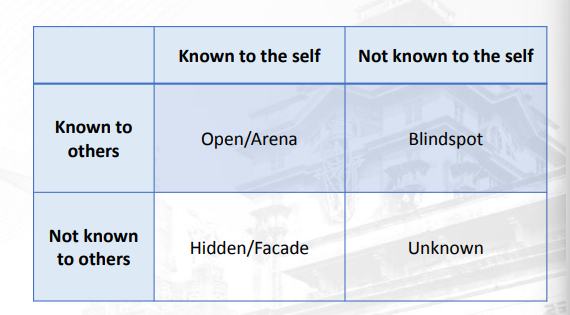
Johari Window
Technique used to enhance the individual's perception on self and others.
Symbolic Interactionism
the self is created and developed through human interaction
I - active aspect
me - socialized aspect
Conscious
refers to those thoughts and feelings that we are aware of
Preconscious
experiences that are unconscious but could become conscious with little effort
Unconscious
contains all drives, urges or instincts that are beyond our awareness but motivate our feelings, thoughts and behavior
ID (Biological Self) - Pleasure principle
represents the basic need of man
Natural part of the self
Animalistic nature of man
SUPEREGO (Social Self) - Idealistic Principle
incorporates the values and morals of society which are learned from one's parents and others
EGO (Psychological Self) - Reality principle
The only region of the mind that is in contact with reality; it operates to fulfil the reality principle
The ego constantly tries to reconciles the irrational wants of the id and the superego with the realistic demands of the world
explain Id, Superego, and Ego

Anxiety
Weak ego will lead to
Defense Mechanism
To protect the ego from anxiety, we use
Sublimation
Redirecting unacceptable or harmful impulses into positive, creative, or socially acceptable achievements (e.g., taking out anger on a punching bag instead of a person).
Repression
Unconsciously blocking or pushing away unpleasant feelings, thoughts, or memories so you forget them.
Regression
Slipping back to an earlier, younger stage of behavior or development during times of high stress or anxiety.
Displacement
Redirecting negative feelings or urges away from the real source of stress onto a less threatening object or person (e.g., yelling at a friend when you're actually mad at your boss).
Projection
Taking your own unacceptable impulses, feelings, or thoughts and attributing them to someone else instead.
Imaginary Audience
Adolescents are thought to believe that others are always watching and evaluating them, and that they are special and unique
Self-Concept
is a knowledge representation that contains knowledge about us, including our beliefs about our personality traits, physical characteristics, abilities, values, goals, and roles, as well as the knowledge that we exist as individuals
Self-Esteem
Used to describe a person's overall sense of self-worth or personal value
congruence
Carl Rogers believed that for a person to achieve self-actualization they must be in a state of
TEMPORAL COMPARISON
Considering your present condition in relation to how you were in the past
SOCIAL COMPARISON
Evaluating yourself in comparison to others – using others as a basis for evaluating your attributes
Upward social comparison
When we compare ourselves with those who we believe are better than us
Downward social comparison
When we compare themselves to others who are worse off than ourselves
Passive downward comparison
Happens when a person takes into consideration the previous condition in making comparison
Active downward comparison
Happens when a person compares himself/herself with others by demeaning or causing harm to them
Reference Group
A group to which an individual or another group is compared
Individualism
A human being has an individualistic nature and is an independent part of the universe and the society
Collectivism
A human being is an integral part of the universe and the society
Buddhism
The self is the source of all sufferings. It is our quest to forget about the self, forget the cravings of the self, break the attachments you have with the world, and to renounce the self in order to attain the state of Nirvana.
Hinduism
believe that an individual’s action (karma) – the bad or good actions that the individual performed in a previous life determines his or her caste
Taoism
Self does not exist without the existence of the other. Self as a separate identity is supported by the equal and opposite sensation of otherness
Confucianism
Filial piety is a foundational concept in the thought of Confucius. It teaches how one should properly act according to their relationship with other people; focused on having a harmonious social life.