Lecture 04 — The Central Dogma of Molecular biology
 Call Kai
 Learn
Learn Practice Test
 Spaced Repetition
 Match
Match Flashcards
 Knowt Play
1/9

There's no tags or description
Looks like no tags are added yet.
Name | Mastery | Learn | Test | Matching | Spaced | Call with Kai | Chat |
|---|
No analytics yet
Send a link to your students to track their progress
10 Terms
Outline the central dogma & describe information flow
Core idea: Biological information flows in one direction:
DNA → RNA → Protein
Key processes:
Transcription: DNA → RNA
Translation: RNA → protein
Replication: DNA copying itself
Reverse transcription: RNA → DNA (only virus)
what is The Omics
the collectiv study of an entire field or biomolecule within the organism
Define genome
Genome:
All DNA in an organism. Every nucleated cell contains the full genome.
the DNA blueprint for every part of an organism
chromosome > genes >DNA (comprised of nucleic acid)
vary in makeup, count, structure between organisms, species, within species, between cells
define transcriptome
Transcriptome:
All RNA in a cell (mRNA, rRNA, tRNA, miRNA, siRNA).
two different cell types > different transcriptome
same cell types > same transcriptomes
define Proteome:
All proteins expressed in a cell.
two different cell types > different proteome
same cell types > same proteome
Why genome, transcriptome and proteome differ:
Different cell types express different genes.
Same genome → different transcriptomes → different proteomes
Differences in size & construction between bacterial and eukaryotic genomes
Eukaryotic genomes:
Large (10 Mb–150 Gb).
Linear chromosomes, wrapped around histones.
chromosomes condensed into chromatin, wrapped around histone proteins
Prokaryotic genomes:
Small, typically 150 kb–15 Mb.
Circular chromosomes, no nucleus.>no histones
benefit of having small chromosome: faster DNA replication > faster cell division
Complexity note:
Genome size or chromosome number does not correlate with organism complexity.
Describe the universal genetic code
Universal: Shared by almost all organisms.
Triplet: 3 nucleotides = 1 codon.
Non-overlapping: Each base belongs to only one codon. (5>3)
Redundancy: Many amino acids have multiple codons.
Start codon: AUG (Met).
Stop codons: UAA, UAG, UGA.
what are start codon and stop codon ?
Start codon: AUG (Met).
Stop codons: UAA, UAG, UGA.
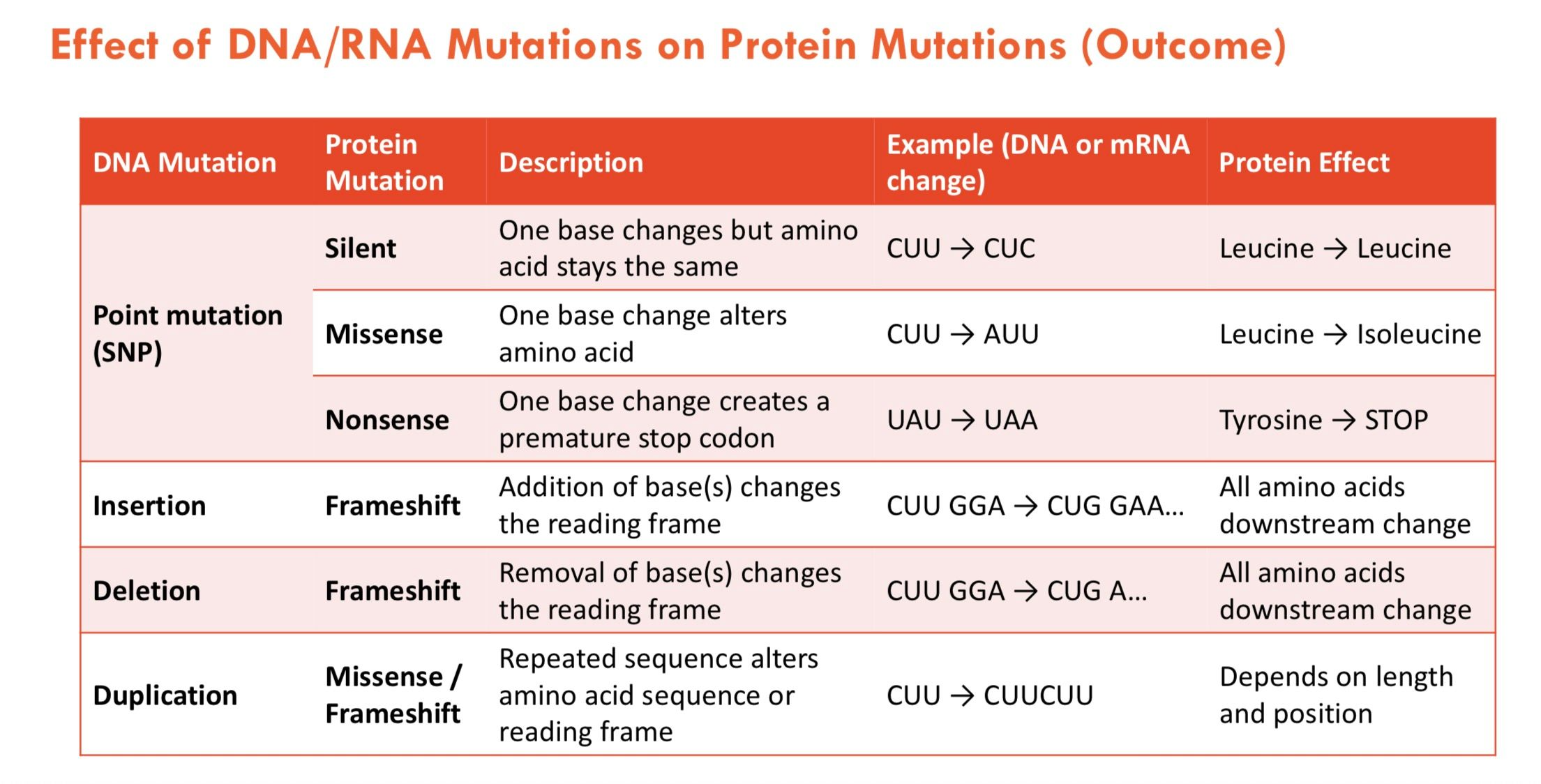
type of DNA/ protein mutation