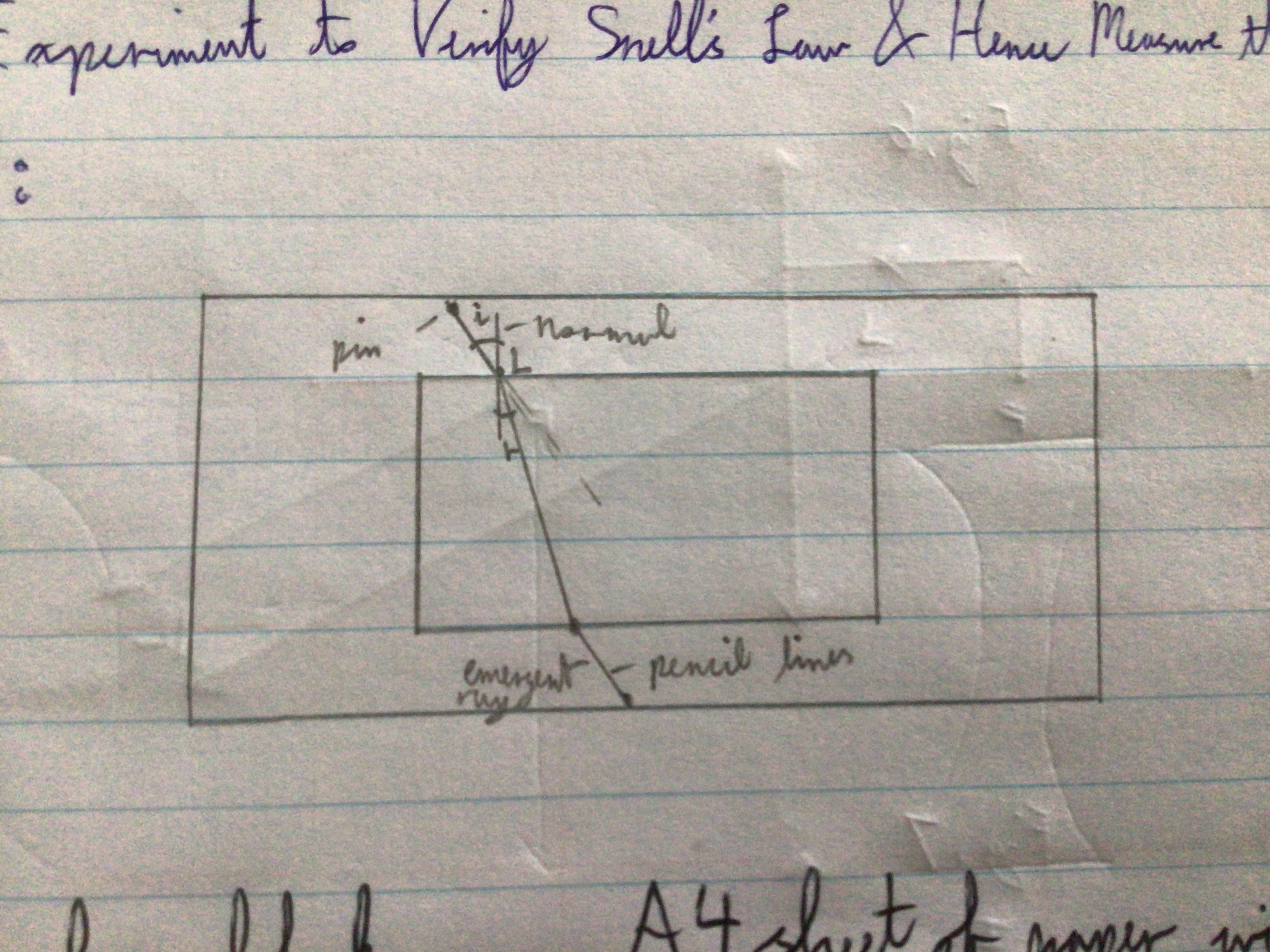
An Experiment to Verify Snell's Law & Hence Measure the Refractive index of Glass/perspects
 Studied by 0 people
 Call with Kai
 Learn
Learn Practice Test
 Spaced Repetition
 Match
Match Flashcards
 Knowt Play
1/9

There's no tags or description
Looks like no tags are added yet.
Name | Mastery | Learn | Test | Matching | Spaced | Call with Kai |
|---|
No study sessions yet.
10 Terms
Step 1 (An Experiment to Verify Snell's Law & Hence Measure the Refractive index of Glass/perspects in Sketchbook)
Place a glass block on an A4 sheet of paper with two pins at an angle to the block and outline the block
Step 2 (An Experiment to Verify Snell's Law & Hence Measure the Refractive index of Glass/perspects in Sketchbook)
Place two more pins on the other side of the block so that they seem to be in line with the first two pins when viewed through the block
Step 3 (An Experiment to Verify Snell's Law & Hence Measure the Refractive index of Glass/perspects in Sketchbook)
Remove the block and the pins and draw the three rays and normal as shown
Step 4 (An Experiment to Verify Snell's Law & Hence Measure the Refractive index of Glass/perspects in Sketchbook)
Measure i and r
Step 5 (An Experiment to Verify Snell's Law & Hence Measure the Refractive index of Glass/perspects in Sketchbook)
Repeat steps 1-4 five more times
Step 6 (An Experiment to Verify Snell's Law & Hence Measure the Refractive index of Glass/perspects in Sketchbook)
Complete the table and plot the graph of Sin (i) verses Sin (r)
Step 7 (An Experiment to Verify Snell's Law & Hence Measure the Refractive index of Glass/perspects in Sketchbook)
Find the slope of the graph
What sort of graph should you get from the Snell's law verification?
straight line graph
Why do you get a straight line from the graph?
because according to Snell's law they are directly proportional
Draw the Apparatus for An Experiment to Verify Snell's Law & Hence Measure the Refractive index of Glass/perspects in Sketchbook
…