Receptor Theory
 Call Kai
 Learn
Learn Practice Test
 Spaced Repetition
 Match
Match Flashcards
 Knowt Play
1/32

There's no tags or description
Looks like no tags are added yet.
Name | Mastery | Learn | Test | Matching | Spaced | Call with Kai | Chat |
|---|
No analytics yet
Send a link to your students to track their progress
33 Terms
How can drugs be classified
Similar chemical structure, same mechanism of action, similar therapeutic use
What is pharmacodynamics
What medication does to the body
What is pharmacokinetics
What does the body do to the medication
What does ADME stand for
Absorption, Distribution, metabolism, excretion
What is a biological receptor
Macromolecular protein that bind to ligand
What are the 4 types of receptors
Ligand gated, G coupled protein, enzyme linked, intracellular
What are ligand gated channels
Extracellular receptors that need ligand to bind to open; example: Nicotinic acetylcholine receptors
How do G coupled protein receptors work
Ligand bind to r → GDP release + GTP binding to G protein → alpha subunit dissociate and activate cAMP or PLC
What does Gq activate
PLC → Activate both IP3 and DAG pathways to increase Ca and PKC respectively
What does Gs and Gi do
Gs act to increase cAMP and PKA; Gi inhibit this
How do enzyme linked receptors work (insulin)
Insulin bind to r → Autophosphorylation of tyrosine kinase receptor → Phosphorylation of other pathways → Action of insulin
How do intracellular receptors work (steroid)
Steroid diffuse across membrane → Bind to receptor INSIDE cell → Leads to transcription of genes
Rank the different types of receptors based on the time of response from shortest to longest
Ligand gated (milliseconds) → Enzyme linked (minute to hours) → Intracellular (hours to days)
What is receptor affinity
Strength of attraction; low = less attraction, drug pops off receptor; high = higher potency
What is potency
The amount of drug needed to produce a cellular effect; higher affinity = higher potency = lower dose
What is selectivity
Degree that a drug can bind to a single receptor
How does Kd relate to affinity
Kd = degree of dissociation; lower Kd = higher affinity
How is receptor occupancy calculated
f = [ligand-receptor complex]/[total receptors]
Does increasing the amount of drug always indicate higher action
No → The number of receptors are finite, if all are occupied higher concentrations do not produce effect
What is Emax
The greatest effect that agonist can produce if taken at highest tolerated level
What is EC50
Amount of drug (concentration) needed to produce 50% of Emax
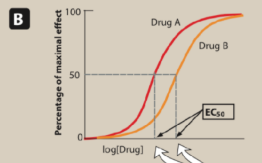
Based on figure B, which drug is more potent
Drug A, since the EC50 is smaller → Means that a smaller concentration is needed to produce 50% of Emax than Drug B
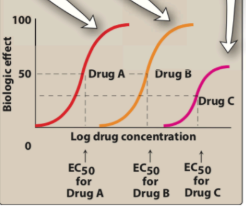
Interpret this graph
The curve of the graph shows that drug A and B have the same efficacy (Emax) but drug A is more potent because the EC50 is lower; C is the worst of the three
What are the types of agonists
Full, partial and inverse
How does an inverse agonist differ from an antagonist
Inverse agonist brings effect BELOW baseline; antagonist never goes below baseline
What is the difference between full and partial agonists
Full produces complete receptor activation; partial produces <100% of binding
What are the types of antagonists
Competitive, non competitive (irreversible) and other
What is the difference between competitive and non-competitive antagonist
Competitive antagonists fight with normal ligand to bind to receptor; non-competitive alters receptors so that only it can bind to it
What is the effect of Ki on inhibition
Lower Ki = higher inhibitory effect
What are functional/physiological antagonist
Two drugs act on two receptors that have opposite action (eg: Histamine bind to H1 to bronchoconstrict, EP bind to beta 2 to bronchodilate)
What are chemical antagonists
Drug counters the effect of another by chemical reaction (eg: protamine sulfate is positive and binds to heparin that is negative charge)
What is pharmacokinetic antagonist
One drug accelerate metabolism of another (eg: phenobarbital induced enzyme induction increase warfarin metabolism
What is desensitization
Repeated exposure leads to lower effect to prevent cell damage; agonist → down regulate, antagonist → up regulation