Gas exchange in Animals
 Studied by 0 people
 Call Kai
 Learn
Learn Practice Test
 Spaced Repetition
 Match
Match Flashcards
 Knowt Play
1/24

Earn XP
Description and Tags
Eduqas Biology Alevel
Name | Mastery | Learn | Test | Matching | Spaced | Call with Kai |
|---|
No study sessions yet.
25 Terms
What is gas exchange?
The process by which oxygen reaches cells and carbon dioxide is removes
Why is gas exchange needed?
-obtaining minerals like CO2 and O2 form environment
-removing waste from cells
ficks law
rate of diffusion∝ (surface area x concentration difference)/ diffusion distance
What is needed on a respiratory surface for maximum rate of diffusion?
-large surface area relative to volume
-thin
-permeable
-moist to allow a medium where gases dissolve before diffusion
-maintain a concentration gradient
diffusion in single-celled organism (amoeba)
-large surface area: volume
-lower metabolic needs so less oxygen needed and less waste product
-cell membrane is thin and moist
-so small that distance between organelles is small so diffusion is sufficient as a transport method
-oxygen enters by passive diffusion as oxygen content in water is less then inside cell
Simple multicellular organisms?
-decrease SA:V ratio so slower diffusion
-gases can diffuse through skin surface, don’t need gas exchange organs
-lower oxygen requirements
Flat worms (aquatic)
-take oxygen from water
-exchange gas over entire body surface
-larger species are flattened to increase SA:V and decrease distance over which gases have to diffuse
-slower so more modest oxygen requirements
Earth worms
-Elongated shape provides larger SA:V
-slower so more modest oxygen requirements
-damp environment for moistness + keep moist by secreting mucus
-O2 diffuses into capillaries of circulatory system
-haemoglobin
-diffusion gradient maintained as O2 is carried to other parts of the body
Larger Multiucellular
-SA:V too small to supply their needs as they have a higher metabolic rate
Amphibians
-babies use gills and skin for gas exchange (SA and capillary supply, short diffuson distance)
-adults at rest use thin, permeable skin and capillary network near skin
-when active use lungs which cut down on water loss and improve surface area for gas exchange (not highly folded like the lungs of mammals but do increase the surface area for gas exchange.)
-closed circulatory system containing blood with haemoglobin
Fish problems
-Small SA:V
-very active so high O2 demand
-water is more dense than air so has a lower O2 content
How gills work in fish
Mouth (buccal cavity) opens and the floor (bottom of mouth) loweres. Volume of cavity increases so pressure inside the head decreases FORCING water to come in
-at the same time the Opercular valve is closed and the opercular cavity containing the gills expand. This increases the volume, decreases the pressure and water form the mouth moves into the opercular cavity (gills)
-Mouth closes causing a high pressure in buccal cavity and low in opercular cavity so water continues to move over gills. The opercular valve opens and lets water out
-sides of opercular cavity force inward so increasing pressure and floor of buccal cavity steadily moves up maintaining flow over gills.
Structure of Gills
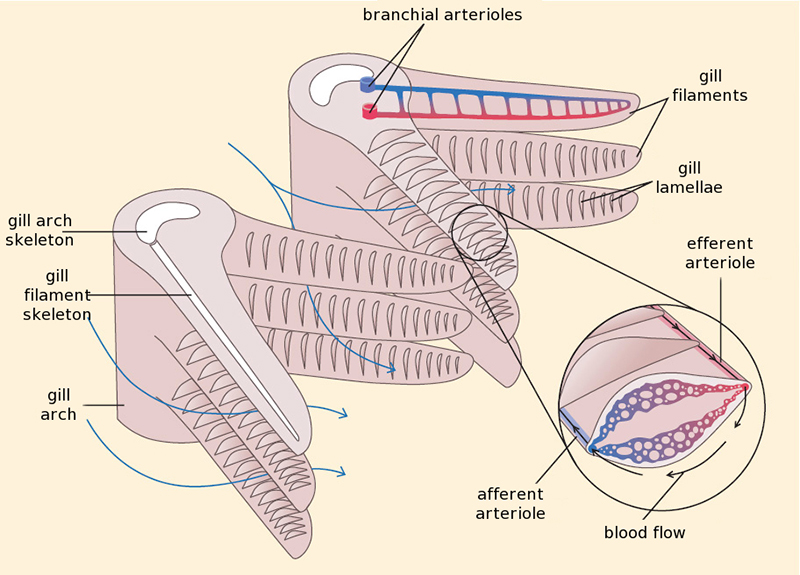
Fish adaptations
-gills increase surface area
-ventilation causes a continuous movement of water over the gills
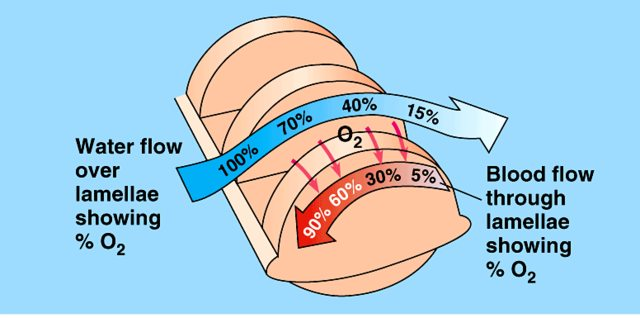
what is countercurrent flow
blood in gill plates / lamellae flows in the opposite direction to the water (bony fish)
What is good about countercurrent flow
More efficient for oxygen intake as: the oxygen concentration in the water will always be higher than in the blood where they meet throughout the whole lamellae, meaning the concentration gradient is always upheld
What is Parallel flow?
When the blood in the lamellae and water outside flow in the same direction (cartilaginous fish)
Why is parallel flow bad?
Eventually the concentration of oxygen inside and outside of the lamellae will reach equilibrium and there will be no more net diffusion after that point.
Exoskeleton in insects
its impermeable cuticle ruddes water loss by exaportaiton, howerver this creates a gas exchange problems
What are Trachaea?
INsects have tubes ntide the body to carry air close to tissue. Connects outside environment to internal organs. They are branched and lined with Chitin to keep them open
What are spiracles?
Paired holes in the exoskeleton o the thorax and abdomen that air enters in from, can close to limit water loss
CO2 in insects?
CO2 build up in the trachea stimulates the spiracles to open allowing CO2 out and air to diffuse in. The drop in CO2 stimulates the spiracles to close again, presenting water loss
What is spiracular fluttering?
the rapid partial opening and closing of spiracles to allow gas exchange to occur
What is at the end of trachaeal branches?
fluid filled treacheoles where gas exchnage occures directly into the muscle fibres by diffusion
What is ventillation in larger/ more active insects
The abdomen expands which lowers the pressure inside. The abdominal spiracles close and the thorax spiralces remain open with the low pressure pulling in fresh air.
-To remove carbon dioxide rich air the abdomen contracts to lower the pressure inside . The thoracic spindles close and the abdominal spiracles open, forcing stale air out