Phineas Gage + Sperry roger
 Call Kai
 Learn
Learn Practice Test
 Spaced Repetition
 Match
Match Flashcards
 Knowt Play
1/21

There's no tags or description
Looks like no tags are added yet.
Name | Mastery | Learn | Test | Matching | Spaced | Call with Kai | Chat |
|---|
No analytics yet
Send a link to your students to track their progress
22 Terms
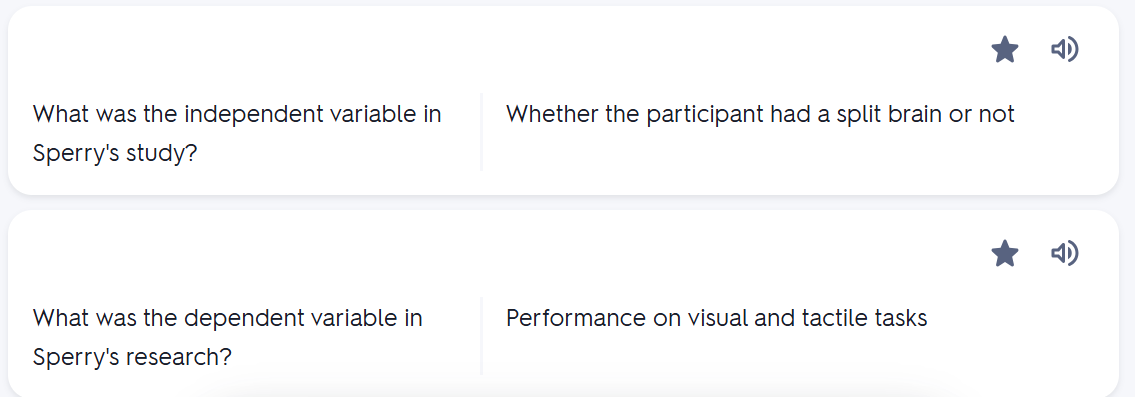
Roger sperry independent variable
was whether or not the participant was a split-brain patient
dependent variable
was their performance on the tasks
Strengths sperry:
Sperry used a case study and a natural experiment and therefore he was able to gain both quantitative and qualitative data
His research has been very influential in inspiring further research in this area of neuropsychology, which is ongoing
Qualitative data was gathered as sperry made notes on the participants behaviour when doing the visual and tactile tasks e.g. how they responded to each of the images. This means that sperry gained a lot of insight on their behaviour, increasing our knowledge of lateralisation of function.
Weaknesses
The sample size of 11 is very small and therefore not generalisable to a larger population
All participants were given the same tasks even though they had differences in levels of hemisphere deconnection, which means that the results may have been affected by individual differences
The case study method is open to researcher bias and Sperry may have manipulated his findings to match his hypothesis
Phineas Gage Independent variable:
The destruction of the left frontal lobe by a 13-pound iron tamping rod.
Phineas Gage Dependent variable:
The changes in Gage's personality and social behaviour
Strengths Phineas Gage
His return to functional life suggests the brain's remarkable capacity for neuroplasticity
Weakness phineas gage
Lack of Generalizability: As a single case study, the specific effects of Gage's brain damage cannot be broadly applied to the general population. Brain organization, resilience, and function vary greatly from person to person.
Subjective and Biased Reporting: Information regarding his "changed personality" stems largely from subjective notes by his doctor, John Harlow, and secondhand observations from acquaintances. These accounts may have been exaggerated to fit the moral and behavioral expectations of the era
Stigma sperry roger
The study could be seen to be socially sensitive as it causes a stigma and controversy surrounding a split brain person, highlighting that they do have a different brain to other people and that they may be slower or unable to perform certain functions. This could cause embarrassment or marginalisation from certain activities.
Sperry roger
Participants looked at a screen.
Images/words were flashed to either the left or right visual field.
Because each hemisphere controls the opposite side of the body, Sperry could test how each hemisphere worked independently.
Why it’s an experiment:
Highly controlled environment
Manipulated what participants saw
Measured responses (what they said, drew, or pointed to)
How phineas gage was studied:
Doctors observed his behaviour before and after the accident.
They recorded personality changes.
There was no controlled experiment — just detailed observation of one individual.
Why it’s a case study:
Focused on one person
No manipulation by researchers
Real-life, naturally occurring event
Ethical Considerations sperry
Patients were already undergoing surgery for medical reasons (Sperry did not cause harm).
However, questions about informed consent standards in early neuroscience research (less strict than today).
Ethical Considerations phineas gage
No formal consent procedures (research ethics standards didn’t exist yet).
However, the injury was accidental — not caused for research.
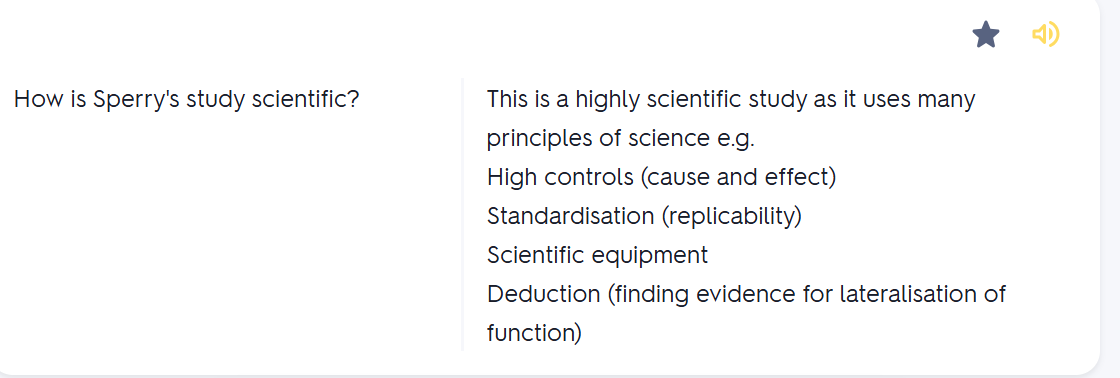
how sperry study is scientific
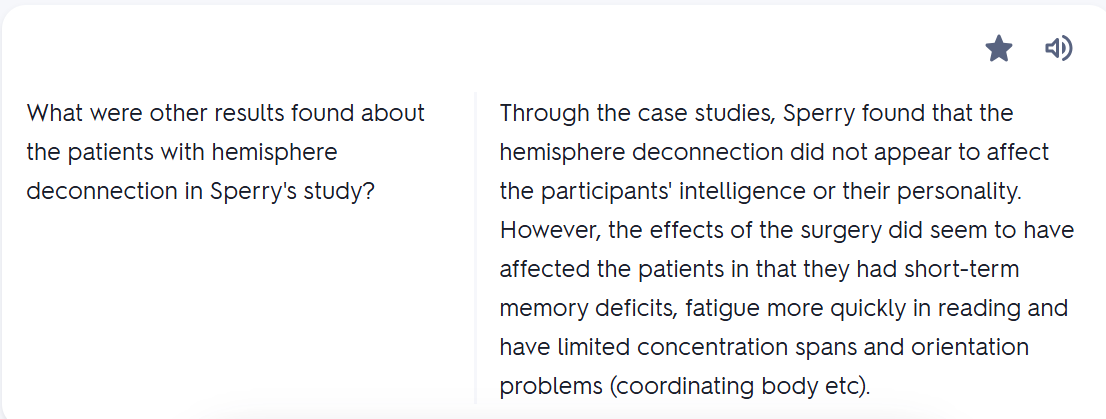
hemsiphere deconnection
Phineas Gage:
Understanding of Brain Function: Gage's case provided early evidence that specific brain regions are linked to personality and behavior, particularly the frontal lobes. This has led to further exploration of the frontal lobe's role in emotional regulation and decision-making.
Neuroplasticity: His ability to adjust to life after his injury highlighted the brain's capacity to adapt, influencing research in recovery and rehabilitation following brain injuries.
Roger Sperry:
Lateralization of Brain Function: Sperry's research established that the two hemispheres of the brain have specialized functions, particularly in language and spatial tasks. This has informed therapies for individuals with brain injuries and has implications for understanding developmental disorders.
Clinical Applications: Knowledge from Sperry's work has influenced treatment approaches for epilepsy (e.g., split-brain surgery), cognitive rehabilitation, and the understanding of how brain injuries can affect cognitive functions differently based on the affected hemisphere.
Phineas gage
- Longitudinal, qualitative research, observing behaviour throughout his life after
Roger sperry
convienence quantative