psyc2081 mid term
 Call Kai
 Learn
Learn Practice Test
 Spaced Repetition
 Match
Match Flashcards
 Knowt Play
1/40

There's no tags or description
Looks like no tags are added yet.
Name | Mastery | Learn | Test | Matching | Spaced | Call with Kai | Chat |
|---|
No analytics yet
Send a link to your students to track their progress
41 Terms
Operant conditioning (Pavlov)
Learning relationship between stimuli or events in the world.
Attraction towards or away from certain stimuli, objects or events.
Instrumental learning (Skinner)
Learning relationship between our actions and stimuli, objects or events.
Disinhibition
Restoring CR after extinction, when paired with another stimulus (e.g. sound paired with light).
New stimulus removes attention required for inhibition to CS.
‘Skinner Box’ Apparatus
Automatic scheduling of events and recording of responses.
Pressing bar → access to food.
Lever presses are instrumental in procuring food.
I.e. Pavlov’s dogs did not need to salivate to procure food.
Schedules of reinforcement
Rules that control the timing and frequency of reinforcement delivery in operant conditioning.
Maintaining behaviour: occasional (partial) reinforcement > consistent reinforcement.
Ratio schedules
Type of schedule where reinforcement depends on some number of responses.
Produces rapid rates of responding.
Fixed ratio n
Where n responses are required to procure the reinforcer.
Characterised by post-reinforcement pauses.
Period where subject does not immediately respond after receiving reinforcement (hesitation/pause).
E.g.
n = 5 → employee paid $50 every 5 pair of shoes made.
n = 10 → purchase coffee 10 times, get a free cup of coffee.
n = 3 → child gets sticker every 3 completed homework assignments.
Variable ratio n
Where n responses on average are required to procure the reinforcement.
Very constant rates of responding (no post-reinforcement pause).
E.g.
VR-10 → behaviour is reinforced, on average, every 10th time in occurs.
VR-5 → salesperson might secure a sale on average every 10 houses. The exact house that yields a sale is completely random.
Interval schedules
Behaviour is rewarded only after a specific period of time has elapsed since the previous reinforcement.
Fixed interval schedule
Behaviour is reinforced after a fixed period of time.
E.g. exams: occurs at regular intervals, studying ceases after exam (post-reinforcement pause) and re-starts next semester.
Variable interval schedule
Behaviour is reinforced at variable intervals of time.
E.g. checking emails.
Sign trackers
Cue presented → fixated on predictive cue itself > actual reward.
Cue gains incentive salience.
E.g. animal obsessively licks lever rather than food bowl.
Associated with addiction.
Goal trackers
Cue presented → ignores cue itself → immediately directs attention to where the reward will be delivered.
Learn that the cue is simply a predictor of the outcome.
More cognitive learning.
Less dopamine-dependent.
Temporal contiguity
Proximity in time between two events.
Temporal continuity
Unbroken or simultaneous presentation of stimuli.
Why are temporal continuity and contiguity insufficient for learning?
Cue needs to predict an outcome.
Response-Outcome Contingencies
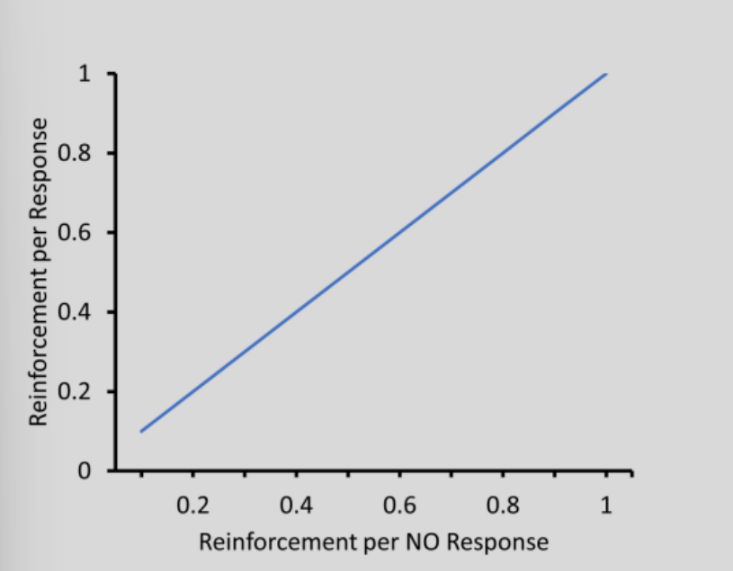
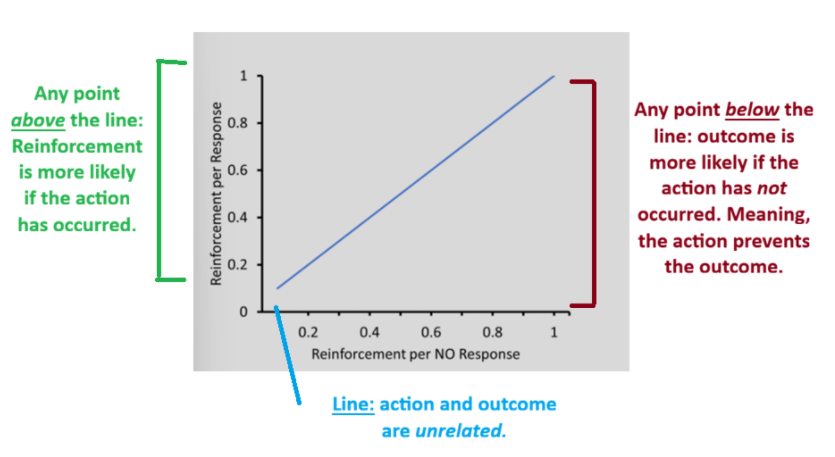
Instrumental learning depends on contingency (how much the action predicts the otucome).
Not just action and outcome occurring together.
Outcome occurs regardless of action → action perceived as less effective → less learning.
E.g. tank study.
E..g rats and lever-pressing (food procured regardless).
Super conditioning
When a new, neutral stimulus is paired with a reward or punishment in the presence of a previously conditioned inhibitor.
Accelerated conditioning.
Rapid reacquisition
Subject relearns conditioned response significantly faster when exposed again after extinction than during initial learning.
Reinstatement
Return of extinguished conditioned fear response caused by exposure to US on its own.
When CS is subsequently presented, the extinguished fear response suddenly reappears.
Spontaneous recovery
Reappearance of an extinguished response after a rest period, without any additional training.
Renewal
Sudden reappearance of a response when moved to a new environment or returned to the original context.
Suggests extinction in context-dependent.
Different paradigms: AAB, ABA, ABC
Protection from extinction
Another cue is present during extinction → that cue is used to explain the missing US.
Target cue loses less associative strength.
One cue blocks the extinction of another cue.
Super-extinction
Breaking learned associations more effectively than standard extinction.
Pairing two excitatory cues → no US.
Larger negative prediction error than normal extinction.
The cue with more associative learning will super-extinguish a target stimulus more effectively than a weaker trained cue.
Sensory preconditioning
Subject learns to link two neutral stimuli together before experiencing a biological reward or punishment.
Reduces risk of over-generalisations.
Study:
Introduce two neutral stimuli paired together.
One gets paired with US.
Findings: second stimuli produces same CR.
Medial temporal lobe
Sensory preconditioning occurs from communication between the PRh and BLA.
Complementary memory and attention systems → complex associative integration between two stimuli.
PRh (Perirhinal Cortex)
Functions as the peripheral state of attention.
Maintains a trace of a pre-exposed familiar stimulus.
Retrieves the representations of sound during light-shock pairings.
BLA (Basolateral Amygdala)
Represents a focal state of attention.
Processes a novel or salient stimuli that predicts an outcome.
Required to process the direct conditioning between light and the shock.
Shaping
Process of guiding an organism to perform a complex behaviour.
Done through many successive trials of reinforcing small segments of the behaviour.
Learning curve
Graphical representation of the relationship between experience and proficiency (or in this context, learning contingency).
Negatively accelerated pattern
Rapid initial progress.
Gradually tapers off as the individual approaches a threshold or limit.
Change highest at beginning, slows down over time.
Link-based approach
Learning is automatic.
Building mental ‘links’ between concepts.
Two stimuli experienced together → brain creates direct connection between their mental representations.
Propositional approach
Learning is a high-level cognitive process.
Based on logic, instructions and prior knowledge → consciously working out an explanation.
Propositions contain context.
Defines exactly how two events are related.
E.g. A causes B.
Blocking memory (propositional account)
Blocking occurs because people reason that B is not causal.
Memory for the outcome remains good.
This account products blocking of causal judgements only.
Because people can remember the outcome prefectly well.
However, reason that B was not the cause.
Blocking memory (link-based account)
Blocking occurs because little learning happens about B.
Memory for the outcome should also be reduced (blocked).
This account predicts blocking of both learning and memory.
Because expected outcomes generate little prediction error.
Blocking memory of outcomes (Mitchell)
Supports link-based accounts.
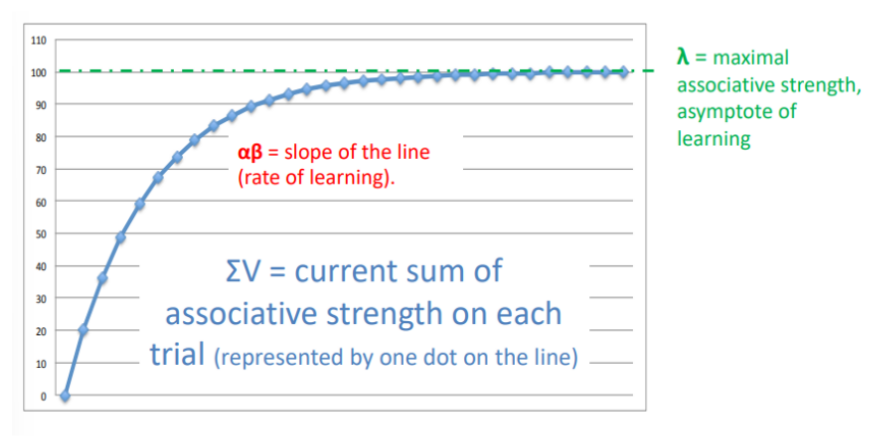
Rescorla-Wagner model predicts that expected outcomes are processed less and therefore are remembered less well.
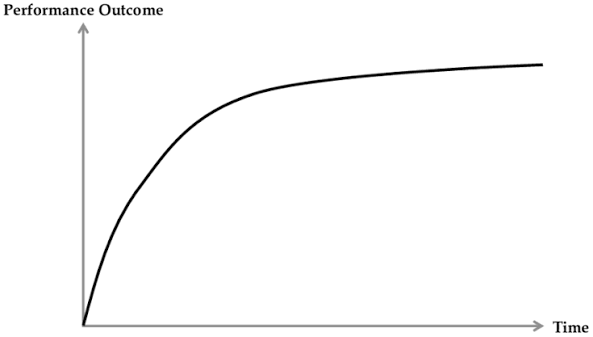
How would the Rescorla-Wagner model be represented on this graph?
Overshadowing
Compound CS but each CS has different salience.
Cue with higher salience accrues more associative strength.
Higher alpha = higher rate of learning.
Overexpectation
Predicted stronger outcome than what actually happens.
Two separate stimuli trained independently but share same single outcome.