First ECON 101 Midterm 1 (Staub)
 Call Kai
 Learn
Learn Practice Test
 Spaced Repetition
 Match
Match Flashcards
 Knowt Play
1/127

There's no tags or description
Looks like no tags are added yet.
Name | Mastery | Learn | Test | Matching | Spaced | Call with Kai | Chat |
|---|
No analytics yet
Send a link to your students to track their progress
128 Terms
Microeconomics
the study of how households and businesses make choices
Macroeconomics
the study of how individuals, firms, and markets function together
Understand and explain the following key ideas of economics:
1. People make decisions and therefore face tradeoffs because resources are scarce
2. People are rational
3. The true cost of something includes its opportunity cost
4. "How much" decisions are made at the margin
5. People respond to incentives
Ceterus Paribus
all else equal
Positive Analysis
when analysis is based on facts and concerned with "what is"
Normative Analysis
when analysis is subjective and concerned with what "ought to be"
Efficiency
no one can be made better off without making someone else worse off
Equity
fair distribution of benefits
Why use a PPF?
to think about the trade-offs that face any economy
Points inside/on/outside the PPF are
Inside: feasible but not efficient
On: feasible and efficient in production
Outside: not feasible
Efficient in Production
economy can not produce more of any one good without producing less of something else
Efficient in Allocation
economy allocates its resources so that consumers are as well off as possible
How do you calculate opportunity cost?
OC of good X = how much good Y you could have gained in that same time / 1 unit of good X
Economic Growth shifts the PPF...
outward because the economy can produce more
A producer with a comparative advantage can...
produce more at a lower opportunity cost
A producer with an absolute advantage can...
produce more
How should you price a good in trade?
between each producer's opportunity cost of producing the good themselves
When are their gains from trade?
ALWAYS; everyone has a comparative advantage in something
Without trade you can consume...
what you produce
A producer should specialize in the good which....
they have the comparative advantage in producing.
Where does comparative advantage come from?
1. climate and natural resources
2. relative abundance of labor and capital
3. technology
What assumptions do we make about perfectly competitive markets?
many buyers and sellers
all products are identical
no barriers to entry
no individual's actions have a noticeable effect on the price sold
Law of Demand
consumers buy more of a good when its price decreases and less when its price increases
Law of Supply
producers offer more of a good as its price increases and less as its price falls
Demand vs. Quantity Demanded
Demand refers to the relationship between price and quantity while quantity demanded is how much people will buy at any given price
Supply vs. Quantity Supplied
Supply is the curve, but quantity supplied is a point on the curve.
5 factors shifting the demand curve
1. Income
2. Price of Related Goods
3. Tastes/Preferences
4. Expectations
5. Number of Consumers
How is INCOME related to shifts in the demand curve?
normal good: when income rises, demand rises
inferior good: when income rises, demand decreases
How is PRICE OF RELATED GOODS related to shifts in the demand curve?
complements in consumption: if one good increases in price, demand for its complement decreases
substitutes in consumption: if one good increases in price, demand for its substitute increases
complements in consumption
goods that tend to be consumed together
substitutes in consumption
goods that can be used in place of another good to satisfy similar needs or desires
How is TASTES/PREFERENCES related to shifts in the demand curve?
as tastes/preferences shift towards a good, increase in demand
How is NUMBER OF CONSUMERS related to shifts in the demand curve?
more people in market= more demand
less people in market = less demand
How do you calculate market demand/ market supply?
Add up all individual demands/supplys
5 factors of supply
1. Price of Inputs
2. Tech Change
3. Prices of Complements/Substitutes in Production
4. Expected Future Prices
5. Number of Sellers
How are EXPECTATIONS related to shifts in the demand curve?
expect price to increase, demand increases NOW
expect price to decrease, demand decreases NOW
How does PRICE OF INPUTS affect supply?
price of inputs increases = supply decreases
price of inputs decreases = supply increases
How does TECH CHANGE affect supply?
tech increase = supply increases
How does PRICE OF COMPLEMENTS/SUBSTITUTES affect supply?
complements in production: price of one good increases, supply of complement increases
substitutes in production: price of one good increases, supply of other decreases
complements in production
goods that must be produced together
substitutes in production
alternative products that producers COULD use their resources to make
What does it mean for a market to be at equilibrium?
quantity supplied = quantity demanded
How do you calculate market equilibrium?
1. Look at D and S schedules
2. Look at intersection on graph
3. Algebra
What if P>P*?
-Excess supply = surplus
-Driven up to equilibrium
What if P<P*
-Shortage
-Buyers will bid up the price
-Driven to equilibrium
How does increase/decrease in demand affect equilibrium?
increase: increases P* and Q*
decrease: decreases P* and Q*
How does increase/decrease in supply affect equilibrium?
increase: decrease P* and increase Q*
decrease: increase P* and decrease Q*
How does equilibrium change with simultaneous shifts in S and D?
Both increase: Q* increases, P* ambiguous
Both decrease: Q* decreases, P* ambiguous
S increase, D decrease: Q* ambiguous, P* decreases
S decrease, D increase: Q* ambiguous, P* increases
Value vs. Price
value is what we get (benefits), and price is what we pay
Consumer Surplus
the difference between what you are willing to pay and what you actually pay
CS= WTP-P
Producer Surplus
the difference between the lowest price a firm would be willing to accept for a good or service and the price it actually receives
PS = P-MC
marginal cost
the cost of producing one more unit of a good
marginal benefit
the additional benefit to a consumer from consuming one more unit of a good or service
Total Surplus
consumer surplus + producer surplus
An outcome is economically efficient when...
total surplus is maximized/ marginal cost = marginal benefit
How do changing prices affect producer surplus?
price increases, increases producer surplus
price decreases, decreases producer surplus
How do changing prices affect consumer surplus?
price increases, decreases consumer surplus
price decreases, increases consumer surplus
elasticity
a measure of the responsiveness of quantity demanded or quantity supplied to a change in one of its determinants
inelastic demand
-describes demand that is not very sensitive to price changes
-E

elastic demand
-describes demand that is very sensitive to a change in price
-E>1
-change in QD > change in P

perfectly elastic demand
-demand in which quantity drops to zero at the slightest increase in price
-E= infinity

perfectly inelastic demand
-the case where the quantity demanded is completely unresponsive to price and the price elasticity of demand equals zero
-E= 0

unit elastic demand
-demand is unit elastic when the percentage change in quantity demanded is equal to the percentage change in price
-E= 1
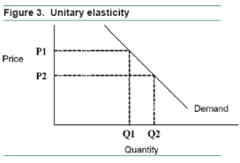
How are slope and elasticity related?
-NOT EQUAL
-slope is change in P/ change in Q-- units
-elasticity is % changes --- unitless
-flatter slope = more elastic demand
formula for elasticity

formula for midpoint method of elasticity

Determinants of the Price Elasticity of Demand
1. The availability of close substitutes
2. The passage of time
3. Whether the good is a luxury or a necessity
4. The definition of the market
5. The share of a good in a consumer's budget
How does AVAILABILITY OF CLOSE SUBSTITUTES affect elasticity of demand?
more substitutes = more elastic demand
less substitutes = less elastic demand
How does PASSAGE OF TIME affect elasticity of demand?
more time = more elastic
less time= less elastic
How does LUXURIES VS. NECESSITIES affect elasticity of demand?
luxuries = more elastic
necessities = less elastic
How does DEFINITION OF THE MARKET affect elasticity of demand?
More narrow market definition = more elastic demand
Less narrow market definition = less elastic demand
How does SHARE OF A CONSUMER'S BUDGET affect elasticity of demand?
large share of good in consumers budget = more elastic
low share of good in consumers budget= less elastic
If demand is elastic, the _____ effect dominates the _____ effect, and a(n) _____ in price will cause total revenue to rise.
quantity; price; decrease
If demand is inelastic, the _____ effect dominates the _____ effect, and a(n) _____ in price will cause total revenue to rise.
price; quantity; increase
elasticity on a linear demand curve

income elasticity of demand
a measure of how much the quantity demanded of a good responds to a change in consumers' income, computed as the percentage change in quantity demanded divided by the percentage change in income
What is the income elasticity of INFERIOR GOODS ?
Income Elasticity of Demand < 0
What is the income elasticity of LUXURY GOODS ?
Income Elasticity of Demand > 1 ---- income elastic
What is the income elasticity of NECESSITY GOODS ?
0
cross-price elasticity of demand
a measure of how much the quantity demanded of one good responds to a change in the price of another good, computed as the percentage change in quantity demanded of the first good divided by the percentage change in the price of the second good
What is the cross-price elasticity of SUBSTITUTES IN CONSUMPTION?
-EXY>0
- PY increases, QDX increases
- same direction
What is the cross-price elasticity of COMPLEMENTS IN CONSUMPTION?
-EXY
price elasticity of supply
a measure of how much the quantity supplied of a good responds to a change in the price of that good, computed as the percentage change in quantity supplied divided by the percentage change in price

Elastic Supply
EPS>1
Inelastic Supply
EPS
Perfectly elastic supply
EPS = infinity
Perfectly inelastic supply
EPS = 0
Determinants of Elasticity of Supply
1. availability of inputs
2. time
How does AVAILABILITY OF INPUTS influence elasticity of supply?
Increased availability of inputs = increased elasticity of supply
decreased availability of inputs = decreased elasticity of supply
How does TIME influence elasticity of supply?
Supply more elastic over longer time horizon
price ceilings
maximum legal price that can be charged in a market
price floors
government imposed limits on how low a price can be charged
If price ceiling is _______ P*, it will have no effect.
above
If price ceiling is _______ P*, there will be excess demand.
below
How do you calculate DWL?
TS in the efficient outcome-TS in the inefficient outcome
How do you calculate TS?
CS + PS
Dead Weight Loss (DWL)
the loss in total surplus that occurs whenever the market does not produce the efficient equilibrium quantity.
When is a price ceiling binding?
below equilibrium
Binding Price Ceilings lead to....
excess demand
Who is better off after the imposition of a price ceiling?
Consumers who can still buy the good at the lower price