Pancreatic Transplant Assessment
 Call Kai
 Learn
Learn Practice Test
 Spaced Repetition
 Match
Match Flashcards
 Knowt Play
1/24

There's no tags or description
Looks like no tags are added yet.
Name | Mastery | Learn | Test | Matching | Spaced | Call with Kai | Chat |
|---|
No analytics yet
Send a link to your students to track their progress
25 Terms
transplantation of the pancreas can occur for several reasons, including
treating severe type 1 diabetes
— of the time, patients undergo a renal transplant at the same time
80%
two common types of transplantation techniques
exocrine bladder drainage and exocrine enteric drainage
With exocrine bladder drainage,
the vasculature of the donor pancreas is anastomosed to the recipient’s common iliac vessels and the donor duodenum is anastomosed to the urinary bladder
With exocrine bladder drainage, the recipient’s urinary bladder is
used to expel the pancreatic secretions
drawback of exocrine bladder drainage
dehydration and bladder irritation
more common type of pancreatic transplantation
exocrine enteric drainage
with an exocrine enteric drainage,
the donor’s duodenum is anastomosed to a loop of jejunum
with the exocrine enteric drainage technique, the
splenic and SMA’s are connected with the donor iliac arteries
the splenic and SMA’s are connected with the donor iliac arteries done with a exocrine enteric drainage is referred to as a
“Y” graft
with a exocrine enteric drainage, the donor common iliac portion is anastomosed to the recipient’s
common iliac artery and external iliac artery
these transplants may be located in the
RUQ or on the right side and have a vertical orientation within the body
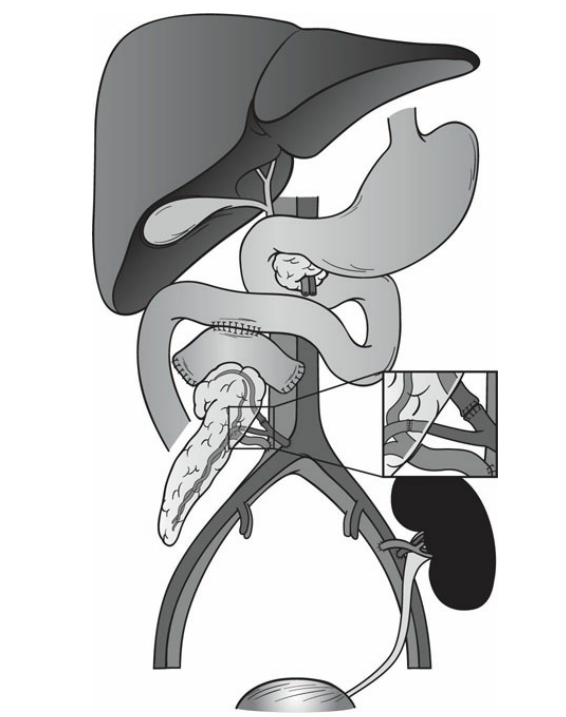
Pancreatic transplant of the most common exocrine enteric drainage arrangement.
the pancreatic parenchyma should be
homogeneous and may be hypoechoic just after transplantation
a hypoechoic transplant may also be a sign of
pancreatitis or acute rejection
with rejection, the pancreas may also appear
heterogeneous
— are often indicative of acute rejection as well
elevated resistive indices
with chronic rejection, the pancreas can appear more
hyperechoic, atrophic, and contain calcifications
pancreatic transplant fluid collections
abscess
ascites
hematoma
urinoma (secondary to anastomosis problems at the urinary bladder)
pseudocysts
common vascular complication that typically occurs shortly after surgery
graft thrombosis, whether arterial or venous
graft thrombosis must be suspected if — can be detected within the gland
no flow
other complications include
pancreatitis
arterial stenosis
pseudoaneurysms
fluid collections
sonographic findings of acute pancreatic transplant rejection
hypoechoic or heterogeneous gland
elevated resistive indices
pancreatic transplant vascular complications
arterial stenosis: focal areas of increased velocities
arterial thrombosis
graft thrombosis
pseudoaneurysms
splenic vein thrombosis: elevated pulsed-wave doppler resistive index in the arterial inflow doppler waveform, often greater than 1.0; absent splenic inflow
strictures: evident with turbulent flow
Sonographic findings of chronic pancreatic transplant rejection
hyperechoic echotexture
atrophy
pancreas may contain calcifications