Term 3 Homeostasis
 Call Kai
 Learn
Learn Practice Test
 Spaced Repetition
 Match
Match Flashcards
 Knowt Play
1/15

There's no tags or description
Looks like no tags are added yet.
Name | Mastery | Learn | Test | Matching | Spaced | Call with Kai | Chat |
|---|
No analytics yet
Send a link to your students to track their progress
16 Terms
What are the factors that affect enzyme activity?
Temp
Optimum temp - maximum rate of enzyme activity
Above optimum - alter the structure of active sites of enzymes - denature - substrates are unable to bind - no longer complementary active site
pH
Above or below - enzyme denatures
Changing pH can alter the structure of the active site of enzyme or the substrate itself
What do membrane proteins have to do with hormones?
FOR WATER-SOLUBLE HORMONES - PEPTIDES/PROTEINS - which cannot pass thru the cell membrane
Hormone binding sites - many hormones travelling in the blood can only act on cells by binding to complementary protein receptors on the outside of the membrane to stimulate a response
e.g. insulin or adrenaline
Where do steroid hormones bind?
Intracellular receptors - lipid soluble - they travel through the plasma membrane
e.g. oestrogen or testosterone
How can cell communication occur?
Direct contact between cell membrane proteins of adjacent cells
Hormones
Neurotransmitters
What is the equation for aerobic respiration? Both.
Glucose + Oxygen → Water + Carbon dioxide + 36 ATP
C6H12O6 + 6O2 → 6H2O + 6CO2 + 36ATP
What is aerobic respiration?
Type of cell respiration used to release energy stored in chemical bonds of glucose when oxygen is available - more efficient process than anaerobic as it produces more ATP
What are the 3 stages of aerobic respiration? Where does each stage occur
Glycolysis - cytosol
Krebs cycle - mitochondria
Electron transport chain - mitochondria
What happens during the stages of aerobic respiration?
Glycolysis
Glucose is broken down into pyruvate (2C3H3O3-)
IN THE PRESENCE OF OXYGEN
Pyruvate enters the mitochondria
After pyruvate enters the mitochondria it becomes Acetyl-CoA before it can enter the main energy cycle (the Krebs cycle). 2-carbon molecule attached to a special helper (Coenzyme A).
Krebs Cycle - citric acid cycle - mitochondrion
Electron transport chain - mitochondrion - oxygen is the final electron acceptor that allows the production of ATP to occur efficiently
What is the stimulus response model?
6 stages
Stimulus - change in the internal/external environment that can be detected by the organism
Receptor - cells or tissues that detect the stimulus
Transmission - relay of information via nerves and/or hormones to an effector
Effector - organ/muscle or gland brings about a response after recieving the information
Response - the action which occurs as a result of the initial stimulus
Feedback - OCCURS WHEN the response has an impact on the initial stimulus - positive (reinforces/increases) or negative (reverses)
Is homeostasis constant?
NO - NOT STATIC
dynamic equilibrium - internal conditions fluctuate within tolerance limits - active adjustment
What are examples of positive feedback?
When a newborn sucks on the mother’s breast nipple - releases hormones to further stimulate the release of milk - which was the initial response
Breastfeeding can release oxytocin in the mother’s brain, promoting affection and bonding between the mother and child - the oxytocin can pass thru the breast milk to the baby - further promoting the bond.
REINFORCING THE INITIAL STIMULUS
What 2 systems detect and respond to stimuli from the internal and external environments? When is each usually involved?
Nervous - more rapid/direct communication
Endocrine
What is the nervous system made up of? What are their primary roles?
CNS - brain (controls the CNS) and spinal cord (link between brain and peripheral nerves) - processes, interprets, stores info; transmits messages to the muscles, glands and organs
PNS - nerves and ganglia located outside CNS - transmitting the info to and from the CNS - relay info from sensory receptors to the CNS and from the CNS to the effectors
How can the PNS be further subdivided?
Somatic (voluntary) - nerves are under conscious control e.g. influencing the skeletal muscles
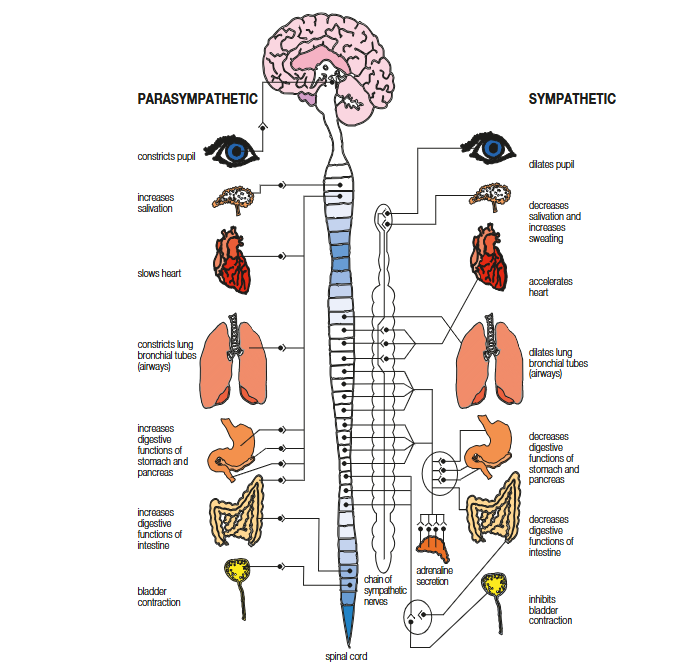
Autonomic (involuntary) - nerves involved in unconscious responses; regulates glands, blood vesselse.g. changes in heart rate - further divided into:
Sympathetic - controls fight/flight/freeze/fawn response - mobilises body for action; energy output
Parasympathetic - rest and digest - conserves energy
What can the sympathetic and parasympathetic systems do?