EMES 204 Ch. 2
 Call Kai
 Learn
Learn Practice Test
 Spaced Repetition
 Match
Match Flashcards
 Knowt Play
1/27

There's no tags or description
Looks like no tags are added yet.
Name | Mastery | Learn | Test | Matching | Spaced | Call with Kai | Chat |
|---|
No analytics yet
Send a link to your students to track their progress
28 Terms
cell envelope
consists of a series of layered structures that surround the cytoplasm and govern cellular interactions with the external environment
simple transport
consists only of a transmembrane transport protein
sodium-proton antiporter
Exchanges sodium ions for protons across membrane.
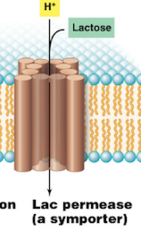
lac permease
membrane protein that transports lactose into the cell
ABC transporter
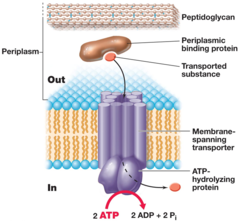
binding proteins are involved and energy comes from ATP
- binding protein + transported substance
- ATP-hydrolyzing protein
break part of ATP to make
- ADP → provides spring of energy
group translocation
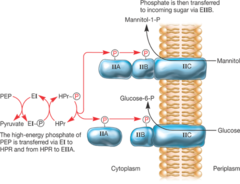
chemical modification of the transported substance driven by phosphoenolpyruvate
membrane functions
1. permeability barrier
2. anchor proteins
3. energy conservation
peptidoglycan
A protein-carbohydrate compound that makes the cell walls of bacteria rigid

teichoic acids
Polymers found in Gram-positive bacterial cell walls.
Lipopolysaccharide (LPS)
Molecule that makes up the outer layer of the outer membrane of Gram-negative bacteria
Gram-positive bacteria
Bacteria that have a thick peptido glycan cell wall, and no outer membrane. They stain very darkly (purple) in Gram stain.
gram-negative bacteria
Bacteria that have complex cell walls with less peptidoglycan but with lipopolysaccharides. Very toxic and hard to treat.
periplasm
The gel-like material that fills the region between the cytoplasmic membrane and the outer membrane of Gram-negative bacteria.
s-layer
an outermost cell surface layer composed of protein or glycoprotein present on some Bacteria and Archaea
major elements
Carbon (C), Hydrogen (H), Nitrogen (N), Oxygen (O), Phosphorus (P), Sulfur (S)
micronutrients
Iron (Fe), Magnesium (Mg), and others
trace elements
Cobalt, Lanthanum, and other rare earth metals
hydrophilic
Attracted to water (phosphate head)
hydrophobic
Water fearing (fatty acid tail)
phospholipid
consists of polar phosphate head and nonpolar lipid tail; make up the phospholipid bilayer in the cell membrane

selective permeability
A property of a plasma membrane that allows some substances to cross more easily than others.
transmembrane proteins
integral proteins that do not extend all the way through the membrane.
peripheral proteins
The proteins of a membrane that are not embedded in the lipid bilayer; they are appendages loosely bound to the surface of the membrane.
Why do polar molecules have difficulty passing through the phospholipid bilayer?
Two factors contribute. First, the negatively charged phosphate head groups can repel other charged molecules. Second, the hydrophobic interior of the bilayer is chemically incompatible with polar or charged molecules, creating a strong energetic barrier to their passage.
What structural properties allow the cell wall to provide strength while still permitting molecular exchange?
The cell wall, composed of peptidoglycan, provides mechanical reinforcement to counteract the approximately 2 atmospheres of internal osmotic pressure while maintaining porosity for molecular exchange
How is the cell membrane analogous to a battery in terms of energy conservation?
Functions as a biological battery by maintaining a proton gradient (high H⁺ outside, low H⁺ inside), which drives ATP synthesis and other energy-requiring processes
What is changing shape during ABC transport — the substrate or the proteins?
The proteins change shape, not the substrate. Specifically, ATP hydrolysis causes a conformational change in the ATPase component, which in turn causes the transmembrane protein to open and facilitate substrate passage. The substrate itself remains chemically unchanged in ABC transport (unlike group translocation).
What prevents the substrate-binding protein from simply drifting away into the environment?
the periplasm