All Experiments
 Call Kai
 Learn
Learn Practice Test
 Spaced Repetition
 Match
Match Flashcards
 Knowt Play
1/248

There's no tags or description
Looks like no tags are added yet.
Name | Mastery | Learn | Test | Matching | Spaced | Call with Kai | Chat |
|---|
No analytics yet
Send a link to your students to track their progress
249 Terms
How does chlorine help kill microorganisms in water?
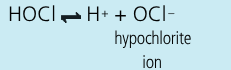
chlorine reacts with water to form a weak acid called hypochlorous acid
this dissociates into H+ ions and hypochlorite ions, which have little power to kill germs
the hypochlorous acid needs to be kept in its associated form in order to be effective
What is the main chemical added during the comparator test?
DPD
What colour is DPD?
pink
What test kit is used in this experiment?
Hach test kit
Describe the method used to measure the concentration of free chlorine in pool water:
small quantity of deionised water placed in one viewing tube - reference tube - and placed on the left in the black comparator box
small quantity of water sample placed in another viewing tube tube, a DPD tablet is added and sol. is stirred until dissolved
a pink colour is observed due to the presence of free chlorine
this placed on the right in the black comparator box
comparator box is held up to a source of light + the disc is rotated until the colours in each openeing best match each other
the number visible is recorded in ppm
cover is placed over the colour disc to prevent discolouration from age and use
Anion: Chloride TOI
Test - add a few drops of AgNO₃ solution to a solution of the solid
Observation - a white precipitate is formed which is soluble in dilute ammonia solution
Inference - Ag⁺ + Cl⁻ -> AgCl↓
Anion: Sulfate or Sulfite TOI
Test - add BaCl₂ solution to a solution of the solid
Observation - a white precipitate is formed
Inference- Ba²⁺ + SO₄ ²⁻ → BaSO₄↓
- Ba²⁺ + SO₃ ²⁻ → BaSO₃↓
Test - distinguishing test, add dilute HCl
Observation- if precipitate remains → sulfate
- if precipitate dissolves → sulfite
Inference- SO₃ ²⁻ + 2H⁺ → SO₂ + H₂O
- BaSO₄ + HCl → no reaction
Anion: Carbonate or Hydrogen-carbonate TOI
Test - Add dilute HCl to the solution of the solid
Observation - Fizzing is observed. The gas (CO₂) is given off which turns limewater milky
Inference - CO₃ ²⁻ + 2H⁺ → CO₂ + H₂O
HCO₃ ⁻ + H⁺ → CO₂ + H₂O
Ca(OH)₂ + CO₂ → CaCO₃↓ + H₂O
Test - Distinguishing test. Add MgSO₄ to a fresh solution of the solid
Observation - White precipitate forms → Carbonate
No precipitate forms → Hydrogen-carbonate, boiling will give a precipitate
Inference - Mg²⁺ + CO₃ ²⁻ → MgCO₃↓Mg²⁺ + 2HCO₃⁻ → Mg(HCO₃)₂
Mg(HCO₃)₂ → MgCO₃↓ + CO₂ + H₂O
Anion: Nitrate TOI
Test - Brown ring test. Add freshly prepared saturated FeSO₄ solution to a solution of the solid. Add concentrated sulfuric acid
Observation - A brown ring is formed at the junction of the two liquids → nitrate ion is present
Inference - Brown ring is due to the presence of nitrate
Anion: Phosphate TOI
Test - Ammonium molybdate is added to a solution of the solid. Concentrated nitric acid is added, the solution is warmed.
Observation - a yellow precipitate is formed
Inference - Phosphate ions are present
Write an equation for the experiment to illustrate Le Chatelier’s principle
Iron (III) Chloride + Potassium Thiocynate ⇌ Ferrocyothyate + Chloride ions
Fe3+Cl3- + CNS- ⇌ Fe(CNS)2+ + 3Cl-
yellow colourless red
- delta H
Method to show the effect of temperature
add FeCl3 to a test-tube with potassium thiocyanate
observe the colour
heat the solution + note colour change
colour becomes more yellow
equilibrium shifts to the left
cool the solution + note the colour change
red colour intensifies
equilibrium shifts to the right
Method to show the effect of concentration
add FeCl3 to a test tube with KCNS
observe the colour
add conc. HCl to the solution + note change
becomes more yellow
equilibrium shifts to the left
KCNS is added + note change
red colour intensifies
equilibrium shifts to the right
lol
Describe the method
presoak a wooden splint
dip it into the salt
hold over the blue flame of the Bunsen burner
Lithium colour
Crimson
Potassium
lilac
Barium
green
Strontium
red
Copper
blue-green
Sodium
yellow
Conclusion of the experiment
each metal provides a unique colour due to the different electron configurations of the electrons
and therefore different electron transitions of energy levels
Method
using a graduated cylinder place a known volume of HCl in a polystyrene cup
usinge a separate graduated cylinder place a known volume of NaOH into a separate polystyrene cup
both solutions should be the same concentration
allow both cups to come to the same temperature
pour the NaOH to the HCl and quickly place lid on the cup
a digital thermometer is used to record the temperature increase
cups are swirled
heat rise is recorded and heat of neutralisation is calculated
Why is polystyrene used?
is a good insulator
What precautions are take?
care is taken to avoid loss of liquid due to splashing as this would change the volume used and impact results
stir to ensure the temperature is constant througout
digital thermometer is used which is more accurate than alcohol thermometers
lid reduces heat loss to surrounding
lol
Stationary phase
chromatography paper
Mobile phase
suitable solvent
Procedure
fe
Key steps + observations in the procedure for the reaction of ethanoic acid with sodium carbonate:
place anydrous sodium carbonate and ethanoic acid into a boiling tube connected to a solution of limewater
effervescence occurs, limewater goes milky showing the gas produced is carbon dioxide
a lit taper held at the mouth of the boiling tube is extinguished, carbon dioxide is present
Write an equation for the reaction between ethanoic acid and sodium carbonate

Write an equation for the reaction between carbon dioxide and limewater:

Key steps + observations in the procedure for the reaction of ethanoic acid with magnesium:
place magnesium metal into a solution of ethanoic acid
effevervescence occurs and a lit taper is held above the mouth of the test-tube
a squeakly pop, means that hydrogen gas is produced
Write an equation for the reaction between ethanoic acid and magnesium:

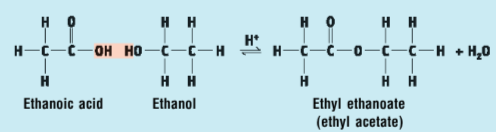
Key steps + observations in the procedure for the reaction of ethanoic acid with ethanol:
add ethanol and ethanoic acid together with some sulfuric acid (catalyst) in a test tube
observe that there is no colour change and a fruity smell is produced to the the ester (ethyl ethanoate) formed
Draw the structures in the reaction between ethanoic acid and ethanol + indicate the oxygen and hydrogens that form a water molecule
Key steps and observations in the procedure to recrystallise a sample of benzoic acid:
a known mass of benzoic acid crystals are dissolved in a minimum amount of hot water
the solution is filtered use a heated funnel to remove insoluble impurities
the solution in cooled in ice, and a seed crystal is added to speed up the process
the crystals are collected by vaccuum filtration which separates benzoic acid from soluble impurities
crystals air dry and their mass is obtained
Why is the minimum amount of hot water used
benzoic acid is very soluble in hot water
the more solvent the less crystals will be obtained
.
.
Write a balanced equation for the formation of ethene?
C2H5OH —Al2O3→C2H4 + H2O
Key steps + observations in the procedure for the preparation of ethene:
some ethanol is poured into a boiling tube, and glass wool is added to soak up the ethanol and holds it in place at the end of the boiling tube
a small heap of aluminium oxide (alumina) is place midway along the boiling tube
the aluminium oxide is gently heated by the Bunsen burner, the ethanol is not heated directly as it would vaporise and pass over the aluminium oxide too quickly without being dehydrated to form ethene
bubbles of displaced air from the apparatus are allowed to escape for a short time before 5 test tube and a glass jar of ethene are collected
once finished, the apparatus is raised so that the delivery tube is no longer in the water, and only then is the Bunsen burner turned off; this prevents suck back
What safety precautions are taken when preparing ethene?
stopper on the boiling tube must be air tight, and the Bunsen burner must not be allowed near the mouth of the boiling tube as any gas that escapes is flammable
suck back occurs when the Bunsen burner is turned off before the delivery tube is removed from the water
the alcohol vapour in the boiling tube cools, creating a vacuum, and the water is sucked back to fill the space
the cold water can cause the hot boiling tube to crack or shatter
to avoid suck back, raise the apparatus in order to remove the delivery tube from the water before turning off the Bunsen
Describe the physical properties of ethene:
ethene is a colourless gas with a sweetish smell
collected over water, therefore it must be insoluble in water otherwise it would have dissolved; it is only soluble in organic solvents such as cyclohexane and chloroform
Describe the combustion of ethene:
stopper is removed from a test tube and a lit wax taper is held at the mouth of the test tube
a yellow-luminous, slightly smoky flame is observed
when gas has stopped burning some limewater is added to the test tube, which is then stoppered and shaken
limewater turns milky due to the production of CO2
Describe the tests for unsaturation on ethene:
bromine water is added to a test tube of ethene, which is stoppered and shaken
colour change from yellow-orange to colourless is observed
bromine bonds with the very reactive alkene to form a new colourless compound
acidified potassium permanganate is added to a test tube of ethene, which is stoppered and shaken
colour change from purple to colourless is observed
Write and equation for the combustion of ethene:
C2H4 + 3O2 → 2CO2 + 2H2O
Write an equation for the reaction between limewater and carbon dioxide:
Ca(OH)2 + CO2 → CaCO3 + H2O
Key steps and observations in the procedure
a sample of the crystals are placed on the melting point block
they are heated using a hot plate while observing the crystals and thermometer
the range of temperatures over which the benzoic acid melts is recorded
.
.
.
Key steps + observations in the procedure for the oxidation of Phenylmethanol to Benzoic acid with KMnO4 sol. in alkaline conditions
place phenylmethanol, KMnO4 and sodium carbonate into a conical flask
heat in a water bath for some time
a brown precipitate forms
cool the flask and add concentrated hydrochloric acid + use blue litmus paper to ensure acidic conditions
add sodium sulftie to reduce the Mn4+ ioms to Mn2+
white crystals form
place conical flask in ice to crash out the crystals
filter off crystals using a Buchner flask and funnel
use the filtrate to wash out the conical flask
crystals are allowed to air dry overnight
Why is this reaction carried out in alkaline conditions?
this oxidation reaction works best in alkaline conditions
What colour changes are noticed in this experiment?
Purple to brown precipitate to white crystals
Why is KMnO4 used?
it is an oxidising agent
3 Reasons why conc. HCl is used?
converts sodium benzoate intermediate to benzoic acid
neutralises any excess sodium carbonate
helps Mn4+ ions to reduce to Mn2+
Why is sodium sulfite added?
is a reducing agent that allows Mn+4 ions to be reduced to Mn+2 ions
these ions are soluble in water which ensures they do not contaminate the benzoic acid crystals
Why was the flask placed in ice?
benzoic acid has poor solubility in cold water allowing them to crash out
How were soluble impurities removed from the crystals?
they are washed with ice cold water
What else could be used to dry the crystals?
place them in a desicator
Describe the colour of calcium dicarbide?
grey-brown or sandy, due to the presence of impurities
What impurities can be found in calcium dicarbide?
calcium sulfide CaS
calcium phosphide Ca3P2
calcium nitride Ca3N2
Key steps + observations in the procedure for the preparation of ethyne:
using a spatula, some calcium carbide is placed in a Buchner flask, it must not be touched as moisture from the hand could start the reaction
water is added slowly using a dropping funnel
fizzing takes place in the Buchner flask, a white solid calcium hydroxide is formed and the Buchner flask becomes warm, as an exothermic reaction is occurring
the ethyne gas is bubbled through acidified copper sulfate solution, to remove impurities of hydrogen sulfide, phosphine and ammonia as ethyne does not dissolve
bubbles of gas start to come through the delivery tube, a few test tubes of the gas are collected, the first few are discarded as they only contain displaced air
What safety precautions are taken when preparing ethene?
since ethynes an explosive misture with air, no naked flam should be brought near the gas preparation apparatus, and all tests should be performed away from the apparatus
after the ethyne is collected the apparatus should be dismantled to ensure no more ethyne is produced
Describe the physcial properties of ethyne:
ethyne is a colourless gas with a sweetish smell, but if impurities are still present, it will not smell nice
insoluble in water; it is only soluble in organic solvents such as cyclohexane and chloroform
Describe the combustion of ethyne:
lid is removed from the gas jar and a lit taper is held at the mouth of the gas jar
a more yellow-luminous, smokey flame and great deal of soot is observed
the soot is a result of unburnt carbon, due to lack of sufficient oxygen to burn it completely
Describe the tests for unsaturation on ethyne
bromine water is added to a test tube of ethyne, which is stoppered and shaken
colour change from yellow-orange to colourless is observed
bromine bonds with the very reactive triple bond to form a new colourless compound
dilute acidified potassium permanganate is added to a test tube of ethyne, which is stoppered and shaken
colour change from purple to colourless is observed
the very reactive triple bond reacts with the potassium permanganate to produce a colourless product
Write an equation for the complete combustion of ethyne in excess oxygen:
2C2H2 + 5O2 → 4CO2 + 2H2O
What is the other name for liquid-liquid extraction?
solvent extraction
Key steps + observations in the procedure for the isolation of clove oil from an emulsion by liquid-liquid extraction using cyclohexane
place the emulsion into a separating funnel with a small quantity of cyclohexane and shake, the cyclohexane will dissolve the clove oil without mixing with water
the organic layer sits on top of the water, the aqueous and organic layers are collected separately in beakers
place the aqueous layer back into the separating funnel, and wash the aqueous layer a further 2 times to maximise the amount of eugenol collected
anhydrous magnesium sulfate (MgSO4) is added to the organic solution, to remove any water that is present as it is a drying agent
the mass of a clean dry conical flask is obtained, and the solution is filted to remove the hydrated magnesium sulfate
fresh cyclohexane is added to remove traces of oil in the filter paper
place the conical flask in a water bath and heat, this will remove the volatile cyclohexane
the new mass of the conical flask is found and the difference is the mass of the clove oil
How does steam distillation extract oils from plants?
the mixture of steam and oil distils below the boiling points of both water and oil
too high a temperature would destroy the plant material
Why is cyclohexane heated in a water bath?
very flammable so should never be heated directly using a Bunsen burner
Describe the appearance of magnesium sulfate before + after it is added to water:
from a white powder to a white crystal
Key steps + observations in the procedure for the preparation of a sample of soap:
set up a reflux apparatus
oil containing glycerol tristearate, sodium hydroxide, ethanol and antibumping granules are added to a pear shaped flask
gyceryl tristearate is the key component for making soap
sodium hydroxide is the base present for base hydrolysis/saponification to occur
antibumping granules ensures a smooth, contolled boil
ethanol acts as a solvent for the oil
reflux for 30 minutes to ensure reaction completion and no loss of ethanol solvent
the walls of the coated become coated with the sodium salts of the fatty acids that have not been hydrolysed
set up distillation apparatus to collect ethanol, which has a lower boiling point
the contents of the pear shaped flask is poured into a beaker containing brine, which will precipitate the soap and dissolve excess sodium hydroxide
use a small amount of water to ensure all washings go into the brine solution, only a small amount to ensure the solution is still saturated
soap (sodium stearate) is filtered off and washed with ice cold water, to remove excess sodium hydroxide; the water being ice cold prevents the soaps from dissolving too quickly
soap is allowed to air dry overnight on filter paper
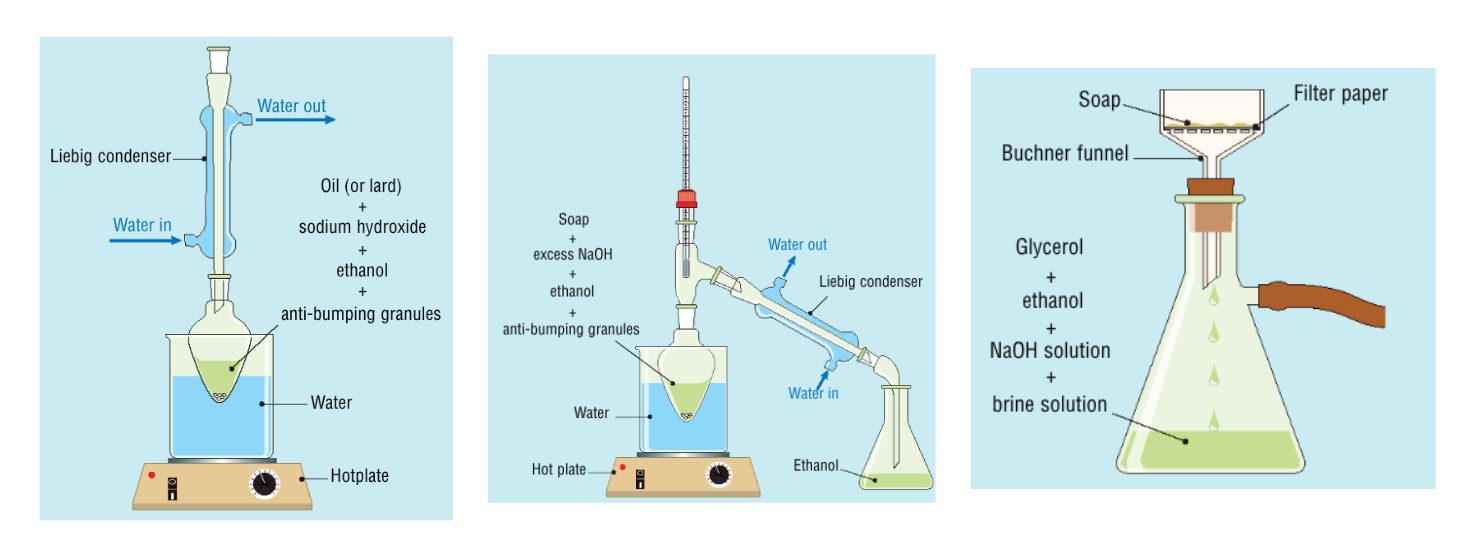
What is refluxing and why is is used
a lab technique in which a liquid is boiled in a container that is attached to a vertical condenser
vapour from the boiling liquid condenses and flows back into the flask which keeps the liquid boiling without the loss of vapour
this prevents the flask running dry whilst allowing sufficient time for the reaction to occur, maximising the yield
What is brine?
a concentrated solution of sodium chloride (NaCl or salt) in water
What is the test to confirm that soap has been produced?
put in a test tube with water, stopper and shake
the soap forms a lather in the presence of water
Write a word + chemical equation for the preparation of soap:
Glycerol tristearate + Sodium hydroxide → Sodium Stearate (Soap) + Glycerol
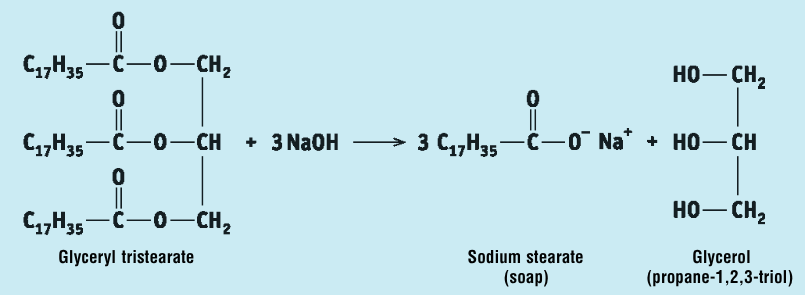
What is the IUPAC name for glycerol?
Propan-1,2,3-triol
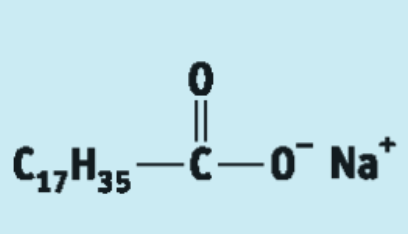
Draw the structure of sodium stearate:
sodium octadecanoate
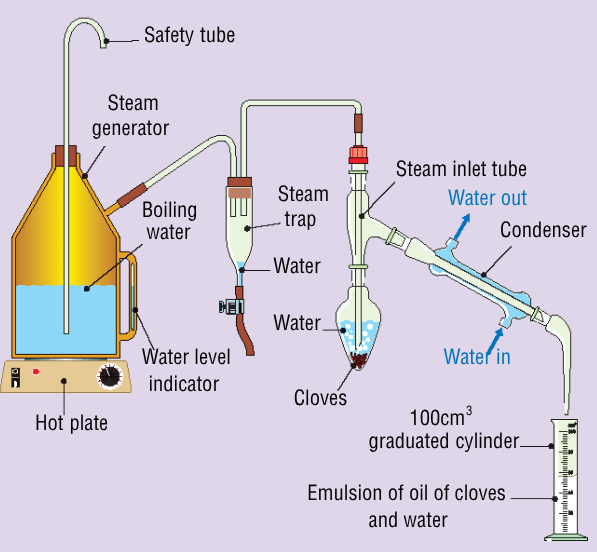
Key steps + observations in the procedure for the extraction of clove oil from cloves by steam distillation:
the apparatus for steam distillation is set up
the steam generator or copper kettle provides steam
the safety tube prevents a build of pressure formed by the steam
steam tap prevents excess steam from entering the pear shaped flask
liebig condenser condenses the emulsion: water in at the bottom out at the top
a milky emulsion is collected, a mixture of clove oil and water
Draw a diagram of the steam distillation apparatus:
What are safety precautions are taken during this experiment?
as steam is being used exercise care to avoid scalding
euganol can burn the skin so gloves should be worn when handling the emulsion obtained
What are some precautions taken during this experiment?
ensure the bottom of the safety tube is placed below the water at all times, otherwise steam would escape rather than entering the pear shaped flask
Name the substance that is the main part of clove oil + draw its structure:
Eugenol (4-allyl-2-methoxy phenol)

Key steps + observations in the procedure for the reaction of ethanal and propanone with acidified KMnO4
in a test tube some potassium permanganate is acidified with dilute sulfuric acid
ethanal is added, and the test tube is placed in a beaker of warm water
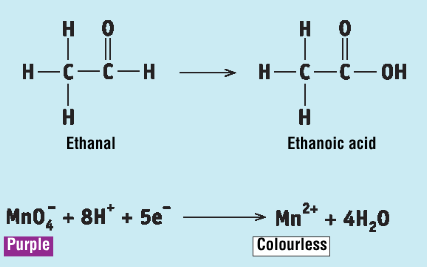
the ethanal is oxidised to ethanoic acid, and the acidified potassium permanganate changes from purple to colourless as it has been reduced
when the experiment is repeated with propanone, the potassium permanganate solution does not change colour as ketones are not oxidised by potassium permanganate
Write the 2 half-reactions that took place in the reaction of ethanal with acidified KMnO4
Key steps + observations in the procedure for the reaction of ethanal and propanone with Fehling’s reagent
Fehling’s reagent is made up by mixing equal quantities of Fehling’s A and Fehling’s B, forming a clear royal blue solution
in a test tube containing Fehling’s reagent, some ethanal is added
the test tube is placed in a beaker of warm water, and the ethanal is oxidised to ethanoic acid
a brick-red precipitate is observed as the Cu2+ ions (blue) in the Fehling’s reagent are reduced to Cu+ ions (red) by the ethanal
when the experiment is repeated with propanone, no red precipitate is observed when the Fehling’as reagent and propanone are heated together, as ketones arenot oxidised by Fehling’s reagent since it is a weak oxidising agent
What is Fehling’s A and Fehling’s B?
Fehling’s A - a blue solution of copper sulfate in water
Fehling’s B - a colourless solution of potassium sodium tartrate (Rochelle salt) and sodium hydroxide in water