Cranial Nerves
 Call Kai
 Learn
Learn Practice Test
 Spaced Repetition
 Match
Match Flashcards
 Knowt Play
1/31

There's no tags or description
Looks like no tags are added yet.
Name | Mastery | Learn | Test | Matching | Spaced | Call with Kai |
|---|
No analytics yet
Send a link to your students to track their progress
32 Terms
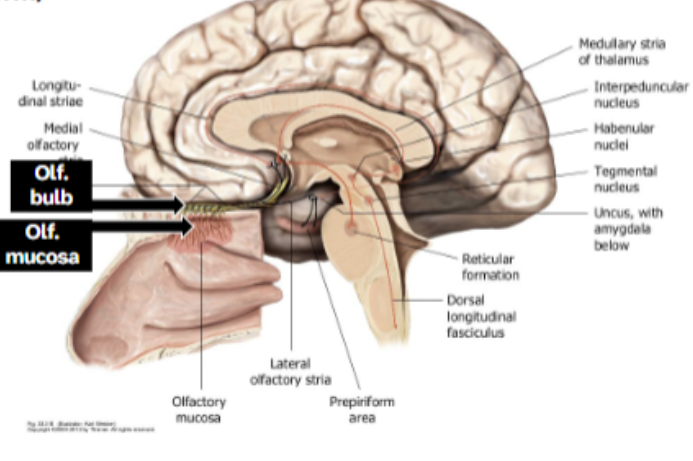
CN I Olfactory Nerve (Sensory)
Sensory fibers from nasal mucosa for smell
Neurons in nasal cavity
Axons project superiorly through cribriform/olfactory foramina in ethmoid bone
CN II Optic Nerve (Sensory)
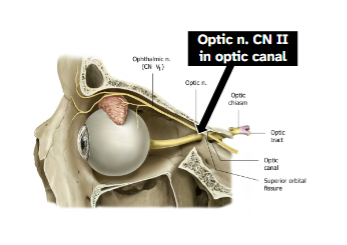
Sensory fibers from retina for vision
Wrapped by meninges
Runs in optic canal with ophthalmic artery
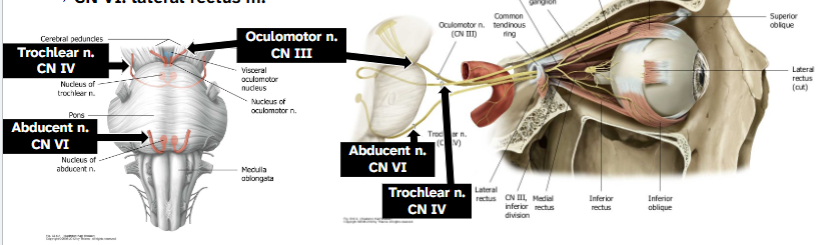
CN III Oculomotor (Motor)
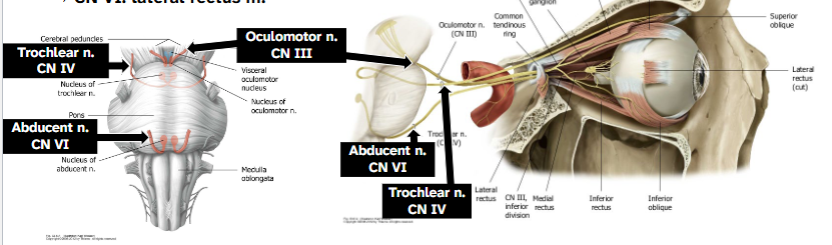
Motor to extraocular muscles, parasympathetic
Emerges from brainstem → cavernous sinus → superior orbital fissure
Nuclei in midbrain (III and IV)
CN IV Trochlear (Motor)
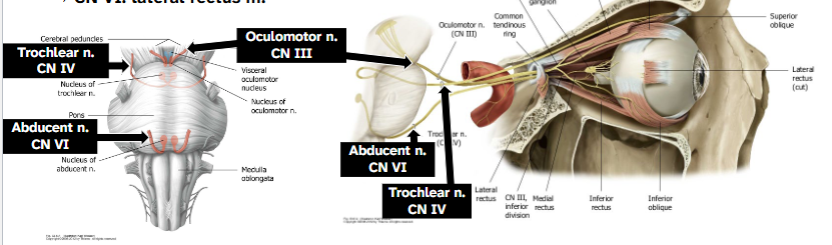
Motor to superior oblique
Pons
Emerges from brainstem → cavernous sinus → superior orbital fissure
CN VI Abducens (Motor)
Motor to lateral rectus
Midbrain (III, IV)
Emerges from brainstem → cavernous sinus → superior orbital fissure
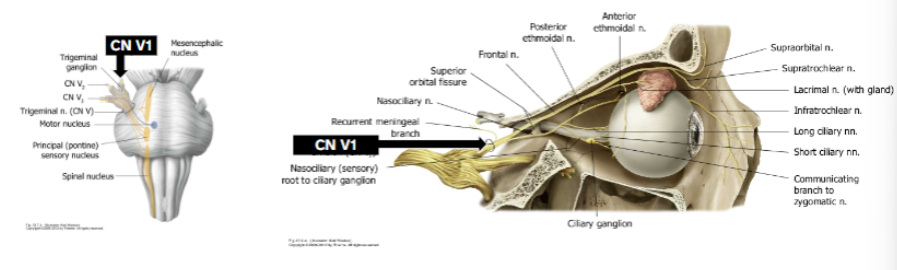
CN V1 Ophthalmic Nerve (Branch of CN V- Both)
Exits brain stem on lateral pons with all of CN V
Moves through cavernous sinus
Enters orbit through superior orbital fissure
Sensory
3 branches- nasociliary (anterior & posterior ethmoidal, infratrochear, long ciliary nn.), frontal (supraorbital, supratrochlear nn.), lacrimal
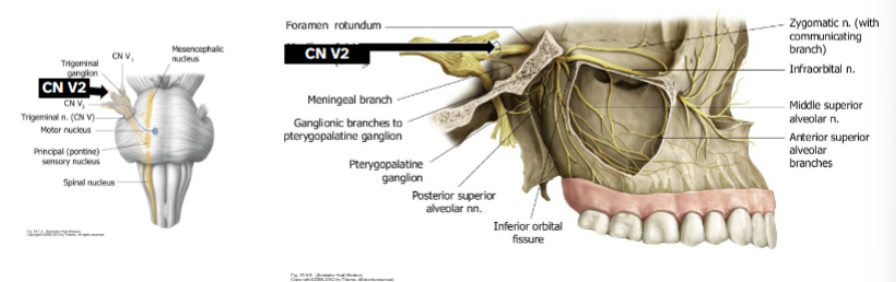
CN V2 Maxillary Nerve (Branch of CN V-Both)
Exits brain stem on lateral pons with all of CN V
Moves through cavernous sinus
Exits cranial cavity through foramen rotundum
Sensory- only from meninges, the maxillary sinus, nasal cavity mucosa, nasopharyngeal mucosa, palate, upper teeth, and skin of the midface
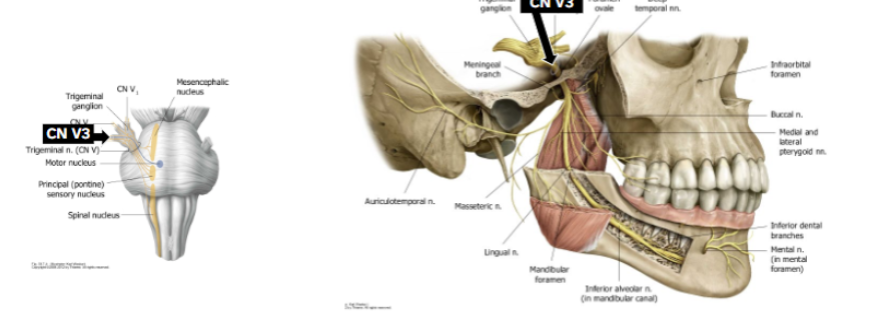
CN V3 Mandibular Nerve (Branch of CN V-Both)
Exits brain stem on lateral pons with all of CN V
Exits cranial cavity through foramen ovale
MOTOR to mm. of mastication, anterior digastric m., mylohyoid m., TVP, TTymp
SENSORY from meninges, skin of lower face & parotid region, TMJ & ear canal, lower teeth,
anterior 2/3 tongue (not taste)
CN VII Facial Nerve (Both)
Exits the brain stem at the pontomedullary junction
Exits cranial cavity at the internal auditory meatus
MOTOR to mm. of facial expression,
post. digastric, stylohyoid, and stapedius mm.
Parasymp MOTOR to lacrimal, nasal,
sublingual, and submandibular glands
SENSORY from ear canal
Special SENSORY for taste
from the anterior 2/3 tongue
CN VIII Vestibulocochlear (Sensory)
Exits the brain stem at the pontomedullary junction
Exits cranial cavity at the internal auditory meatus
SENSORY only
vestibulo- portion for balance
cochlear portion for hearing
CN IX Glossopharyngeal (Both)
- Exits the brain stem at the postolivary sulcus
in the medulla
→ Exits cranial cavity at the jugular foramen
→ MOTOR to stylopharyngeus m.
→ Parasymp MOTOR to parotid gland
→ SENSORY from the post. tongue, oropharynx,
palatine tonsils; carotid sinus & carotid body
→ Special SENSORY for taste from the
posterior 1/3 tongue
CN X Vagus (Both)
- Exits the brain stem at the postolivary sulcus
in the medulla
→ Exits cranial cavity at the jugular foramen
→ MOTOR to salpingopharyngeus, lev. veli
palatini, palatoglossus, laryngeal mm.,
pharyngeal constrictor mm.
→ Parasymp MOTOR to glands of the larynx,
heart, lungs, GI tract to mid-transv. colon
→ SENSORY from external ear,
meninges of post. cranial fossa,
mucosa of the larynx,
laryngopharynx; heart, lungs,
esophagus, GI tract to
mid-transv. colon
→ Special SENSORY for
taste from the
epiglottic region
CN XI Accessory (Motor)
Exits the brain stem at the postolivary sulcus in the medulla
Exits cranial cavity at the jugular foramen
MOTOR to trapezius and sternocleidomastoid mm.
CN XII Hypoglossal (Motor)
Exits the brain stem at the preolivary sulcus in
the medulla
Exits cranial cavity at the hypoglossal foramen
MOTOR to tongue mm. (genioglossus,
hyoglossus, styloglossus, intrinsic mm.
Ethmoidal foramina
Exit point for CN I
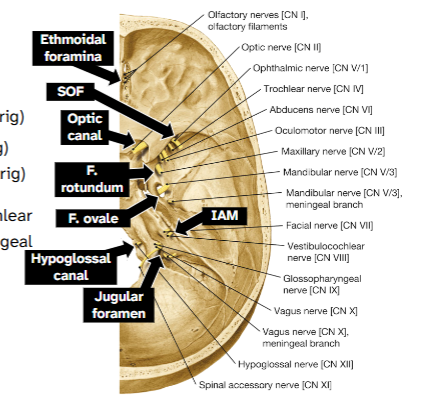
Optic Canal
Exit point for CN II
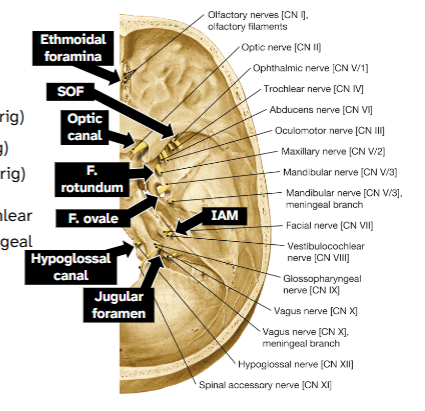
Superior Orbital Fissure
Exit point for CN III, IV, VI + CN V1 (Ophthalmic)
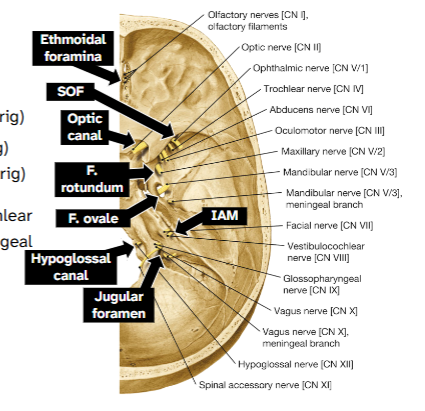
Foramen Rotundum
Exit point for CN V2 Maxillary
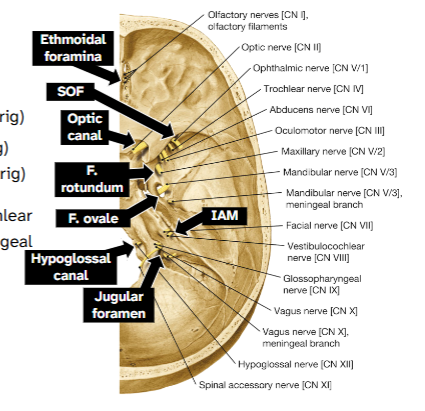
Foramen Ovale
Exit point for CN V3 Mandibular
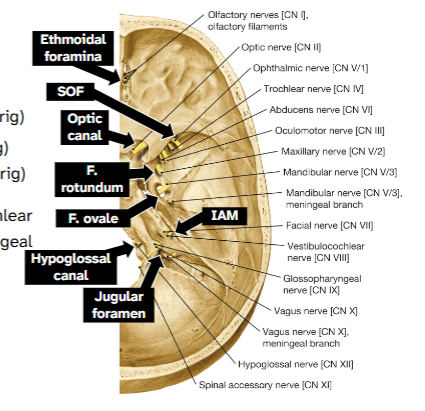
Internal Acoustic Meatus
Exit point for CN VII and CN VIII
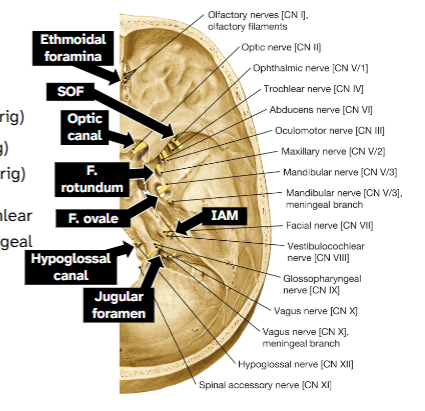
Jugular Foramen
Exit point for CN IX, X, XI
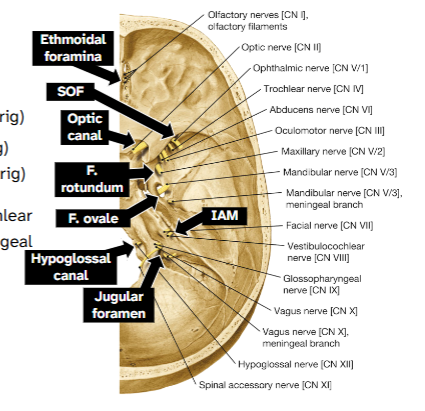
Hypoglossal Canal
Exit point for CN XII
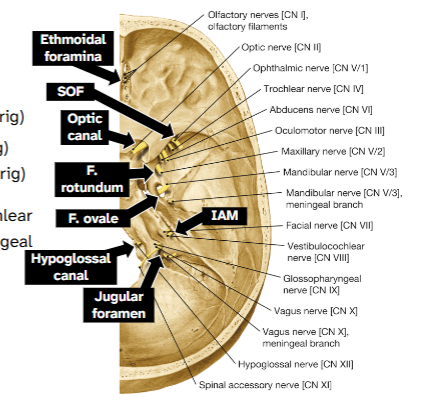
CN I Pathway
Olfactory bulb → cribriform plate → ethmoidal foramina
CN II Pathway
Optic chiasm → optical canal to cranial cavity
CN III Pathway
Interpeduncular fossa of midbrain → posterior cranial fossa → middle cranial fossa → cavernous sinus → superior orbital fissure
CN IV Pathway
Posterior surface of midbrain → dorsal midbrain → medial edge of tentorium → middle cranial fossa → cavernous sinus → superior orbital fissure
CN V Pathway
Pons → anterolateral pons into posterior cranial fossa → middle cranial fossa → CNV1 superior orbital fissure, CNV2 foramen rotundum, CNV3 foramen ovale
CN VI Pathway
Medullaopotine surface, medial to CN VII → exits between pons and medulla → superior orbital fissure
CN VII Pathway
Exits laterally between pons and medulla → internal acoustic meatus → stylomastoid foramen
CN VIII Pathway
Medullapotine sulcus, lateral to CN VII → exits brainstem between pons and medulla → internal acoustic meatus
CN IX
Retro-olivary groove of medulla → exits cranial cavity at jugular foramen → ganglia inf. to jugular foramen → inn. stylopharyngeus → branch into posterior oral cavity deep to hyoglossus → branch enters pharynx
CN X
Retro-olivary groove of medulla → exits cranial cavity at jugular foramen → runs between ICA and IJV → hella branches