international politics final
 Call Kai
 Learn
Learn Practice Test
 Spaced Repetition
 Match
Match Flashcards
 Knowt Play
1/58

There's no tags or description
Looks like no tags are added yet.
Name | Mastery | Learn | Test | Matching | Spaced | Call with Kai | Chat |
|---|
No analytics yet
Send a link to your students to track their progress
59 Terms
What is the study of International Politics?
The study of IR is a transition from pursuing normative goals (peace, prosperity, and human rights) to understand the positive logic and evidence-based global action.
Strategic perspective: international relations are inseparable from domestic politics and that leaders prioritize personal political power over abstract national interests
What are the fundamental challenges to international cooperation?
Distribution of benefits: the conflict between “winners and losers” agreements.
Credibility of commitments: difficulty of distinguishing between costly signals (actions with real consequences) and cheap talk (rhetoric).
Uncertainty and misinformation: the prevalence of bluffing and the necessity of learning from an opponents behavior.
Collective action problems: challenges that often lead to social outcomes that are suboptimal, or less than what the parties involved want.
Indivisibility: some issues cannot be easily divided
Tools and constraints of Foreign Policy
Mechanisms
Bargaining: negotiating over distribution of resources or outcomes
Coercion: using the threat of punishment or promise to reward to influence behavior
Constraints
Power: the ability to incentivize (reward) or coerce (punish) others to achieve desired goals
Preferences: what an actor wants, how much they want, and the beliefs held by other actors
What is Neorealism and Realism?
Believes that war is the natural state of affairs, the main focus is on conflict.
Assumptions: international politics is anarchic. States are rational, unitary actors that maximize security above everything else. Power is only pursued as long as it does not jeopardize security.
Hypothesis
Neorealist Stability (Bipolarity): A central neorealist argument is that bipolar systems (two major power blocs) are more stable than multipolar ones because they minimize uncertainty. The logic is that uncertainty lead to miscalculations, which in turn yield instability and war.
Criticisms: The sources argue that the bipolarity hypothesis is logically flawed because it assumes leaders always respond to uncertainty with caution. If some leaders respond to uncertainty with boldness, there is no guaranteed relationship between the number of "poles" and system stability.
Power parity: neorealist logic suggests that states engage in balancing power to reach equal power distributions to ensure security. However, data indicated that war is actually more likely when the initiator of the threat is weaker, suggesting that threatening when one cannot deliver is a bad miscalculation.
What is Liberalism?
The democratic ideal that focuses on trade, international organizations, and cooperation. Shared interests are more important than power distributions.
Assumptions: international politics is hierarchical. Cooperation is the natural state of affairs, advanced through norms (observed conduct) and regimes (laws)
Key Hypotheses
Hegemonic Stability: Cooperation is improved when a dominant (hegemonic) state protects shared values.
Shared Interests: Alliances are long-lived because they reflect deep shared interests rather than temporary security needs.
Interdependence: Economic ties and a "commercial spirit" create transnational bonds that encourage accommodation over conflict.
What is contructivism?
Posits that state and national objectives are not fixed but are socially constructed through processes of legitimation, role redefinition, and reflection.
Logic and Arguments: The theory focuses on how norms and socialization shape preferences. It assumes that a leader’s initial actions are strategic—seeking legitimacy—but that over time, external pressure and socially accepted international norms alter their self-perception. This "Role Redefinition" leads to a shift in how leaders define their own self-interest.
Human Rights application
Application: In the context of human rights, constructivists argue that international law creates norms that alter a government's perception of its interests. If a leader gives rhetorical support to a norm to gain legitimacy, international pressure eventually forces them to change their behavior to match that rhetoric, gradually increasing compliance. However, the sources note that empirical evidence over the past 30 years shows little shift in global regard for human rights, challenging this constructivist view.
What is the strategic perspective?
Domestic and international interactions are dialectical.
Core principals:
Leaders care about themselves, personal interests takes precedents over national interests.
Strategic adjustment where leaders pick policies they think produce the best outcome for them, anticipating that rivals are doing the same.
Domestic constraints meaning if long-term beneficial policy for a nation results in a leaders’ short-term ouster (of office), the policy will not be proposed.
What is alliance reliability?
70% of the time, allies do not help when an allied state is attacked
What is democratic efficiency?
Democracies will over 90% of wars they start (selective, only go to war when they have high chance of winning due to audience costs) while autocratic is only 60%
What is Game Theory and it’s main components?
Analyzes the probability (the likelihood of various actions), utilities (values actors place on specific results, and beliefs (the information and perceptions actors hold about their environments and rivals.
Main concepts:
Players: the specific individuals or groups (ex. leaders, nations, or factions) involved in the interaction.
Terminal histories (moves): the possible paths or sequences of actions through the situation.
Player functions (sequence): determining who plays when. The order of play affects the outcome.
Preferences and utilities: each player has a rank ordering of possible outcomes. These are assigned a utility (U), which is a subjective numerical value.
What are the types of information in Game Theory? What are the next steps?
Types of information
Complete information: knowing the prior history of play
Perfect information: knowing the exact payoffs at the end of the game
Common knowledge: information that all players know, and they know that others know
Private information: knowledge held by one player that others do not have
Next Steps
Beliefs and probabilities: in uncertain situations, payers assign probabilities to different outcomes or to the “type” (ex. tough vs. weak) of their opponent
Strategies: a complete contingent plan of action that specifies what a player will do at every possible point of the game.
What are the key analytical tools in Game Theory?
Nash equilibrium (NE): a stable state where no player can benefit by unilaterally changing their action
Subgame perfect nash equilibrium: a refinement of NE used in sequential games to rule out non-credible threats. It is solved using backwards induction (looking to the end of the game and working backwards to determine best replies)
Mixed strategies: choosing actions probabilistically (ex. playing an action with 1/3 chance to solve distribution issues or make an opponent indifferent between their choices)
Bayes’ rule: a logical tool for learning from action, by allowing players to update their beliefs about an opponent’s true intention based on observed behavior
Types of Game Theory
Prisoner’s dilemma (PD): the difficulty of cooperation. The arm/disarm game is a classic PD scenario where two governments are better off if both disarm, but each has a dominant incentive to arm
Repeated PD: explores how long-term interactions and strategies like tit-for-tat or grimm trigger can induce cooperation if players value the future sufficiently
Battle of the sexes: a coordination game (ex. the U.S. and Israel deciding whether to sanction or destroy nuclear facilities) where both sides want to coordinate but prefer different outcomes
Sequential games: modeled using the extensive form, represented as a game tree. Game where players take turns making moves, one player chooses from the actions of another. Used to rule out non-credible threats
Simultaneous games: players act at the same time without knowing the opponent’s choice
Power transition game: the interaction between a rising state and a declining state over contro of the international status quo.
What is Median Voter Theorem?
MVT is a non-strategic model of policy choice that predicts which specific policy outcome will prevail based on the distribution of voter preferences. Theorem implied that the median chooser’s position (cumulative power of voted exceeds 50%) will always win in a majority-rule system.
Core assumptions: for the MVT to hold, preferences must me unidimensional (able to be mapped on a single line) and single-peaked (voters have one most-preferred point, utility decreases moving father away from it). Single-peaked violates Arrow’s theorem of universal domain
Limitations: MVT assumes all actors behave sincerely, meaning it leaves no room for coercion, bluffing, or strategic voting.
What is bipolarity and stability? Claims? Critique?
This concept is a central hypothesis of Neorealism, which argues that the structural distribution of power determines the stability of the international system.
Neorealist claim: neorealists argue that bipolar systems (two major power blocs) are more stable than multipolar systems (more than two blocs) because "bipolarity minimizes uncertainty”
Logic of uncertainty: the argument is that high uncertainty in multipolar systems leads to miscalculations, which in turn lead to war and system instability. In bipolar systems, its easy for nations to anticipate how their rivals will organize a threat.
Critique
Logic is flawed because it required an unstated assumption about how leaders respond to uncertainty. If leaders respond with added caution, multipolarity might be more stable, but if they respond with boldness, bipolarity is more stable.
Leaders have utility functions and risk preferences, there is no guaranteed relationship between number of blocks and stability.
What are the basic assumptions of Game Theory?
Rationality: people are assumed to be rational, meaning they have preferences, beliefs, and constraints, and they do what they believe is in their best interest
Information costs: it is considered irrational to seek additional choices if the expected outcome of doing so exceeds the gain
Anticipatory: choices are influenced by the anticipated actions of others and expected consequences
What is Nash Equilibrium?
Primary solution concept in game theory: a set of strategies where no player can benefit by changing their actions. Used during simultaneous games.
Represents “no regret” decisions, incorporate social learning and self-enforcing agreements
Strategies can be “pure” (choosing one action for sure) or mixed (choosing based on probability)
Strict dominance: when one strategy always gives a played a higher payoff than any other option, regardless of what the other players choose. A rational player will choose strictly dominant strategy
The dominant strategy is always a nash equilibrium but not ever nash equilibrium relies on dominant strategies
What is Subgame Perfect Nash Equilibrium (SPNE)?
Used during sequential games. A strategy is subgame perfect is it is a “best reply” at every single decision point in the tree, regardless of whether that point is actually reached during play.
Sequential modeling identifies threats and non-credible threats by using subgame perfection.
What is the rationalist theory for war? What are the failures?
Posits that because war is inherently costly and risky, there should always exist a negotiated settlement that all partied prefer to the act of fighting.
War is categorized as the ex-post inefficient meaning that any outcome achieved from conflict could have been reached more efficiently through pre-war agreement
War still occurs from three primary rationalist failures: incomplete information (uncertainty regarding power to resolve), commitment problems (the inability to trust that an opponent will uphold the deal in the future), and indivisibility (issues that cannot be easily partitioned)
To resolve this, they use Bayes’ Rule, tool to learn from action. By observing previous moves from a rival, they can use that information for their true incentives
What is rationalist theory?
A logic-based approach which assumes that political actors, primarily leaders, are rational individuals who make choices to maximize their own interests, which is usually centered on their own political survival.
For an actor to be considered rational, their preferences need to match two logical criteria: completeness (the actor must be able to compare any two alternatives and determine if they prefer one or are indifferent) and transitivity (if an actor prefers x to y, and y to z, they must logically prefer x to z)
What is the Strategic Perspective?
Key tenet of rationalist theory is that IR cannot be separated from domestic politics.
The theory focuses on leaders who produce the best outcome for themselves, even if those policies are harmful to the nation’s long-term interest
Actors engage in strategic adjustment, meaning their choices are influences by what they expect rivals (domestic and foreign) to do. This interaction is typically modeled using Game Theory
What are the variables for an EU equation? How is it set up?
Probability (p): likelihood of winning (p), where 0 ≤ p ≤ 1. The probability of losing is (1-p)
Utility (u): the subjected value of an outcome, U(win)=1
Costs: the subjective price of fighting (militia, life, and destruction). Costs are subtracted from the utility of the outcome.
Compromise (x)
Ex.
Leader A → p-k → p-k > U(SQ)
Leader B → 1-p-k → (1-p-k) > U(SQ)
What is incomplete information (uncertainty)?
States often disagree about the probability of victory (p) and the cost (k) of fighting.
Bluffing and lying: leaders have incentives to misrepresent their strength or resolve to gain a better deal
Miscalculation: when one state underestimated, refused to compromise, or did not believe in the others’ victory
What are commitment problems?
Even if a deal is reached, actors may not believe the other side will honor it. This is compared to the prisoners dilemma where self-interest violates agreement even though it would be better for both parties.
Future demands: a deal today might make one side stronger tomorrow (p increases) allowing them to demand even more in the future
Disarming risks: if a faction like the IRA or Hamas disarm as part of deal they lose the ability to prevent the other side from reneging on the agreement later
What is indivisibility?
Some issues cannot be easily divided, such as who holds total control over a government during a revolution
Revolutionary conflict: in cases where revolutionary groups seek to destroy a government, no middle ground compromise may be possible
Rarity: true indivisibility is rare for often side payments or complex trades can make an issue indivisible
What are risk profiles?
The shape of a leader’s utility function (U(x)) affects the success of bargains.
Risk-averse: a leader who favors a “sure thing” compromise over a gamble of similar value. This expands the bargaining space.
Risk-acceptant: a leader who favors gambles over “sure thing” compromises. If a leader like Putin is risk-acceptant, they may require utility utility concessions far outside the bargaining space, making war more likely.
Risk-neutral: within the bargaining space (between p-k and p+k)
What are the structural theories of war?
Structural accounts posit that the distribution of power within a global system, rather than individual state choices, dictated international affairs. Two primary structural theories are neorealism (balance of power) and Power Transition Theory. Theories are evaluated on two standards
Evidence (does history match the hypothesis?) and logic (do hypotheses follow theories core assumptions logically?)
What is Power Transition Theory?
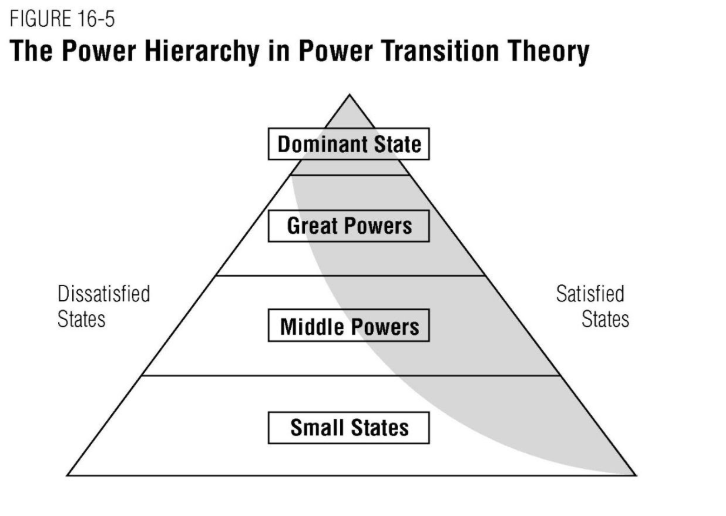
A structural theory of war that presents a “non-idealistic” challenge to realism. It shares realism’s focus on the importance of power, but it rejects the realist assumption that the IR system is anarchic, arguing that it hierarchical. According to PTT, war is most likely when a powerful and dissatisfied state reaches approximate power parity with the dominant state (no balance of powers).
Dominant state sets the rules and norms (SQ), great powers are powerful states that may be satisfied or dissatisfied with the SQ, middle powers are stated with moderate influence, and small states are the most numerous and most often dissatisfied
How do states react according to PTT?
Declining state → challenge or resist → rising state → accept or reject
When a powerful state grows strong enough to challenge the hegemon, the two powers reach approximate power parity, and long-term international factors like differing rates of economic growth drive the transition. PTT views these growths as inevitable and largely unalterable even by war. The states know how the other will react. How states react:
Declining state resists if: the cost of war is low, the rising state’s growth rate is high, or the declining state is risk-averse. It will resist until a critical time where K becomes greater than the cost of new rules
Rising state challenges if: it believes the declining state will accept (post-critical time) or if it is risk-acceptant, the SQ is highly unsatisfactory, and K is low
What is selectorate theory?
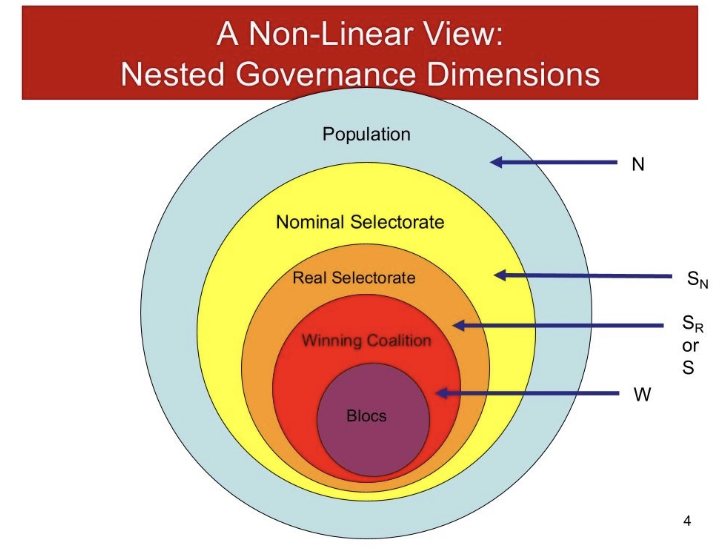
The theory posits that political survival and governance quality are not determined by autocracy and democracy labels, but rather by the relative sizes of a leaders winning coalition (W) and the selectorate (S). Main takeaway is that the leader’s primary motivation is to survive in office and maximize discretionary control over revenue.
S: set of people who have at least some legal say in choosing a leader (all eligible voters in a democracy or the members of a ruling party in an autocracy)
W: subset of the selectorate whose support is essential for the leader to remain in office. The incumbent loses power if they lost the support of W.
To stay in power, leaders must pay their W enough to prevent them from defecting to a challenger. Payment comes in two forms:
Private goods: resources such as corruption, spoils, and tribute to prevent W from defecting. In small W systems (autocracies), it is logically efficient for a leader to provide only private goods to essential supporters.
Public goods: policies such as national security, rule of law, and clean water that benefit everyone equally. In large W systems (democracies), leaders must provide high-quality public goods to satisfy their large W.
What is bayes’ theorem?
Mathematical tool used for learning from action and updating beliefs under conditions of uncertainty. In IR, it allows leaders to calculate contingent probability (how consistent an observed behavior is with their prior expectations) to determine an opponents type of intentions (tough or weak).
Bayes’ theorem is most effective when actors use “costly signals” (actions that are expensive to take) to reveal information, or “cheap talk” (statements with no cost) which often fails to change an opponent’s beliefs

Prior beliefs: the initial probability assigned to an outcome or type before new information is revealed
Updated beliefs: the new probability calculated after observing an action
What is the loyalty norm ratio?
In selectorate theory, the relationship between W and S determines the loyalty of the coalition to the incumbent.
Small W/S (high loyalty): when the pool of potential replacements (S) is large but the coalition (W) is small (ex. rigged election autocracy), supporters fear that if they defect to a challenger, they will not be included in the next W. This allows leaders to be incompetent or corrupt and still stay in power. They often purge people to create a learning affinity.
Large W/S (low loyalty): in systems where W is a large fraction of S (democracies), supporters are less loyal because they have probability of being included in a challenger’s future W. This makes democratic leaders highly accountable for policy performance.
According to selectorate theory, what are the five rules for political survival?
Keep the winning coalition as small as possible (to minimize the number of people to pay)
Keep your selectorate as large as possible (to maintain high loyalty and large pool of replacements)
Control the flow of revenue (tax as much as possible to maximize discretionary funds)
Pay supporters just enough to keep them loyal, and no more
Don’t take supporter money to make the people’s lives better (unless it’s necessary for survival)
What is selectorate theory’s democratic peace?
Because large W leaders lose office if they fail, they only initiate wars they are overwhelmingly likely to win (audience costs). Democracies win wars at higher rates than other regimes, initiate conflict on other regimes (not the other way around), and attempt to utilize negotiations/peace management.
Wartime effort: large W spend vast resources and make extra effort to ensure victory, as their survival depends on it. This leads to a quicker and more efficient victory (normally). Small W leaders are more likely to pocket those resources to supporters.
Foreign aid: the theory suggest aid it often given to needy autocrats (small W) because the aid acts as private goods for that leader, buying their policy concessions for the donor at a low price to the donor’s constituents.
What are governance outcomes according to selectorate theory?
Large W: by providing more public goods, society is wealthier (higher per capita income and more productive economy), healthier (longer life expectancy), freer and transparent (greater personal freedom and govt transparency), and higher immigration rates
Small W: “good policy is bad politics” using private goods there is higher corruption, abuses of human rights (increased use of torture and political killings), inefficiency in health and life, and higher disaster fatality (they do not prioritize public safety)
What is the Fearon model of Audience Costs?
This model describes the domestic political consequences a leader faces when they escalate a crisis but subsequently back down.
Accountability and regime: audience costs are assumed to be higher for democracies because leaders are directly accountable to their domestic populations
Crisis intensity: the cost to the leader increases as a crisis becomes more intense
“Locked-in” effect: at a certain point in a crisis a leader may prefer the risks of war over the domestic political fallout of backing down. Democratic leaders are perceived to reach the locked in stage faster due to higher K
What are the dynamics of signaling?
International actors use signaling to communicate intentions. These signals are categorized by their inherit credibility and the costs they impose on the sender.
Cheap talk: statements that carry no inherent costs to the speaker and often disregarded if not backed by action
Costly signals: statements or actions that are expensive for the speaker to make, which increases their credibility in the eyes of the observer
What is the normative view for democratic peace?
Suggests that democratic citizens and leaders possess values that favor peaceful resolution of disputes.
Kant’s perpetual peace: Kant argues that republican constitutions constrained the impulsiveness of leaders. he believed a commercial of trade and the development of international law would create a moral and legal framework for peace
Bounded competition: Dixen notes that democratic leaders are accustomed to the politics of competing values within normative guideline. When two democracies clash, both sides see bounded competition as the mutual norm.
What are the critiques of the normative view of democratic peace?
Inconsistent application: histories show that democracies engage in imperialism and the subjugation of others
Lopsided wars: democracies have emerged in lopsided scenarios (ex. US invasions of Grenada)
Covert actions: leaders may bypass norms is they believe they can avoid detection
What are institutional constraints regarding democratic peace theory? Criticisms?
Posits that the complexity of the democratic process requiring a broad base of support makes leaders reluctant to wake war unless its a necessity or the goals justify the mobilization costs.
Counter arguments:
Popularity of war: the “rally around the flag” can make war politically advantageous. Historically, almost all U.S. “war presidents” were reelected.
Speed of action: while democratic decision-making is allegedly slow, democracies have shown the ability to declare war rapidly when pronounced
What are the key concepts of the International Interaction Game?
Uses game theory to explain why democracies fight autocrats but not each other:
First strike advantage: nations prefer to attack rather than be exploited
Exploitation risks: democracies generally prefer negotiation over forced-capture. However, autocracies are are perceived as willing to exploit democracies
Preemption: against other democracies, nations do not fear exploitation and thus negotiate. Against autocracies, the fear of exploitation leads to preemptive strikes for first advantage
Shortcomings of IIG
While IIG explains why democracies initiate against autocracies and maintain peace with each other, it fails to explain why democracies win the wars or why their casualties remain low
What is the democratic advantage in warfare?
Democracies win approximately 76% of the wars they participate in, compared to 47% for non democracies. Reasonings:
Selection effect: democracy leaders are more selective, only starting wars they expect to win because of audience costs
Superior morale and treatment: democratic soldiers may fight harder becuase they believe in the cause, better informed, and better trained
Leadership and innovation: in democracies, promotion is based on merit rather than political standing. Dem leaders do not fear their own troops, allowing for independent innovation and a better information flow
Resource allocation: autocrats prioritize private goods over defense goals
What is Sun Tzu’s small coalition strategy?
The selectorate explanation of democratic peace:
Efficiency: advocates for not raising a second levy or loading supply wagons more than twice
Rewards: emphasizes capturing spoils for the men to use for their own gain and loyalty
Logic: resources are better used for private rewards to keep supporters loyal than prolonging the war effort
What is the Weinberger doctrine’s large coalition strategy?
The selectorate explanation of democratic peace:
Vital interest: forces should only be committed is the fight is for national interest, leading to wholehearted commitment (clear intention of winning with all necessary efforts)
Public support: requires reasonable amount of public support
Last resort: conflict is the last resort
What is the selectorate theory on war effort?
Initial effort: small W do not make larger marginal effort that large W
Prolonged conflict: if a war lasts for more than 1 year, large W shift significantly to more resources while small W don’t
Post war spending: large W victors maintain higher military spending to enforce post-war policy settlements. Small W return to pre-war spending once they have extracted private goods
According to selectorate theory, why do recipients accept aid? Why do donors give aid?
The recipient leader faces a tradeoff, accepting resources to reward their W vs. the cost of policy concession endured.
In poor countries with small W, the marginal utility of money is high. Even a small aid can benefit the leader’s W. Acceptance is more likely when W is low, the countries existing revenue is low, and the policy cost is low.
Donors offer just enough to get the policy concession they want
Democratic leaders must satisfy the people and citizens prefer money spent nationally. Aid is given if the policy concession is worth more to the donor’s constituents than the cost of aid.
Buying concessions is more attractive for rich, large W donors because the marginal value of a dollar at home is relatively small compared to its purchasing power in a small country.
What is the reality of aid?
Aid is often intentionally directed towards corrupt governments because they are the cheapest to buy in terms of policy concessions
Aid provides the exact amount of resources necessary to enhance the survival of the recipient leader not the welfare of the people
Aid reduces economic growth and harms the prospects for democratization by subsidizing autocrats and encouraging the suppression of public goods
The democratic paradox: democratic donor leaders are doing what their people want, or securing policy concessions at the lowest possible cost. To do otherwise would be domestically “anti-democratic”
If the goal was to truly alleviate poverty, the global community would need to prioritize the welfare of the poor over strategic policy interests of donor nations. Only then leaders would be incentivized to increase aid and ensure it is not diverted by recipient regimes.
What is the structure of international organizations?
There is a clear trade-off between size and results
Large organizations: characterized by “shallow demands” on members, leading to meaningless compliance. These orgs often struggle with free-riding, weak enforcement, and the sub-optimal advancement of goals
Small organizations: these orgs must limit their objectives, as expansion puts their goals at risk. However, they attract “sincere members” capable of meaningful compliance.
Mechanics of Cooperation
Information and monitoring is essential to reveal cheating for cooperative behavior, some mechanisms are law merchants, better business bureaus, international atomic energy agency, and courts
What are enforcement strategies for international organizations?
Tit-for-tat: a strategy of reciprocity (if you do this today I will do it to you tomorrow). It is quick to punish and quick to forgive, though it can be exploited if the temptation to defect is too high
Grimm trigger: an unforgiving strategy where one defection leads to permanent non-cooperation. While this raises the cost of cheating, it may harm the punisher in the long run.
Role of flexibility: flexible enforcement can improve compliance with costly demands. It makes real compliance politically affordable for member stated and helps preserve orgs during difficult periods, even if it encourages minor amounts of cheating.
What is the collective action problem with goods?
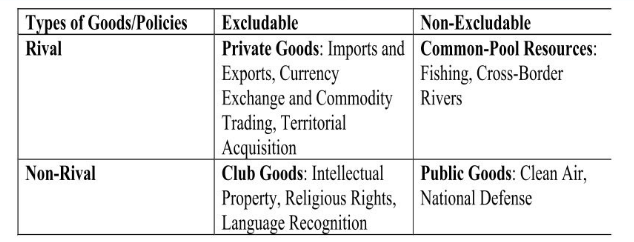
Non-excludable: one person’s access does not diminish another’s access
Non-rival: one person’s use does not “use up” the good
Four types of goods
Rival and excludable: private goods (imports/exports, currency, and territory)
Rival and non-excludable: common pool resources (fishing and rivers)
Non-rival and excludable: club goods (IP, religious rights)
Non-rival and non-excludable: public goods (clean air and water, national defense)
How do you achieve pareto efficiency in IR crises?
Where one party is better off and no party is worse off, organizations use strategies:
Coordination and coercion: threats/punishment to force agreement for rivals
Distribution and transfers: providing subsidies or foreign aid to reward positive actions
Monitoring and reporting: utilizing inspectors or reporting agencies to reveal cheating
Education and altruism: encouraging participation through non-material incentives
What are the competing theoretical explanations of why states might/might not comply with foreign aid?
Constructivism (violations infrequent): suggests that international law creates norms of conduct that eventually alter a governments perception of its own interests. Rhetorical support leads to behavioral change when leaders face intl. pressure to abide by agreed upon norms. (Finding: very little shift in global human rights that can be attributed to norms/treaties)
Liberalism (violations infrequent): posits that intl. law promotes shared values and cooperation, often where a hegemonic power protects these values. Like constructivism, it hypothesizes that signing treaties increases compliance and that departures from the law are rare.
Realism (frequent violations): views intl. law as a codification of the national interests of other states. Violations expected if those interests become incompatible with the law. Realists argue that treaties reflect short-term interests.
Selectorate variant: contends the rights are “public goods”, which are better provided if the W is larger (women’s rights and torture have a strong correlation with W size)
What is the global solutions paradox?
The premise that global warming requires global solutions leads to several systemic issues in IR:
Shallow agreements: treaties often lack depth to ensure broad participation
Lack of enforcement: strong agreements frequently lack enforcement mechanisms
Free-riding: nations benefitting from emission reductions of others without bearing the cost (comparing the cost to the net-benefit is negligible)
What are the primary findings of the political economy of trade?
Power of comparative advantage: trade is beneficial when countries specialize in goods where they have relative efficiency (comparative advantage ), regardless of whether one country is more efficient in all production
The size of W is a critical predicator of trade policy. Govts with large W favor free trade while govts with small W use protectionism to reward loyalists
Impact of protectionism: tariffs and trade restrictions generally raise costs for consumers, reduce supply, and stifle growth. Empirically, protectionism is strongly correlated with higher income inequality
Factor abundance and mobility: trade patterns are driven by countries abundant factors (capital in right countries and labor in poor countries). The mobility of these factors determines whether political conflict over trade is class-based or industry-based
What are the two primary types of economic advantage that drive trade?
Absolute advantage: capacity to produce a good or service at a lower cost than anyone else
Comparative advantage: the relative efficiency of production. This is determines using opportunity costs, the relative efficiency with which resources are employed such that one country is better at producing one specific good compared to the other
What is the Heckscher-Onlin theorem?
Explains trade patterns based on factor abundance
Rich countries possess abundant capital-intensive products (ex. cars) while poor countries are abundant in labor-intensive products (ex. clothes)
Countries are more efficient when using their abundant factors and import products for their scarce factors
What is the Stoper-Samuelson theory?
Focuses on class-based conflict, theory applies when labor and capital are freely mobile. Trend is that capital and labor move to where they receive the highest return.
Outcomes: in rich countries the wealthy get richer faster than the poor. In poor countries the poor get richer faster than the rich
Political choice: restrictions on immigration, emigration, and foreign investments are political interventions designed to protect inefficient domestic workers or business owners by limiting mobility
What is the Ricardo-Viner model?
Industry-based conflict where the model applies when one factor of production is immobile (ex. a car plant that cant be moved)
The conflict is warfare over trade that is industry based, not the class based
Support for protection: both labor and capital within a specific industry facing import competition will lobby the government for tariffs
Opposite to protection: export-orientation industries and those owning mobile factors generally oppose protectionism
What are the different kind of currency systems?
Float system: free market supply and demand determines value which encourages indirect manipulation (ex. printing money) to favor exports
Fixed exchange rate: predetermined quantity against another currency which means it doesn’t respond to market shifts and can invite inflation from over-printing
Pegged systems: tied to the fluctuating value of another countries money, making it vulnerable to the economic conditions (recession/inflation) of the tying country
Dolarized systems: using the U.S. dollar as local currency, making it vulnerable to dollar fluctuations and signals lack of confidence in home government
Non-convertible system: currency cannot be sold for another currency which encourages black markets, discourages investment, and hinders emigration