Ch. 21 - Lymphatic System & Immunity (Most Likely)
 Call Kai
 Learn
Learn Practice Test
 Spaced Repetition
 Match
Match Flashcards
 Knowt Play
1/306

There's no tags or description
Looks like no tags are added yet.
Name | Mastery | Learn | Test | Matching | Spaced | Call with Kai | Chat |
|---|
No analytics yet
Send a link to your students to track their progress
307 Terms
Which of the following cells produce antibodies?
A. Mast cells
B. Monocytes
C. Plasma cells
D. Neutrophils
C. Plasma cells
Which of the following organs lack(s) lymphocytes?
A. Spleen
B. Thymus gland
C. Lymph nodes
D. Brain
D. Brain
The largest collection of lymphatic tissue in the adult body is located in which of the following organs?
A. Spleen
B. Tonsils
C. Thymus
D. Liver
A. Spleen
Peyer's patches are found in the:
A. Red pulp of the spleen
B. Lining of the small intestine
C. Lobules of the thymus
D. Tonsils
C. Lobules of the thymus
Which of the following is the primary function on the lymphatic system?
A. Production, maintenance, and distribution of plasma proteins
B. Production, maintenance, and distribution of lymphocytes
C. Transportation of hormones
D. Circulation of nutrients
B. Production, maintenance, and distribution of lymphocytes
Which of the following are responsible for cellular immunity?
A. Plasma cells
B. Suppressor T cells
C. Cytotoxic T cells
D. Macrophages
C. Cytotoxic T cells
Immunoglobulins that attach to mast cells and basophils and are involved in allergic reactions are abbreviated as which of the following?
A. IgE
B. IgG
C. IgM
D. IgA
A. IgE
T lymphocytes must mature in which of the following organs before they can stimulate B lymphocytes?
A. Bones
B. Liver
C. Thymus
D. Spleen
C. Thymus
Which of the following statements is true about autoantibodies?
A. They are important in tissue rejection reactions
B. They function against the body's normal antigens
C. They are produced by phagocytes
D. They are produced during an allergic reaction
B. They function against the body's normal antigens
Portions of the spleen that contain the largest numbers of lymphocytes are known as:
A. Red pulp
B. White pulp
C. Adenoids
D. Lymph nodes
B. White pulp
During a primary immune response, which of the following immunoglobulins first appears in the lymph?
A. IgG
B. IgA
C. IgM
D. IgE
C. IgM
Which type of immunoglobulin is composed of five single molecules found together?
A. IgG
B. IgD
C. IgM
D. IgA
D. IgA
Lacteals are special lymphatic capillaries located in which of the following organs?
A. Right lymphatic duct
B. Hilum of the spleen
C. Lymph nodes
D. Small intestine
B. Hilum of the spleen
Which of the following is the first line of cellular defense against pathogens?
A. Plasma cells
B. Lymphocytes
C. Phagocytes
D. Mast cells
D. Mast cells
Which of the following is not a physical barrier to infection?
A. Basement membranes
B. Epithelium
C. Body hair
D. Complement
C. Body hair
Most of the lymph returns to the venous circulation by which way of the following?
A. Dural sinus
B. Right lymphatic duct
C. Thoracic duct
D. Hepatic portal vein
E. Cisterna chyli
C. Thoracic duct
Which of the following cells help to regulate the immune response?
A. Plasma cells
B. Cytotoxic cells
C. Helper T cells
D. NK cells
E. B cells
C. Helper T cells
Which of the following is a function for lymphocytes?
A. Are actively phagocytic
B. Produce proteins called antibodies
C. Decrease in number during viral infections
D. Are primarily found in the red bone marrow
B. Produce proteins called antibodies
Which of the following releases antibodies?
A. T cells
B. Reticular cells
C. NK cells
D. Dendritic cells
E. B cells
E. B cells
Which of the following structures drains lymph from the right side of the head and thorax?
A. Collecting duct
B. Lumbar trunk
C. Thoracic duct
D. Right lymphatic duct
E. Cisterna chyli
D. Right lymphatic duct
Which of the following areas of the spleen contains large numbers of lymphoid nodules?
A. Lymph nodes
B. Adenoids
C. Peyer's patches
D. Red pulp
E. White pulp
E. White pulp
Which of the following cells produce antibodies?
A. Cytotoxic T cells
B. Helper T cells
C. Plasma cells
D. Natural killer cells
E. Suppressor T cells
C. Plasma cells
Which of the following cells are responsible for humoral immunity?
A. Suppressor T cells
B. Cytotoxic T cells
C. Helper T cells
D. NK cells
E. B cells
E. B cells
Lymph leaves a lymph node via:
A. the cortical sinus.
B. the white pulp.
C. afferent lymphatic vessels.
D. efferent lymphatic vessels.
E. the subcapsular sinus.
D. efferent lymphatic vessels.
Cancer cells can be destroyed before activation of adaptive immunity by:
A. B lymphocytes.
B. T lymphocytes.
C. agglutination.
D. natural killer cells.
E. pinocytosis.
D. efferent lymphatic vessels.
Inflammation produces all of these cardinal signs, except:
A. redness.
B. tissue death.
C. swelling.
D. pain.
E. heat.
B. tissue death.
Which of the following dominate in the cortex of a lymph node?
A. Plasma cells
B. NK cells
C. T cells
D. B cells
E. Basophils
C. T cells
Lymph enters a lymph node through the ______ vessel and exits it via the ______ vessel.
afferent; efferent
Microscopic vessels extending into interstitial spaces in complex networks are called lymphatic ______ .
capillaries
Cytotoxic T cells continually recognize and eliminate ______ cells and virally infected cells.
tumor
Defense of the body against a particular microorganism is provided by _____ immunity.
specific
Fluid inside the lymphatic capillaries:
lymph
Special lymphatic capillary of the small intestine:
lacteal
Hormone-like peptide that binds to uninfected cells to act as a protective antiviral:
interferon
A reaction between the antigen-antibody complex:
opsonization
Aggregated lymphoid nodules in the wall of the small intestine:
peyer's patches
The basic internal structural framework of an organ:
stroma
Ability of the immune system to mobilize and deploy its antibodies due to stimulation by an antigen:
immunocompetent
Severe localized swelling of lymphatic vessels:
lymphedema
A chronic or excessive enlargement of lymph nodes:
lymphadenopathy
An inflammation of lymphatic nodules of the pharynx:
tonsillitis
An inflammation of lymphatic vessels:
lymphangitis
What is the major difference between lymph and interstitial fluid?
A. Composition of electrolytes
B. White blood cells are present in lymph
C. Location
D. Types of proteins present
E. Red blood cells are present in interstitial fluid
C. Location
What causes lymph from the small intestines to appear white?
A. Proteins
B. WBC
C. RBC
D. Lipids
E. Fats
D. Lipids
The left subclavian vein receives lymph from*
A. Left axillary vein
B. Lumbar trunk
C. Jugular trunk
D. Thoracic duct
E. Right lymphatic duct
D. Thoracic duct
The skeletal muscle and respiratory pumps are used in
A. Lymphatic system
B. Cardiovascular system
C. Immune system
D. Lymphatic and Immune systems only
E. Lymphatic, Immune and Cardiovascular systems
E. Lymphatic, Immune and Cardiovascular systems
In the thymus, where is it speculated that T cells die.
A. Capsule
B. Trabeculae
C. Epithelial cells
D. Hasall's corpuscles
E. T cells do not die in the thymus
D. Hasall's corpuscles
This portion of the lymph node does not contain any lymphatic nodules.
A. Inner cortex
B. Outer cortex
C. Medulla
D. Sinuses
E. Trabeculae
A. Inner cortex
Which of these does NOT provide a physical or chemical barrier?*
A. Macrophages
B. Saliva
C. Urine
D. Mucus
E. Stratified squamous epithelium
A. Macrophages
These are mainly used to kill infectious microbes and tumor cells.
A. Natural killer cells
B. Perforins
C. Platelets
D. Mucus
E. Antimicrobial proteins
A. Natural killer cells
Which of the following is NOT a sign of inflammation?
A. Redness
B. Pain
C. Heat
D. Mucus production
E. Swelling
D. Mucus production
Which of the below do NOT induce vasodilation and permeability (increased fluid flow) to an infection site.
A. Histamines
B. Kinins
C. Perforin
D. Leukotrienes
E. Complement
C. Perforin
This can only stimulate an immune response if attached to a large carrier molecule.
A. Epitope
B. Antigen
C. Hapten
D. MHC
E. CD8
C. Hapten
Which of the following is responsible for diversity in the immune system?
A. Antigen receptors
B. MHC
C. Hapten
D. MHC and antigen receptors
E. Epitopes
D. MHC and antigen receptors
This class of cells includes macrophages, B cells and dendritic cells.
A. Antigen presenting cells
B. Primary lymphocytes
C. T cells
D. RBC
E. Epitope cells
A. Antigen presenting cells
This can only become activated when bound to a foreign antigen and simultaneously receiving a co-stimulate.
A. B Cell
B. T Cell
C. Interferon
D. MHC
E. Antigen presenting cell
A. B Cell
These display CD 4 in their membrane and are associated with MHC class II molecules.
A. Cytotoxic T cells
B. Helper T Cells
C. Memory T Cells
D. MHC
E. B cells
B. Helper T Cells
T Cells secrete this toxin that is used to fragment DNA.
A. Perforin
B. Tumor antigen
C. Interferons
D. Lymphotoxin
E. Toxin T
D. Lymphotoxin
This will lead to inflammation, enhancement of phagocytosis and bursting of microbes.
A. Classical complement system
B. Alternative complement system
C. Apoptosis
D. Classical and Alternative complement systems
E. Hapten activation
D. Classical and Alternative complement systems
This action makes microbes more susceptible to phagocytosis.
A. Opsonization
B. Cytolysis
C. Inflammation
D. Complement
E. Hybridoma
A. Opsonization
This is a self-responsive cell that is inactive.
A. Deleted cell
B. Hybridoma cell
C. Epitopic cell
D. Anergy cell
E. Natural killer cell
D. Anergy cell
This is characterized by the inability of the immune system to protect the body from a pathogen.
A. Immunodeficiency diseases
B. Allergy
C. Autoimmune disease
D. Transplantations
E. Transplantations
A. Immunodeficiency diseases
An acute allergic response can lead to:
A. Transplantation
B. Retroviruses
C. Anaphylactic shock
D. Passive immunity
E. Active immunity
C. Anaphylactic shock
This class of antibodies is produced after an initial exposure to antigens.
A. IgA
B. IgE
C. IgM
D. IgD
E. IgG
C. IgM
Of the following which is considered the body's second major defense.
A. Mucous cells
B. Germ cells
C. Lymphocytes
D. Natural killer cells
E. None of the above
C. Lymphocytes
Lymphocytes can recognize
A. Self cells
B. Foreign cells
C. B cells
D. T cells
E. Natural killer cells
B. Foreign cells
In B cell receptors, the light/heavy variable regions are located
A. Transmembrane region
B. Tips of the molecules
C. There is no variable region on a B cell receptor
D. Depends on the type of B cell
E. There are only constant regions
B. Tips of the molecules
What is the most polymorphic molecule in the immune system?
A. Lymphocytes
B. Monocytes
C. MHC
D. WBC
E. RBC
C. MHC
The primary response will peak how many days after an exposure?
A. 1 day or less
B. 2-7
C. 10-17
D. 20-30
E. Over a month
C. 10-17
Which type of immunity defends against any type of invader?
A. Nonspecific
B. Specific
C. Cell mediated
D. Antibody mediated immunity
E. None of the above
A. Nonspecific
This is the ability of an antigen to react specifically with the antibodies or cells it has provoked.
A. Specificity
B. Immunogenicity
C. Reactivity
D. Epitopes
E. Immune Response
C. Reactivity
Which of the following is NOT a function of the lymphatic and immune system?*
a) Draining excess interstitial fluid
b) Maintaining water homeostasis in the body
c) Transporting dietary lipids
d) Carrying out immune responses
e) All of these are functions of the lymphatic and immune system
b) Maintaining water homeostasis in the body
Lymphatic capillaries, because of their greater permeability than blood capillaries, can readily absorb which molecules that are NOT easily absorbed by blood capillaries? Select all that apply.
a) proteins
b) lipids
c) interstitial fluid
d) carbohydrates
a, b
Which anti-microbial substances reduce viral replication in uninfected cells?
a) Transferrins
b) Perforins
c) Complement proteins
d) Defensins
e) Interferons
e) Interferons
Which of these chemicals do NOT induce vasodilation, increased permeability, and increased fluid flow to an infection site?
a) Histamines
b) Kinins
c) Perforin
d) Leukotrienes
e) Complement proteins
c) Perforin
Which of the following induces the production of a specific antibody?
a) Phagocytosis
b) Antigen
c) Antibody
d) Defensin
e) Immunoglobulin
b) Antigen
Which class of cells includes macrophages, B cells and dendritic cells?
a) Antigen presenting cells
b) Primary lymphocytes
c) Plasma cells
d) Memory cells
e) Helper cells
a) Antigen presenting cells
Which complement system action makes microbes more susceptible to phagocytosis?
a) Opsonization
b) Cytolysis
c) Inflammation
d) Neutralization
e) Cascade activation
a) Opsonization
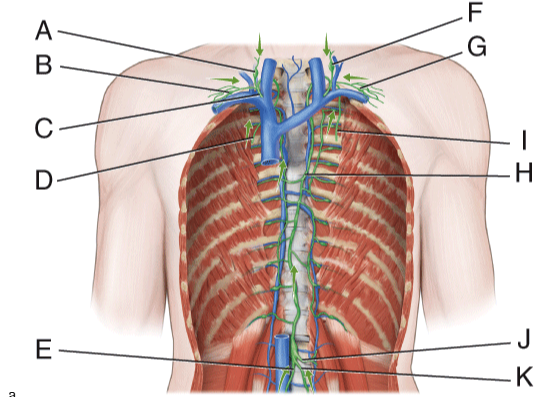
In the diagram which vessel drains lymph from the upper right side of the body into venous blood at the right subclavian vein.
a) B
b) C
c) F
d) G
e) E
b) C
—
B (Right subclavian trunk)
C (Right lymphatic duct)
F (Left jugular trunk)
G (Left subclavian trunk)
E (Right lumbar trunk)
A (Right jugular trunk)
D (Right broncho mediastinal trunk)
H (Thoracic duct)
I (Left broncho mediastinal trunk)
J (Left lumbar trunk)
K (Intestinal trunk)
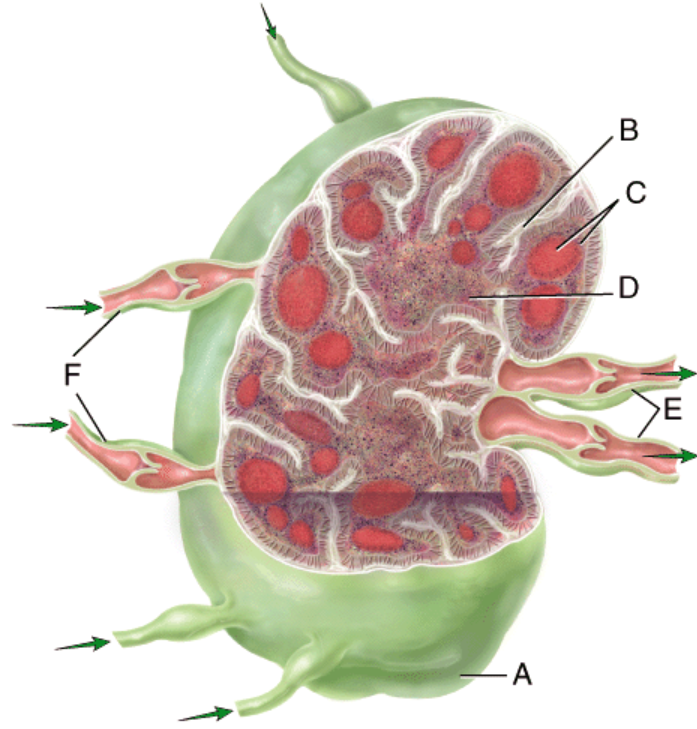
In the diagram, which region would include B cells, plasma cells and macrophages?
a) B
b) C
c) D
d) E
e) None of these choices
c) D
—
A (Capsule)
B (Trabecula)
C (Lymphatic nodule)
D (Medulla)
E (Efferent lymphatic vessels)
F (Afferent lymphatic vessel)
Which class of antibodies in the blood and lymph indicates a recent invasion?
a) IgA
b) IgE
c) IgM
d) IgD
e) IgG
c) IgM
Which of the following cells is part of the body's second line of defense?
a) Mucous cells
b) Dendritic cells
c) B and T Lymphocytes
d) Natural killer cells
e) None of these choices
d) Natural killer cells
The ability of an antigen to react specifically with the antibodies or cells it has provoked is called
a) Specificity
b) Immunogenicity
c) Reactivity
d) Antigen processing
e) Antigen presentation
c) Reactivity
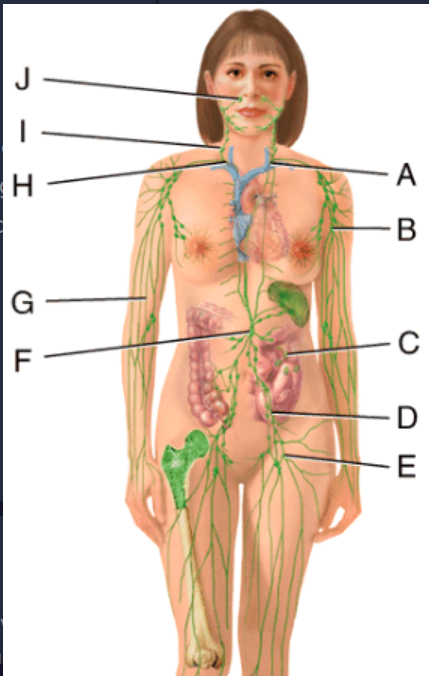
Which structure in the figure is the right lymphatic duct?
a) D
b) C
c) F
d) H
e) A
d) H
—
A (Thoracic duct)
B (Axillary node)
C (Aggregated lymphatic nodule)
D (Iliac node)
E (Inguinal node)
F (Cisterna chyli)
G (Lymphatic vessel)
H (Right lymphatic duct)*
I (Cervical node)
J (Palatine Tonsil)
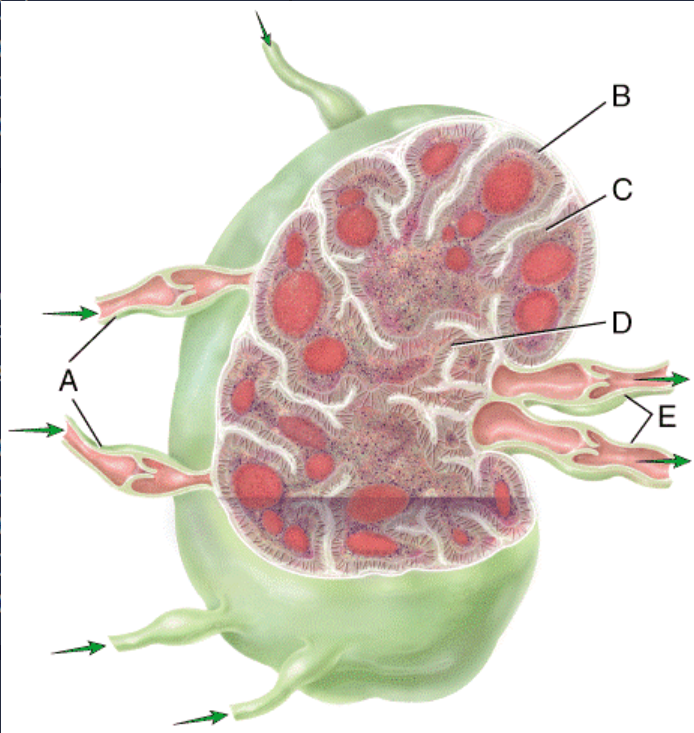
In the figure, B, C & D are identifying which component of the lymph node?
a) sinuses
b) stroma
c) capsule
d) parenchyma
e) valves
a) sinuses
—
A (Afferent lymphatic vessel)
B (Subcapsular sinus)
C (Trabecular sinus)
D (Medullary sinus)
E (Efferent lymphatic vessels)
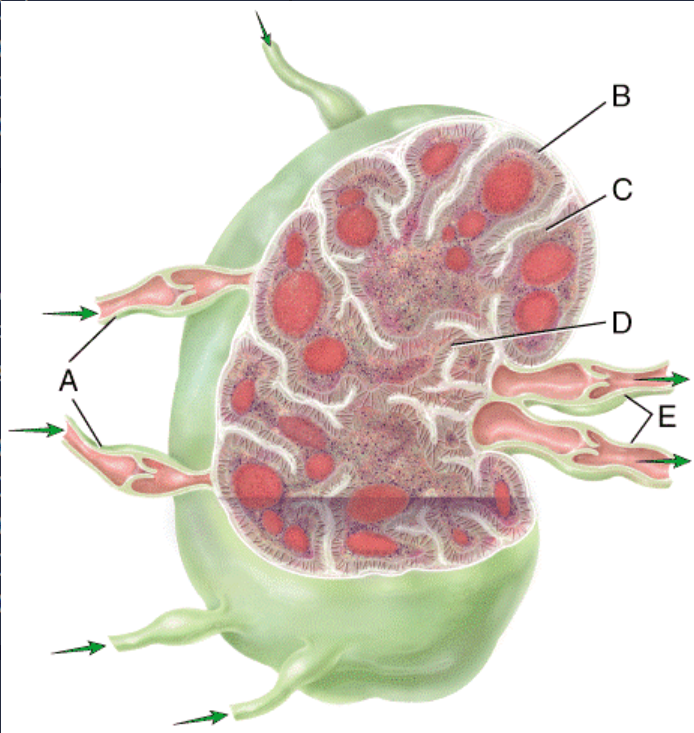
What type of cell is located in area B in the figure?
a) B cells
b) dendritic cells
c) macrophages
d) T cells
e) plasma cells
a) B cells
—
A (Afferent lymphatic vessel)
B (Subcapsular sinus)
C (Trabecular sinus)
D (Medullary sinus)
E (Efferent lymphatic vessels)
Antigens that induce an allergic reaction are called
a) lymphotoxins
b) perforins
c) granulysins
d) cytokines
e) allergens
e) allergens
Which of the following is NOT an effect of aging on the immune system?
a) Increased susceptibility to infections
b) Increased susceptibility to malignancies
c) Decreased response to vaccines
d) Increased response of T cells to antigens
e) Decreased production of antibodies
d) Increased response of T cells to antigens
Which of the following organ systems is NOT aided by the MALT (mucosa-associated lymphatic tissue)?
a) Respiratory system
b) Digestive system
c) Muscular system
d) Urinary system
e) Reproductive system
c) Muscular system
Which of the following is an INCORRECT matching of immune system cells and their functions?
a) Macrophage - process and presentation of foreign antigens to T cells
b) Dendritic cell - processes and presents antigen to T and B cells
c) B cells - process and presents antigen to helper T cells
d) Plasma cell - produces and secretes antibodies
e) All of these are correct matching of the cells and their functions
e) All of these are correct matching of the cells and their functions
A tonsillectomy may be recommended when the patient has suffered with which of the following symptoms for more than three months despite treatment? Select all that apply.
a) obstructed air pathways
b) difficulty swallowing
c) difficulty talking
d) change in taste
a,b,c
Which of the following cells exists in the greatest variety in the immune system?
Lymphocyte
Which chemical released by cytotoxic T cells fragments DNA?
Lymphotoxin
which portion of the lymph node does not contain any lymphatic nodules?
a. inner cortex
b. outer cortex
A. Inner cortex
which class of cells includes macrophages, B cells, and dendritic cells?
a. antigen presenting cells
b. primary lymphocytes
c. t cells
d. rbc
e. epitopes
A. antigen presenting cells
which class of antibodies is mainly found in sweat, tears, breast milk, and GI secretions?
a. IgG
b. IgA
c. IgM
d. IgD
e. IgE
B. IgA
which leads to inflammation, enhancement of phagocytosis, and lysis of microbes?
a. classical complement system
b. alternative complement system
c. apoptosis
d. classical and alternative complement systems
e. Hapten activation
d. classical and alternative complement systems
which is an inactive, self responsive cell?
a. deleted cell
b. hybridoma cell
c. epitaphic cell
d. anergy cell
e. natural killer cell
D. anergy cell
Which class of antibodies indicates a recent invasion?
a. IgA
b. IgE
c. IgM
d. IgD
e. IgG
C. IgM
which cell is considered to be the most important cell in the immune system?
a. cytotoxic T cells
b. B lymphocytes
c. T Helper cells
d. Eosinophils
e. macrophages
C. T Helper cells