ELECTRICITY AND MAGNETISM
 Call Kai
 Learn
Learn Practice Test
 Spaced Repetition
 Match
Match Flashcards
 Knowt Play
1/29

There's no tags or description
Looks like no tags are added yet.
Name | Mastery | Learn | Test | Matching | Spaced | Call with Kai | Chat |
|---|
No analytics yet
Send a link to your students to track their progress
30 Terms
Magnetic flux can always be attributed to:
A. Ferromagnetic materials
B. Aligned atoms
C. Motion of charged particles
D. The geomagnetic field
C
Movement of charges (current) produces magnetic field
Which of the following statements is true?
A. Unlike charges repel each other.
B. Like charges repel each other.
C. Unlike charges attract each other.
D. Both B and C.
D
A changing magnetic field:
A. Produces an electric current in an insulator.
B. Magnetizes the earth.
C. Produces a fluctuating electric field.
D. Results from a steady electric current.
C
Explanation:
A - no current flow in insulator
B - earth’s magnetic field is produced by motion of molten iron in outer core
D - steady current or DC produces stable magnetic field

For the current carrying conductor lying in the magnetic field shown in the figure below, the direction of the force on the conductor is:
A. downwards
B. to the right
C. upwards
D. to the left
A
Explanation: (Fleming’s Left Hand Rule)
First finger (current) - north to south
Second finger (field) - “dot” means out of the page, “x” means into the page
Thumb (force) - downward
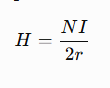
Which is the wrong statement? The magnetizing force at the center of a circular coil varies
A. directly as the number of its turns
B. directly as the current
C. directly as its radius
D. inversely as its radius
C
Explanation: Look at the formula
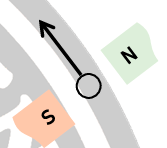
Two bar magnets are placed parallel to each other and about 2 cm apart, such that the south pole of one magnet is adjacent to the north pole of the other. With this arrangement, the magnets will:
A. attract each other
B. have no effect on each other
C. repel each other
D. lose their magnetism
A
If a neutral atom loses one of its valence electrons, it becomes a (n)
A. negative ion.
B. electrically charged atom.
C. positive ion.
D. Both B and C.
D
Explanation: losing valence electron, it surely will become a charged particle since there is an imbalance in charges. it is now a positive ion since it lost negative charge.
For the current-carrying conductor lying in the magnetic field shown in the figure below, the direction of the current in the conductor is:
A. towards the viewer
B. away from the viewer
C. upwards
D. downwards
B
Explanation: Use fleming’s left hand rule
The most basic particle of negative charge is the ____.
A. coulomb
B. proton
C. electron
D. neutron
C
Aluminum, with an atomic number of 13, has
A. 13 valence electrons.
B. 3 valence electrons.
C. 13 protons in its nucleus.
D. Both B and C.
D
Explanation:
B - use the formula 2n²
C - atomic number = no. of protons
The nucleus of an atom is made up of
A. electrons and neutrons.
B. ions.
C. neutrons and protons.
D. electrons only.
C
One ampere of current corresponds to
A. 1 C/1 s
B. 1 J/1 C
C. 6.25 X 10^18 electrons
D. 0.16 x 10^-18 C/s
A
Explanation:
A - current = coulomb/s (Q/t)
B - voltage = joule/coulomb
C - elementary charge: 1C = 6.25 × 10^18 electrons
Conventional current is considered
A. the motion of negative charges in the opposition direction of electron flow.
B. the motion of positive charges in the same direction as electron flow.
C. the motion of positive charges in the opposition direction of electron flow.
D. None of the above.
C
Explanation
A - negative charges don’t flow opposite with electron flow (negative chage = electron)
B - conventional is opposite with electron flow
The coulomb is a unit of
A. electric charge.
B. potential difference.
C. current.
D. voltage.
A
Explanation
B - Volt
C - Ampere
D - Volt
The coulomb is a unit of:
A. Power
B. Voltage
C. Energy
D. Quantity of electricity
D
Explanation
A - Watts
B - Volt
C - Joule
Voltage drop is the:
A. maximum potential
B. difference in potential between 2 points
C. voltage produced by a source
D. voltage at the end of the circuit
B
Which of the following statements is false?
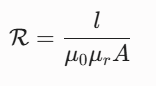
A. For non-magnetic materials reluctance is high
B. Energy loss due to hysteresis is greater for harder magnetic materials
C. The remanence of a ferrous material is measured in ampere/meter
D. Absolute permeability is measured in henrys per meter
C
Explanation
A - reluctance is opposition to magnetic flux
B - lots of energy wasted since hard magnetic materials want to stay magnetized
D - unit of absolute permability is H/m
The effect on an air gap in a magnetic circuit is to:
A. increase the reluctance
B. reduce the flux density
C. divide the flux
D. reduce the magnetomotive force
A
Explanation: in air gap, relative permeability is 1, so it decreases denominator
If a conductor is horizontal, the current flowing from left to right and the direction of the surrounding magnetic field is from above to below, the force exerted on the conductor is:
A. from left to right
B. from below to above
C. away from the viewer
D. towards the viewer
C
Explanation: use left hand rule
Electromotive force is provided by:
A. resistance’s
B. a conducting path
C. an electric current
D. an electrical supply source
D
The most basic particle of positive charge is the _____.
A. coulomb
B. proton
C. electron
D. neutron
B
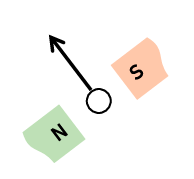
For the current-carrying conductor lying in the magnetic field shown in the figure below, the direction of the current in the conductor is:
A. towards the viewer
B. away from the viewer
C. upwards
D. downwards
A
Explanation: Use left hand rule
The magnetic field due to a current carrying conductor takes form of:
A. rectangles
B. concentric circles
C. wavy lines
D. straight lines radiating outwards
B
The atomic number of an element is determined by:
A. The number of neutrons.
B. The number of protons
C. The number of neutrons plus number of protons
D. The number of electrons
B
An ion:
A. Is electrically neutral.
B. Has positive electric charge.
C. Has negative electric charge.
D. Might have either a positive or negative charge.
D
Explanation: an ion is an atom that has gained or lost one or more electrons giving net electric charge
Cation (positive ion) - lost electron
Anion (negative ion) - gained electron
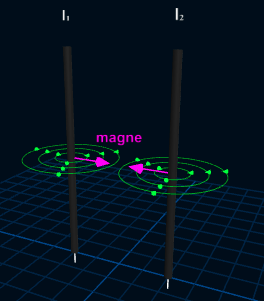
There is a force of attraction between two current-carrying conductors when the current in them is:
A. in opposite direction
B. in the same direction
C. of different magnitude
D. of the same magnitude
B
Explanation:
A coulomb is:
A. Represents a current of one ampere.
B. Flows through a 100-watt light bulb.
C. Is one ampere per second.
D. Is an extremely large number of charge carriers.
D
Explanation
A & C - Ampere is coulomb per second
B - irrelevant
D - 1 coulomb = 6.24×10^18 electrons
Which of the following units can represent magnetic flux density?
A. The volt-turn.
B. The ampere-turn.
C. The gauss.
D. The gauss-turn.
C
Explanation:
B - mmf (ampere-turn or gilbert)
C - magnetic field density (tesla or gauss)
A ferromagnetic material:
A. Concentrates magnetic flux lines within itself.
B. Increases the total magnetomotive force around a current-carrying wire.
C. Causes an increase in the current in a wire.
D. Increases the number of ampere turns in a wire.
A
Explanation:
B & D - mmf / ampere-turns does not depend on material
C - introducing ferromagnetic material increases resistance in AC and no effect on current in DC