ultrasound quiz 2
 Call Kai
 Learn
Learn Practice Test
 Spaced Repetition
 Match
Match Flashcards
 Knowt Play
1/25

There's no tags or description
Looks like no tags are added yet.
Name | Mastery | Learn | Test | Matching | Spaced | Call with Kai | Chat |
|---|
No analytics yet
Send a link to your students to track their progress
26 Terms
Anastomosis
A connection made surgically between adjacent blood vessels, parts of the intestine, or other channels of the body, or the operation in which this is constructed
Amnioncity
The number of amniotic (inner) membranes that surround fetuses in multiple pregnancy (determine if it’s low or high risk pregnancy)
Dizygotic twins
Independent fertilization. Fraternal twins. Two ova.
Monozygotic
Identical twins. One ovum that separates into two.
Bifurcation
The splitting of a vessel into two
Crown rump length
The measurement of the fetus from crown to rump, 1st trimester.
Cut de sac
A blind pouch or cavity that is closed at one end(posterior). Used specifically to the rectouterine (pouch or Douglas), most dependent
Hyperemia
Increased blood flow to an organ or structure
Hypertrophy
The increase in the size of an organ or tissue due to the enlargement of its cells. excessive growth.
Lymphadenopathy
Refers to the swelling of lymph nodes which can be secondary to bacterial, viral, or fungal infections, autoimmune disease, and malignancy.

Which is a normal lymph node
A
Murphy sign
Medical maneuver used to help differentiate pain in the upper right quadrant of the abdomen during a physical exam.
Torsion
Twisting
Valsalva maneuver
Breathing technique that can help diagnose abdominal hernias, including inguinal hernias. Increases intra abdominal which makes the hernia sac more visible by causing it to enlarge and protrude
Patient prep: ABD
Fasting 8 hours prior
Patient prep: ABD soft tissue
No prep
Patient prep: pelvis
4 × 8oz water, 1 hour prior
Patient prep: limited pelvis
EV only, no prep
Patient prep: renal
4 × 8oz water, 1 hour prior
No prep necessary:
Thyroid, upper and lower extremities, lumps, bumps, carotid, scrotum

What is A?
Kidney
4 organs included in the abdominal protocol:
Gallbladder, pancreas, kidneys and spleen

Depth
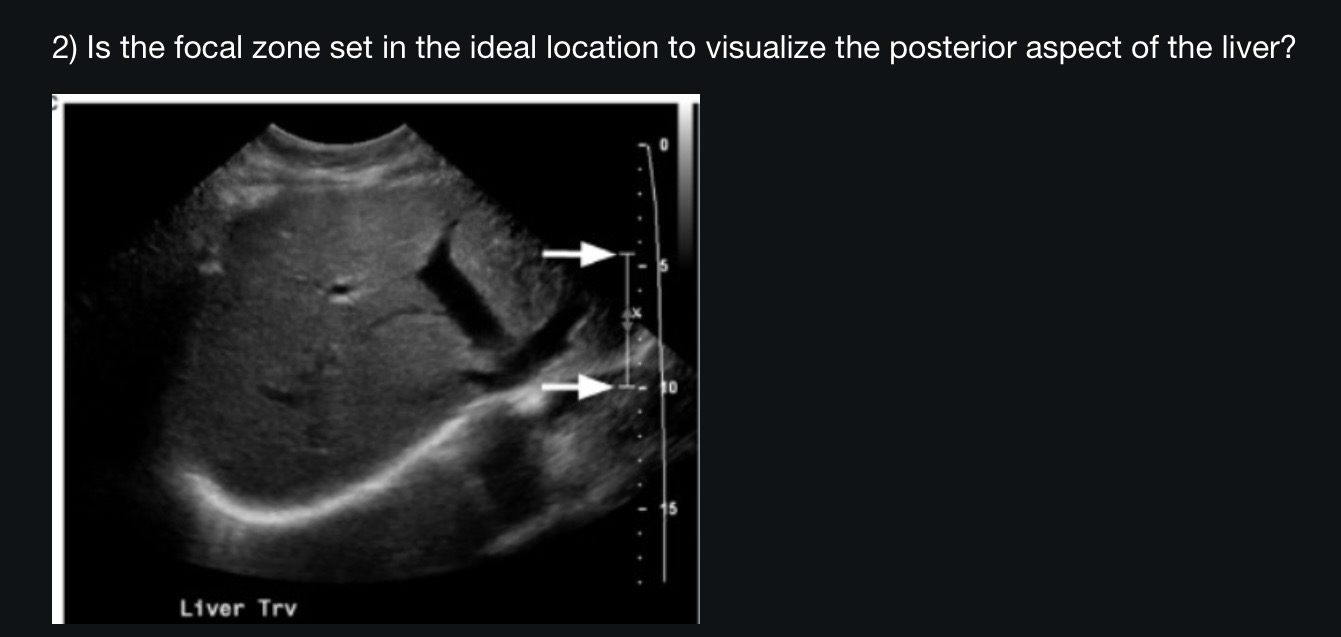
Focal point should be lower
Fallopian tubes
Rarely visible unless something is wrong