Distribution PK
0.0(0)
Studied by 1 person Call Kai
 Learn
Learn Practice Test
 Spaced Repetition
 Match
Match Flashcards
 Knowt Play
Card Sorting
1/32

Earn XP
Description and Tags
Last updated 5:51 PM on 11/27/22
Name | Mastery | Learn | Test | Matching | Spaced | Call with Kai |
|---|
No analytics yet
Send a link to your students to track their progress
33 Terms
1
New cards
Comment on the protein drugs volume of distribution?
V very close to plasma volume
2
New cards
Comment on the basic vs acidic drugs volume of distribution.
Basic drugs have a larger V than acidic drug.
3
New cards
What can we infer from large V values?
The drug is largely distributed to the tissue
4
New cards
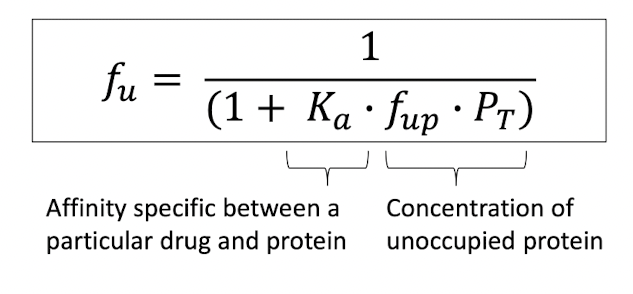
What are the factors that affect plasma protein binding?
1. Concentration of total protein (Pt)
Alteration due to disease ( decrease in albumin in cirrhosis)
Increase in a-AGP can reduce P
Alteration due to DDI (more drug to compete for protein)
2. Ka
Affinity of a drug to a protein
Alteration due to genetics (changing structures of albumin a-AGP)
Alteration due to dissease induced modification of a-AGP
Alteration due to disease ( decrease in albumin in cirrhosis)
Increase in a-AGP can reduce P
Alteration due to DDI (more drug to compete for protein)
2. Ka
Affinity of a drug to a protein
Alteration due to genetics (changing structures of albumin a-AGP)
Alteration due to dissease induced modification of a-AGP
5
New cards
Why do we measure C instead of Cu when we are doing clinical test?
Since fu is relatively stable and constant, C alone is enough to be a surrogate for calculating Cu
6
New cards
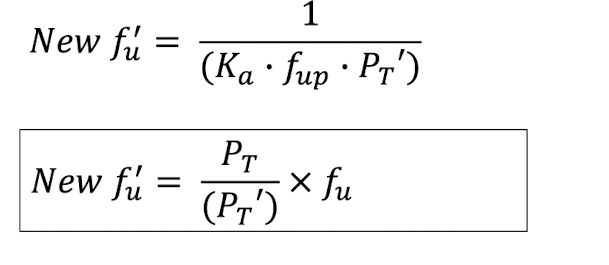
How do we calculate for the new changed fu'
7
New cards
Dose a change in fu affect any primary parameters?
Yes
It affects CL and V
It affects CL and V
8
New cards
How does the change in fu affect V?
For drugs with large V (tend to go in the tissue)
changes in fu causes proportionate change in V
For drugs with smaller V (tend to go in the plasma)
changes in fu result in minimal change in V
changes in fu causes proportionate change in V
For drugs with smaller V (tend to go in the plasma)
changes in fu result in minimal change in V
9
New cards
when is distribution equilibrium achieved?
Cu = Cut
Kp=Ct/C
net flux of free drug movement is 0
Kp=Ct/C
net flux of free drug movement is 0
10
New cards
What is Kp
it is tissue to plasma equilibrium distribution ratio
it varies from one tissue to another
it varies from one tissue to another
11
New cards
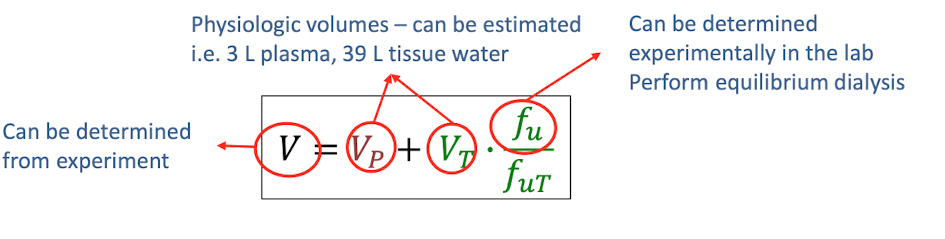
What is the equation of the model Gibaldi and McNamara model?
V=Vp+Vt x (fu/fut)
12
New cards
What are the factors affecting fut (tissue protein binding)?
DDI
other endogenous substance
competing for the tissue protein binding site
other endogenous substance
competing for the tissue protein binding site
13
New cards
What are the factors affecting Vt (volume of tissue)
Physiological
Changes in water:fat ratio from peads to geriatrics
Obese patients (more adipose tissue)
Pathology
liver cirrhosis, ascites, more water in the body
In renal disease (edema, fluid overload)
Change in apparent volume of distribution for very lipophilic or very hydrophilic drug
Changes in water:fat ratio from peads to geriatrics
Obese patients (more adipose tissue)
Pathology
liver cirrhosis, ascites, more water in the body
In renal disease (edema, fluid overload)
Change in apparent volume of distribution for very lipophilic or very hydrophilic drug
14
New cards
What is a two compartment model in distribution?
Assumption:
1) drug distributes instantaneously throughout the central compartment
2) Drugs in tissues of peripheral compartments reaches equilibrium with central compartments after sometime
after sometime, it has reached equilibrium, we can assume that they are one compartment.
1) drug distributes instantaneously throughout the central compartment
2) Drugs in tissues of peripheral compartments reaches equilibrium with central compartments after sometime
after sometime, it has reached equilibrium, we can assume that they are one compartment.
15
New cards
What are the central compartments?
Blood and well -perfused organs
heart
brain
liver
kidney
lungs
heart
brain
liver
kidney
lungs
16
New cards
What are peripheral compartments?
less highly perfused tissues
Muscles
fats
bones
Muscles
fats
bones
17
New cards
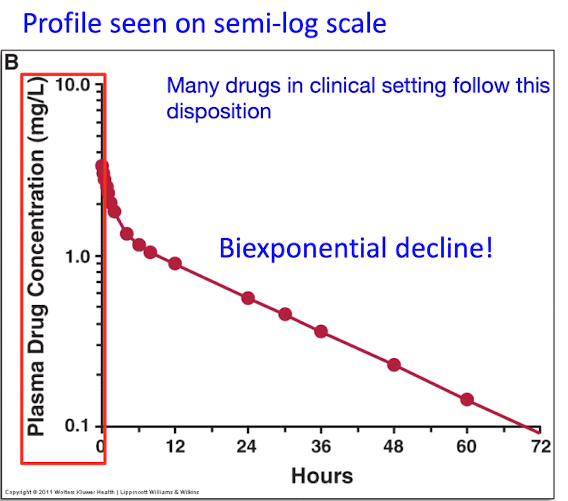
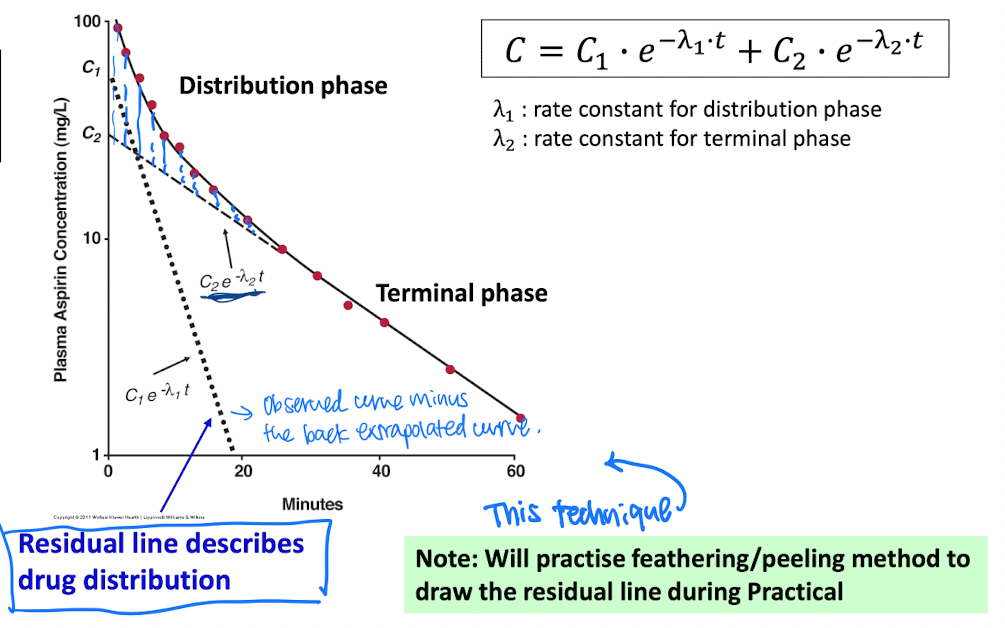
What is the shape of the two compartment model distribution curve?
It is bi-expoenetial
It must be drawn on a semi-log graph
It must be drawn on a semi-log graph
18
New cards
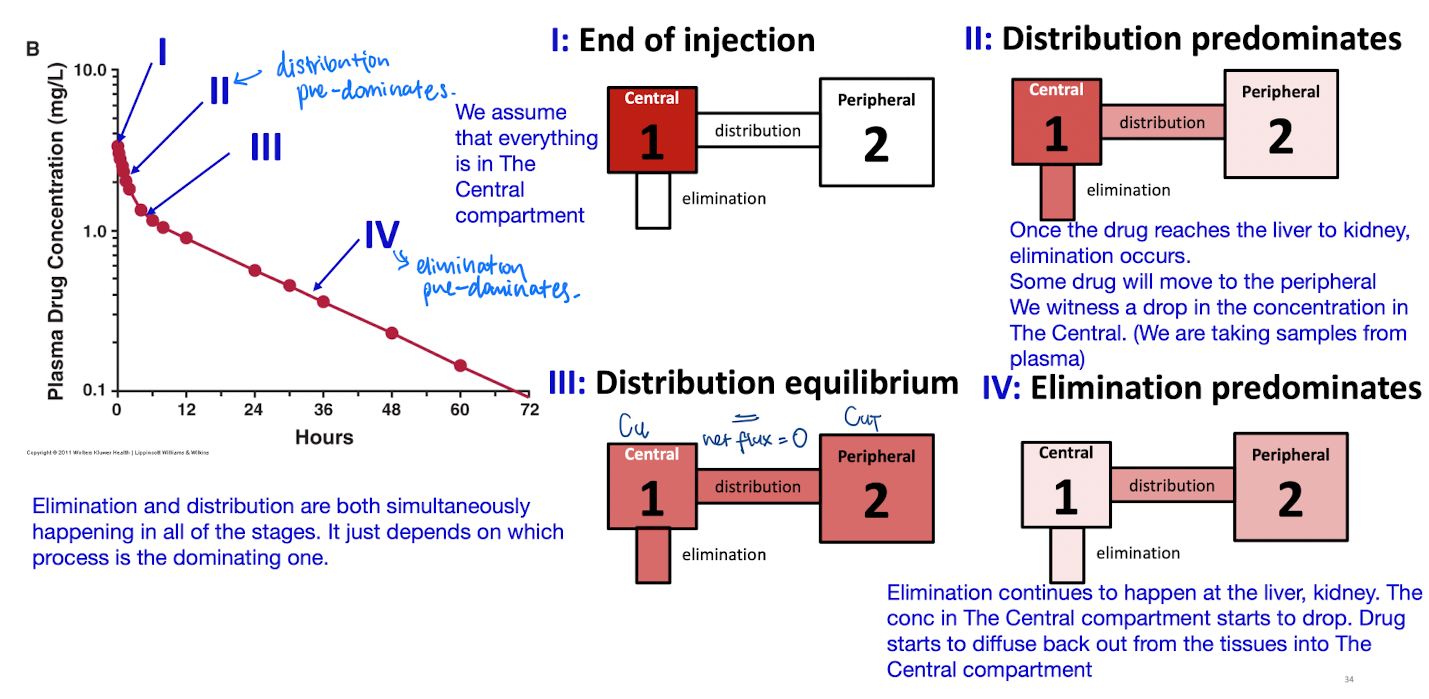
Explain the PK process in the two-compartment model.
I. End of injection (the Co)
II. Distribution predominates (steep decline)
III. distribution equilibrium (Cu=Cut) (point of inflection)
IV. Elimination predominates (almost linear straight line) drug diffuse back from the peripheral to the central compartments to be eliminated
II. Distribution predominates (steep decline)
III. distribution equilibrium (Cu=Cut) (point of inflection)
IV. Elimination predominates (almost linear straight line) drug diffuse back from the peripheral to the central compartments to be eliminated
19
New cards
Where do we take samples from when we are obtaining samples for the two-compartment model?
The Plasma
20
New cards
What is Vss?
it is volume of distribution at steady state (in multiple dosing)
Concentration of drug are equal in the central and peripheral compartment
Cu=Cut
at stage III
Drug input=drug output
total distributional space of the system, the sum of the volume of the central and peripheral compartments
Concentration of drug are equal in the central and peripheral compartment
Cu=Cut
at stage III
Drug input=drug output
total distributional space of the system, the sum of the volume of the central and peripheral compartments
21
New cards
what is Vb?
volume of terminal phase
Concentration is greater in the periphery (drug diffuse back into the central)
Concentration is greater in the periphery (drug diffuse back into the central)
22
New cards
What is Vc / V1 ?
Volume of central compartment
The moment the drug is aminstered. The dose resides in the central compartment
Vc=Dose/C0
The moment the drug is aminstered. The dose resides in the central compartment
Vc=Dose/C0
23
New cards
How is the compartmental models of drugs defined?
It is defined experimetally, you cannot predict them.
Muscl see how many exponential terms there are
Muscl see how many exponential terms there are
24
New cards
Why is it important to collect the samples at correct time?
Sampling time affects the elimination half-life found.
25
New cards
How does the two compartment model describing PK after a single IV bolus dose look like?
26
New cards
What is the C0 in two compartment model describing PK after a single IV bolus graph?
C0= C1 + C2
27
New cards
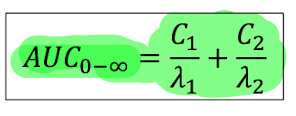
How to calculate for the AUC of two compartment model describing PK after a single IV bolus graph?
28
New cards
What are the factors that affect the rate of distribution of drugs?
1. Perfusion rate-limited distribution mlmin-1g-1
- tissue membrane present no barrier (permeability is ok)
- depends on the blood flow, more blood flow, more vascularity, more distribution
2. Permeation rate-limited distribution
- drugs have challenges permeating a membrane
- drug physicochemical characteristics (pKa, logP, size, degree of ionisation)
Unionised, more lipophilic, more able to permeate
- tissue membrane present no barrier (permeability is ok)
- depends on the blood flow, more blood flow, more vascularity, more distribution
2. Permeation rate-limited distribution
- drugs have challenges permeating a membrane
- drug physicochemical characteristics (pKa, logP, size, degree of ionisation)
Unionised, more lipophilic, more able to permeate
29
New cards
What is kt?
the fraction rate of drug distribution (rate of drug presentation to the tissue or drug leaving the tissue)
30
New cards
How does higher perfusion rate affect kt?
Higher perfusion rate, higher kt, t1/2 decreases
focus on the graphs with the organs comparison. higher the perfusion rate, the faster it reaches the distribution equilibrium
focus on the graphs with the organs comparison. higher the perfusion rate, the faster it reaches the distribution equilibrium
31
New cards
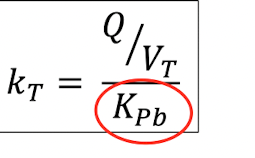
How does Tissue to blood equilibrium distribution ratio (Kpb) affect kt?
Kpb= Ct/Cb
More fats, Kpb increases, kt decreases, t1/2 longer, it takes longer for the drug to reach distribution equilibrium, more accumulation of drug
More fats, Kpb increases, kt decreases, t1/2 longer, it takes longer for the drug to reach distribution equilibrium, more accumulation of drug
32
New cards
What makes a drug take longer to reach distribution equilibirum?
1. poor perfusion
2. greater partitioning of drug into a tissue
2. greater partitioning of drug into a tissue
33
New cards
Is time distribution half life a primary parameter?
Yes it is, it is affect by physiological conditions.