Lecture 1: Introduction to Lower Extremity Orthotics
 Call Kai
 Learn
Learn Practice Test
 Spaced Repetition
 Match
Match Flashcards
 Knowt Play
1/29

There's no tags or description
Looks like no tags are added yet.
Name | Mastery | Learn | Test | Matching | Spaced | Call with Kai | Chat |
|---|
No analytics yet
Send a link to your students to track their progress
30 Terms
Orthotics
(noun)
The field or specialization that we practice; the science of analyzing and creating an Orthosis
Orthotist
(noun)
Practitioner who makes, fits, and adjusts orthoses
Orthotic
(adjective)
Can be used to describe a noun (e.g. an orthotic device)
Orthosis
(noun)
The device made by the orthotist which is used to aid an existing but functionally limited part of the body
Orthoses
(noun)
Plural of Orthosis
History of orthotics
Pictorially dated back to Egyptian times.
The necessity of ambulation and ADLs forced people to create supplemental aids for the injured body.
Canes
Walking Sticks
Splints
Slings
Goals of Orthotics
Control Motion
Control Pain
Control Deformity
How to do orthotics control motion?
Stopping motion
Resisting motion
Assisting motion
How to do orthotics control pain?
Pain usually controlled by
Limiting motion
Stopping motion
Pain can also be controlled by
Stress reduction in a joint through
Support
Shock-absorbing cushion
How to do orthotics control deformity?
Orthotic Forces can:
Accommodate
Prevent or slow progression of deformity
Resist
Prevent development or progression of deformity
Correct
Decrease or correct existing deformity
What is the full name?
FO
Foot orthosis
What is the full name?
AFO
Ankle foot orthosis
What is the full name?
KAFO
Knee ankle foot orthosis
What is the full name?
KO
Knee orthosis
What is the full name?
HKAFO
Hip knee ankle foot orthosis
What is the full name?
HO
Hip orthosis
What is the full name?
THKAFO
Thoracic hip knee ankle foot orthosis
Materials used in orthotics
Metal (titanium, steel, aluminum)
Plastic (polyethylene, polypropylene)
Foam Plastic (plastazote, pelite)
Laminated Plastic (acrylic, epoxy)
Leather
Rubber
Fabric (dacron, nylon, cotton)
Composites
Classes of Orthoses
Conventional
Metal and leather
Thermoplastic
Hybrid
Combination of conventional and thermoplastic
Arguably composites too
Conventional Orthoses
Defined by having side bars and ankle joints and some form of shoe attachment.
Originally known as the "metal" orthosis with:
steel ankle joints
steel stirrups
either aluminum or steel side bars
Aluminum calf band, leather cover

Benefits of Conventional Orthoses
Adjustable ankle
Not as hot as a thermoplastic system
Accommodates fluctuating edema
Can be very sturdy
Disadvantages of Conventional Orthoses
Can be heavy
Limited patient contact surfaces create higher pressures with less control
Wear only one pair of shoes or
Must have many shoes modified
Bulky
Ongoing maintenance
Thermoplastic Orthoses
Modified to have intimate contact over all weight bearing areas
Bony prominences relieved
Usually a vacuum-formed thermoplastic orthosis.
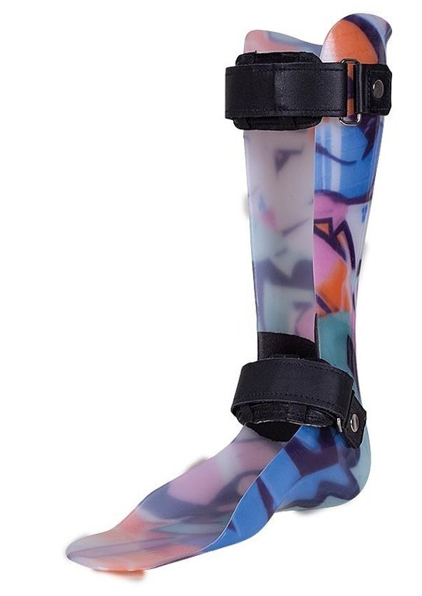
Benefits of Thermoplastic Orthoses
Intimate contact
Increased control
Decreased pressure
Fits inside shoes
Pt can change shoes without visiting orthotist
Light weight
Cosmetic
Fits under pants
Patterns and such
Deficits of Thermoplastic Orthoses
Patient may be allergic to plastic
Total contact does not work well with fluctuating edema
Can be hot
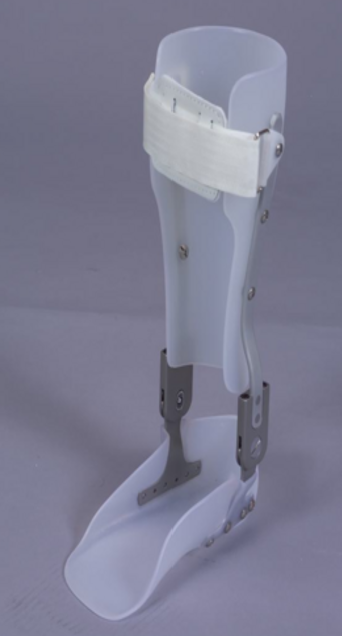
Hybrid Orthoses
Defined as having characteristics of both thermoplastic and conventional orthoses
Often conventional AFO with thermoplastic footplate instead of stirrup attached to shoe
What would work?
Goal: prevent IP motion in patient’s foot to reduce pain secondary to arthritis
Orthosis: rigid FO
What would work?
Goal: redistribute pressure across entire plantar surface of patient’s insensate diabetic foot
Soft FO
What would work?
Goal: relieve aching feet secondary to flexible pes planus
Semi-rigid FO
What would work?
Goal: resist plantar flexion and allow dorsiflexion motion at the ankle for patient with drop foot
Orthosis:
Leaf spring AFO (PLS)
Articulated thermoplastic AFO with plantarflexion stop
Conventional AFO with double action ankle joints