psyc 337 - psychopathology and antisocial personality disorder
 Call Kai
 Learn
Learn Practice Test
 Spaced Repetition
 Match
Match Flashcards
 Knowt Play
1/80

There's no tags or description
Looks like no tags are added yet.
Name | Mastery | Learn | Test | Matching | Spaced | Call with Kai | Chat |
|---|
No analytics yet
Send a link to your students to track their progress
81 Terms
first mentions of psychopathology
Philippe pinel - mania without delirium. koch - psychopathic inferiority. from German word psychopastiche - suffering soul
cleckley's 16 features of psychopathy 3 categories
shallow-deceptive features, behavioral deviance features, mask features
shallow deceptive features
untruthfulness and insincerity. lack or remorse or shame. general poverty in major affective reasons. pathological egocentricity and incapacity for love. specific loss of insight. unresponsiveness in general interpersonal relations.
behavioral deviance features
inadequately motivated antisocial behavior. poor judgment and failure to learn by experience. unreliability. fantastic and uninviting behavior with and sometimes without drink. sex life impersonal, trivial and poorly integrated. failure to follow any life plan.
mask features
superficial charm and good intelligence. absence of delusions and other signs of irrational thinking. absence of nervousness or psychoneurotic manifestations. suicide rarely carried out
hare psychopathy checklist - revised (PCL-R) - development
hare, based on work with male offenders and forensic populations in Vancouver
hare psychopathy checklist - revised (PCL-R) - administration
administered by a mental health professional. semi structured interview and reviewed of collateral information
hare psychopathy checklist - revised (PCL-R) - scores
20 items, scores 0-40. 0=does not apply, 1 = partially applies, 2 = definitely applies. cut off scores for North America is 30 for clinical, often 25 for research
hare psychopathy checklist - revised (PCL-R) - use
assessment in high security psychiatry units, correctional settings, research, risk assessment, violence, recidivism.
psychopathy factors
1 is interpersonal/affective, 2 is social deviance
factor 1 facets
interpersonal and affective
factor 2 facets
lifestyle and antisocial
interpersonal facet
glibness/super charm. grandiose self worth, pathological lying, conning/manipulative.
affective facet
lack of remorse or guilt. shallow affect, callous/lack of empathy. failure to accept responsibility for actions
lifestyle facet
need for stimuli. prone to boredom. parasitic lifestyle. lack of realistic, long term goals. impulsivity, irresponsibility.
antisocial facet
poor behavioral controls. early behavioral problems. juvenile delinquents. revocation of condition release. criminal versatility
ted bundy facet 1
Superficial charm / glibness
• Charismatic and socially engaging
• Approached women politely and confidently
• Former girlfriend described him as "warm, loving and intelligent"
Grandiose sense of self-worth
• Portrayed himself as intellectually superior
• Believed he was smarter than investigators and tried to manipulate law
enforcement and the media
Pathological lying
• Used multiple aliases when approaching victims
• Admitted during interviews that deception became habitual and ea
Conning / manipulative behavior
• Pretended to have a broken arm (fake cast) and asked women for help loading
items into his car, then abducted the
ted bundy facet 2
Lack of remorse or guilt
• "Guilt...it's this mechanism we use to control people. It's an illusion" - Bundy
• "I don't feel guilty for anything...I feel guilty for people who feel guilt" -Bundy
Shallow affect
• Emotions appeared rehearsed rather than genuine
• Appeared calm, controlled and relaxed when discussing murders
Callous / Lack of empathy
• Extreme violence and objectification of victims
• Returned to crime scenes to revisit victims' bodi
Failure to accept responsibility
• Denied all crimes until he confessed to 30 murders on death row
• Externalized responsibility (blamed pornography)
• "I'm a victim of circumstances", "The press demonizes me" -Bundy
ted bundy facet 3
Need for stimulation / proneness to boredom
• Engaged in risk-taking behaviors, including returning to crime scenes
• Escaped from jail twice and continued offending
Parasitic lifestyle
• Relied on others financially
Impulsivity
• Described himself as an "amateur" and an "impulsive killer" in his early years
• Some murders occurred opportunistically rather than through elaborate planning
Lack of realistic long-term goals
• Attended law school briefly but barely attended class because he was too busy
committing crimes
Irresponsibility
• Struggled with stable employment and financial obligation
ted bundy facet 4
Poor behavioral controls
• Escalated quickly from voyeurism to theft to serial homicide
Early behavioral problems
• Reports suggest early deviant behaviors
Revocation of conditional release
• 1977 courthouse escape
• 1977 jail escape in Colorado
Juvenile delinquency
• Engaged in theft and other delinquet behaviors as a youth
Criminal versatility
• Bundy's criminal activity included: burglary, assault, kidnapping, serial homic
triarchic model of psychopathology
boldness, meanness, disinhibition. difficult temperament is disinhibition and means. low fear is meanness and boldness. psychopathy is all 3
boldness
fearless dominance, low anxiety, thrill/adventure seeking
meanness
arrogance, lack of close relationships, instrumental aggression, exploitative behavior, physical cruelty to animals and humans
disinhibition
impulsivity, negative affectivity, neuroticism, anger, emotion dysregulation
other measures of psychopathy
hare psychopathology checklist - youth version for adolescents. self report measures, but these are significantly less reliable than the PCL-R due to self report biases, poor insight, and manipulation
psychopathy as a construct
psychopathy is primarily a personality construct characterized by affective and interpersonal traits, including charm, manipulation, and a lack of empathy
ASPD as a dsm-5 diagnosis
antisocial personality disorder is classified in the dsm-5 defined by a pervasive pattern of disregard for others rights, impulsivity, and deceitfulness. it emphases behavioral patterns over personality traits
conduct disorder dsm 5 criteria
aggression to people and animals. destruction of property, deceitfulness or theft. serious violations of rules. specify onset
conduct disorder onset
childhood onset type is at least one symptom prior to 10. adolescent onset type is no symptoms prior to age 10. unspecified onset is not enough info.c
conduct disorder specifier
with limited prosocial emotion. lack of remorse or guilt, callous - lack of empathy, unconcerned about performance, shallow or deficient affect
what is closest dsm diagnosis to psychopathy
conduct disorder with limited prosocial emotion specifier
antisocial personality disorder diagnosis - A
a pattern of disregard for and violation of the rights of others, occurring since age 15, as indicated by three or more of the following.
failure to confirm to social norms with respect to lawful belabors, deceitfulness, impulsivity or failure to plan ahead, irritability and aggressiveness, recklesss disregard for safety of self or others, consistent irresponsibility, lack of remorse
antisocial personality disorder diagnosis - B
aged at least 18 years
antisocial personality disorder diagnosis - C
evidence of conduct disorder before age 15
antisocial personality disorder diagnosis - D
antisocial behavior occurs outside course of schizophrenia or bipolar disorder
aspd does not equal psychopathy
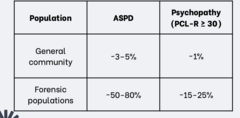
ASPD: dsm diagnosis, behavioral focus, conduct disorder before 15, no empathy deficit required, 3 to 5 prevalence, categorical - present or absent.
Psychopathy: research construct, affective and behavioral, no developmental requirement, callousness is core, 1 to 2 prevalence, dimensional - scored on continuum
most psychopaths meet aspd criteria, most ppl with aspd are not psychopaths
prevalence for aspd and psychopathy
aspd course
cannot be diagnosed before 18. chronic course, yet becomes less evident by age 40. less engagement in criminal behaviors
psychopathy course
can emerge eerily in life, moderately stable from adolescence to adulthood. multiple developmental trajectories exist. most youth show low levels, with a smaller group showing increasing or persistently high levels. those with chronically high traits have the greatest risk for violence and criminal behavior
Moffit's Developmental Taxonomy
adolescence limited course, life persistent course. supported by neurological differences in AL and LCP offenders
adolescence limited course
origins in social processes, begins in adolescence, driven by maturity gap, desists in early adulthood.
life course persistent
interaction between neuropsychological vulnerabilities and adverse environments. beings in childhood. persists into adulthood
etiological and risk factors - biological
genetics, neurobiology differences, ans
etiological and risk factors - environmental
attachment and early caregiving, parenting styles and family, prenatal and perinatal factors, SES and neighborhood. peers and substances
genetics
modest to high heritability of psychopathic traits - additive genetic influences account for 29-59 percent of variance. strongest evidence for callous-unemotional CU traits.
implicated genes
MAO-A - low activity variants + maltreatment + aggression riskl
DRD4, COMT - dopameinergic pathways, reward sensitivity and impulsivity. some genes common with autism. no single psychopathy gene - environment shapes expression
prefrontal cortex
abornmalities and less connectivity with amygdala. affects impulse control, emotional processing, self regulation, decision making, moral reasoning, planning
amygdala
psychopathy - reduced volume and reactivity. aspd and antisocial behavior - some evidence of greater threat related reactivity. affects fear processing and emotional learning
reduced connectivity between vmPFC and amygdala
reduced communication may impair how emotional signals guide decision making in psychopathy
Blairs violence inhibition mechanism model
non psychopath - distress cues to amygdala activation to aversive response to aggression inhibited
psychopath - distress cues to impaired amygdala to no aversive response to aggression continues
reward and punishment sensitivity - psychopathy
reduced sensitivity to fear, threat, and punishment cues. heightened dopaminergic reaction in response to reward cues
reward and punishment sensitivity - antisocial personality disorder
punishment insensitivity. difficulty inhibiting reward driven behavior
reward and punishment sensitivity - overall
deficits in learning from emotional and reinforcement signal may contribute to persistent antisocial behavior
fearlessness theory
low arousal plus low punishment sensitivity equals failure to learn from consequences
sensation seeking theory
low arousal to seeks stimulation tor each optimal level
ans
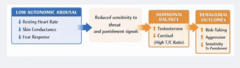
car example
low alarm system (reduced fear and threat sensitivity) plus weak brakes (reduced behavioral inhibition and control) plus strong accelerator (increased approach motivation and dominance related processes_
psychopathy and empathy for pain study
fMRI design of 24 blocks
12 blocks imagine-self ("Imagine these situations were happening to you")
12 blocks imagine-other ("("Imagine these situations were happening to someone else")
low psychopathy participants - increased reaction to imagining others pain, lower when imagining their own
high participants - increased reaction to imagining own pain, suppressed reaction when imagining others pain
attachment and early caregiving
Early attachment relationships shape how children learn trust, emotion
regulation and empathy. Insecure and disorganized attachment
are associated with higher risk for conduct problems, antisocial behavior and psychopathic traits. Evidence of devaluation of attachment bonds in psychopathic individuals. Attachment disruption may contribute to difficulties forming relationships and responding to others' distress
parenting style risk factor
harsh, inconsistent, neglectful, poor supervision, physical punishment
family structure risk factor
separation from parent, frequent caregiver change, large sibling group
parental characteristics risk factor
criminality, substance use, mental illness, delinquent siblings
home environment risk factor
high conflict, domestic violence exposure
protective factors risk factor
strong family functioning and parental support, practical parental modeling, warm parenting
family illustration for ted bundy
grew up believing his grandparents were his parents and his mother was his sister, creating confusion about family identity. reports describe a violent and a volatile grandfather and a tense home environment. family instability and secrecy may have contributed to early emotional insecurity and social difficulties
prenatal and perinatal factors
associated with antisocial behavior. unwanted conception, no exposure to or shorter duration of breastfeeding, prenatal alcohol tobacco/nicotine and psychotropic drug exposure, maternal stress/depression, severe maternal nutritional deficiency during pregnancy, lead exposure. For psychopathy specifically, evidence is more limits: prenatal risk factors appear to interact with temperament (e.g., low fear) and early caregiving rather than acting as direct causes
SES structural disadvantages
low SES, poverty/SES deprivation
environmental stressors
neighborhood violence, resource scarcity, chronic stress exposure.
contextual risk
can amplify risk for antisocial behavior, not a direct cause in isolation
antisocial behavior as adaption to adversity?
ASPD is disproportionately diagnosed in low sea and minority populations, raises questions about diagnostic bias. does antisocial behavior in some contexts reflect a protective survival strategy rather than disorder? in adverse social environments - higher psychopathic traits give socially adaptive outcomes, gains status, influence, and mating opportunities in harsh social environments
peers and substances
association with antisocial or deviant peers increases risk for delinquency and substance use. low empathy and fearlessness associated with early affiliation with deviant peers. social learning, modeling and reinforcement of antisocial behavior. callous - unemotional traits show associations with antisocial behavior and substance use. substance use and antisocial traits frequently co occur, often linked to impulsivity and sensation seeking. peers and substance use can reinforce and escalate antisocial behaviors, especially in individuals with underlying vulnerabilities
job posting analysis
hill and Scott conducted content analysis of 25 job positions for executive positions. 96 percent of executive job ads included traits overlapping with psychopathic characteristics. corporate environments may unintentional reward or select for psychopathic interpersonal traits
successful versus unsuccessful psychopathy
some individuals with psychopathic traits avoid criminal conviction and function in high status or competitive environments. factors associated with successful psychopathology: Fearlessness, Stress immunity, Social potency, Normal of superior cognitive performance, Professional achievement, Stable SES, Leadership, Pride, Aversion to punishment, and Better executive functioning, impulse control and planning ability. both groups share interpersonal and affective traits but unsuccessful psychopaths tend to show higher impulsivity and antisocial behavior. psychopathy may involve similar personality traits expressed through different behavioral outcomes depending on self control and context
gender differences
aspd 3x more common in men than in women. men show more physical aggression and criminal behavior. may be a product of socialization, women show more relational aggression, manipulative, and interpersonal conflict. impulsivity and aggression may be more self directed in women. pclr and aspd criteria were developed in male offender samples, which may underestimate antisocial traits in women
why treatment is challenging
Core affective deficits remove emotional levers that therapy often
relies on Motivation for treatment (Psychopathy diagnosis associated with a 30% increase in program dropout, Often court-mandated rather than voluntary) Therapeutic relationship challenge, Can be verbally/ emotionally abusive or threatening, Manipulation (e.g., staff-splitting), Less responsive to evidence-based approaches (Aggressive Behavioural Control Program) treatment pessimism
psychopathic and treatment outcomes
psychopaths who participated in the therapeutic community exhibited higher rates of recidivism than the psychopaths who did not
unethical treatments
treatments of 80 hours per week. men locked in small rooms to discuss issues and confront each other, little staff patient contact (offenders running their own treatment. hallucinogens and sedatives administered. group pressures, nude encounter groups, deprivation
Review of studies on the treatment of psychopathy (Salekin et al., 2010)
n = 8 treatment studies on adult samples; n = 5 on youth samples
Treatment effects found to be small
Child and adolescent populations derive greater benefit
Treatment for psychopathy should focus on risk management and behavioral outcomes rather than altering core personality trait
affective approaches
contingency management (rewards to reinforce desirable behaviors), improved social functioning (addiction severity). schema therapy (may improve social functioning day until patients gain unsupervised leave), dialectical behavior therapy. may reduce self harm
risk responsivity model
risk need responsivity, risk - psl used as risk assessment tool. psychopathic offender show greater risk levels and criminogenic needs. may benefit from high intensity services. needs - greater density and severity of all criminogenic needs except financial issues. Focus on teaching skills through behavioral and cognitive-behavioral techniques. Offers education and/or vocational skills training, assistance with familial reconnection, assistance for community reintegration. Emphasis on patient-provider relationship. Responsivity: high psychopathic offenders should be assigned more senior staff, intervention should be done in small teams with specific instructions to avoid staff splitting
consequences of stigma
individuals with aspd are perceived by members of the jury as more violent, yet sane and responsible for their actions. most court officials to not consider it to be a real psychiatric illness, implications for severity of sentence. staff hold negative attitudes toward individuals with personality disorders in correctional settings - perceived as manipulative and resistant. distress may be minimized. reduces empathy and access to mental health support