Psych 360 - Final
 Studied by 0 people
 Call Kai
 Learn
Learn Practice Test
 Spaced Repetition
 Match
Match Flashcards
 Knowt Play
1/23

There's no tags or description
Looks like no tags are added yet.
Name | Mastery | Learn | Test | Matching | Spaced |
|---|
No study sessions yet.
24 Terms
Explain the elements of the Hexaflex in ACT.
Helps people work to achieve psychological flexibility
Staying in the present
Detaching from self-narratives
Accepting life’s difficulties and your thoughts
Not fighting/challenging them
Connecting with values
Committed, driven action towards them
Leads to a more process-oriented, values-driven life
Explain the 3 fundamental techniques of TFP. About what percent do you use them in therapy?
Clarification - Helps the client identify what they really want to express to the therapist
Confrontation - Helps the therapist challenge the client’s defenses with contradicting ideas to gauge their reactions
Interpretation - Provides logic and reason for the client to understand
What is the fundamental rule of psychoanalysis in general and TFP in particular?
The concept of free association
Client’s role - speak freely about whatever comes to mind without censorship
Therapist’s role - To listen and gain access to the client’s thought process
Explain the elements of an object relations dyad. Give an example.
A model w/ 2 circles and an arrow in the middle
Self and other in the circles
Arrow represents how they affect each other
Helps regulate what goes on in a therapy session
Ex: If a client has intense feelings about someone, it will impact how they feel about themselves and vice versa
What are transference and counter-transference?
Transference - The client unconsciously projecting their thoughts/feelings about someone/thing onto the therapist
Counter-transference - The therapist’s unconscious response and reaction to the client’s projection
What are the 3 levels of thought in CBT?
Automatic thoughts - Always running through our minds that we rarely pay attention to
Conditional Beliefs - Thoughts we live by circumstantially
Core beliefs - Thoughts we whole-heartedly believe about ourselves
Usually negative when depressed
Explain the 5 column thought record used in CBT?
Helps challenge unwanted thoughts
Describe the event
Rank how it made you feel (1-100)
Describes thoughts you had about it
Challenge cognitive distortions
Probability or evidence statements
Re-rank your outcome w/ new feelings score
What are the elements of a DBT chain analysis?
Problem behavior - What happened to client
Usually a behavior they want to change
Prompting event - What triggered the event leading to problem behavior
Links in chain - Whatever happened between the P.E. and the P.B
Our thoughts, emotions, sensations, etc.
Vulnerability factors - What made them susceptible to the prompting event
Consequences - What happens following the problem behavior
Either long or short (immediate) term
According to DBT, how does invalidation disrupt emotion regulation?
Invalidating environment
Where problematic behavior serves to validate the negative emotions
Your thoughts and feelings are responded to in ways that suggest they are invalid (ex:neglect)
Leads to emotional dysregulation and extreme behaviors
What is creative hopelessness?
A strategy therapists use to help clients let go of the agenda that they’re in control of their feelings
People tend to believe that you can hold on to happiness or that it's a permanent feeling
Happiness, like all other emotions, come and go
Explain STRUGGLE and OBEY mode according to the Happiness Trap?
OBEY - Fusion; Our thoughts and feelings dominate us
Command our attention and dictate our actions
STRUGGLE - Experiential avoidance; Attempting to actively and unsuccessfully block out and ignore unwanted thoughts
Explain the 4 steps as discussed in class for treating anxiety according to CBT.
Education
Coaching to reinforce skills outside of the session
Learning about the anxiety
Usually w/ other people
Relaxation
Calms the body’s stress response
Regulates emotions
Cognitive Restruction
Helps brain reorganize its thought process regarding the anxiety
Exposure
Attempting to face the anxious feelings head-on
What are you trying to do when saying the phrase, “I’m noticing I’m having the thought…?”
Fundamental unhooking skill
Acknowledging unwanted thought and not dwelling on it
You have to acknowledge that's how the brain works; No point trying to deny it
Creating separation (diffusion) between your brain and the thoughts
Giving the thoughts less power over you
Why is the concept of workability so important in ACT?
Helps us determine whether the actions we take move us in the direction of our chosen values
Encourages people to step outside of fundamental truths and focus on what is important to them
Describe 3 of your favorite unhooking techniques from the Happiness Trap.
Silly voices, Thanking the mind, Musical thought
Helps you realize the hooked thoughts are nothing more than a string of words in your head
Gives them less power over you
Loses its impact on you
Draw and label the essential elements of a choice point diagram.
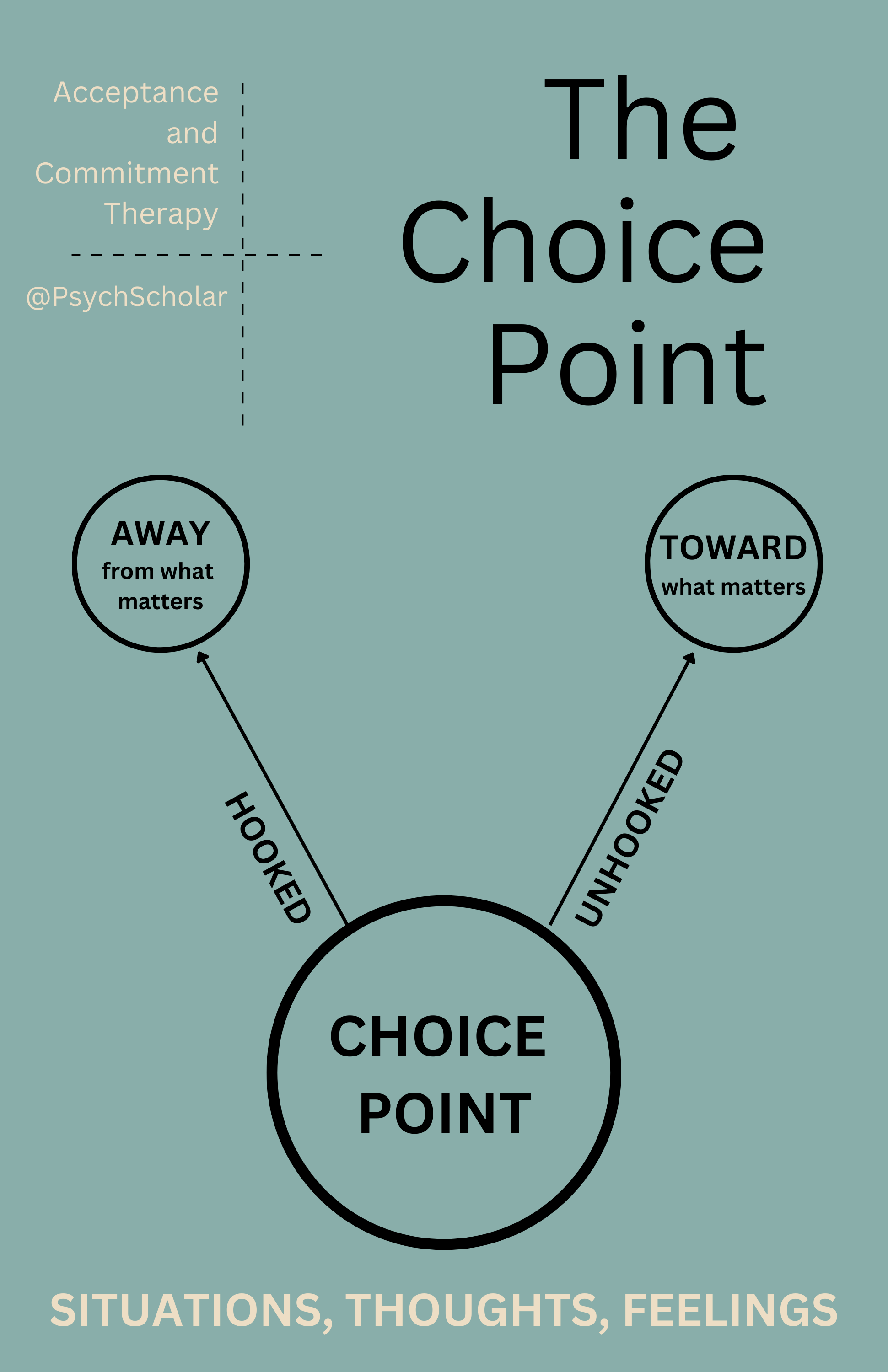
List the 6 unhooking skills.
Core unhooking skills
Name the story - Acknowledging the thought by giving it a name
Name the process - Acknowledging the mind’s thought process, especially when worrying/obsessing
Playful unhooking skills
Play w/ text - Imagine thought as words on screen; Changing size, font, color, etc.
Silly voices - Saying thought aloud in silly character voice
Thank the mind - playfully thanking mind for hooked thought
Musical thought - Singing the thought in musical form
What is the difference between the noticing and thinking self?
Thinking Self
Commenting, judging,analyzing your experiences
Like a radio constantly playing in the background (usually negative thoughts)
CBT fights and challenges the thinking self
Becoming aware of your negative automatic thoughts and challenging them
Noticing Self
Noticing whatever thoughts/images appear from the thinking self
ACT tries to develop and emphasize the noticing self
No point challenging the thoughts
Helps diffuse and distance yourself from the thoughts and let them go
List 3 mindfulness practices.
Ten Slow Breaths Exercise, mindful walking, bodily scans
A good way to practice ACT and develop the noticing self skill
Whenever your mind gets distracted as you're breathing, you learn to let them come and go
Gently unhook from the thoughts that pull you off task and refocus your attention
What is the difference between values and goals?
Goals - Your destination and what you want to achieve
Values - The process of how to get to your goals
How you view yourself, others, and situations regardless on whether you accomplish your goals
Why is it better to be process rather than outcome oriented?
Process oriented - Able to appreciate and acknowledge the journey you took to move closer towards your goals.
Able to say you did your best with what you could control even if you don’t reach your goals
Outcome oriented - Cannot control outcome
More painful if you fail
What are SMART(ER) goals?
Makes your broad goal clearer and easier to achieve
Specific
Measurable
Achievable
Relevant
Time-bound
Evaluate
Did you accomplish goal?
What got in the way?
Revise
What is TAME?
Similar to ACE
Take note
Similar to acknowledging the feeling
Allow
Giving the feeling permission to be there
Make Room
Open up to the feeling; Letting it freely flow through you; Invite it in
Expand awareness
Broaden our focus to include everything around
Use the pac-man model to explain the Documentary of You and cognitive filter.
Pac-man - Self view (story)
Biased story in the documentary of your life
Cognitive filter - chooses what thoughts are consistent with self view
usually negative
Documentary is not a complete accurate representation of who we are