Chapter 2 - Molecules and Membranes
 Call Kai
 Learn
Learn Practice Test
 Spaced Repetition
 Match
Match Flashcards
 Knowt Play
1/43

There's no tags or description
Looks like no tags are added yet.
Name | Mastery | Learn | Test | Matching | Spaced | Call with Kai | Chat |
|---|
No analytics yet
Send a link to your students to track their progress
44 Terms
Cells
Complex and diverse
Water
most abundant molecule in cells
Ions and polar molecules are hydrophilic or hydrophobic
HYDROPHILIC
inorganic ions constitute 1% or less of the cell mass
Nonpolar molecules are hydrophilic or hydrophobic
HYDROPHOBIC
cannot interact with water
List the 4 organic molecules
Carbohydrates
Lipids
Nucleic acids
Proteins
Carbohydrates
simple sugars and polysaccharides
Monosaccharides
Major nutrients of cells
the basic formula is (CH2O)n
Glucose (C6H12O6)
Monosaccharides are joined together by dehydration reactions called….
glycosidic bonds
Oligosaccharides
polymers of a few sugars
Polysaccharides
macromolecules; polymers of hundred or thousands of sugars
Common polysaccharides
Glycogen, starch, cellulose, chitin
Functions of carbohydrates
Energy
Cell surface markers
they are linked to other cellular components such as lipids or proteins
Example - the ABO blood group
Fatty Acids
Long hydrocarbon chains with a carboxyl group (COO-)
Unsaturated fatty acids: one or more double bonds
Saturated fatty acids: no double bonds
How are fatty acids stored?
triacylglycerols (triglycerides or fats)
Phospholipids
principal components of cell membranes
Glycerol phospholipids
the fatty acids are bound to glycerol bound to a phosphate group
Sphingomyelin
only non glycerol phospholipid
polar head group is formed from serine
All phospholipids have….
hydrophobic tails and hydrophilic head groups
Many cell membranes have…
glycolipids or cholesterol
Steriod hormones
derivatives of cholesterol
Examples - estrogens and testosterone
Nucleic acids
principal informational molecules
Deoxyribonucleic acid (DNA)
Ribonucleic acid (RNA)
Messenger RNA (mRNA)
Ribosomal RNA
Transfer RNA (tRNA)
DNA vs RNA
Both - consist of purine and pyrimidine bases linked to phosphorylated sugars
DNA - two purines (adenine and guanine) and two pyrimidines (cytosine and thymine)
RNA - uracil in place of thymine
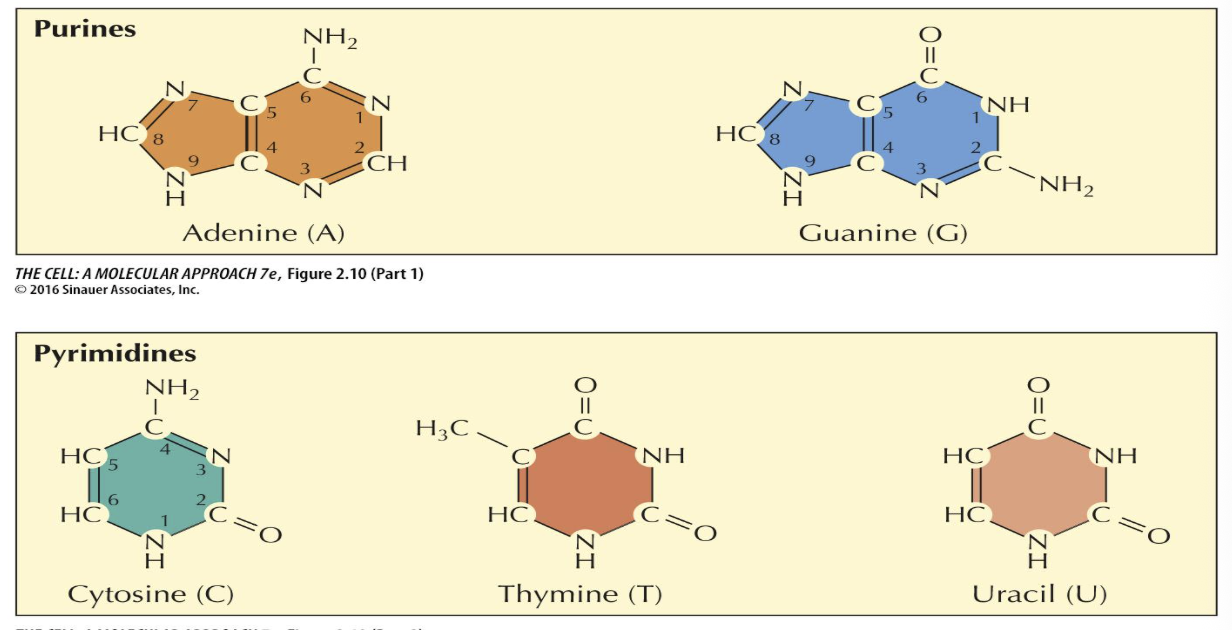
Nucleotides
one or more phosphate groups
Nucleosides
based linked to sugars
DNA vs RNA sugar
DNA - sugar 2’-deoxyribose
RNA - sugar ribose
Polymerization of nucleotides
Phosphodiester bonds
Oligonucleotides
Polynucleotides
Always synthesized 5’ to 3’ direction
DNA - two polynucleotide chains
bases are on the inside, joined by H-bonds
complementary base pairs (guanine with cytosine — adenine with thymine)
Proteins and Functions
Most diverse
several thousand different proteins
direct almost all activities
Functions
Structure
Transport and storage
Transmission
Defense
Enzyme
How many different amino acids are there
20 different AA

How are amino acids grouped?
By their side chains
nonpolar
polar
charged basic groups
acidic
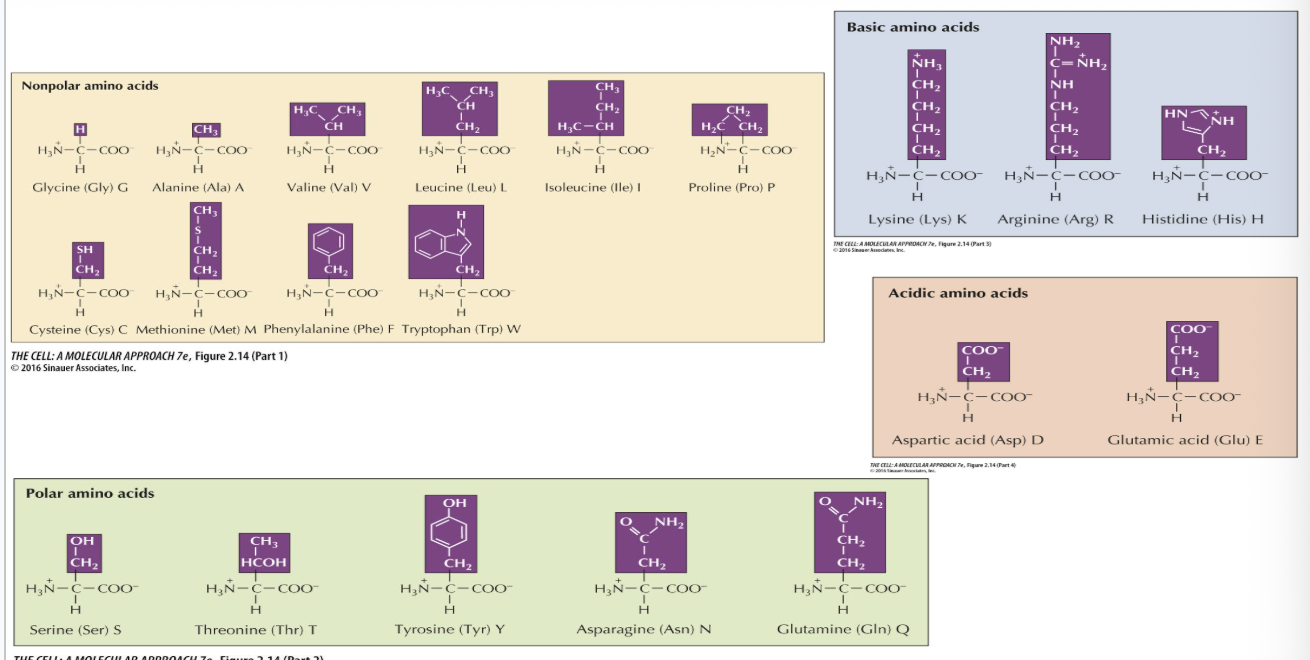
How are amino acids joined and what are they called?
Peptide bonds join AA
Called polypeptides
X-Ray crystallography
laboratory method used to fine the 3D arrangement of atoms inside a crystal
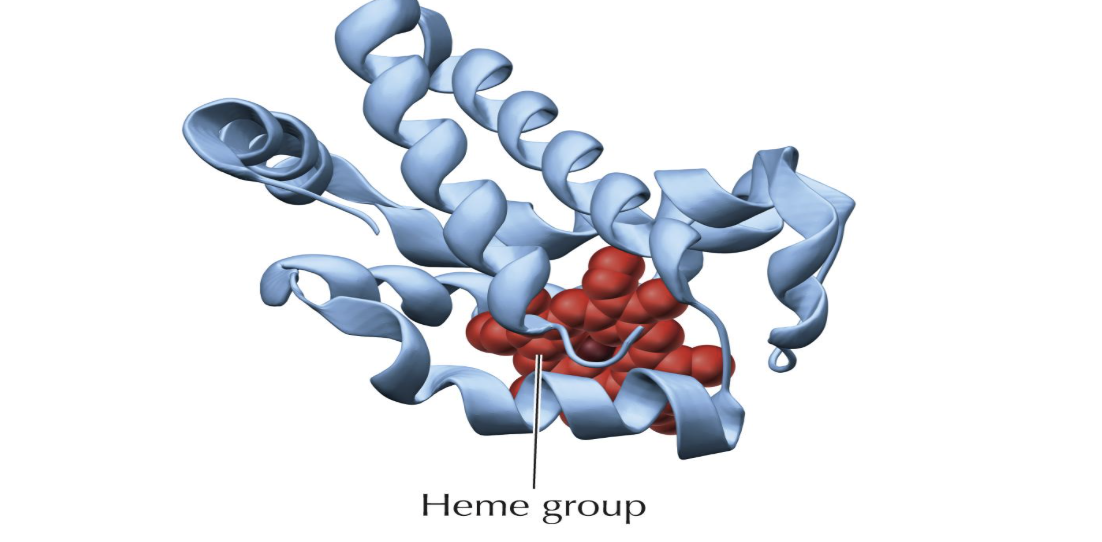
What are the proteins structure levels?
Primary
Secondary (alpha and beta sheet)
Tertiary
Quaternary
Cell membranes - Phospholipids
associated with proteins
aggregate in water
from phospholipid bilayer
Cell membranes are localized in different places
Plasma membrane
Subcellular organelles
Nucleus
mitochondria
many other organelles
True or False: Membranes do not have selective permeability.
False, they have do have have selective permeability
Small, nonpolar molecules can diffuse across
Ions and larger uncharged molecules cannot diffuse across
True or False: Molecules freely rotate and move.
True
Unsaturated fatty acids chains = double bonds create kinks
Cholesterol
membrane fluidity
rigidity
maintains membrane fluidity
Fluid Mosaic Model
Intergral membrane proteins - directly
Peripheral membrane proteins - indirectly
Transmembrane proteins - expose to both sides
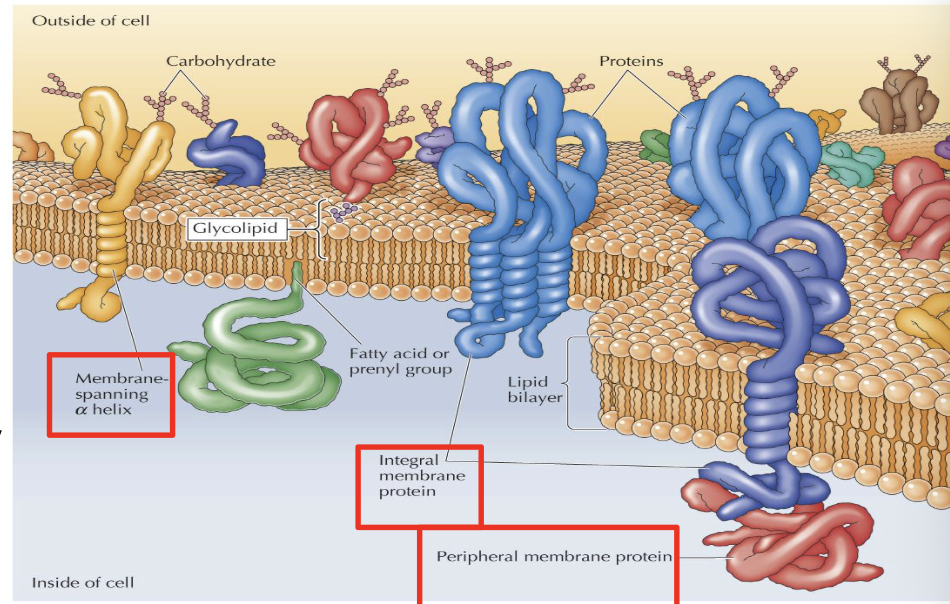
β-barrel proteins
present in some bacteria, chloroplasts, and mitochondria

Channel proteins
open pores across membrane
ion channels - pass inorganic ions
Carrier proteins
selective and transports small molecules
Passive transport
concentration and electrochemical gradient
Active transport
require energy to transport against concentration gradient