Lecture 10: Carbohydrates
 Call Kai
 Learn
Learn Practice Test
 Spaced Repetition
 Match
Match Flashcards
 Knowt Play
1/28

There's no tags or description
Looks like no tags are added yet.
Name | Mastery | Learn | Test | Matching | Spaced | Call with Kai | Chat |
|---|
No analytics yet
Send a link to your students to track their progress
29 Terms
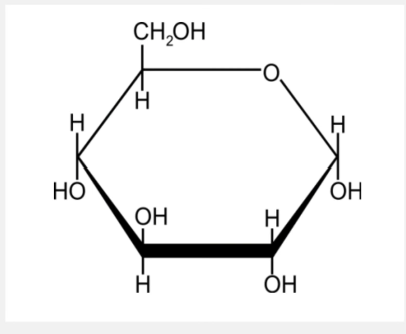
What are Carbohydrates?
Carbohydrates are a group of organic compounds made of oxygen, carbon and hydrogen. (CH2O)
Due to their structure, highly polar and interact well with water
Carbohydrates Function
Serve as energy sources, energy storage molecules, and structural components
Found in sugars, starches, glycogen, cellulose and even in nucleic acids.
Carbohydrate Structure
Made of oxygen, carbon and hydrogen
Contain multiple -OH groups and often an aldehyde or ketone group
Can contain ethers (ROR) and alcohols (OH) but NOT Chlorine (CL).
Classification of Carbohydrates
Carbohydrates are classified based on their size and complexity.
Monosaccharides
Disaccharides
Polysaccharides
Monosaccharides
Simplest form, just single sugar units
Ex: Glucose, Ribose*, Deoxyribose*
Ex: Ribose* = Sugar (Aldopentose) found in RNA and ATP
Ex: 2-Deoxyribose* = Sugar (Aldopentose) found in DNA
Monosaccharides Name depending on Functional Groups in it
Aldehyde in Monosaccharide = Aldose
Ketone in Monosaccharide = Ketose
Number of Carbons in Monosaccharides
3 = triose
4 = tetrose
5 = pentose
6 = hexose
7 = heptose
Disaccharides
When two monosaccharides are linked together
Linked together by = Glycosidic bond (acetal linkage) “The glue between them”
Ex: Glucose + Fructose = Sucrose (A disaccharide)
Glycosidic bond: Acetal Linkage
The bond that links 2 monosaccharides together and forms a disaccharides.
Cellobiose/Cellulose
It’s 2 glucose molecules stuck together, A disaccharide
β-1,4 = a specific bond
Humans can’t break this bond, meaning can’t digest it
Polysaccharides
Long chains of many sugar units linked together (monosaccharides)
Ex: Glycogen = the storage carbohydrate in humans
Has α-1,4 and α-1,6 bonds
Highly branched = more end points = quick glucose release, so body can release energy very quickly when needed
α-1,4 and α-1,6 Glycosidic Bonds
Bonds in Glycogen polysaccharides
α-1,4 bonds = straight chains
α-1,6 bonds = branch points
So glycogen is not straight and highly branched like a tree
Polymerization
The process of building a big molecule from many small repeating units using active sugar nucleotides
Your body doesn’t just randomly build glycogen It uses “activated sugars” (like charged building blocks)
ATP indirectly used to activate the building process
Glycogen vs Cellulose
Glycosidic Linkage
- Glycogen = a-1,4 and a-1,6
- Cellulose = b-1,4
Digestible
- Glycogen = Yes!
- Cellulose = No! Humans lack enzymes to hydrolyze B-1,4 bonds
Isomerism in Carbohydrates
Molecules that share the identical chemical formula, such as C₆H₁₂O₆, but feature distinct atomic arrangements.
Enantiomers
Epimers
Anomers
Conformers
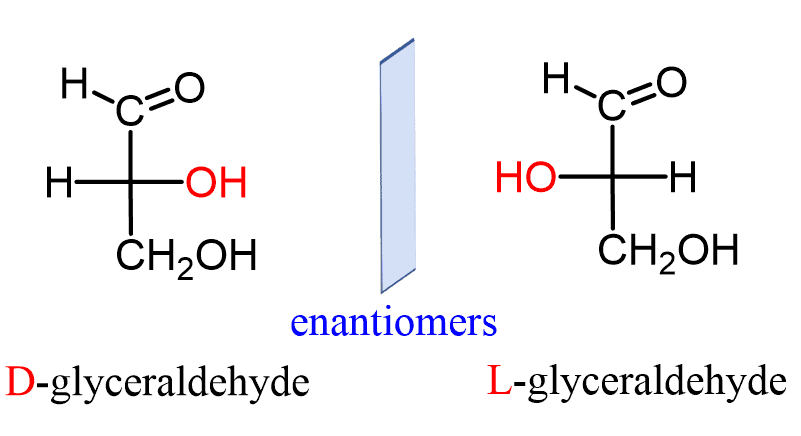
Isomerism in Carbohydrates: Enantiomers
Exact mirror images: D- and L- forms of the same carbohydrate
Same formula but react differently in enzyme reactions (D vs L)
Ex: Aldohexose
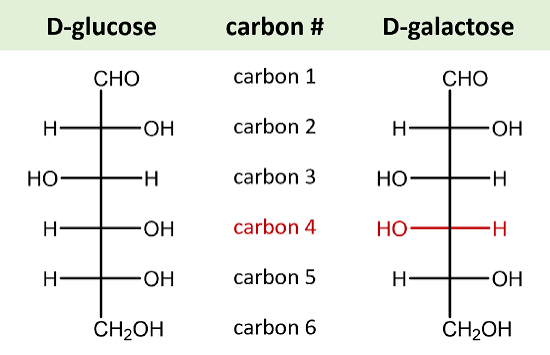
Isomerism in Carbohydrates: Epimers
Molecules that share exact same molecular formula but differ in spatial arrangement of atoms at only one chiral center (ex: glucose and galactose)
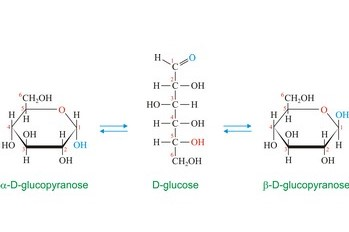
Isomerism in Carbohydrates: Anomers
Special type of carbohydrate isomer that emerge when a linear sugar molecule undergoes cyclization into a ring structure
a- and B- forms created when glucose cyclizes
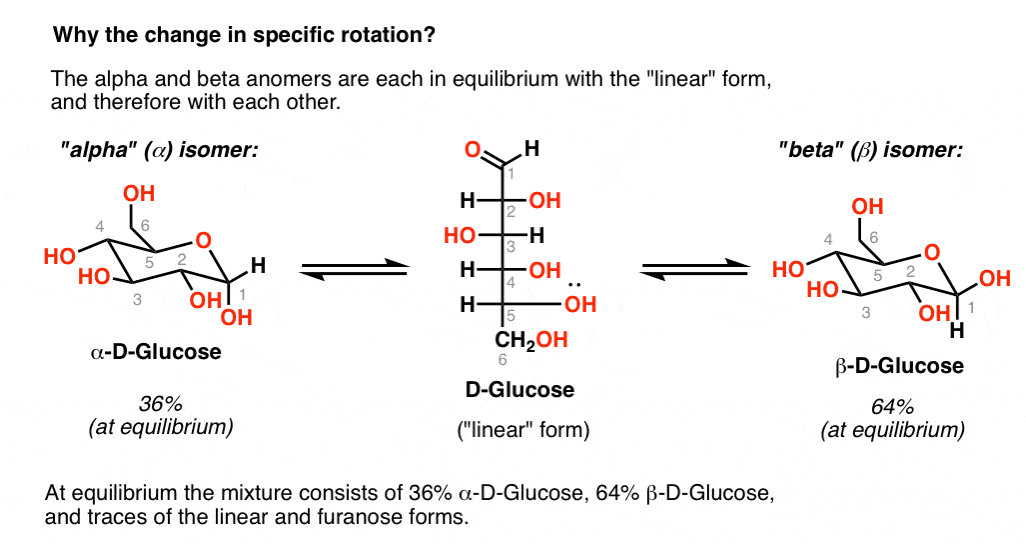
Anomers: Mutarotation
Means that the two anomers of a sugar (α and β forms) can switch back and forth in solution.
Can go form a form to chain to b form when in water
Isomerism in Carbohydrates: Conformers
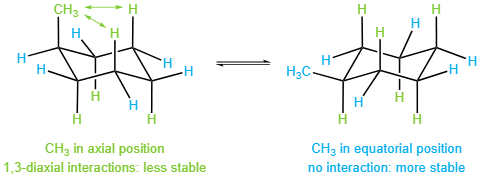
Molecules have the same structure and connectivity, but differ by rotation around single bonds.
Glucose can exist in chair and boat forms
Results from rotation about C-C single bond
Bulky groups more stable in equatorial position (opposite)
Bulky groups not stable in axial position (same way): cause steric strain
2^n Rule
The number of possible stereoisomers depends on the number of chiral center a molecule has, where n is the number of chiral centers.
Ex: Aldotetroses has 2 chiral centers so 4 stereoisomers
Aldohexoses: Type of Enantiomers
A monosaccharide (simple sugar) that contains an aldehyde group at carbon-1.
Has 16 stereoisomers so 8 D pairs and 8 L pairs
Function of Carbohydrates: 1. Energy Storage + Release
Glucose = Primary energy molecule
Glycogen = Stored glucose for later use
Maltose - Energy storage
2 glucose with a-1,4 linkage (not found in cellulose).
Function of Carbohydrates: 2. Structural Roles
Carbohydrates serve as structural roles such as cellulose in plant walls.
Cellobiose = the repeating unit of Cellulose, linked by b-1,4 bonds.
Function of Carbohydrates: 3. Building blocks for Biomolecules
Ribose and Deoxyribose form the backbone of Nucleic acids like ATP, DNA, and RNA
Fun fact: Ribose has one more hydroxyl group than Deoxyribose
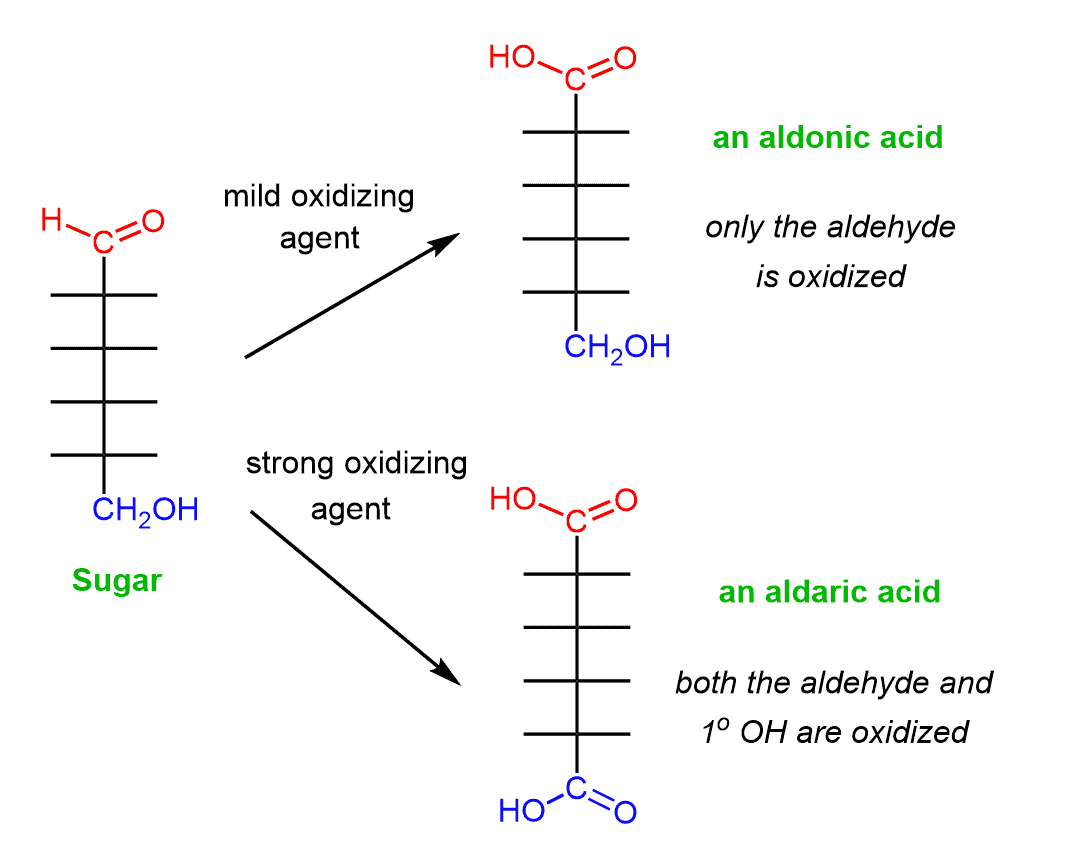
Function of Carbohydrates: 4. Reducing Sugars
Some carbohydrates can be oxidized to form carboxylic acids
Function of Carbohydrates: 5. Cell Recognition
Carbohydrates can be involved in cell recognition,
Carbohydrates Key Points Review
Carbohydrates provide energy for life (glucose metabolism, glycogen storage)
Serve as structural materials (plant cell walls)
Involved in cell communication and recognition
Small structural differences (epimers,anomers,enantiomers) can completely change biological activity