exam 1
 Call Kai
 Learn
Learn Practice Test
 Spaced Repetition
 Match
Match Flashcards
 Knowt Play
1/72

There's no tags or description
Looks like no tags are added yet.
Name | Mastery | Learn | Test | Matching | Spaced | Call with Kai | Chat |
|---|
No analytics yet
Send a link to your students to track their progress
73 Terms
location, character/quality, quantity/severity, timing, setting, aggravating/relieving factors, associated factors, and patient’s perception
what are the eight critical characteristics?
greeting, name, self-introduction, purpose of interview/why you’re there, timeframe, expectations, and confidentiality
What should be included in your introduction of a patient interview?
biographic data, reason for seeking care, present health/history of present illness (HPI), past history, medication reconciliation, family history, review of systems, functional assessment/activity of daily living (ADLs)
what is the health history sequence?
name, age, DOB, birthplace, address, phone number, gender, martial status, race, ethnicity, language, occupation, and record the source of information
what is included in the biographic data?
is the primary reason that patient is seeking care, documented in their exact words with a timeframe
ex: “I’ve had a burning stomach pain for three days”
what is a chief complaint (cc) and an example of one?
childhood illnesses, accidents/injuries, serious/chronic illnesses, hospitalizations, operations, obstetric history, immunizations, last exam date, and allergies
what are some questions to ask when gathering past medical information?
pain rating, feelings/symptoms, and patient concerns
what are 3 examples of subjective data?
vital signs, physical examination findings, and lab results
what are 3 examples of objective data?
location, quality, severity, timing, setting, aggravating/relieving factors, associated factors, and patient’s perception
what are critical characteristics to ask a patient about their chief concern?
present health focuses on current health status or detailed specifies of immediate chief complaint
past history covers prior medical events, including past surgeries, hospitalizations, childhood illnesses, immunizations, and allergies
what is the difference between present health and past history?
chief concern is asked as an open-ended question (what brings you in today?)
past history focus on categories (any past surgeries, chronic conditions, or allergies?)
ROS asks head-to-toe direct questions (any chest pain, cough, or joint stiffness?)
what is the best way to ask a patient about their chief concern? their past medical history? their other body systems?
biographic data: identify who the patient is
reason for seeking care: chief complaint
HPI: PQRSTU
past health: summarize prior medical background
family history: tracks genetic risks and heath trends
ROS: evaluates subjective, head-to-toe body systems to cartch unmentioned symptoms
ADLs: measures lifestyle, self-care ability
perception of health: captures the patient’s personal perspective on their overall health
what are the differences between the different parts of a health history?
facilitation, clarification, reflection, explanation, empathy, and confrontation
what are the different therapeutic communications?
facilitation
encourages patient to say more
clarification
asking for confirmation
reflection
echoes to helpe express meaning
explanation
informing person by sharing factual and objective information
empathy
names a feeling and allows its expression
confrontation
clarifying inconsistent information
complete database describes current and past health state and forms baseline to measure all future changes
Focused/problem-centered database collect “mini” database, smaller scope and more focused than complete database.
They are important because it ensures nurses choose the right depth of assessment to deliver good care
how would explain a focused database compared to a complete? why might this be important to understand the differences when it comes to health assessment?
emergency database is a rapid collection of data often complied concurrently with lifesaving measures
includes ABCs, level of consciousness, and immediate physical findings
what might an emergent database include?
assessment: collect, organize, validate, and document data
diagnosis: identify health problems, risk and strengths
planning: prioritize problems/diagnoses, formulate goals, and write nursing orders
implementation: reassess the client, determine the nurse’s needed for assistance
evaluation: collect data related to outcomes, compare data with outcomes
what are parts of the nursing process
subjective data is how the patient is feeling, what the patient states
objective data what we observe, test results, and vital signs
what are the differences between subjective and objective data?
open-ended questions that prompt a narrative response in the patient’s own words
closed-ended question is a direct question that asks for specific facts or a simple “yes” or “no” answer
what is the difference between an open-ended question and a close-ended question?
facilitation encourages patients to say more
clarification asks for confirmation
explain the difference between facilitation and clarification?
empathy is when you develop an understanding and sensitivity for others feeling’s
this is important b/c it promotes open communication, and helps nurses deliver compassion, and patient-centered care.
what is empathy? why is it important in nursing?
For example patient “I’ve been feeling really overwhelmed in the mornings” nurse “go on, I’m listening (or nodding and saying “tell me more”)
what is an example of facilitation in a conversation with a patient?
having your full attention to the patient by leaning forward and nodding while saying, “Mm’hmm, go on” to encourage that patient to keep sharing details without interrupting their flow
why is health assessment an important link in the nursing process?
during an emergency assessment to quickly gather specific, life-saving information, such as asking a patient experiencing chest pain
what is an example of when you would use a close-ended statement or question?
erythema
red colored skin
pallor
pale colored skin
jaundice
yellow colored skin
cyanosis
blue colored skin
diaphoresis
thyrotoxicosis and stimulation of nervous system with anxiety or pain
edema
is fluid accumulating in the intracellular spaces and not normally present
skin tugor
pinched skin recedes slowly or “tents” and stands by itself (less elasticity)
capillary refill
depress the nail edge to blanch and then release, noting the return of color
begins the moment you first lay eyes on the patient before you even start the formal physical examination/health history interview
when does the general survey begin?
inspection
what part of assessment is the general survey (inspection, percussion, palpation, or auscultation)?
physical growth
what is the best index of a child’s growth?
new born: 32-38 cm average of 34 cm about 2 cm larger than chest circumference
6 months-
what should you know about an infant’s head circumference at age 1 month? What about 6 months? 1 year/12 months?
stature, nutrition, symmetry, posture/position, and contour
what are 3 body structure findings in a general survey?
facial expression, mood and affect, speech, speech pattern, dress, and personal hygiene
what are 3 behavior findings in a general survey?
BMI stands for body mass index
overweight: 25.0-39.9 and obese: greater than 40.0
BMI= weight in kg/(height in meters) ^2 or BMI: weight in lbs x 73/(height in inches)^2
how would a nurse calculate a patients BMI? what does DMI stand for? what is considered overweight and obese?
adults: standing scale, morning time, light clothing, no shoes, and empty bladder
infants: calibrated platform scale, completely naked/clean diaper, hand hovering for safety
children: standing scale, light clothing, and no shoes
what is considered best technique for weighing adult patients? Infants? Children?
dizziness
a range of sensation associated with impaired spatial perception, balance, or lightheadedness
vertigo
specific type of dizziness characterized by a false sensation of self-motion/environmental movement
Imbalance or lack of proportion between the features on the left and right sides of the face.
What is facial asymmetry?
Enlarged tonsils are graded on a 1+ to 4+ scale based on their size and how much space they occupy in the oropharyngeal airway between the anterior tonsillar pillars and the uvula: 1- visible 2- halfway between tonsillar pillars and uvula 3- touching uvula 4-touching one another
How do you grade enlarged tonsils?
Have patient depress tongue with tongue blade. Check for color, exudate, or lesions. Test cranial nerve 12 (hypoglossal) ask a person to stick out tongue, should protrude in midline. Note any breath odor, halitosis (poor oral hygiene, consumption of alcohol, smoking/dental infection)
How do you assess the palate and uvula?
protect, prevent penetration, perception, fluid balance, temperature regulation, identification, communication, wound repair, absorption and excretion, and production of vitamin D
what is the function of the skin?
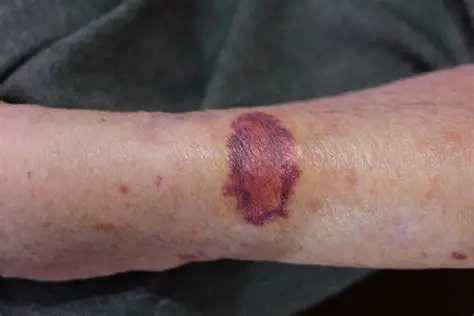
ecchymosis
a purplish patch resulting from extravasation of blood into the skin, more than. 3mm in diameter
macule
solely a color change, flat and circumscribed, less than 1 cm

papule
felt and caused by superficial thickening of the epidermis

linear
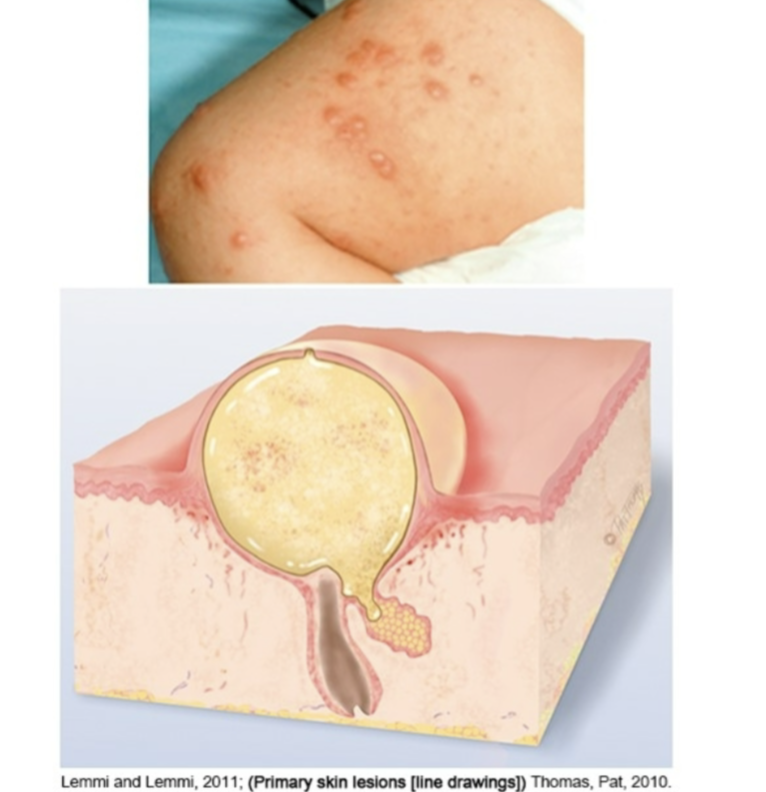
scratch, streak, line, or stripe vesicle: elevated cavity containing fluid up to 1 cm (blister)

nodule
solid, elevated, hard or soft, greater than 1 cm that may extend deeper into dermis than papule

pustule
pus in cavity that is circumscribed and elevated
fissure
linear crack with abrupt edges extending into dermis

ulcer
deeper depression extending into dermis with irregular shape, may bleed, leaves scar

Cardiovascular:
cyanosis: poor tissue perfusion or severe deoxygenation
pallor: decreased cardiac output, peripheral vasoconstriction
Abdominal:
jaundice: indicating hepatic dysfunction
spider angiomas: chronic liver disease/cirrhosis
Pulmonary:
cyanosis: impaired gas exchange, hypoxemia
clubbing of fingers: chronic hypoxemia, COPD, pulmonary fibrosis, and lung cancer
What skin findings tell you something about the cardiovascular system? Abdominal system? Pulmonary system?
Cyanosis, rapidly spreading erythema with skin sloughing, and unstageable pressure injuries (stages 3 & 4)
Name 3 findings of the integumentary system that would be a priority finding?
Braden Scale: Sensory perception, moisture, activity, mobility, nutrition, friction and shear (scoring less than 9)
Describe patients, diagnoses, history, and other considerations that might place someone at risk for a pressure injury?
Infants: sweat and sebaceous glands are less active and so skin’s hydrolipid film is relatively weak, barrier function is impaired and is less resistant, sensitive to chemical, physical, and microbial influences, prone to drying out, and more sensitive to UV
Older adults: epidermis thins and flattens, less elasticity, loss of collagen, slow wound healing, decrease in sweat and sebaceous glands (dryness, deep wrinkles), melanocytes decrease and rate of hair growth decreases, and nails grow slower and become more thicken
What lifespan changes in the skin can affect their overall health?
Normal:
Temp 37 degrees Celsius/98.6 degrees Fahrenheit
Pulse: 50-95 beats with 2+ force, and regular rhythm
Respirations: 16-25 breaths and non-labored
BP: less than120/less than 80
O2: 97-99%
Irregular:
Temp: above 37.8 degrees Celsius or below 36 degrees Celsius
Pulse: less than 50 beats or more than 95 beats, 3+, 1+, or 0 force, and irregular rhythm
Respirations: 8-12 or more than 25 breaths, labored
BP: greater or below 120/ greater or below 80
O2: less than 97%
What vital sign findings are normal? What vital sign findings would make you concerned?
Have patient rest supine for at least 3 minutes, take baseline readings of pulse and BP, and then repeat with person sitting and then standing. Abnormal finding: orthostatic hypotension: drop in systolic pressure of greater than 20mmHg or diastolic pressure greater than 10mmHg after changing into a standing position.
How would you check orthostatic blood pressures? What would be considered an abnormal finding?
Recheck BP after 1-2 minutes, ensure cuff is appropriate size and positioned correctly over brachial artery, measure on opposite arm, or ask for another nurse to double check reading
What should you do if you are not sure if the blood pressure reading is correct?
Count heart rate for the full 60 seconds and count total bpm, evaluate the patient for signs of distress, chest pain, shortness of breath, dizziness, verify medical history, and document of irregularity in patient’s chart
What would you do if you noticed a patient’s heart rate was irregular and it seemed like a new finding?
BP 200-/85: recheck manually with proper cuff size. Assess for target organ damage (headache, chest pain, vision changes). Elevate head of bed and notify provider immediately.
Temp 104.5: apply non-invasive cooling agent without inducing shivering and notify provider.
HR 45: check for symptoms and review baseline. If asymptomatic and stable, document as a normal physiological variant. If not asymptomatic assess for lightheadedness, or chest pain. Obtain 60-second pulse, review medications, and notify provider.
SPO2 90%: check respiratory effort and verify probe placement (not on nail polish, pt doesn’t smoke) and position comfortably, apply supplemental oxygen per protocol.
RR 32: elevated head of bed, assess lung sounds and oxygen saturation, coach deep breathing, and notify provider.
Consider next nursing steps if a patient’s BP is 200/85? Or what about a Temp of 104.5? Or a Heart Rate of 45 of a marathon runner? Heart rate of 45 of an 89-year-old female? O2 sat of a 2-year-old child at 90%? Make up your own vital signs and consider next steps…..
Irregular heart rate: <50 bpm= bradycardia
Sinus arrhythmia is when the heart rate varies with respiratory cycle (speeding up with inspiration, slowing down to normal with expiration)
What is an irregular heart rate? Is this something concerning? What is sinus arrhythmia?
Yes if after exercising or doing something with cardio.
Could someone have a 3+ pulse bilaterally that was considered normal?
Blood pressure measures how fast the heart contracts and rests.
Systolic is when the heart contracts.
Diastolic is when the heart rests.
Pulse pressure is the difference between systolic and diastolic.
Factors affecting BP: age, sex, weight, exercise, etc.
Mean arterial pressure (MAP) is the average blood pressure in a person’s arteries during a single cardiac cycle.
Pretend to describe to your patient what a blood pressure is? What is the systolic? What is the diastolic? What is the MAP? What is pulse pressure? What are 3 things that can affect someone’s blood pressure?
Faulty arm position (above or below level of heart)
2. taking blood pressure when person is anxious/angry
cuff wrap is too loose/uneven/bladder balloon out of wrap
What are 3 common errors in taking a blood pressure measurement?
Ages over the age of 3 years old.
Verify cuff size, calm child, try different areas arms or thighs, or use manual papulation/auscultation
At what age is most common to take regular blood pressures? What if you are having a difficult time obtaining a blood pressure on a 2-year-old?