Lecture 2&3: Cell injury and death & Mechanisms/Causes of cell injury
 Call Kai
 Learn
Learn Practice Test
 Spaced Repetition
 Match
Match Flashcards
 Knowt Play
1/19

There's no tags or description
Looks like no tags are added yet.
Name | Mastery | Learn | Test | Matching | Spaced | Call with Kai | Chat |
|---|
No analytics yet
Send a link to your students to track their progress
20 Terms
Necrosis
INFLAMMATORY
Cell Size - Swelling
Nucleus - Pyknosis → Karyorrhexis → Karyolysis
Plasma membrane - disrupted
Cellular contents - Enzymatic digestion
Physiologic or pathologic - Pathologic (lots of irreversible cell injury)

Apoptosis
NON-INFLAMMATORY
Cell Size - Shrinkage
Nucleus - Fragmented
Plasma membrane - Intact
Cellular contents - Intact
Physiologic or pathologic - Often physiologic

Cell Injury - Reversible Cellular Swelling
Plasma membrane alterations (loss of microvilli, blunting, blebbing)
Mitochondrial changes (swelling, amorphous densities)
Cell Injury - Irreversible Necrosis
Dilation of ER (detachment of polysomes, myelin figures)
Nuclear alterations (disaggregation of granular and fibrillar elements)
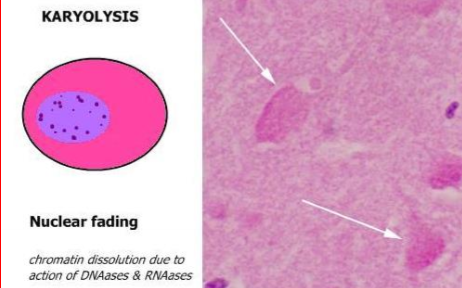
Karyolysis - dissolving of chromatin
Pyknosis - nuclear shrinkage
Karyorrhexis - pyknotic nucleus undergoes fragmentation
Karyolysis
Nuclear fading
Chromatin dissolution
Pyknosis
Nuclear shrinkage
DNA condenses into shruken mass
Karyorrhexis
Nuclear fragmentation
Intrinsic factors of cellular injury
Genetic influences
Metabolic
Nervous system
Extrinsic factors of cellular injury
Viruses
Temperature
Radiation
Chemicals
Bacteria
Intrinsic Pathway
Mitochondrial pathway
Extrinsic Pathway
Death receptor pathway
receptor-ligand relations
Principal Mechanisms of Cell Injury
Oxygen Deprivation and Chemical Agents
Hypoxia, ischemia, multiple injurious stimuli
Infectious Agents
Mutations, cell stress, infections
Physical Agents
Radiation
Immunologic Reactions
Infections, immunologic disorders

ROS 3 Main Pathological Effects
Lipid Peroxidation
Protein modification
DNA damage
These lead to necrosis
5 general causes of cellular injuries
Oxygen deprivation
Chemical agents
Immunologic reactions
Physical agents
Aging
Oxygen deprivation
Hypoxia - oxygen deficiency
Cyanide
Carbon monoxide
Ischemia - loss of blood supply and/or nutrients
Chemical Agents
Membrane permeability, cell metabolism
Air pollutants (ozone)
Insecticides
Asbestos (ROS)
Therapeutic drugs
Ethanol (-OH)
Sterilization of implantable devices
Ethylene Oxide
One of the most commonly used sterilization methods
For products that can’t tolerate heat, moisture, chemicals, etc.
Toxic Effects:
MUTAGENIC from chronic exposure
Alkylating agent (irritating, sensitizing, narcotic effects)
Sterilization of implantable devices methods
Autoclave vs Gas
Ethylene Oxide
Microwaves
Formaldehyde gas
Hydrogen peroxide plasma
Ozone gas
Chemical solutions
Ionizing radiation
Immunologic Reactions
Defends against pathogens but can turn on self
Ex: hypersensitivity
Physical Agents
Trauma (blasts, bullets, etc.)
Extremes of temperature
Radiation
Electric shock
Sudden changes in atmospheric pressure
Caisson’s Disease/The Bends