Chpt 1 - Intro to International Marketing
 Call Kai
 Learn
Learn Practice Test
 Spaced Repetition
 Match
Match Flashcards
 Knowt Play
1/48

There's no tags or description
Looks like no tags are added yet.
Name | Mastery | Learn | Test | Matching | Spaced | Call with Kai | Chat |
|---|
No analytics yet
Send a link to your students to track their progress
49 Terms
what is marketing?
Marketing is the activity, set of institutions, and processes for creating, communicating, delivering, and exchanging offerings that have value for customers, clients, partners, and society at large. (AMA, 2017)
core concepts of marketing
marketing mix
market segments
exchange (what do we give? what do we get in return?)
building relationships
CREST model
• Competition (how to competitors impact our 4 p’s)
• Regulatory/Political/Legal (how do laws impact 4 p’s)
• Economic (how does economy impact 4 p’s)
• Sociocultural (how does culture impact 4 p’s)
• Technological (how does tech impact 4’s)
how do we focus on customer needs and wants?
Successful marketing is focused on customer needs and wants, and developing programs that engage consumers and inspire customer loyalty
Need occurs when a person feels deprivation or dissatisfaction
Want is a need that is shaped by a person’s knowledge, culture, and personality
A principal activity is to research consumers to understand what they need and want, and the forces that shape those needs and wants
the value chain is composed of what? what is the essence of marketing?
marketing, product design, manufacturing, and transportation logistics.
essence of marketing is to provide a superior value proposition to surpass the competition
value chain equation
perceived value = benefits/costs
benefits must outweigh costs in order for consumer to see value
how do we increase the value of a product?
improve benefits
reduce price
improve product
find new distrib channels
create better communication
cut monetary and nonmonetary costs and prices
utilitarian value
derived from a product that helps the consumer with some task
can provide a clearly rational explanation for the purchase.
Actions that provide utilitarian value are worthwhile because they provide a means to an end.
Actions provide value because the object or activity allows something else good to happen or be accomplished.
eating broccoli for nutrition
hedonic value
derived from the immediate, positive gratification that comes from some activity
The value is provided entirely by the actual experience and emotions associated with consumption, not because some other end is or will be accomplished.
Often associated with feelings of pleasure, excitement, escape, or fantasy
hedonic and utilitarian value are not
mutually exclusive
The best consumer experiences are those that provide both high utilitarian value and high hedonic value – dining in dark restaurants provides both the hedonic experience and the utilitarian need for nourishment
origin of global marketing
• International trade has existed for centuries
• Great Britain dominated the world economy
• Following World War II, a new era began
• Four decades ago, the phrase global marketing did not exist
• Today, global marketing helps companies realize their full commercial potential
global marketing
the scope of activities outside the home country market
marketers encounter unique or unfamiliar features in countries or regions, like bribery and counterfeiting, piracy and corruption
why do companies need to adopt global marketing?
for survival.
A management team that fails to understand the importance of global marketing risks losing its domestic business to competitors with lower costs, more experience, and better products.
what is the fundamental difference between regular marketing and global marketing?
the scope of activities
product/market growth matrix

market penetration strategy
existing markets and existing products
Grow share in places you already operate.
Starbucks is building on its loyalty card and rewards program with a smartphone app that enables customers to order in advance and pay for purchases electronically. For in-store purchases, the app displays a bar code that the customer can scan. And loyal customers eagerly await the return of Pumpkin Spice Latte each fall.
market development strategy
new markets and existing products
Find new buyers in new areas or demographics.
Starbucks entered Italy in 2018, starting with a 25,000-square-foot flagship Reserve Roastery in Milan. Walking distance from the landmark Duomo, the Roastery offers pastries by local bakery Princi as well as the aperitivo beverages that are so popular throughout Italy. Today, Starbucks has some two dozen stores in Italy.
product development strategy
existing market and new products
To attract new customers
Starbucks rolls out new flavors every year. For the non-coffee drinker, how about an Iced Gingerbread Oat Milk Chai?
diversification strategy
new markets and new products
Adding new products to attract new markets
In 2011, Starbucks dropped the word “Coffee” from its logo. Since then, the company has acquired a juice maker, Evolution Fresh; the Bay Bread bakery; and tea retailer Teavana Holdings.
An industry is global to the extent that
a company’s industry position in one country is interdependent with its industry position in another country
indicators of globalization include
1. Ratio of cross-border investment to total capital investment
cross border = 10 billion, total capital = 15 billion
ratio is that 2/3 of the business if global
2. Proportion of industry revenue generated by all companies that compete in key world regions
local = 10 billion
global market = 50 billion
ratio is that 1/5 is local
3. Ratio of cross-border trade to worldwide production
focus
concentration and attention on core business and competence
why are focus, value, and competitive advantage important?
• Value, competitive advantage, and focus are universal in their
relevance and guide marketing in any part of the world.
• Companies that understand and engage in global marketing can offer
more value to customers than those who do not.
pros and cons of globalization
– Hundreds of million of people have been lifted from poverty and joined the middle class
– Where globalization has raised wages, living standards have improved
– Not all gains from globalization have been evenly distributed
• We may be entering a new era of “globalization in reverse”
when people reject globalized brands and opt for the local one instead
single country marketing strategy vs GMS
single country marketing: Focuses on choosing a target market and developing a standard marketing mix.
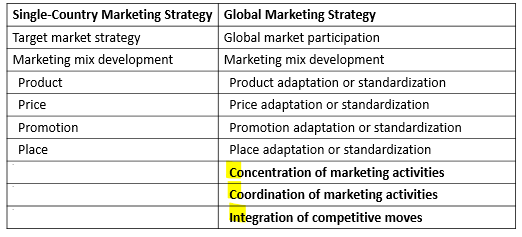
global marketing strategy
Managers at global companies understand the importance of local excellence.
• Marketing practices will vary from country to country
• An important managerial task is recognizing how much marketing plans can be extended worldwide and the extent to which adaptation is required.
• The way a company addresses this is a manifestation of its global marketing strategy (GMS)
global marketing strategy consists of what two things
Addresses target selection and the marketing mix on a global scale, specifically balancing two key choices:
1. Global Market Participation
2. Standardization vs. Adaptation
GMS: Global market participation
The extent to which a firm maintains operational presence across major world markets
GMS: standardization
homogeneous products—“one size fits all”
The degree to which each element of the marketing mix is executed identically (standardized)
GMS: customization/ adaptation
special products for every region
The degree to which each element of the marketing mix is executed tailored to local markets (adapted).
3 Strategic Management Dimensions of GMS
1. Concentration of Marketing Activities
2. Coordination of Marketing Activities
3. Integration of Competitive Moves
Concentration of Marketing Activities
The degree to which specific marketing mix activities (e.g., promotional creation, pricing decisions, product design) are centralized in one or a few global locations vs. decentralized across regions.
Coordination of Marketing Activities
The degree to which marketing mix activities across different country markets are planned and executed interdependently.
Integration of Competitive Moves
The extent to which a firm’s competitive tactics in one country market depend on or leverage tactics used in other global markets.
Ultimate Goal of GMS
To structure marketing decisions across borders so that total worldwide performance is maximized, rather than optimizing individual country units in isolation.
- Companies must understand that if they want to go global, they cant only have homogenous products, or they cant only customize their products. They must be global and local.
BRICS
long recognized countries as offering significant growth opportunities (Brazil, Russia, India, China, and South Africa)
MINTS
a new group with great potential (Mexico, Indonesia, Nigeria, and Turkey)
think ___/act ____
there is more to the story than “think globally, act locally.
Many companies are learning that it is equally important to think locally and act globally.
In practice, this means that companies are discovering the value of leveraging innovations that occur far from headquarters and transporting them back home.
examples of effective global marketing: mcdonalds
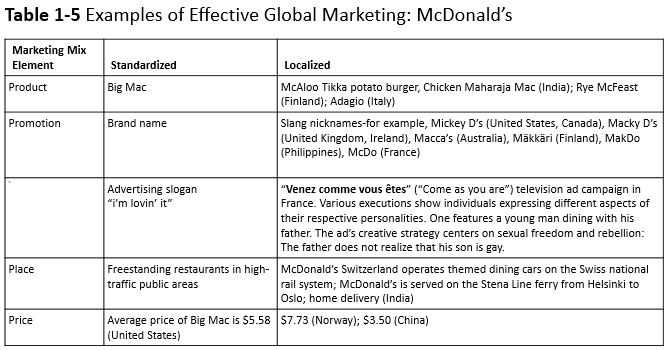
global marketing examples
For U.S. companies, 75% of total world market for goods and services is outside the country. US is the biggest national market.
• Coca-Cola earns 75% of operating income and 2/3 of profit outside North America
• For Japanese companies, 90% of world market is outside the country
• 94% of market potential is outside of Germany for its companies even though it is the largest EU market
driving forces affecting global integration and marketing
1. Regional economic agreements
2. Converging market needs and wants and the information revolution: some places drink more pop than water, making sure we get the pop to them
3. Transportation and communication improvements: flights, zoom meetings
4. Innovation and Entrepreneurship: ppl want new products and innovation
5. Product development costs: Product development costs are going down, its easier to create new products bc its cheaper to create
restraining forces affecting global integration and marketing
1. Management myopia and organizational culture: Management just saying they will only focus on locally, wont listen to local experts, their work culture is all about only doing well and not actually working locally
2. National controls: tariffs, quotas to protect national brands
3. Opposition to globalization: Don’t want international brands coming, small towns don’t want chains coming into the main street
EPRG framework
1. Ethnocentric
2. Polycentric
3. Regiocentric
4. Geocentric
ethnocentric orientation
– The lowest “level” or evolutionary stage in the EPRG framework: the conscious or unconscious belief that one's home country (e.g., home- country know-how, policies, products, etc.) is superior.
– arrogance, Sees only similarities in other countries
– Assumes products and practices that succeed at home will be successful everywhere
– Leads to a standardized or extension approach to marketing
polycentric orientation
– Each country is unique
– Each subsidiary develops its own unique business and marketing strategies. Results in high levels of marketing mix adaptation, often implemented by autonomous local managers
– Often referred to as multinational
– Leads to a localized or adaptation approach that assumes products must be adapted to local market conditions
axe in europe is called links, target market is the same
regiocentric orientation
– A region becomes the relevant geographic unit
– Management’s goal is to develop an integrated regional strategy
– Some companies serve markets throughout the world but on a regional basis
– Variant of the multinational model
– Example: Home Depot operates stores in the United States, Canada, and Mexico
geocentric orientation
– The fourth level in the EPRG framework: the understanding that market opportunities throughout the world are best exploited by means of a true GMS. Management recognizes that country markets may be characterized by both similarities and differences.
– A company operating with a geocentric orientation will use both extension and adaptation strategies.
– Entire world is a potential market
– Strives to develop integrated global strategies
– Known as either a global or transnational company
global company
• Typically, customers are able to associate a global company or its key brand(s) with the headquarters country
• A global company pursues marketing opportunities in all parts of the world using one of two strategies:
1. Pursues serving world markets from a single country; or
2. Sourcing globally to focus on select country markets
transnational company
• The most highly evolved organizational form. In a transnational company, a geocentric orientation prevails. A true transnational may be "stateless" in the sense that customers do not necessarily associate the company or its key brands with the headquarters country.
• A transnational company differs from a global company in its pursuit worldwide of marketing opportunity by fully integrating and coordinating two strategies: sourcing products from a variety of different countries AND serving multiple country markets across most world regions.
EX: IKEA, everyone knows its swedish