Pascal’s Triangle
 Call Kai
 Learn
Learn Practice Test
 Spaced Repetition
 Match
Match Flashcards
 Knowt Play
1/82

There's no tags or description
Looks like no tags are added yet.
Name | Mastery | Learn | Test | Matching | Spaced | Call with Kai | Chat |
|---|
No analytics yet
Send a link to your students to track their progress
83 Terms
Find the probability of the following:
flipping a coins and it landing heads up
½ (independent)

In this unit, you either win or lose. No in between.


Find the probability of the following:
rolling a single 6-sided die and it landing on the number 4
1/6 (independent)

Find the probability of the following:
rolling a single single 13-sided die (labeled 1-13) and it landing on an odd number
7/13 (independent)
What is the probability formula?
(# favorable outcomes) / (# of total outcomes)

Imagine a chip started at the peak of the triangle, and imagine that it hit each peg until it reached the bottom.
Each number under (grey boxes→flip) represents the number of ways a chip can get to that stop from the _____ point peak.
How do you determine the number of ways the chip can reach that spot?
starting
To find the number of ways, add the path(s) that lead directly to it.


What is the probability that if you launch your chip from point E, you will land on 10,000?
252/ 1020 → 21/85
favorable outcomes/ total outcomes

What is the probability that if you launch your chip from point E, you will land on 10,000?
252/ 1020 → 21/85
favorable outcomes/ total outcomes


For each row, alternate between - and + when you total the entries, always starting with subtraction.
(For example, - 1 + 4-6 + 4-1 ). What is the pattern in the total for each row?
It will always be equal to zero


For each row, square all the entries then add them up. Find the location where the sum lies in the triangle. What type of geometric shape is formed if you connect the ends of the row (the 1s) to each other and to the number containing the sum?
1+1 =2 (middle line, hexagon below it)
1+3+3+1= 6 (middle line, hexagon below it)

Pick any "1" on the edge as your starting point.
From your starting point, add the entries going diagonally downward (deeper into the triangle) until you want to stop. Is the sum an entry in close proximity to the numbers you just added? Describe its location as precisely as possible.
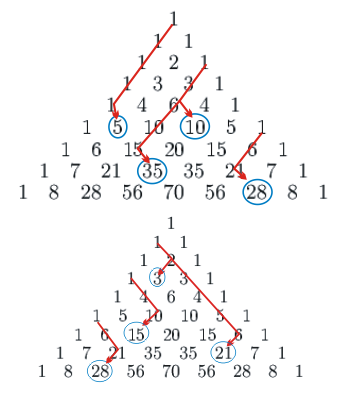
You decide to order from the new pizza place down the street. Unfortunately, the new establishment only has 4 toppings to offer: Anchovies, Broccoli, Cabbage, and Duck meat. Thus, you could order something like ABD or just B, etc. By listing out the possibilities, how many ways are there of ordering:
i) Only one type of topping?
ii) Two different toppings?
iii) All four toppings
i) 4
ii) 6
iii) 1

Solve using Desmos and Ti-84:
For Desmos... tap on the "functions" menu near the lower left corner. Scroll to the very bottom and tap on the
"nCr" option. Fill in the rest so that your entry looks like this: nCr(3,1).
For the TI-84...press the MATH key (below the ALPHA on the left, arrow over to PROB, arrow down to 3:
nCr, then enter in the subscripts as indicated in the problems.
- On your calculator, you will need to type the left subscript first, then the nCr, command, then the right subscript. The first problem will look like this on your calculator screen: 3 nCr 1
Describe the nCr trend on Pascal’s triangle!
n= row
r= diagonal number

What is S{17} on Pascal’s triangle?
The sum 17th row from the top.
If I have 6 cookies, how many different cookie cakes can i make picking three toppings?

A restaurant has 10 options, and I want 2 toppings. How many different plates can I make?

How do you do “nCr” In each of of the three calculators?

What is a combination? Does order matter?
n= number of total objects
r= number of objects chosen at once
0≤ r ≤ n

How do you find 4C1 in Pascal’s triangle?

T/F:
In Combinations (nCr), the n value will always be greater then the r value.
True!
You have more “total numbers” than “ways”

What are the first 6 “levels” of Pascal’s triangle?

What is a coefficient?
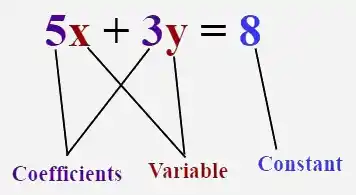
What is a binomial?

What is the “fast trick” to expanding BINOMIALS?
Given (a+b) ^5
starting with a^5, decrease by one each time in the exponent. (Here, until you reach zero).
starting with b^0, increase by one each time in the exponent. (Here, until you reach 5)
+ sign will always go in between terms because if you have a negative, the sign will automatically become negative!
____(a^5) (b^0) + ____(a^4) (b^1) + ____(a³) (b²)+ ____(a²) (b³)+ ____(a) (b^4) +________(a^0)(b^5)
The coefficients are that row of numbers. Here, the row = 5 (multiplicity)!
Row 5 of Pascal’s triangle: 1 5 10 10 5 1
1(a^5) (b^0) + 5(a^4) (b^1) + 10(a³) (b²)+ 10(a²) (b³)+ 5(a) (b^4) +1(a^0)(b^5)
simplify.
1(a^5) + 5(a^4) (b^1) + 10(a³) (b²)+ 10(a²) (b³)+ 5(a) (b^4) +1(b^5)
→ answer!
What is a, and what is b?
(n-1)³
n = a
(- 1) = b
What is a, and what is b?
(2x - y²)³
2x = a
(- y²) = b
What are my coefficients (all of them) for the binomial (a+b)^6 ?
1,6,15,20,15,6,1
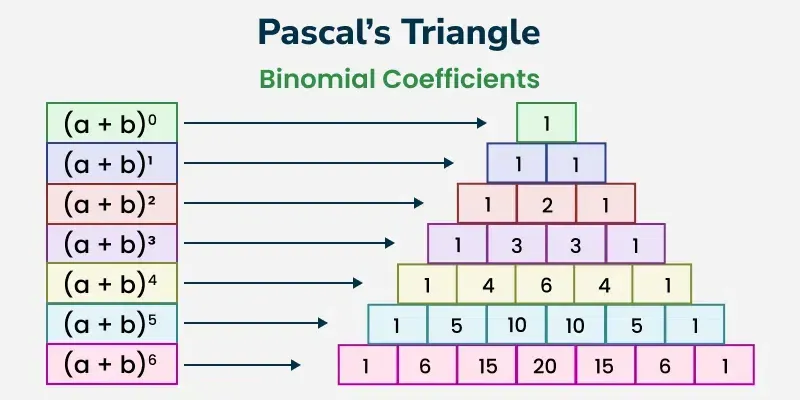

Factor this using the binomial expansion theorem.

When order is important, use the formula ___________
nPr
There are 9 lanes on the track at the Jesse Owens Memorial Stadium at OSU. If nine athletes compete in the 100-meter dash, how many different ways can they finish the race? Stated differently, in how many different orders can they finish 1-9?
9P9 = 362880

What is factorial notation?


Notice, factorial ends at #1.
How do you do factorial on your calculators?

How do you divide factorials without calculators?


What are the combinations of the 1st, 2nd, and 3rd rows?

Given (3x-4)^7, find the coefficient of the term containing x^4.
Find the term (a or b) that has the “x”
In this case, a has x, so put the “a” term to the fourth power.
Raise the b-value to (exponent minus a-exponent). Here, 7-4=3
Raise b to the third power.
Find coefficient by doing nCr where n is your total multiplicity, and r is the multiplicity of either “new” a or b term.
Simplify by multiplying.

****Notice: If you add the exponents of the term 724(3x)²(4y)³… 2+3 =5
Matches the expanded form of (3x+4y)^5
For an _____ multiplicity (a+b)^4 for example, there will be a term when both an and b are raised to the same exponent!!!!!!
even

T/F:
Multiplicity of binomial = row of Pascal’s triangle = n [in nCr]
True
What is the “definition” (aka another way) to write the combination formula?

4C2 = four choose 2
When a situation involves _____possible outcomes, a binomial distribution can model the probabilities.
TWO


What is the probability of getting zero correct guesses?
P(X=0)=(4/5)³
The probability of getting zero correct guesses is (4/5)³ because there are three ways to get 0 correct guesses.
P(X=3), goal is to find correct answers
Means…
Out of x paths, the probability of getting 3 correct is…
The sum of all your probabilities will always equal ______
1

Factor out (4/5 + 1/5)³
1(4/5)³(1/5)^0 + 3(4/5)²(1/5) + 3(4/5)(1/5)² + 3(1/5)³
Then simplify
How do you get coefficients?
C
Total paths/ways. The desired paths/ways

What does “fair” mean?
It is equally likely to land one way or another
Example: a “fair” coin is equally likely to land heads or tails, regardless of past observations.
Why is there a difference?
Getting exactly 10 tails on 20 flips
Getting exactly 1000 tails on 200 flips
P(getting exactly 10 tails on 20 flips) = 0.17619
P(getting exactly 1000 tails on 200 flips)= 0.0563
This is because as your sample size increases, your probability will decrease!
larges sample size = more outcome possibilities/ “ways”→ less likely (lower probability) to get a specific answer.
more probabilities/ ways of what could happen for larger sample size.
nCr
What does n mean?
The row of Pascal’s triangle, or the multiplicity of a binomial term
T/F:
In nCr, n and r must be whole numbers
TRUE!!
In the world of probabilities, “at least”/ “no more” then involves adding probabilities together to get your answer.
In the world of probabilities, “exactly” means you need to find your probability, then be done. (No extra work).
Out of 4 kids, “at least 1 will have blue eyes.”
You’re searching for the probability of having a child with blue eyes (1/4).
What is the fastest way to solve?
First, the P of having at least one kid with blue eyes = P(x=1,2,3,4), and add.
To make this faster, you know that the P of having no kids with blue eyes=0 [P(X=0)].
So, you can do 1– P(x=0) to get the P of 1,2,3,4 kids with blue eyes.
Essentially:
Write the probability of no correct guesses when the P of a correct guess is (1/5) to of three trials.
3C0 (4/5)³(1/5)^0
→ 1 (4/5)³
3C0 = nCr = [total trials/ ways ~C~ r = multiplicity of either correct or incorrect] (your choice).
Remember that the two different multiplicities must sum to the total trials/ways/ row #
Why is nCr important?
It shows you how many different ways you can get a possible outcome like “one correct” for example.
think of the tree diagram
Out of 12 light bulbs, at least two are defective. solve for the probability that at least two are defective id the probability of defective = 1/50.

What is n+1-1?
n
if you had (), then it would be multiplication.

Given 210a²b³ , the coefficient of which other term is the same?
flip multiplicities!
210a³b³
What is expected value?
Mathematically, the Expected Value is like the weighted average of all possible outcomes (like the warm-up!). The "weight" of each outcome is the probability of that outcome.

What is weighted average?
Probability of winning x dollars * x dollars

What is the expected value formula?

Expected value involves MANY tries!!
Expected value:
Think of a coin flip. Heads you win two dollars, tails you win nothing.
The expected value is one dollar. Not because you’ll ever actually get one dollar on a single flip — you’ll get two or zero.
But if you flip a hundred times, you’ll land heads about fifty times, so you’ll walk away with roughly a hundred dollars total.
Divide that by a hundred flips and you get one dollar per flip.
That’s the expected value — the average you land on when you zoom out.
Expected value: “lose” x dollars=__
Negative number
Ex: 500(1/5)+ 202(3/5) -350(1/5)
T/F:
Your expected value represents the average amount of “money/etc” for EACH game.
True

if your expected value represents the average amount of “money” for EACH game is $3.00, what will be the expected “gain” if it costs $5 to play each game?
Expected return/average (per game) — cost to play each game
$3 - $5 =$-2.00, you can expect to lose -$2.00 per game played (After many games)!!
Can averages (expected value) be decimals?
YES!!!!

What is the binomial probability distribution?
NOT in money scenarios
For scenarios where you are guessing the average number of number of trials * probability success
**THIS WORKS WHEN THERE IS A CONSTANT PROBABILITY [of winning or losing]!
![<ul><li><p>NOT in money scenarios</p></li><li><p>For scenarios where you are guessing the average number of number of trials * probability success</p></li><li><p>**THIS WORKS WHEN THERE IS A CONSTANT PROBABILITY [of winning or losing]!</p></li></ul><p></p>](https://assets.knowt.com/user-attachments/08bb72a3-d0f7-477d-abcd-8a76fede4439.heic)
Define what expected value means…
After MANY trials from the center of the planks board, a person can expect to make (gain OR lose) about “$3” per chip/each game
In probability, “AND” means…
Multiply probabilities (with nCr) together
In probability, “OR” means…
Add probabilities (with nCr) together
Is Pascal’s triangle symmetrical?
Yes
What is the probability formula?
Favorable outcomes/ total outcomes = P
Common expected value problem:
(Money * probability) + (Money * probability) +… = expected value average (either positive gain or negative loss) per game.
→ moreover, if each game was 5toplay,youwoulddoyourexpectedvalue() and subtract it by the $5 required to play the game!

What’s a faster way to solve?
**THIS WORKS BECAUSE THERE IS A CONSTANT PROBABILITY [of winning or losing]!
![<p>**THIS WORKS BECAUSE THERE IS A CONSTANT PROBABILITY [of winning or losing]!</p>](https://assets.knowt.com/user-attachments/49400525-6058-417c-b88e-8f98284b7ac4.heic)
Jackpot = _____winner(s)
1 winner


Expected value!