A-Level Biology - 3.7.2 Populations
 Call Kai
 Learn
Learn Practice Test
 Spaced Repetition
 Match
Match Flashcards
 Knowt Play
1/7

There's no tags or description
Looks like no tags are added yet.
Name | Mastery | Learn | Test | Matching | Spaced | Call with Kai | Chat |
|---|
No analytics yet
Send a link to your students to track their progress
8 Terms
What is a population?
a group of organisms of the same species
occupying a particular space at a particular time
that can potentially interbreed.
What is a species?
two organisms belong to the same species if they are able to mate to produce fertile offspring
What is a gene pool?
all the alleles in a population
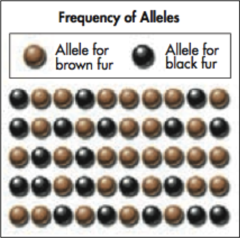
What is allele frequency?
number of times an allele occurs in a gene pool, compared to the total number of alleles in that pool for the same gene
i.e.
number of specific allele/total number of alleles for that gene
What is the Hardy-Weinberg principle?
a mathematical model which predicts that allele frequencies will not change from generation to generation
(if certain conditions are met)
Under what conditions does the Hardy-Weinberg principle apply?
1) mutation is not occurring
2) natural selection is not occuring
3) population is infinitely large
4) all members of the population breed (no selection)
5) all mating is random
6) all individuals produce the same number of offspring
7) no migration in or out of the population
Give the Hardy-Weinberg equation
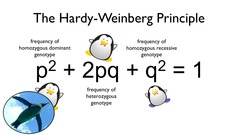
p² + 2pq + q² = 1
p is the frequency of one (usually dominant) allele
q is the frequency of the other (usually recessive) allele
What do p², 2pq, and q² represent in the Hardy-Weinberg equation?
p² = frequency of homozygous dominant genotype
2pq = frequency of heterozygous genotype
q² = frequency of homozygous recessive genotype