Redox
 Call Kai
 Learn
Learn Practice Test
 Spaced Repetition
 Match
Match Flashcards
 Knowt Play
1/31

There's no tags or description
Looks like no tags are added yet.
Name | Mastery | Learn | Test | Matching | Spaced | Call with Kai | Chat |
|---|
No analytics yet
Send a link to your students to track their progress
32 Terms
Definition: Redox Reaction
Electron transfer reactions where reduction and oxidation occur simultaneously
Definition: Reduction
Gain of electrons, gain of hydrogen, loss of oxygen and decrease in oxidation number of an atom
Zn(s) + Cu2+(aq) → Zn2+(aq) + Cu(s)
oxidation → oxidation of Zn increases from 0 to +2
Definition: Oxidation
Loss of electrons, loss of hydrogen, gain of oxygen and increase in oxidation number of an atom.
Zn(s) + Cu2+(aq) → Zn2+(aq) + Cu(s)
reduction → oxidation of Cu decreases from +2 to 0
Definition: Reducing Agent
Substance that loses one or more electrons, undergoes oxidation, and has an increase in oxidation number. It causes other atoms to undergo reduction.
Definition: Oxidising Agent
Substance that gains one or more electrons, undergoes reduction, and has a decrease in oxidation number. It causes other atoms to undergo oxidation.
Definition: Oxidation Number
Number of electrons which the atom loses / gains or tends to lose / gain when it forms a substance
Positive → tends to lose
Negative → tends to gain
Memorise: Format for answering Redox Reaction
The oxidation state of Br increases from -1 in KBr to 0 in Br2. Hence, KBr is oxidised. The oxidation state of Cl decreases from 0 in Cl2 to -1 in KCl. Hence, Cl2 is reduced. Since reduction and oxidation occur simultaneously, the reaction is a redox reaction.
The oxidation number of an atom in an element is always ___.
Na, Mg, Fe, P4, O2
zero
The oxidation number of a monatomic ion is equal to ___
the charge on the ion
Ba2+ = +2
Group 1 elements’ oxidation number is always ___
+1
Group 2 elements’ oxidation number is always ___
+2
Group 13 elements’ oxidation number is always ___
+3
F oxidation number is always ___
-1
H oxidation number is ___ EXCEPT in ….
+1
-1 in metal hydrides, NaH, CaH2
O oxidation number is ___ EXCEPT in ….
-2
-1 in peroxides
+2 in OF2
In a neutral compound, the sum of the oxidation numbers are ___
zero
Al2O3 +3, –2 | 2(+3) + 3(–2) = 0 |
In a polyatomic ion, the sum of the oxidation numbers is equal to the ____.
charge
Cr2O72- +6, –2 | 2(+6) + 7(–2) = –2 |
Definition: Electronegativity
A measure of an atom’s ability to attract electrons in a covalent bond.
Higher electronegativity = Greater attraction for electrons
Higher electronegativity tends to …. shared electrons.
attract
Electronegativity increases … and decreases …
It increases across the period and decreases down the group.
Fluorine = Most electronegative
Oxygen = Second Most electronegative
Memorise: Oxidation States of Ions
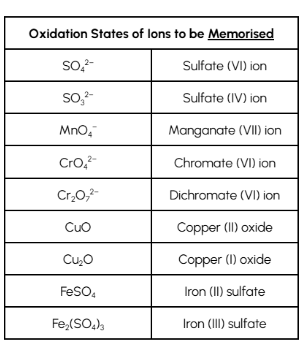
Definition: Disproportionation Reaction
Redox reaction where atoms of an element in a single substance undergo reduction and oxidation simultaneously.
Memorise: Format for answering Disproportionation Reaction
The oxidation state of Cl increases from 0 in Cl2 to +1 in ClO-. Hence, Cl2 is oxidised. The oxidation state of Cl decreases from 0 in Cl2 to -1 in Cl-. Hence, Cl2 is reduced. Since Cl2 is both oxidised and reduced simultaneously, the reaction is a disproportionation reaction.
Memorise: Balancing / Forming Redox Equations
If it is in an acidic medium, use H+ ions to balance hydrogen and H2O to balance oxygen. If it is in a basic medium, after using H+ ions to balance hydrogen, use OH- ions to balance hydrogen and H2O to balance oxygen.
Use the acronym (Apple of Her Eye)
A – Balance all elements other than hydrogen and oxygen
O – Balance oxygen by adding H2O
H – Balance hydrogen by adding H+ (for acidic) / OH- (for basic)
E – Balance electrons
Example: Ion Electron Half-Equation
Example 1
Cr2O72- + I- → Cr3+ + I2 (reaction done in acidic medium)
+6 –1 +3 0
Write half equations containing reactants and products of the species that have undergone oxidation and reduction.
Cr2O72- → Cr3+ [reduction]
I- → I2 [oxidation]
Balance the equations for the elements that have undergone a change in oxidation state.
Cr2O72- → 2 Cr3+
2 I- → I2
Balance the equations for oxygen by adding H2O.
Cr2O72- → 2 Cr3+ + 7 H2O
2 I- → I2
Balance the equations for hydrogen by adding H+.
14 H+ + Cr2O72- → 2 Cr3+ + 7 H2O
2 I- → I2
Balance the equations for the charge by adding electrons.
14 H+ + Cr2O72- + 6e → 2 Cr3+ + 7 H2O [reduction = gain electrons / add e to left side]
2 I- → I2 + 2e [oxidation = lose electrons / add e to right side]
Multiply with the appropriate values such that the number of electrons for both equations are equal.
14 H+ + Cr2O72- + 6e → 2 Cr3+ + 7 H2O
2 I- → I2 + 2e (x3)
= 6 I- → 3 I2 + 6e
Combine to eliminate the electrons. (i.e. total electrons lost due to oxidation = total electrons gained for reduction). The final equation can now be obtained.
14 H+ + Cr2O72- + 6 I- → 2 Cr3+ + 7 H2O + 3 I2
Example 2
MnO4- + SO32- → MnO2 + SO42- (reaction done in aqueous alkaline medium)
+7 +4 +4 +6
Similar steps with acidic medium (1 – 6)
3e + 4 H+ + MnO4- → MnO2 + 2 H2O [reduction]
SO32- + H2O → SO42- + H+ + e (x3)
= 3 SO32- + 3 H2O → 3 SO42- + 3 H+ + 3e4 H+ + MnO4- + 3 SO32- + 3 H2O → MnO2 + 2 H2O + 3 SO42- + 3 H+
Add OH- to both sides to neutralize any H+ present.
4 OH- + 4 H+ + MnO4- + 3 SO32- + 3 H2O → MnO2 + 2 H2O + 3 SO42- + 3 H+ + 4 OH-
= 4 H2O + MnO4- + 3 SO32- + 3 H2O → MnO2 + 2 H2O + 3 SO42- + OH- + 3 H2O
Cancel out the extra H2O by adding / subtracting to obtain the final equation.
4 H2O + MnO4- + 3 SO32- + 3 H2O → MnO2 + 2 H2O + 3 SO42- + OH- + 3 H2O
= 7 H2O + MnO4- + 3 SO32- → MnO2 + 3 SO42- + OH- + 5 H2O
= 2 H2O + MnO4- + 3 SO32- → MnO2 + 3 SO42- + OH-
Example: Change in Oxidation Number
Example 1
Cr2O72- + SO32- → Cr3+ + SO42- (reaction done in acidic medium)
+6 +4 +3 +6
Identify the atoms that have undergone a change in oxidation number.
Find the change in oxidation number, and hence the number of moles of electrons transferred for each reactant.
For Cr2O72- to Cr3+, there is a reduction of Cr from +6 to +3, which means 3 electrons were transferred. However, since the compound has Cr2, to find electrons transferred per mole, we have to calculate 3 x 2, meaning 6 electrons transferred per mole.
For SO32- to SO42-, there is an oxidation of S from +4 to +6, which means 2 electrons transferred per mole.
Balance the atoms that have undergone redox change. Cross multiply the 2 numbers so that total number of electrons gained = total number of electrons lost, and electrons are balanced.
Cr2O72- | SO32- | |
Total number of moles of electrons transferred | 6 x 2 = 12 (6 Cr) | 2 x 6 = 12 (2 S) |
Use the moles of electrons transferred on the left side, and balance the other side normally.
2 Cr2O72- + 6 SO32- → 4 Cr3+ + 6 SO42-
Balance the rest of the atoms not involved in redox. Then, balance the charge by adding H+ (acidic), and balance oxygen and hydrogen by adding H2O.
16 H+ + 2 Cr2O72- + 6 SO32- → 4 Cr3+ + 6 SO42- + 8 H2O
Example 2
MnO4- + NO2- → MnO2 + NO3- (reaction done in aqueous alkaline medium)
+7 +3 +4 +5
Similar steps with acidic medium (1 – 4)
2 MnO4- + 3 NO2- → 2 MnO2 + 3 NO3-
Balance the rest of the atoms not involved in redox. Then, balance the charge by adding OH- (basic), and balance oxygen and hydrogen by adding H2O.
H2O + 2 MnO4- + 3 NO2- → 2 MnO2 + 3 NO3- + 2 OH-
Example: Deducing Unknown Oxidation States
A metallic ion, Ym+ is oxidised to YO4- by Cr2O72- in acidic medium. If 3.50 × 10⁻³ moles of Ym+ require 1.00 × 10⁻³ moles of Cr2O72- for complete oxidation, determine m, and construct the balanced equation for the reaction.
Write down the known half equation.
14 H+ + Cr2O72- + 6e → 2 Cr3+ + 7 H2O
Y’s oxidation number in YO4- would be +7.
Determine the number of moles of the two reactants involved in the redox reaction.
Amount of Ym+ = 3.50 x 10⁻³ mol
Amount of Cr2O72- = 1.00 x 10⁻³ mol
Write down the mole ratio between the 2 reactants. Determine the number of moles of electrons gained (or lost) by 1 mol of the other reactant, and hence, determine the original or final oxidation number.
1 mol of Cr2O72- gains 6e while 1 mol of Ym+ loses (7 – m) e.
Since, total electrons lost = total electrons gained;
3.50 x 10-3 x (7 – m) = 1.00 x 10-3 x 6
7 - m = 1.7143
- m = - 5.2857
m = + 5.2857
m ~ +5
Write down the final equation.
Cr2O72- + 3 Y5+ + 14 H+ → 2 Cr3+ + 3 YO4- + 7 H2O
Memorise: Common Oxidising Agents and What They Reduce to:
MnO4- Manganate (VII) Purple | Mn2+ Manganese (II) [acidic] Pale Pink / Colourless |
MnO2 Manganese dioxide [alkaline] Brown PPT | |
Cr2O72- Dichromate (VI) Orange | Cr3+ Chromium (III) Green |
IO3- Iodate (V) Colourless | I2 (aq) Iodine Brown |
I2 (aq) Iodine Brown | I- Iodide Colourless |
Fe3+ Iron (III) Pale Yellow | Fe2+ Iron Pale Green |
H2O2 Hydrogen peroxide | H2O Water Vapour Colourless |
NO2- Nitrate (III) or Nitrite Colourless | NO (g) Nitric Oxide Colourless |
Memorise: Common Reducing Agents and What They Oxidise to:
Reducing Agents | Oxidised to |
C2O42- Ethanedioate Colourless | CO2 Carbon dioxide |
S2O32- Thiosulfate | S4O62- Tetrathionate |
H2O2 Hydrogen Peroxide Colourless | O2 |
NO2- Nitrite Colourless | NO3- Nitrate (V) |
Cl- Colourless | Cl2 Pale Yellow |
Br- Colourless | Br2 Orange |
I- Colourless | I2 (aq) Brown |
Fe2+ Pale Green | Fe3+ Pale Yellow |
#H2O2 and NO2- are (oxidising/reducing) agents.
BOTH OXIDISING AND REDUCING
If it is on the left, it is an oxidising agent but if it is on the right, it is a reducing agent. MnO4- becomes Mn2+ in acidic, and MnO2 in basic solutions. H2O2 becomes H2O in acidic, and O2 in basic.
Potassium Manganate (VII) Titration:
The KMnO4 is placed in the burette and added to the reducing agent in the conical flask. MnO4- titrations are carried out in ______ and ______ is added in excess to the reducing agent in the conical flask. HCl and HNO3 cannot be used because ______________, and also because _______. Common reducing agents that react with MnO4- are Fe2+, H2O2, C2O42-.
acidic medium
1 mol dm-3 sulfuric acid
the Cl- from HCl can be oxidised by MnO4-
HNO3 itself is an oxidizing agent
Iodometric / Iodine-Thiosulfate Titration
Iodometric titration is used to determine the concentration of iodine or substances which liberate iodine from potassium iodide, KI, such as potassium iodate (V), KIO3. The amount of iodine liberated can be determined by titrating with thiosulfate, S2O32-, as iodine will always react with thiosulfate.
The Oxidation and Reduction Equations are: _____________
There are two steps to an iodometric titration.
An oxidising agent is normally added to excess acidified KI to liberate I2. [The colour, _____, is usually observed]
The liberated iodine is then estimated by titration using a standard thiosulfate, S2O32-.
The brown colour of iodine fades to _____. A _______ is added at this stage to give a ______ coloration due to formation of starch-iodine complex. Addition of ______ drop-by-drop continues until the blue black colour disappears. A _______ solution remains.
Oxidation: 2 S2O32- → S4O62- + 2e
Reduction: I2 + 2e → 2I-
Brown
pale yellow
starch indicator
blue black
thiosulfate
colourless