Exam 4: Dynamic Programming
 Call Kai
 Learn
Learn Practice Test
 Spaced Repetition
 Match
Match Flashcards
 Knowt Play
1/33

There's no tags or description
Looks like no tags are added yet.
Name | Mastery | Learn | Test | Matching | Spaced | Call with Kai | Chat |
|---|
No analytics yet
Send a link to your students to track their progress
34 Terms
Algorithmic Paradigms
Greedy: Make the best local choice at each step
Divide & Conquer: Split into independent subproblems, solve, then combine
Dynamic Programming: Solve overlapping subproblems and reuse results (build up solutions)
Divide and Conquer Approach
Approach: Split into smaller independent subproblems → solve → combine
Subproblems: Non-overlapping (independent)
Examples: QuickSort, MergeSort, Binary Search
Performance: Analyzed with recursion trees + induction
Memory: No need to store subproblem results (unlike DP)
Dynamic Programming Approach
Approach: Solve overlapping subproblems (top-down memoization or bottom-up tabulation)
Subproblems: Overlapping → reuse stored results
Examples: Fibonacci, Knapsack, Longest Common Subsequence
Performance: Avoids recomputation → much faster than brute force
Memory: Uses extra space to store subproblem solutions
Divide and Conquer vs Dynamic Programming Key Differences
Subproblems:
D&C → Non-overlapping
DP → Overlapping
Memory:
D&C → No storage of subproblem results
DP → Stores results (memoization/tabulation)
Use Cases:
D&C → Sorting, searching, large number multiplication
DP → Optimization + counting problems
Weighted Interval Scheduling Basics
Job j
Start time sj
Finish time fj
Label jobs by finishing time f1 <= f2 <= … <= fn
Weight/Value vj
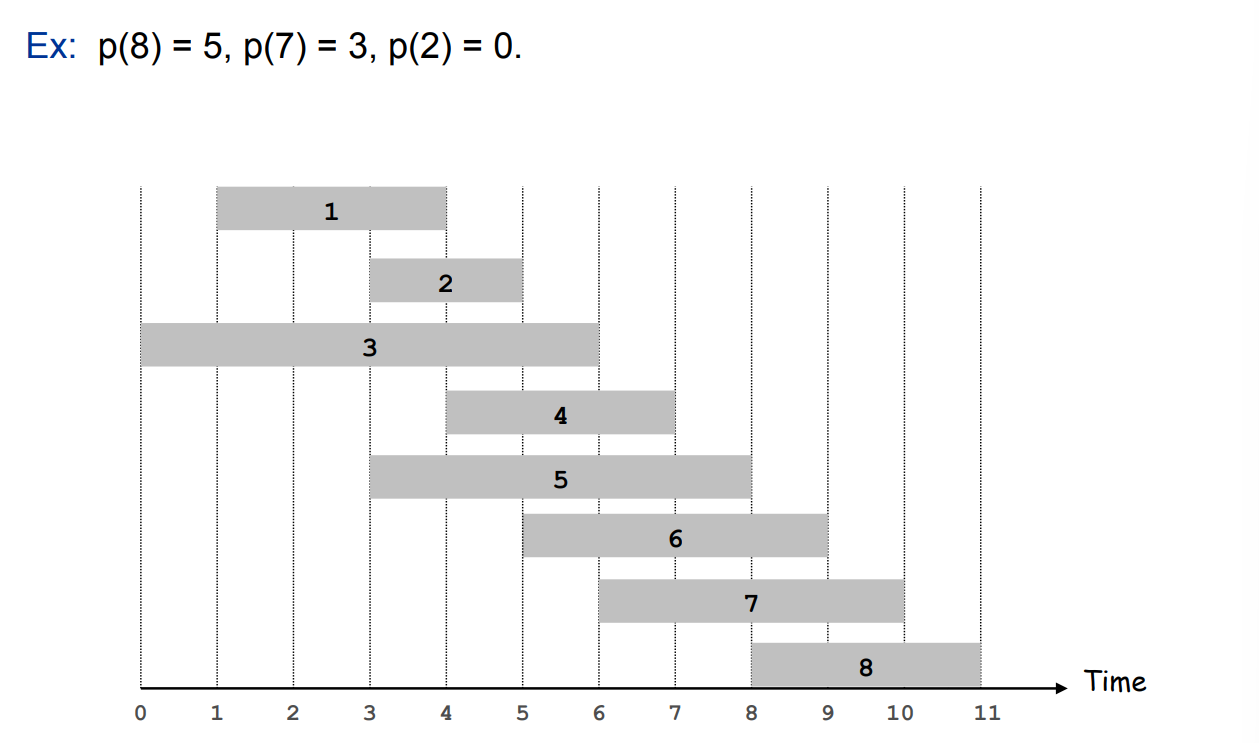
p(j) = the index of the latest non-overlapping job before j
Two jobs are compatible if they DON’T overlap
Goal: Find maximum weight subset of mutually compatible jobs
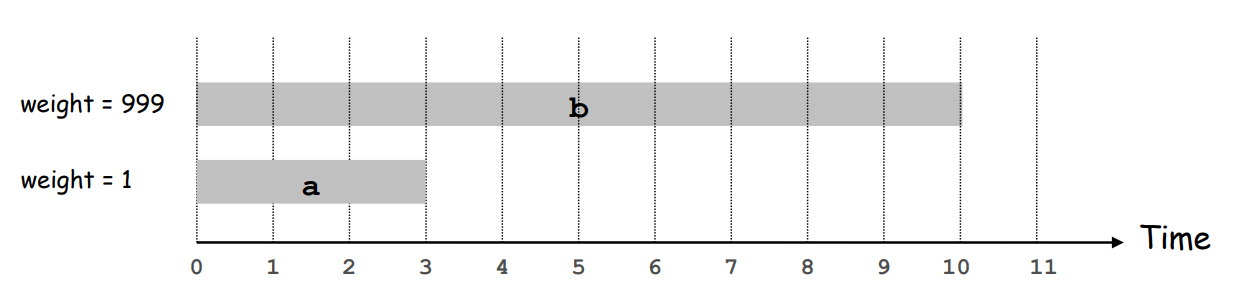
Why can’t we use greedy algorithm for weighted interval scheduling?
Greedy fails if arbitrary weights are allowed.
Earliest Finish Time doesn’t work anymore.
WIS Recurrence Equation + Cases
OPT(j) = Optimal value using job requests 1…j
Case 1: OPT selects job j
Add profit vj
Can't pick incompatible jobs between p(j)+1 and j-1
Add OPT(p(j))
Case 2: OPT skips job j
Take OPT(j-1)
Recurrence:
Key idea: For each job, decide whether to take it or leave it, combining with best compatible previous jobs

Weighted Interval Scheduling Algorithm: Brute Force
Input: n, s1, … sn, f1, …, fn, v1, …, vn
Sort jobs by finish times in ascending order
Compute p(1), p(2), …, p(n)
Compute-OPT(j){
if j == 0: return
else:
return max(vj + OPT(p(j), OPT(j-1))
}
PROBLEM: redundant sub-problems => exponential algorithms

Weighted Interval Scheduling Algorithm: Memoization
Key Idea: store results of each sub-problem in a cache
Sort jobs by finish times in ascending order
Compute p(1), p(2), … p(n)
Create an empty global array
If M[j] is empty, compute:
Either take job j → add its value + best value of compatible previous jobs (M[p(j)])
Or skip job j → take best value without it (M[j-1])
![<p>Key Idea: store results of each sub-problem in a cache</p><ul><li><p>Sort jobs by finish times in ascending order</p></li><li><p>Compute p(1), p(2), … p(n)</p></li><li><p>Create an empty global array</p></li><li><p>If M[j] is empty, compute:</p><ul><li><p>Either <strong>take job j</strong> → add its value + best value of compatible previous jobs (M[p(j)])</p></li><li><p>Or <strong>skip job j</strong> → take best value without it (M[j-1])</p></li></ul></li></ul><p></p>](https://assets.knowt.com/user-attachments/a5ebd91c-a921-4e06-b332-13160748b69a.png)
WIS: Running Time - Memoization
Claim: Memoized Algorithm takes O(n log n) time
Sort jobs by finish time → O(n log n)
Compute compatibility p(j)p(j)p(j) → O(n log n)
DP (memoized):
Each subproblem solved once → O(2 recursive calls *n) total
Overall: O(n log n)
ALREADY SORTED? O(n)
Weighted Interval Scheduling: Finding a Solution
Recover chosen jobs? Post-Processing
Start at j = n
If vj + M[p(j)] > M[j-1]:
→ take job j, go to p(j)Else:
→ skip job j, go to j-1Repeat until j = 0
Reconstructs jobs in O(n)
![<p>Recover chosen jobs? Post-Processing</p><ul><li><p>Start at j = n</p></li><li><p>If vj + M[p(j)] > M[j-1]:<br>→ take job j, go to p(j)</p></li><li><p>Else:<br>→ skip job j, go to j-1</p></li><li><p>Repeat until j = 0</p></li><li><p>Reconstructs jobs in O(n)</p></li></ul><p></p>](https://assets.knowt.com/user-attachments/700224f9-db39-49cc-b634-60e29397ce8d.png)
Weighted Interval Scheduling: Bottom Up
Compute DP table iteratively
Sort jobs by finish time
Compute p(j) for each job (last compatible job)
Initialize M[0] = 0
For j = 1 to n:
→ M[j] = max(vj + M[p(j)], M[j-1])Table M[1..n] stores optimal values iteratively
Reconstruct solution using take vs skip logic
![<p>Compute DP table iteratively</p><ul><li><p>Sort jobs by finish time</p></li><li><p>Compute p(j) for each job (last compatible job)</p></li><li><p>Initialize M[0] = 0</p></li><li><p>For j = 1 to n:<br>→ M[j] = max(vj + M[p(j)], M[j-1])</p></li><li><p>Table M[1..n] stores optimal values iteratively</p></li><li><p>Reconstruct solution using take vs skip logic</p></li></ul><p></p>](https://assets.knowt.com/user-attachments/799184fa-5184-43a9-ba87-883249083162.png)
Algorithm for Dynamic Programming Steps
Define OPT — what the optimal value represents
Define helper functions — e.g., p(j), compatibility checks
Write recursive OPT using these definitions
Decide data structures — arrays/tables to store subproblem results; initialize base cases
Pseudocode:
Base case
General case (use recursive formula or table update)
Optional: Determine if you need to reconstruct the solution from the DP table
Knapsack Problem
n objects
knapsack can carry W kilograms
Item i weighs wi > 0
Item i has value vi > 0
Goal: fill snapsack to maximize total value
Greedy: add maximum ratio of vi/wi, BUT NOT OPTIMAL
Dynamic Programming: False Start
Define OPT(i) = max profit subset of items 1…i
Case 1: OPT does not select item i → best of {1…i-1}
Case 2: OPT selects item i → can’t tell which previous items were chosen; may not fit
Conclusion: Need more subproblems to track additional info (e.g., remaining capacity)
Knapsack Recurrence Equation
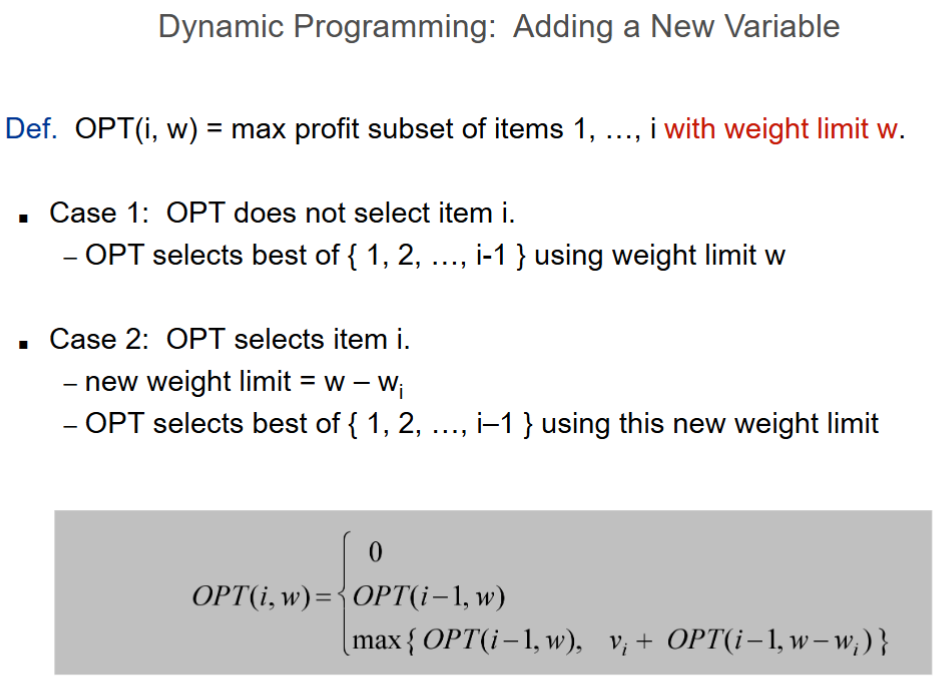
Define OPT(i, w) = max profit using items 1…i with weight limit w
Case 1: Do not select item i → OPT(i–1, w)
Item too heavy
Case 2: Select item i → MAX(OPT(i–1, w – wi) + vi, OPT(i-1, w)}
New weight limit = w - wi
OPT selects best
Knapsack Algorithm: Bottom Up
Input: n items, max weight W, each item has weight and value
Make a table M[i, w] = best value using first i items and weight ≤ w
Base case: 0 items → value 0
For each item:
If it’s too heavy, skip it
Else, pick the better of skipping or taking it
M[n, W] gives the maximum value achievable
![<ul><li><p>Input: n items, max weight W, each item has weight and value</p></li><li><p>Make a table M[i, w] = best value using first i items and weight ≤ w</p></li><li><p>Base case: 0 items → value 0</p></li><li><p>For each item:</p><ul><li><p>If it’s too heavy, skip it</p></li><li><p>Else, pick the better of skipping or taking it</p></li></ul></li><li><p>M[n, W] gives the maximum value achievable</p></li></ul><p></p>](https://assets.knowt.com/user-attachments/b32b98a9-c021-4b57-b41b-fc8e44344712.png)
Knapsack Algorithm: Finding a Solution
Post Processing
After filling table M, start at i = n, w = W
Compare M[i, w] to M[i-1, w]:
If equal → item i not included, move to M[i-1, w]
If M[i, w] = vi + M[i-1, w-wi] → item i included, output it,
move to M[i-1, w-wi]
Repeat until i = 0 or w = 0
This traces which items are part of the optimal solution
![<p>Post Processing</p><ul><li><p>After filling table M, start at i = n, w = W</p></li><li><p><strong>Compare M[i, w] to M[i-1, w]</strong>:</p><ul><li><p>If equal → item i <strong>not included</strong>, move to M[i-1, w]</p></li><li><p>If M[i, w] = vi + M[i-1, w-wi] → item i <strong>included</strong>, output it, </p></li><li><p>move to M[i-1, w-wi]</p></li></ul></li><li><p>Repeat until i = 0 or w = 0</p></li><li><p>This traces which items are part of the optimal solution</p></li></ul><p></p>](https://assets.knowt.com/user-attachments/fd6add1e-5a86-4c70-82de-263f33261e64.png)
Knapsack Problem: Running Time
Bottom-up DP table: Θ(n × W)
Not polynomial in input size (depends on numeric W) → called pseudo-polynomial
Decision version of Knapsack is NP-complete
There are polynomial-time approximation algorithms that can give solutions very close to optimal (e.g., within 0.01%)
Least Segmented Squares: Basics, How?, Objectives, Tradeoff function
n points: (x1, y1), (x2, y2), … (xn, yn)
Goal: find a line (y = mx+b) that minimizes the sum of the squared error (SSE)
How?
Partition points into segments
Fit a line to each segment
Objective:
Minimize E = total squared errors across all segments
Minimize L = number of line segments
Tradeoff Function:
E + cL, where constant c > 0

LSS Recurrence Equation
Notation:
OPT(j) = min cost for points p1 to pj
e(i, j) = min sum of squares for points pi to pj = error of fitting one line to points p1 to pj
c: penalty for adding a new line segment
To compute OPT(j):
Last segment = points pi, …, pj
Cost:
Cost = e(i, j) + c + OPT(i-1)
Recurrence:
In image

Segmented Least Squares: Algorithm
Input: n, p1, …, pn, c
Step 1: pre-compute least squares errors (of fitting a single line to points pi, …, pj)
Equals e(i, j), the cost of a segment from i to j
Step 2: DP array
minimum total cost for points p1 to pj
Compute recurrence equation: consider all starting points i for the last segment ending at pj
For each i, the total cost = error + penalty + optimal cost of prev points
Step 3: Return M[n]
Running time: O(n³)
O(n²) pairs × O(n) per e(i,j)
Return: M[n] = minimum total cost
![<p>Input: n, p1, …, pn, c</p><p>Step 1: pre-compute least squares errors (of fitting a single line to points pi, …, pj) </p><ul><li><p>Equals e(i, j), the cost of a segment from i to j</p></li></ul><p>Step 2: DP array</p><ul><li><p>minimum total cost for points p1 to pj</p></li><li><p>Compute recurrence equation: consider all starting points i for the last segment ending at pj</p></li><li><p>For each i, the total cost = error + penalty + optimal cost of prev points</p></li></ul><p>Step 3: Return M[n]</p><p><strong>Running time:</strong> O(n³)</p><ul><li><p>O(n²) pairs × O(n) per e(i,j)</p></li></ul><ul><li><p><strong>Return:</strong> M[n] = minimum total cost</p></li></ul><p></p>](https://assets.knowt.com/user-attachments/5b10e054-b707-49a4-85fc-82d5b662555f.png)
String Similarity - gaps vs mismatches
Mismatch = wrong letter
Gap = missing or extra letter
these values will vary for different alignments
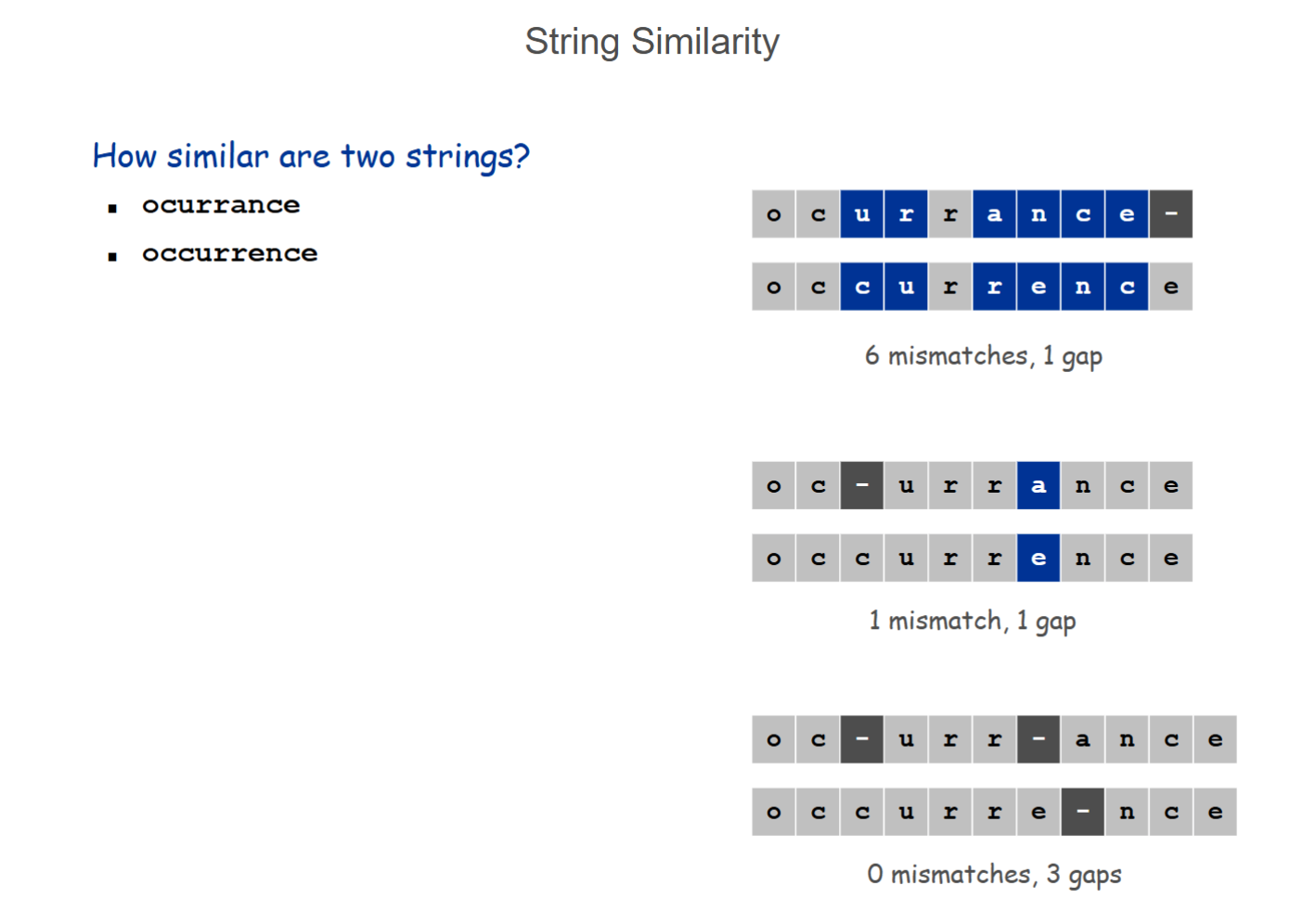
Sequence alignment Goals - Edit Distance Model
Measures the similarity between two strings
Uses two penalties:
Gap penalty δ
Mismatch penalty α_pq
p = char from first string
q = char from second string
penalty for aligned p WITH q
Cost = gap penalty + mismatch penalty
Goal: find alignment with the minimum total cost
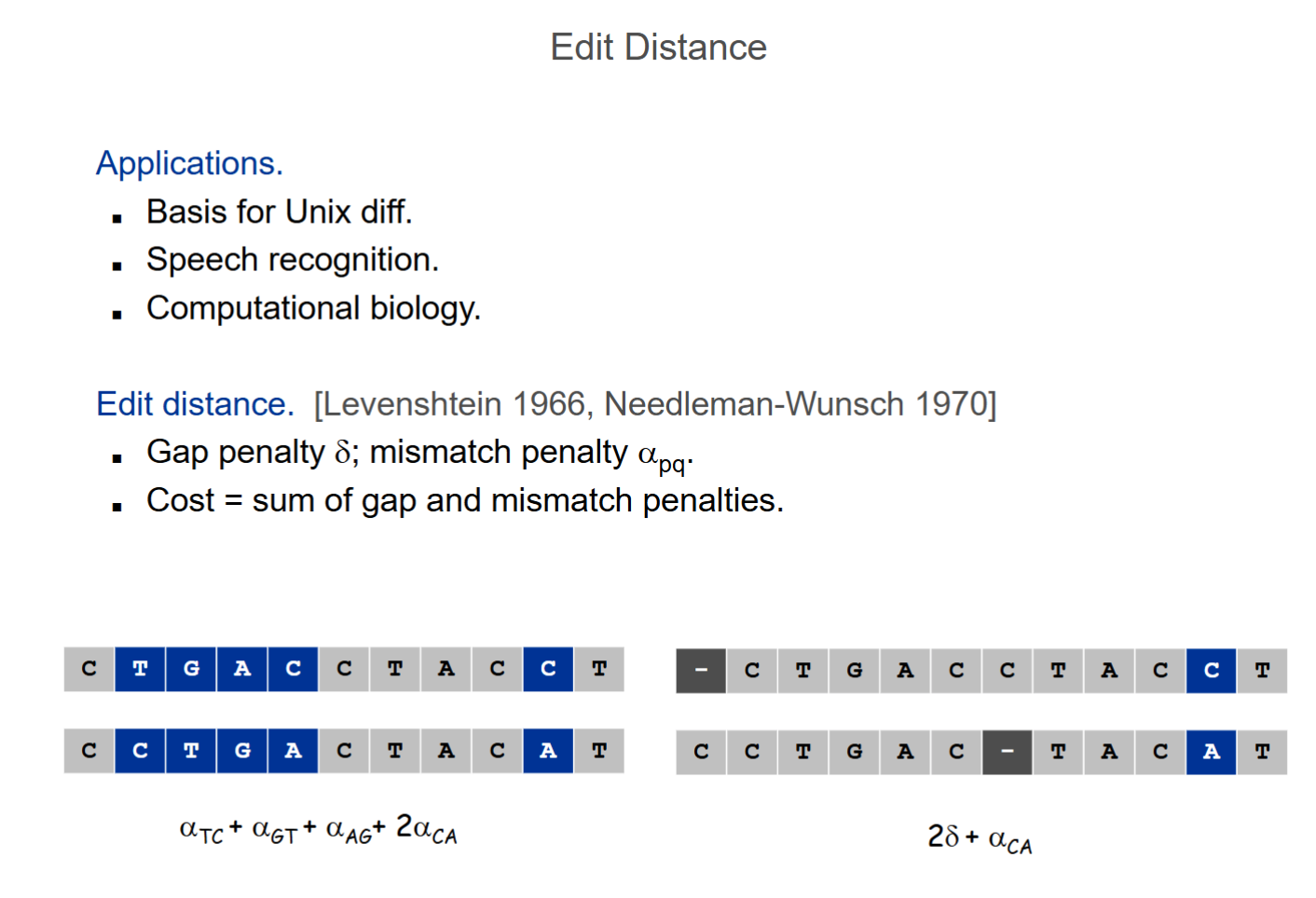
Sequence Alignment Basics
Goal: given two strings X = x1 ×2 … xm and Y = y1 y2 … yn, find an alignment of minimum cost
Alignment (M):
Set of matched pairs xi - yj
Each character used at most once
No crossings allowed
Crossing:
If i < i’ but j > j’
Cost (M) = sum of mismatch penalties + sum of gap penalties in x + sum of gap penalties in y

Sequence Alignment: Recurrence Relation
OPT(i, j)
i = num of characters of X = x1,x2,...,xi
j = num of characters of Y = y1,y2,...,yj
minimum cost to align the first i chars of X with first j chars of Y
Case 1: Match/Mismatch xi with yi
Cost = α_xiyj + OPT(i-1, j-1)
Case 2a: Leave xi unmatched, Gap in Y
Cost = δ + OPT(i−1,j)
Case 2b: Leave yj unmatched, Gap in X
Cost = δ + OPT(i−1,j)
TAKE MIN OF ALL CASES
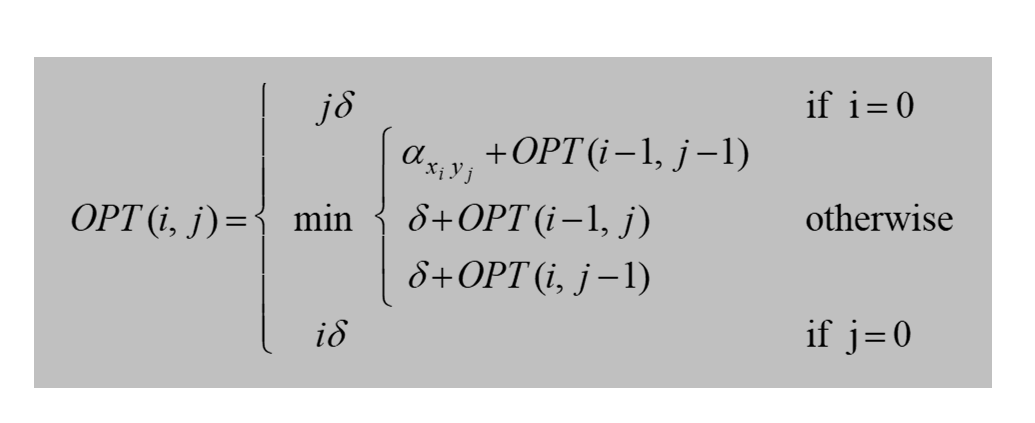
Sequence Alignment: Algorithm
Iterate through all of i
M[i, 0] = i*δ
Iterate through all of j
M[0, j] = j *δ
Recurrence (for i = 1 to m and for j = 1 to n)
M [ i, j] = min of {…}
Return M[m, n]
![<ul><li><p>Iterate through all of i</p><ul><li><p>M[i, 0] = <span style="font-family: "Courier New";">i*δ</span></p></li></ul></li><li><p>Iterate through all of j</p><ul><li><p>M[0, j] = j *δ</p></li></ul></li><li><p>Recurrence (for i = 1 to m and for j = 1 to n)</p><ul><li><p>M [ i, j] = min of {…}</p></li></ul></li><li><p>Return M[m, n]</p></li></ul><p></p>](https://assets.knowt.com/user-attachments/696415dc-d492-45c6-b06f-0efc42ec022b.png)
Sequence Alignment: Algorithm Runtime and Space
θ(mn) time and space
Solution: Hirschberg’s algorithm (1975)
Time: O(m·n)
Space: O(m + n)
Method:
Compute OPT(i, •) from OPT(i-1, •) → only store one row at a time
RNA Secondary Structure Basics
RNA: String B = b1, b2, … bn over alphabet {A, C, G, U}
Secondary Structure = set of base pairs formed within the same RNA strand = S = { (bi, bj) }
Watson-Crick pairing: A-U, U-A, C-G, G-C
No sharp turns: Paired bases must be separated by ≥ 4 bases → i < j - 4
Non-crossing: Pairs cannot cross → if (bi, bj) and (bk, bl) in S, then NOT i < k < j < l
i < k : second pair starts after first pair starts
k < j : second pair starts before before first pair ends
j < l : first pair ends before the second pair ends
Free energy: RNA folds to minimze total free energy
Goal: Find S that maximizes the number of base pairs
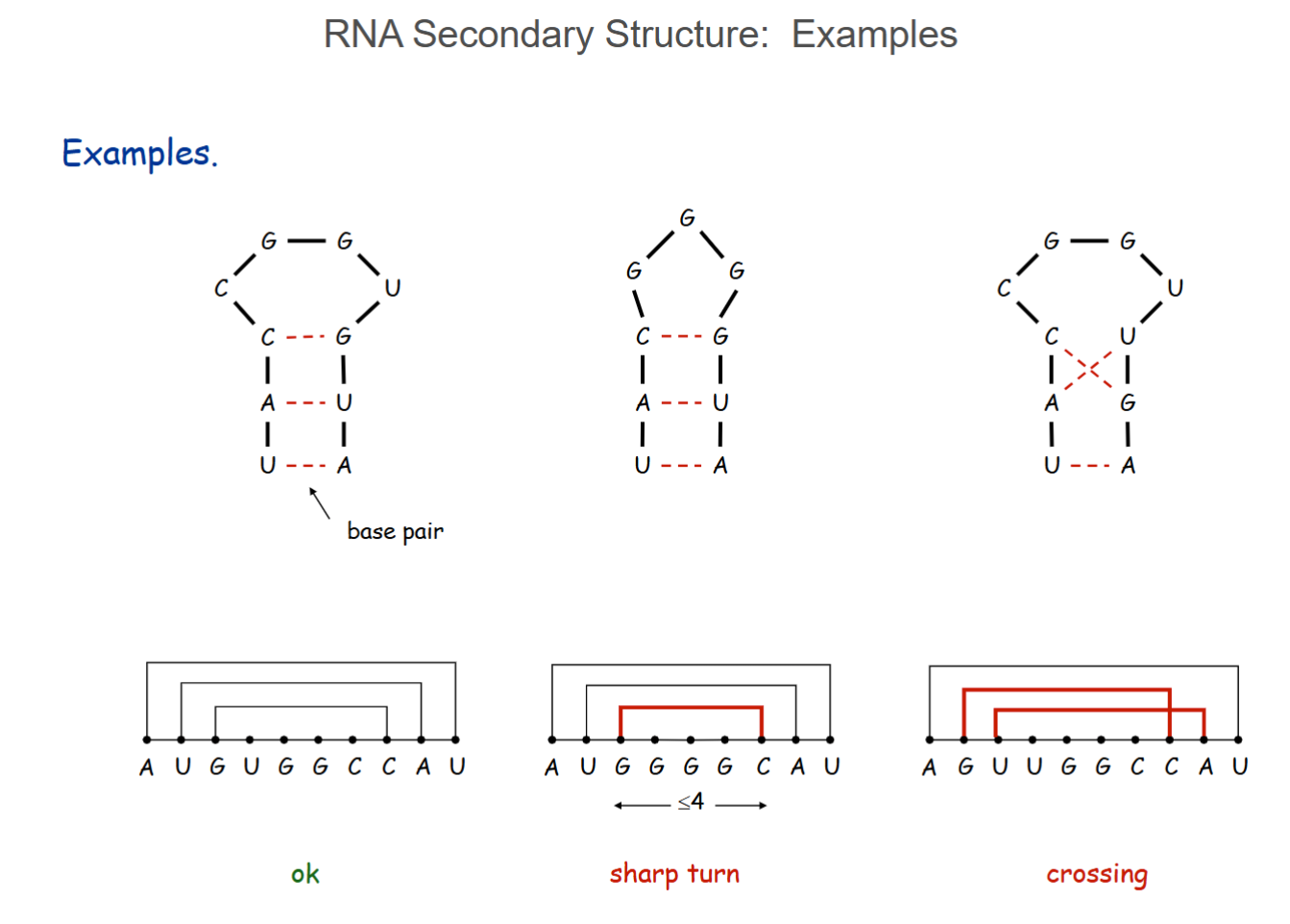
RNA Secondary Structure: First Attempt and Subproblems
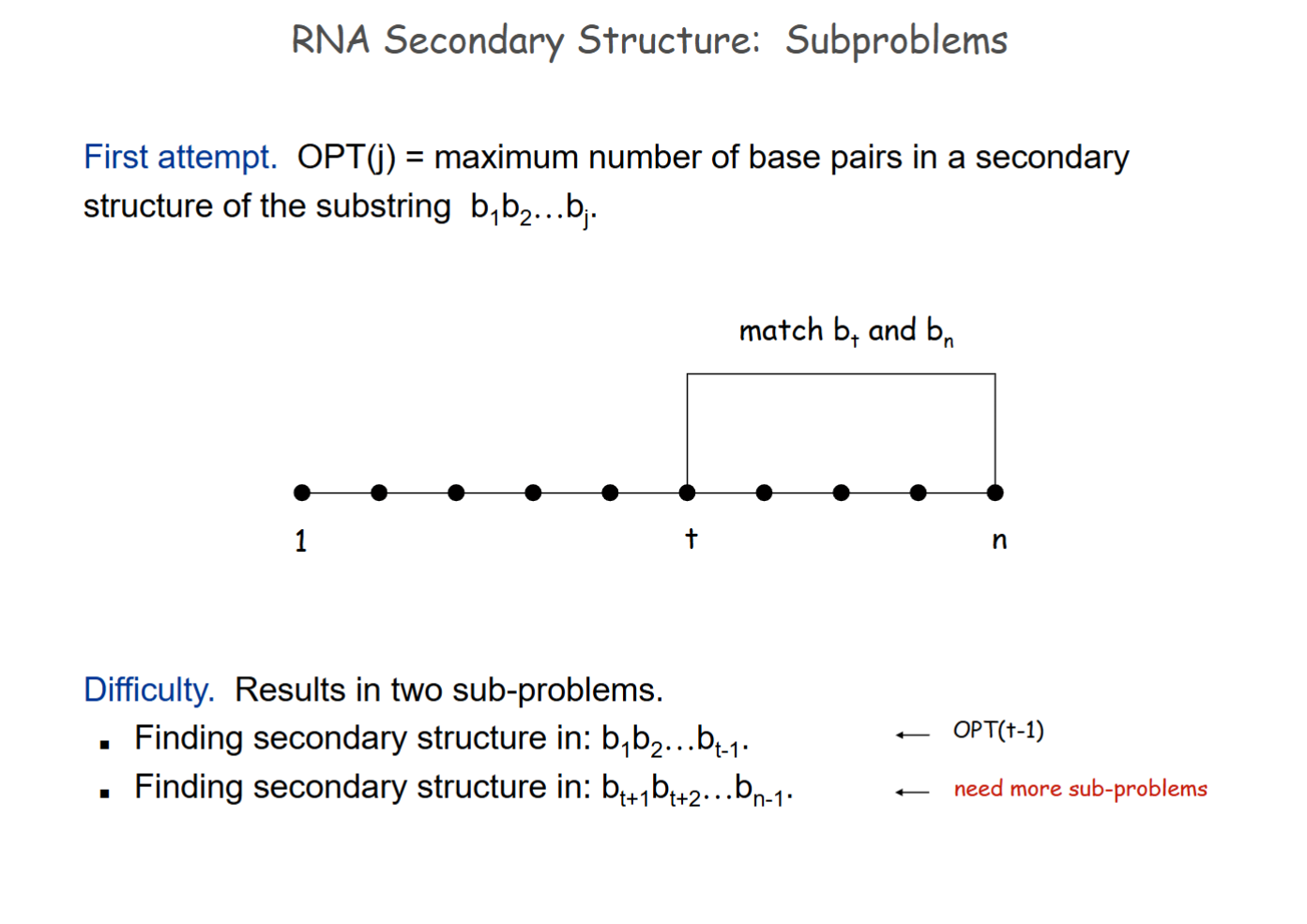
First Attempt:
OPT(j) = max number of base pairs in substring b1 b2 … bj
Difficulty: naive approach splits problem into two subproblems:
Left part: b1…bt−1 = OPT(t-1)
Right part: bt+1…bn-1
Problem: leads to too many subproblems → inefficient
RNA Secondary Structure: Recurrence
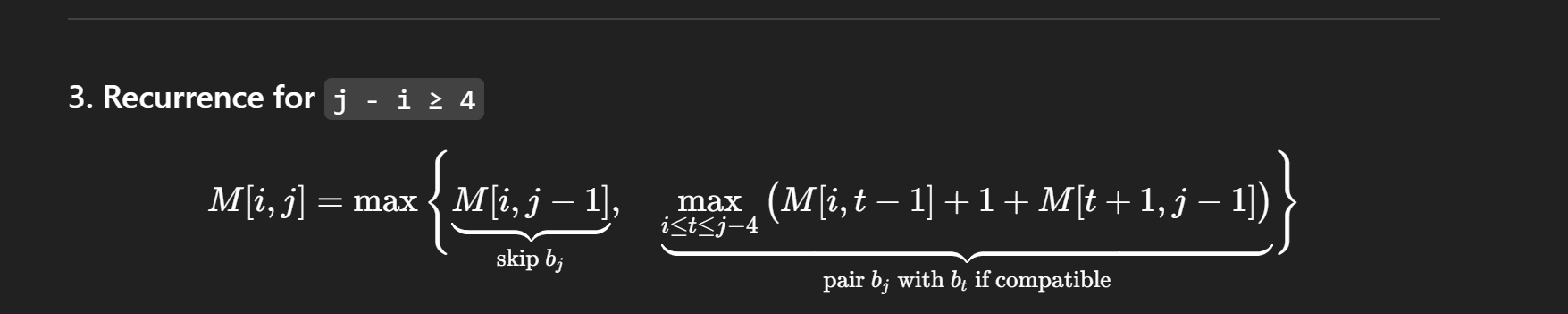
OPT(i, j) = max number of base pairs in substring bi bi+1 … bj
Case 1: Too short to pair (no-sharp-turn)
if i >= j - 4
OPT(i, j) = 0 by no-sharp-turns condition
Case 2: Base bj unpaired
OPT(i, j) = OPT (i, j-1)
Case 3: bj pairs with bt (i ≤ t < j-4)
starting point i is less than or equal to t (earlier base) and is 4 away from j
bt and bj must be Watson-Crick complements
OPT(i, j) = 1 + max over t { OPT(i, t-1) + OPT(t+1, j-1) }
Intuition:
“Try all valid earlier bases bt to pair with bj”
“Pick the one that results in the most base pairs overall”
RNA Secondary Structure: Pseudocode + Running Time
Input: b1 to bn
Loop over interval lengths k=5, 6, …n−1
Loop over start positions i=1… n-k
End position → j = i + k
Compute M[i, j]
Return M[1, n]
Plain language intuition
Look at the last base of your current substring:
Leave it alone → best structure = M[i, j-1]
Pair it with an earlier base → add 1 + best possible pairs on left and right
Pick whichever choice gives more base pairs
Running time → O(n³)
![<p>Input: b1 to bn</p><p>Loop over <strong>interval lengths</strong> k=5, 6, …n−1</p><p>Loop over <strong>start positions</strong> i=1… n-k</p><ul><li><p>End position → j = i + k</p></li><li><p>Compute M[i, j]</p></li></ul><p>Return M[1, n]</p><p>Plain language intuition </p><ul><li><p>Look at the <strong>last base</strong> of your current substring:</p><ol><li><p>Leave it alone → best structure = M[i, j-1]</p></li><li><p>Pair it with an earlier base → add 1 + best possible pairs on <strong>left and right</strong></p></li></ol></li><li><p>Pick whichever choice gives <strong>more base pairs</strong></p></li></ul><p>Running time → O(n³)</p>](https://assets.knowt.com/user-attachments/792e80d3-d193-4a81-ba5a-2c42793ae553.png)
Types of DP
DP Techniques / Patterns:
Binary choice: weighted interval scheduling
Multi-way choice: segmented least squares
Adding a variable: knapsack
Over intervals: RNA secondary structure
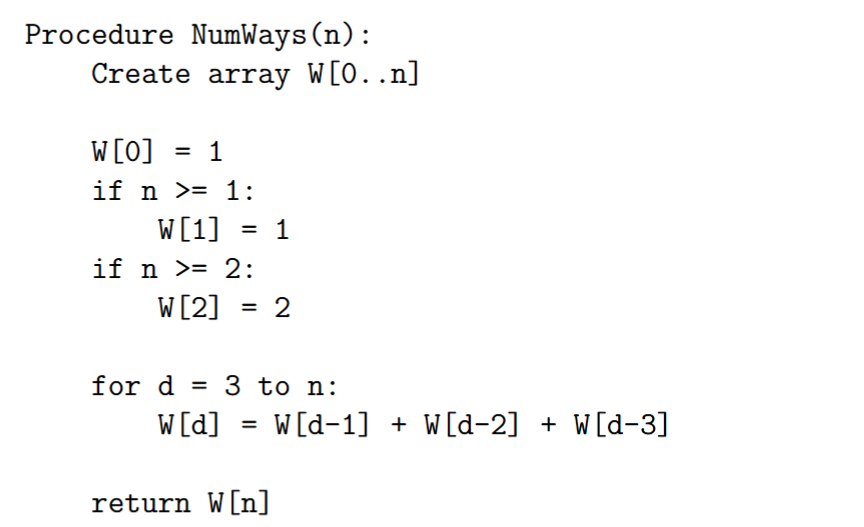
Cookie Needs a Break / Cover Distance formula
OP T (d) = OP T (d − 1) + OP T (d − 2) + OP T (d − 3)