HC: Alkanes only
 Call Kai
 Learn
Learn Practice Test
 Spaced Repetition
 Match
Match Flashcards
 Knowt Play
1/82

Earn XP
Description and Tags
Name | Mastery | Learn | Test | Matching | Spaced | Call with Kai |
|---|
No analytics yet
Send a link to your students to track their progress
83 Terms
Hydrocarbons
organic compounds composed entirely of carbon (C) and hydrogen (H) atoms, serving as the primary components of fossil fuels like petroleum and natural gas.
Alkanes
Paraffin
Alkenes
Olefins
Alkynes
Acetylenes
parum affinis
little or low affinity/ reactivity (alkanes)
CnH2n
gen. formula for cyclic hc
CnH2n+2
gen. formula for acyclic hc
true or false: alkanes are non-polar
true
aliphatic structure
straight, chain, branched, non-aromatic; alkanes, alkenes, alkynes
aromatic structure
contains benzene ring or benzene with alternating double bonds; very stable (due to resonance)
saturated bonds
all single bonds only
unsaturated bonds
can be double or triple bonds
heterocyclic aromatic structure/ compounds
cyclic structures in which the ring atoms may include oxygen or nitrogen while maintaining the special stability of aromaticity
cyclic structure
carbons are connected in a ring (closed chain)
hexane
an alkane obtained from crude oil during petroleum refining
fractional distillation
method used in petroleum refining
crude oil
mixt. of hydrocarbons (many of these are alkanes)
distillation
process to separate components of a liquid mixture based on their boiling points differences through evaporation and condensation.
fractional distillation
type of distillation used to separate a mixture into many components based on close boiling points difference
simple distillation
type of distillation used to separate a mixture into many components based on large boiling points difference
fractionating column
vertical tube that helps separate liquids based on their boiling points by repeated vaporization and condensation.
great IMF, more energy, and high temp/ low boiling point
required to break longer chains
weak IMF, less energy, and low temp/ low boiling point
required to break shorter chains
78.3°C
boiling point of ethanol
100°C
boiling point of water
plates/ trays
horizontal structures inside a fractionating column where vapors condense and liquids are collected during separation.
methane
compound collected as gas (refinery gas) and has low boiling point
hexane
liquid fraction (gasoline range) and has low boiling point
1-4 Carbons
alkane is gas
5-17 Carbons
alkane is a colorless liquid
18 and more Carbons
alkane is a waxy/ white solid, a paraffin wax, or white candles
less dense will...
more dense will…
sink
isomerism
same molecular formula but different structure
alkanes should have…
skeletal isomerism
1° Primary, 2° Secondary, 3° Tertiary, and 4° Quaternary
types of carbon
1° primary carbon
only 1 carbon is attached
2° secondary carbon
only 2 carbon is attached
3° tertiary carbon
only 3 carbon is attached
4° primary carbon
only 4 carbon is attached
stereoisomers
same connectivity but different spatial arrangements
stereochemistry
study of 3D arrangement of atoms in molecules and how this affects their properties
Conformational Isomers (conformers)
arrangement of the atoms in 3d; due to rotation around single bonds; no bonds are broken
Configuration
fixed 3d arrangement (no easy rotation)
Sawhorse Representation
Newman Projection
Staggered Conformation
Eclipsed Conformation
Gauche Conformation
Anti-conformation
6 ways to show conformations
sawhorse representation
bonds are slightly tilted and molecules are slanted in 3d view
newman projection
looking directly along a C-C bond wherein front carbon and back carbon exists.
torsional strain
repulsion between bonds because they are too closed/ aligned (in eclipsed conformation)
steric strain
repulsion b/w atoms/ groups due to crowding in space.
dihedral angle
angle between bonds on the front carbon and bonds on the back carbon
eclipsed and staggered conformation
2 types of newman projection
eclipsed conformation
0° dihedral angle
eclipsed conformation
bonds are perfectly aligned and with highest torsional strain
staggered conformation
can be gauche or anti-conformation
staggered conformation
bonds are not aligned, more relaxed and less energy
gauche conformation
bonds are 60° apart from each other; has slight steric strain
anti-conformation
groups are 180° apart from each other; most stable=no steric and torsional strain = lowest energy
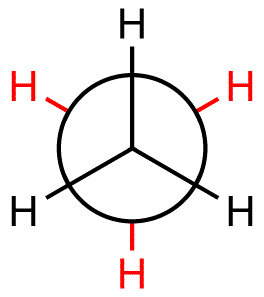
staggered-gauche conformation
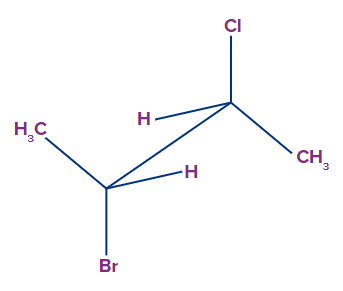
sawhorse representation
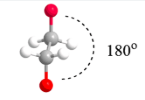
anti-conformation
polymorphism
ability of a compound to exist in >1 crystal form
halogen substituents
fluoro, chloro, bromo, iodo
group 17
group # of halogens in the periodic table
haloalkane
adding halogen to an alkane
109.5°, tetrahedral angle
cycloalkanes ideal angle
cyclopentane/ envelope
most stable cycloalkane
chair > twist-boat > boat
stability order of cyclohexane conformations
cis-trans isomers
refers to stereoisomerism in which substituents on a ring are either on the same side (cis) or opposite side (trans) of the ring plane.
cis isomer
subst. on same side
trans isomer
subst. on opposite side
oxidation/ combustion and
halogenation
the two alkane rxns
combustion
an oxidation rxn that produces flame
complete and incomplete
two types of combustion
complete rxn
happens when there is enough Oxygen (O2)
production of carbon dioxide and water
incomplete rxn
happens when oxygen is limited
products: carbon monoxide and soot
can be cancer-causing (halogenation)
alkanes will not react unless there is a catalyst
soot
black sticky carbon leftover
chloroform (CHCl3) and carbon tetrachloride (CCl4)
carcinogenic compounds
catalyst
speeds up a reaction (ex. UV light/ heat)
cleaving
breaking a chemical bond.
uses curved line to cut an atom away
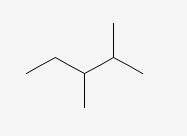
2-3-dimethylpentane
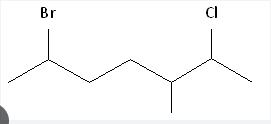
6-bromo-2-chloro-3-methylheptane
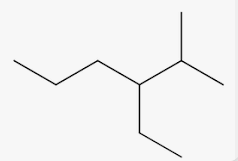
3-ethyl-2-methylhexane
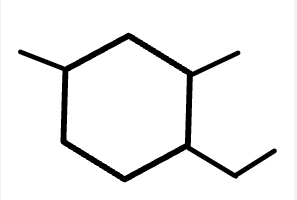
1-ethyl-2,4-dimethylcyclohexane