sports injury terminology
 Call Kai
 Learn
Learn Practice Test
 Spaced Repetition
 Match
Match Flashcards
 Knowt Play
1/19

There's no tags or description
Looks like no tags are added yet.
Name | Mastery | Learn | Test | Matching | Spaced | Call with Kai | Chat |
|---|
No analytics yet
Send a link to your students to track their progress
20 Terms
define a acute injury, and what is needed to CREATE a acute injury.
acute injury : rapid onset from traumatic event, a sudden onset injury.
CRITICAL FORCE is required to CREATE a acute injury.
define chronic injuries.
chronic injuries :
slow onset
gradual development of structural damage
achililies tendon, patellar tendon, cuff tendons)
what are chronic injuries also called?
what are chronic injuries a RESULT from?
Chronic injuries are also called OVERUSE INJURIES.
chronic injuries result from ECCENTRIC CONTRACTIONS.
what are some INTRINSIC factors?
immature cartilage, lack of flexibility, and lack of conditioning.
what are some EXTRINSIC factors?
excessive training, lack of recovery, bad technique, bad equipment
what are sprains?
injuries to ligaments.
define 1st, 2nd, & 3rd degree sprains.
1st : minor damage, mild pain, minor function impairment.
2nd : more damage, pain, moderate swelling, abnormal motion. Limited up to 50%.
3rd: COMPLETE tear of ligament(s), loss of stability, Function is limited OVER 50%.
what are strains?
injuries to tendons, muscles, junctions.
define 1st, 2nd, & 3rd degree strains.
1st degree – mild, little swelling, muscle spasm, minor function impairment.
2nd degree – softer – tissue damage, pain, swelling, FUNCTION LOSS UP TO 50%.
3rd degree – COMPLETE RUPTURE. SIGNIFICANT SWELLING.
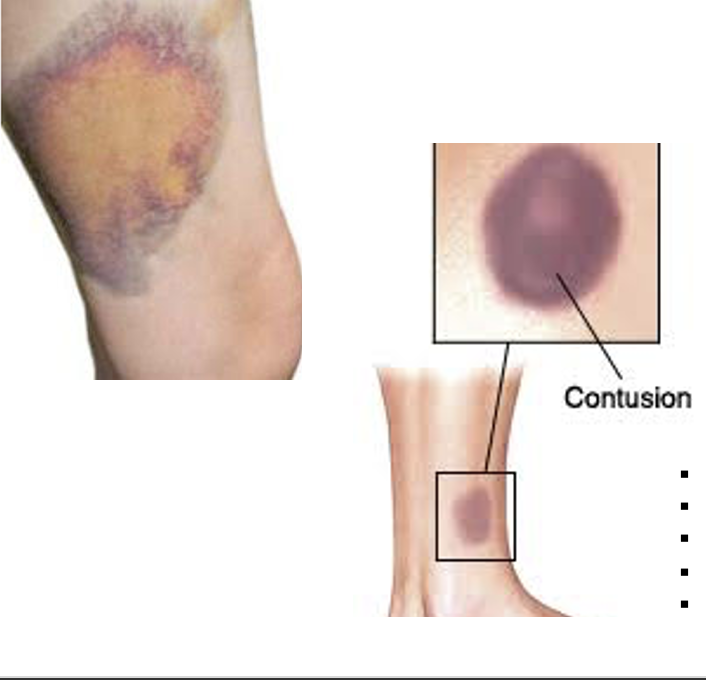
what are contusions? (bruises)
what do they end up becoming? (possibly)
direct blows to body surface.
they end up turning into ECTOPIC CALCIFICATION or MYOSITIS OSSIFICANS.
what is this?
where is this most common?
what should u do?
this is MYOSITIS OSSIFCANS it is a result of repeated bruises or trauma to same area it impairs movement.
BICEPS & QUADS are most impacted.
you should protect the area with padding.
define “itis”
itis
pain
loss of function
swelling & edema
heat
redness
define osis
osis
pain
loss of function
NOT ACTIVELY FORMING (stuck in process of inflammation)
what is a bursae?
fluid filled sac, cushions bones or lubricates the tendon.
define fractures.
define CLOSED, & COMPOUND fractures.
fractures - breaks or cracks in bone
closed fractures - bone DOESN’T protrude from skin.
compound fractures - bone PROTRUDES from skin.
what are some signs & symptoms of fracture
signs and symptoms
Swelling – rapid, due to bleeding
Deformity – may not be obvious; compare both sides
Pain/tenderness – at injury site
Loss of use – guarded movement or inability to bear weight
Crepitation – grating from bone ends rubbing together; do not move to reproduce
History of injury – suspect fracture after severe force or falls from height
what are stress fractures? what causes them.
stress fractures are cracks reactions to overloading.
they are caused from overuse
dull ache, as it worsens each day .
DOESN’T show on X - ray , need MRI.
what are signs and symptoms of stress fractures.
absence of trauma, symptoms persist reepated activity to stressful episodes.
define dislocation
then define subluxation, and luxation
what are some signs and symptoms
dislocation - temporary displacement of bone from normal position.
luxation - COMPLETE DISPLACEMENT (deformity and dysfunction are the key signs).
obvious deformity, and ligament rupture are symptoms.
what are some treatment for dislocation.
for a first time dislocation you should treat as soon as possible
also should use a splint/ and support and refer to a physician for reduction.