CS 182 Week 1
 Call Kai
 Learn
Learn Practice Test
 Spaced Repetition
 Match
Match Flashcards
 Knowt Play
1/25

There's no tags or description
Looks like no tags are added yet.
Name | Mastery | Learn | Test | Matching | Spaced | Call with Kai | Chat |
|---|
No analytics yet
Send a link to your students to track their progress
26 Terms
What is a Proposition
a declarative sentence that is either true or false
Which of these is not a proposition
x+4=2x
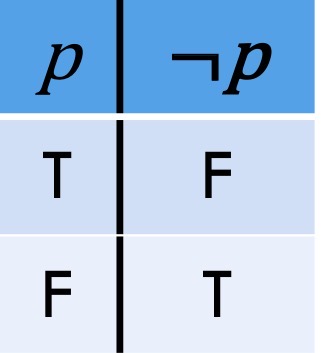
Negation
¬
Conjunction
∧

Disjunction
∨

Implication
→

Biconditional
↔

What is the truth value of the negation ¬p when p is True?
False
When is the conjunction p ∧ q true?
Only when both p and q are true
When is the disjunction p ∨ q false?
Only when both p and q are false
What's the difference between inclusive or (∨) and exclusive or (⊕)?
Inclusive or is true if either or both are true
Exclusive or is true only if exactly one is true
In the implication p → q, when is the statement false?
Only when p is true and q is false
In p → q, what are p and q called?
p is the hypothesis (premise), q is the conclusion (consequence)
What is the contrapositive of p → q?
¬q → ¬p
Is the converse (q → p) always equivalent to the original implication (p → q)?
No — they can have different truth values
What is the inverse of p → q?
¬p → ¬q
When is the biconditional p ↔ q true?
When p and q have the same truth value
What is the correct order of operator precedence from highest to lowest?
¬, ∧, ∨, →, ↔
In a logic circuit, what does a two-input AND gate produce?
The conjunction (p ∧ q) of its inputs
In a logic circuit, what does an inverter (NOT gate) do?
Produces the negation of its input
Tautology
a compound proposition which is always true
Contridiction
a compound proposition which is always false
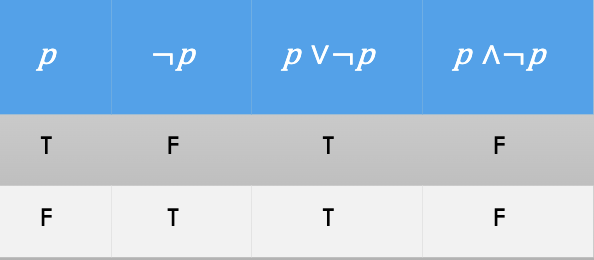
Which one is a tautology
P ∨¬P

Which one is a contradiction
P ∧¬P
Two compound propositions p and q are logically equivalent if p ↔ q is a _____
Tautology
Identity Laws
p^T