25. Cardio Examination ECG

0.0(0)
studied byStudied by 1 person
0.0(0)
full-widthCall Kai
learnLearn
examPractice Test
spaced repetitionSpaced Repetition
heart puzzleMatch
flashcardsFlashcards
GameKnowt Play
Card Sorting

1/31

encourage image

There's no tags or description

Looks like no tags are added yet.

Study Analytics
Name
Mastery
Learn
Test
Matching
Spaced

No study sessions yet.

32 Terms

1
New cards

Rapid Q: Practice Q 1

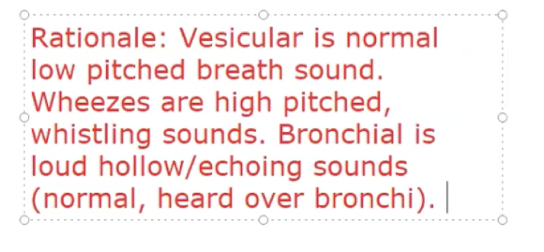
A clinician is auscultating a patient’s lungs. During auscultation, the clinician hears low pitched gurgling and snoring sounds. Which of the following sounds is the clinician MOST LIKELY hearing?

A. Vesicular

B. Wheezes

C. Bronchial

D. Rhonchi

D. Rhonchi
<p>D. Rhonchi</p>
2
New cards

Rapid Q: Practice Q 2

A patient with dyspnea on exertion and has an FEV1 /FVC ratio of 65%. They report chest tightness and frequent coughing. Which lung volume would be decreased compared to a patient with a healthy pulmonary system?

A. Functional residual capacity

B. Residual volume

C. Total lung capacity

D. Expiratory reserve volume

D. Expiratory reserve volume

<p>D. Expiratory reserve volume</p>
3
New cards

FEV1/FVC:

  • Normal = %

  • COPD = %

  • Restrictive Lung Disease = %

  • Normal = ≥ 70-80%

  • COPD = <70%

  • Restrictive Lung Disease = >80%

4
New cards

Rapid Q: Practice Q 3

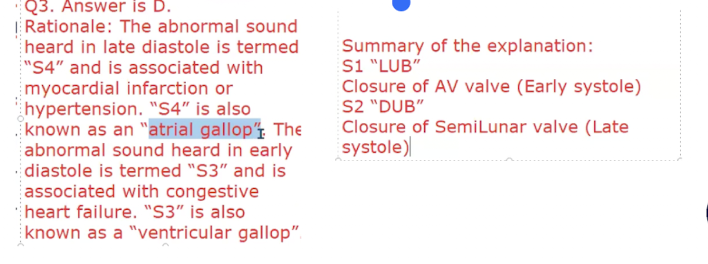
When a physical therapist auscultates the patient’s heart, they hear an S4 heart sound. When can this heart sound be heard and what condition does it MOST LIKELY indicate?

A. Abnormal sound heard in early diastole; congestive heart failure

B. Abnormal sound heard in late diastole; congestive heart failure

C. Abnormal sound heard in early diastole; myocardial infarction

D. Abnormal sound heard in late diastole; hypertension

D. Abnormal sound heard in late diastole; hypertension
<p>D. Abnormal sound heard in late diastole; hypertension</p>
5
New cards

Heart Sounds:

  • S1:

  • S2:

  • S3:

  • S4:

  • S1: LUB

    • Closure of AV Valve

      • Bicuspid and Tricuspid Valve

    • Early Systole

  • S2: DUB

    • Closure of Semilunar Valves

      • Pulmonary and Aortic Valve

    • Late Systole

  • S3: Ventricular Gallop

    • Early Diastole

  • S4: Atrial Gallop

    • Late Diastole

6
New cards
<p>Electrical Activity of the Heart:</p><ul><li><p>Contraction of the Heart depends on what?</p></li><li><p>What is the Conduction System of the Heart?</p></li><li><p>Depolarization = </p></li><li><p>Repolarization = </p></li></ul><p></p><p></p>

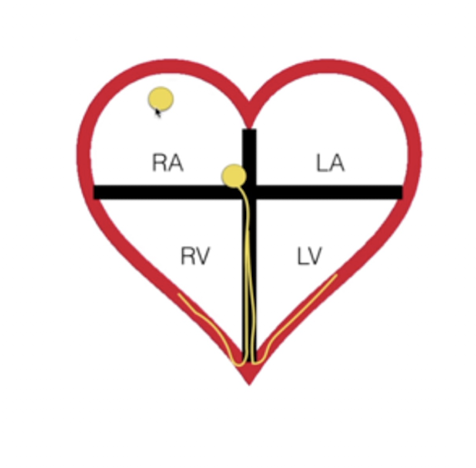
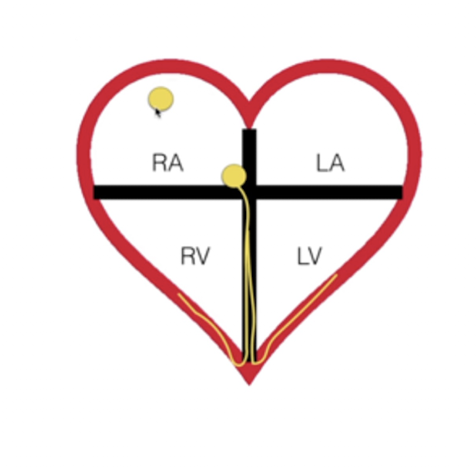
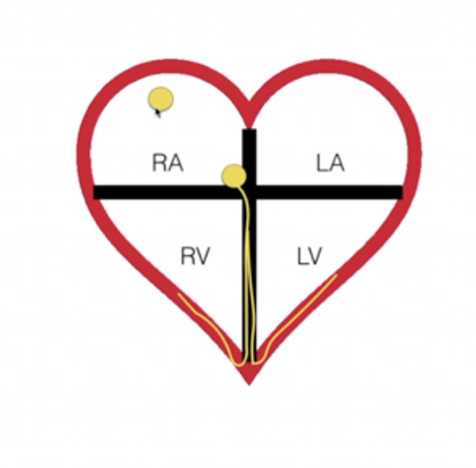
Electrical Activity of the Heart:

  • Contraction of the Heart depends on what?

  • What is the Conduction System of the Heart?

  • Depolarization =

  • Repolarization =

  • Depends on the electrical stimulation of the myocardium

  • Conduction System:

Sinoatrial Node (SA Node) » Atrioventricular Node (AV Node) » Bundle Branches » Purkinje Fibers

  • Depolarization = Contraction

  • Repolarization = Relaxation

<ul><li><p>Depends on the electrical stimulation of the myocardium </p></li><li><p>Conduction System:</p></li></ul><p></p><p>Sinoatrial Node (SA Node) » Atrioventricular Node (AV Node) » Bundle Branches » Purkinje Fibers </p><p></p><ul><li><p>Depolarization = Contraction</p></li><li><p>Repolarization = Relaxation</p></li></ul><p></p>
7
New cards
<p>Electrical Activity of the Heart:</p><ul><li><p>Describe:</p><ul><li><p>Sinoatrial Node (SA Node): </p></li><li><p>Atrioventricular Node (AV Node):</p></li><li><p>Bundle Branches: </p></li><li><p>Purkinje Fibers:</p><p></p></li></ul></li></ul><p></p>

Electrical Activity of the Heart:

  • Describe:

    • Sinoatrial Node (SA Node):

    • Atrioventricular Node (AV Node):

    • Bundle Branches:

    • Purkinje Fibers:

  • Sinoatrial Node (SA Node):

    • Pacemaker

    • Initiates depolarization

  • Atrioventricular Node (AV Node):

    • Passes depolarization to Ventricles

    • Brief delay to allow for ventricular filling

  • Bundle Branches:

    • To L and R Ventricle

  • Purkinje Fibers:

    • Throughout Ventricles

<ul><li><p>Sinoatrial Node (SA Node): </p><ul><li><p>Pacemaker</p></li><li><p>Initiates depolarization </p></li></ul></li><li><p>Atrioventricular Node (AV Node):</p><ul><li><p>Passes depolarization to Ventricles </p></li><li><p>Brief delay to allow for ventricular filling </p></li></ul></li><li><p>Bundle Branches: </p><ul><li><p>To L and R Ventricle</p></li></ul></li><li><p>Purkinje Fibers: </p><ul><li><p>Throughout Ventricles </p></li></ul></li></ul><p></p>
8
New cards
<p>Electrocardiogram (ECG):</p><ul><li><p>What is it?</p></li><li><p>P Wave:</p></li><li><p>QRS Complex:</p></li><li><p>T Wave:</p></li></ul><p></p>

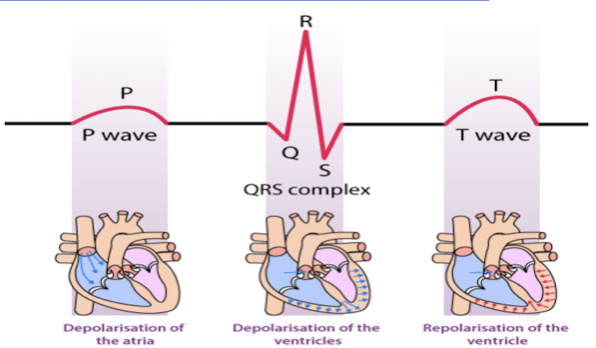
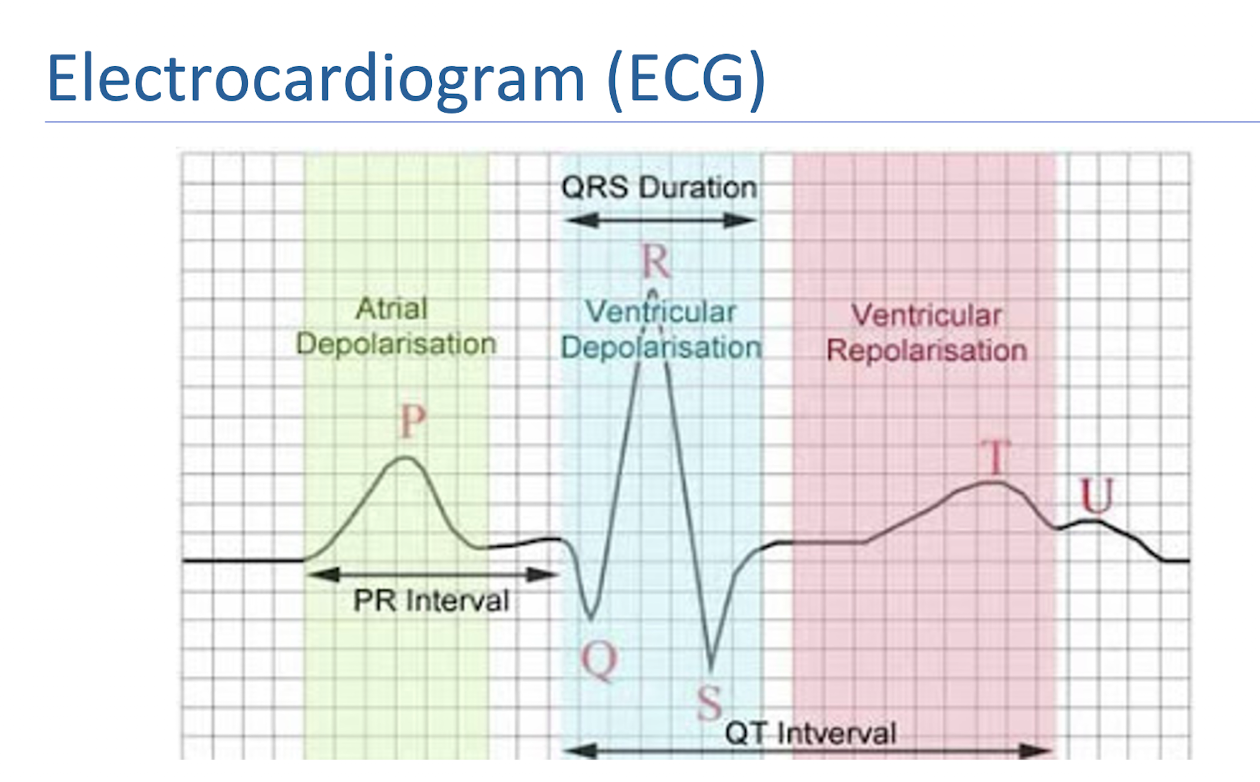
Electrocardiogram (ECG):

  • What is it?

  • P Wave:

  • QRS Complex:

  • T Wave:

  • What is it?

    • Records the electrical activity of the heart

  • P Wave:

    • Atrial Depolarization

  • QRS Complex:

    • Ventricular Depolarization and Atrial Repolarizarion

  • T Wave:

    • Ventricular Repolarization

<ul><li><p>What is it?</p><ul><li><p>Records the electrical activity of the heart</p></li></ul></li><li><p>P Wave:</p><ul><li><p>Atrial Depolarization</p></li></ul></li><li><p>QRS Complex:</p><ul><li><p>Ventricular Depolarization and Atrial Repolarizarion</p></li></ul></li><li><p>T Wave:</p><ul><li><p>Ventricular Repolarization</p></li></ul></li></ul><p></p>
9
New cards

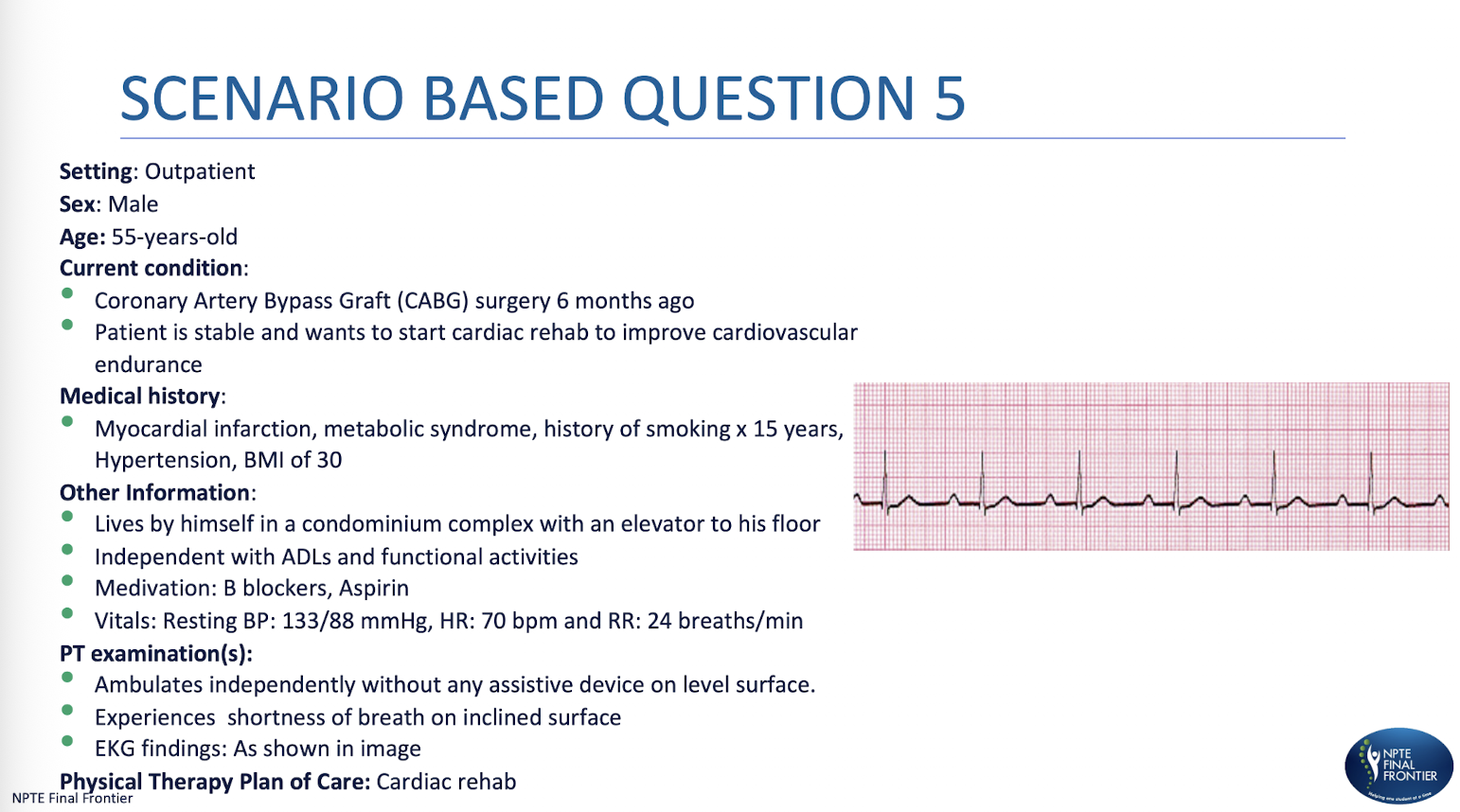
Practice Q 4:

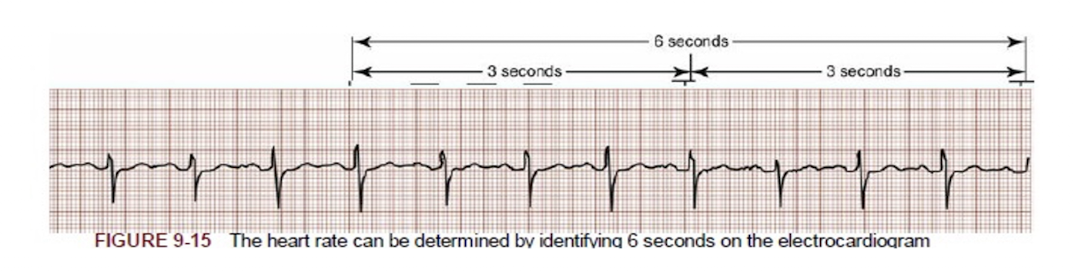
A physical therapist examines the output from a single lead ECG of a patient in an inpatient clinic. The six-second ECG strip is shown in picture below. What should the physical therapist determine the heart rate of the patient as?

A. 110 beats per minute

B. 70 beats per minute

C. 90 beats per minute

D. 60 beats per minute

C. 90 beats per minute

9 R Waves x 10 = 90bpm

<p>C. 90 beats per minute</p><p></p><p>9 R Waves x 10 = 90bpm</p>
10
New cards
<p>Calculate HR: 6 Second Method</p><ul><li><p>Count off 30 large boxes = </p><ul><li><p>1 Large Box =</p></li><li><p>So, 30 Large Boxes =</p></li></ul></li><li><p>Then…</p></li></ul><p></p>

Calculate HR: 6 Second Method

  • Count off 30 large boxes =

    • 1 Large Box =

    • So, 30 Large Boxes =

  • Then…

  • Count off 30 large boxes = 6 seconds

    • 1 Large Box = 0.2 seconds

    • 30 Large Boxes = 6 Seconds

  • Then…

    • Count the number of R waves in 6 seconds, and multiply by 10

<ul><li><p>Count off 30 large boxes = 6 seconds</p><ul><li><p>1 Large Box = 0.2 seconds</p></li><li><p>30 Large Boxes = 6 Seconds</p></li></ul></li><li><p>Then…</p><ul><li><p>Count the number of R waves in 6 seconds, and multiply by 10 </p></li></ul></li></ul><p></p>
11
New cards

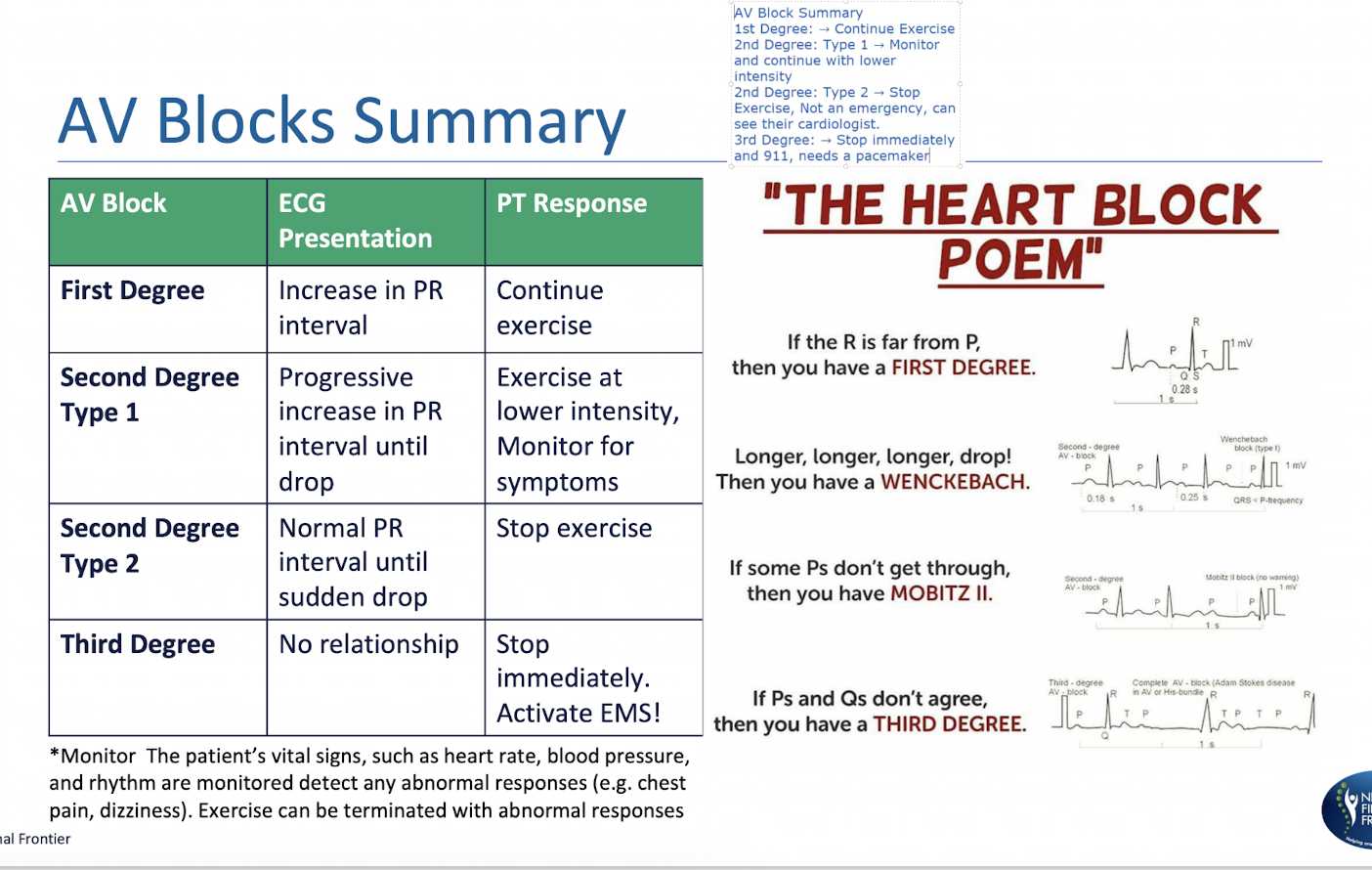
Classification of AV Blocks:

  • 1st Degree Heart Block =

  • 2nd Degree Heart Block =

  • 3rd Degree Heart Block =

  • 1st Degree Heart Block =

    • Delay in Conduction

  • 2nd Degree Heart Block =

    • Partially Blocked Conduction

  • 3rd Degree Heart Block =

    • Fully Blocked Conduction

12
New cards
<p>AV Blocks » 1st Degree</p><ul><li><p>1st Degree</p><ul><li><p>Characteristics: (3)</p></li><li><p>Seen also in athletes with…</p></li><li><p>T/F: Generally, WONT progress, BENIGN condition/not serious</p></li></ul></li></ul><p></p><p></p>

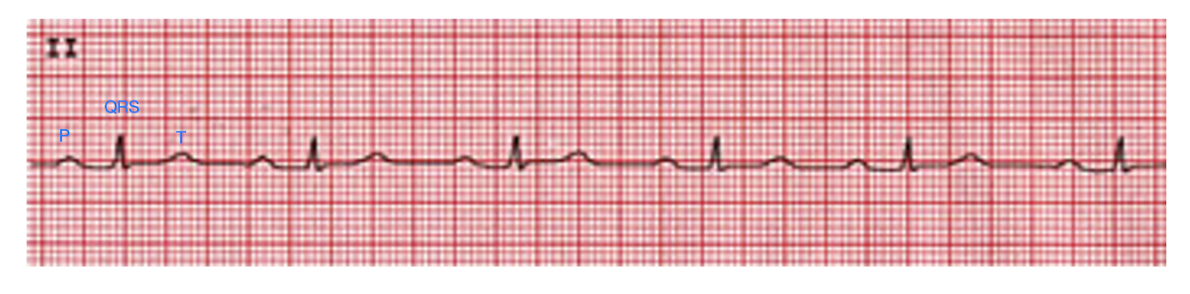
AV Blocks » 1st Degree

  • 1st Degree

    • Characteristics: (3)

    • Seen also in athletes with…

    • T/F: Generally, WONT progress, BENIGN condition/not serious

  • Characteristics:

    • AV Nodal Disease

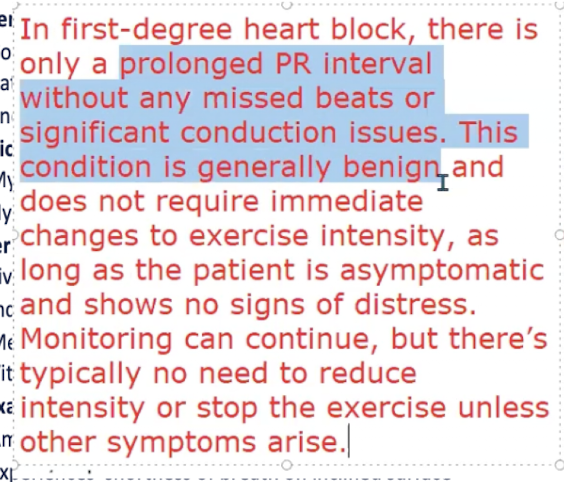
    • PR Interval > 0.2 seconds (1 large box)

    • Each P is followed by QRS

  • Athletes c Increased Vagal Tone (Activity)

  • TRUE

NOTE:

  • Look at the constant elongation of PR
<ul><li><p>Characteristics:</p><ul><li><p>AV Nodal Disease</p></li><li><p>PR Interval &gt; 0.2 seconds (1 large box)</p></li><li><p>Each P is followed by QRS</p></li></ul></li><li><p>Athletes c Increased Vagal Tone (Activity)</p></li><li><p>TRUE</p></li></ul><p></p><p></p><p>NOTE:</p><ul><li><p>Look at the constant elongation of PR</p></li></ul><p></p>
13
New cards
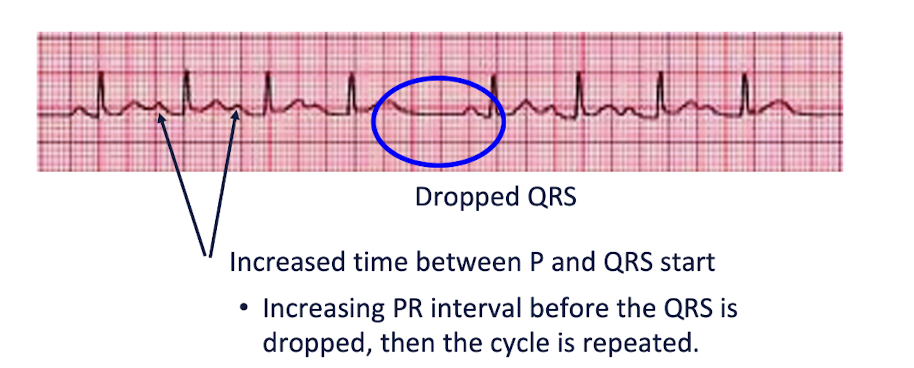
<p>AV Blocks: 2nd Degree </p><ul><li><p>Main Characteristics: (2)</p></li><li><p>What are the 2 Types?</p></li></ul><p></p>

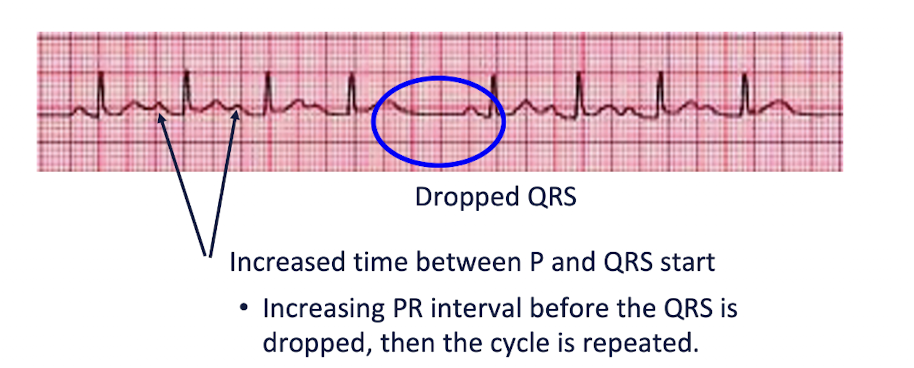
AV Blocks: 2nd Degree

  • Main Characteristics: (2)

  • What are the 2 Types?

  • Main Characteristics:

    • One or more - but not all - of the atrial impulses fail to conduct to the ventricles

    • Increased PR Intervals before QRS is dropped, then cycle is repeated

  • 2 Types:

    • Type 1 // Winckebach // Mobitz Type I

    • Type 2 // Mobitz Type II

<ul><li><p>Main Characteristics:</p><ul><li><p>One or more - but not all - of the atrial impulses fail to conduct to the ventricles </p></li><li><p>Increased PR Intervals before QRS is dropped, then cycle is repeated</p></li></ul></li><li><p>2 Types:</p><ul><li><p>Type 1 // Winckebach // Mobitz Type I</p></li><li><p>Type 2 // Mobitz Type II</p></li></ul></li></ul><p></p>
14
New cards
<p>AV Blocks: 2nd Degree » Type I</p><ul><li><p>AKA:</p></li><li><p>Characteristics: (3)</p></li></ul><p></p><p></p>

AV Blocks: 2nd Degree » Type I

  • AKA:

  • Characteristics: (3)

  • AKA:

    • Wenckebach

    • Mobitz Type I

  • Characteristics:

    • Disease of AV Node

    • PR Interval gets PROGRESSIVELY LONGER each beat until a QRS is “DROPPED”

    • PATTERN IS DESCERNED

<ul><li><p>AKA: </p><ul><li><p>Wenckebach </p></li><li><p>Mobitz Type I</p></li></ul></li><li><p>Characteristics:</p><ul><li><p>Disease of AV Node</p></li><li><p>PR Interval gets PROGRESSIVELY LONGER each beat until a QRS is “DROPPED”</p></li><li><p>PATTERN IS DESCERNED </p></li></ul></li></ul><p></p>
15
New cards
<p>AV Blocks: 2nd Degree » Type II</p><ul><li><p>AKA:</p></li><li><p>Characteristics: (3)</p></li></ul><p></p>

AV Blocks: 2nd Degree » Type II

  • AKA:

  • Characteristics: (3)

  • AKA:

    • Mobitz Type 2

  • Characteristics:

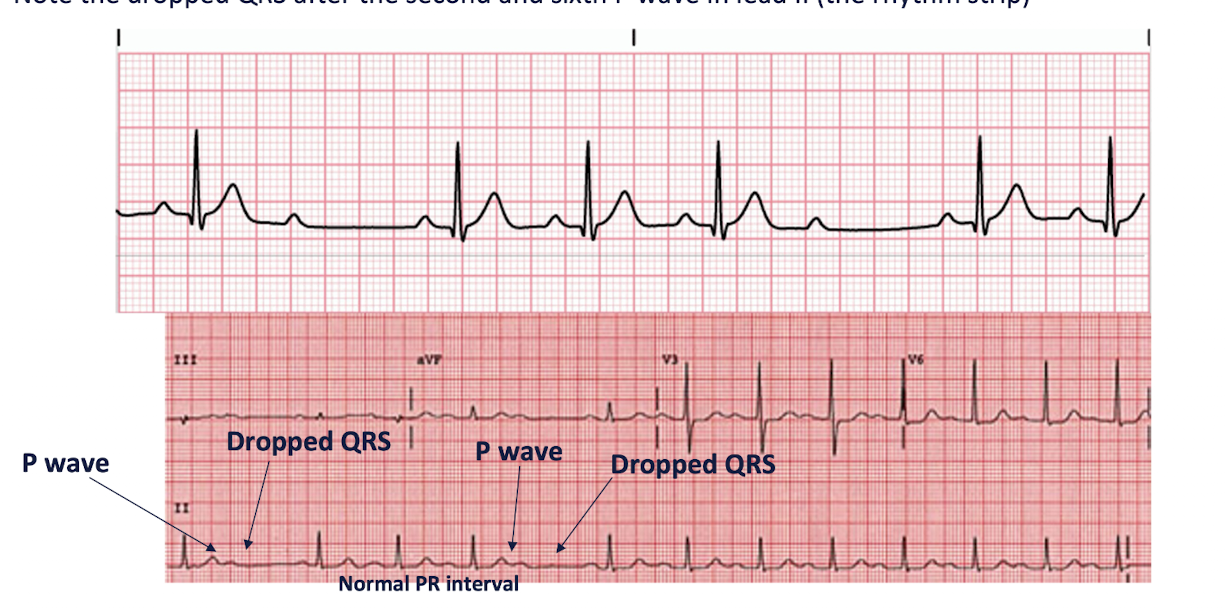
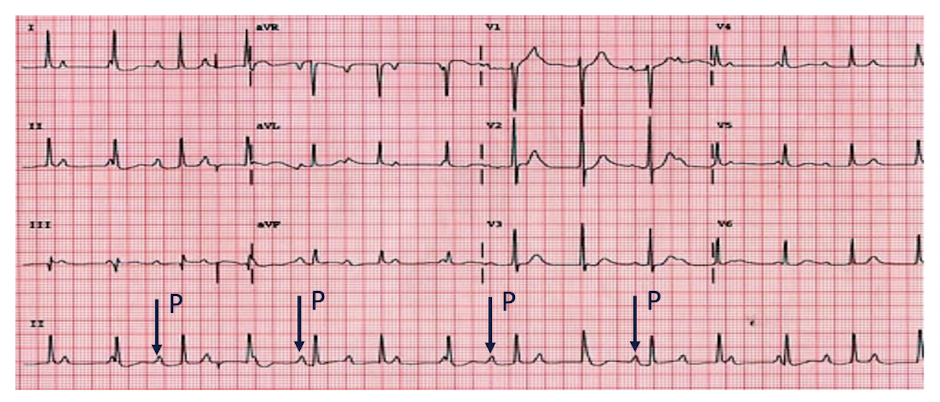
    • Disease of the Bundle of His and Purkinje FIbers

    • PR Intervals are CONSTANT and QRS is “DROPPED” INTERMITTENTLY

    • NO PATTERN CAN BE DISCERNED (unpredictable)
<ul><li><p>AKA:</p><ul><li><p>Mobitz Type 2</p></li></ul></li><li><p>Characteristics:</p><ul><li><p>Disease of the Bundle of His and Purkinje FIbers </p></li><li><p>PR Intervals are CONSTANT and QRS is “DROPPED” INTERMITTENTLY</p></li><li><p>NO PATTERN CAN BE DISCERNED (unpredictable) </p></li></ul></li></ul><p></p>
16
New cards
<p>AV Blocks: 3rd Degree</p><ul><li><p>Characteristics: (3)</p></li></ul><p></p>

AV Blocks: 3rd Degree

  • Characteristics: (3)

  • The atrial rate is INDEPENDENT from ventricular rate

    • P wave and QRS march out separately

  • NO RELATIONSHIP AT ALL, of the PR Intervals

  • PR Interval is constantly changing and QRS is wide and bizarre because of ventricular origin

<ul><li><p>The atrial rate is INDEPENDENT from ventricular rate </p><ul><li><p>P wave and QRS march out separately </p></li></ul></li><li><p>NO RELATIONSHIP AT ALL, of the PR Intervals </p></li><li><p>PR Interval is constantly changing and QRS is wide and bizarre because of ventricular origin </p></li></ul><p></p>
17
New cards
<p>AV Block Summary: </p>

AV Block Summary:

18
New cards
<p>Scenario Based Q 1: </p><p>While walking on a treadmill, the physical therapist sees the ECG pattern, as shown. What is the MOST APPROPRIATE diagnosis?</p><p>A. First degree heart block</p><p>B. Mobitz type I heart block</p><p>C. Mobitz type II heart block</p><p>D. Third degree heart block</p>

Scenario Based Q 1:

While walking on a treadmill, the physical therapist sees the ECG pattern, as shown. What is the MOST APPROPRIATE diagnosis?

A. First degree heart block

B. Mobitz type I heart block

C. Mobitz type II heart block

D. Third degree heart block

A. First degree heart block

<p>A. First degree heart block</p>
19
New cards
<p>Scenario Based Q 2: </p><p>Based on the diagnosed condition, what would be the MOST APPROPRIATE response by the physical therapist?</p><p>A. Stop the treadmill session immediately and contact the cardiologist.</p><p>B. Continue exercising at the current intensity without any modifications</p><p>C. Lower the exercise intensity and monitor the patient closely.</p><p>D. Have the patient rest, then reassess before resuming exercise.</p>

Scenario Based Q 2:

Based on the diagnosed condition, what would be the MOST APPROPRIATE response by the physical therapist?

A. Stop the treadmill session immediately and contact the cardiologist.

B. Continue exercising at the current intensity without any modifications

C. Lower the exercise intensity and monitor the patient closely.

D. Have the patient rest, then reassess before resuming exercise.

B. Continue exercising at the current intensity without any modifications
<p>B. Continue exercising at the current intensity without any modifications</p>
20
New cards
<p>Scenario Based Q 3: </p><p>The patient did not come for physical therapy for 3 consecutive visits. On following up with the patient’s caretaker, they mentioned that the patient was taken to the emergency room as they were experiencing increased shortness of breath at rest and cough with no evident peripheral edema. Which of the following is MOST LIKELY causing the patient’s symptom?</p><p>A. Biventricular heart failure</p><p>B. Right-sided heart failure</p><p>C. Cor pulmonale</p><p>D. Left-sided heart failure</p>

Scenario Based Q 3:

The patient did not come for physical therapy for 3 consecutive visits. On following up with the patient’s caretaker, they mentioned that the patient was taken to the emergency room as they were experiencing increased shortness of breath at rest and cough with no evident peripheral edema. Which of the following is MOST LIKELY causing the patient’s symptom?

A. Biventricular heart failure

B. Right-sided heart failure

C. Cor pulmonale

D. Left-sided heart failure

D. Left-sided heart failure

<p>D. Left-sided heart failure</p>
21
New cards
<p>ST Segment:</p><ul><li><p>ST Segment Depression = </p><ul><li><p>Depression Amount:</p><ul><li><p>What should the PT do?</p></li></ul></li></ul></li><li><p>3 Characteristics:</p></li></ul><p></p>

ST Segment:

  • ST Segment Depression =

    • Depression Amount:

      • What should the PT do?

  • 3 Characteristics:

  • ST Segment Depression = MYOCARIDAL ISCHEMIA

    • Depression Amount: > 2mm/2 small boxes

      • Call 911 + Stop Exercise

  • 3 Characteristics:

    • Decreased Blood Supply

    • ST Segment Depression

    • T Wave Flattened or Inverted

<ul><li><p>ST Segment Depression = MYOCARIDAL ISCHEMIA</p><ul><li><p>Depression Amount: &gt; 2mm/2 small boxes </p><ul><li><p>Call 911 + Stop Exercise</p></li></ul></li></ul></li><li><p>3 Characteristics:</p><ul><li><p>Decreased Blood Supply </p></li><li><p>ST Segment Depression </p></li><li><p>T Wave Flattened or Inverted </p></li></ul></li></ul><p></p>
22
New cards
<p>ST Segment:</p><ul><li><p>ST Segment Elevation =</p><ul><li><p>Elevation Amount:</p><ul><li><p>What should the PT do?</p></li></ul></li><li><p>2 Characteristics:</p></li></ul></li></ul><p></p>

ST Segment:

  • ST Segment Elevation =

    • Elevation Amount:

      • What should the PT do?

    • 2 Characteristics:

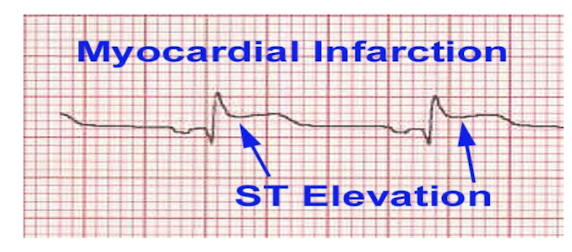
  • ST Segment Elevation = MYOCARDIAL INFARCTION

    • Elevation Amount: > 1mm/1 small box

      • Call 911 + Stop Exercise

    • 2 Characteristics:

      • Complete occlusion of blood supply and cell death

      • ST segment elevation

NOTE:

  • ElevaTION = InfarctION

<ul><li><p>ST Segment Elevation = MYOCARDIAL INFARCTION</p><ul><li><p>Elevation Amount: &gt; 1mm/1 small box</p><ul><li><p>Call 911 + Stop Exercise</p></li></ul></li><li><p>2 Characteristics:</p><ul><li><p>Complete occlusion of blood supply and cell death</p></li><li><p>ST segment elevation</p></li></ul></li></ul></li></ul><p></p><p>NOTE:</p><ul><li><p>ElevaTION = InfarctION</p></li></ul><p></p>
23
New cards
<p>Practice Q 6: </p><p>A patient is walking on a treadmill with ECG leads attached. The physical therapist observes the ECG as shown in the image below. What is the MOST LIKELY diagnosis and intervention?</p><p>A. Myocardial ischemia that has an elevation of the ST segment greater than 1 mm and the PT should stop the protocol</p><p>B. Myocardial infarction that has an elevation of the ST segment less than 1 mm and the PT should stop the protocol and call 911</p><p>C. Myocardial ischemia that has an elevation of the ST segment less than 1 mm and the PT should stop the protocol</p><p>D. Myocardial infarction that has an elevation of the ST segment greater than 1 mm and the PT should stop the protocol and call 911</p>

Practice Q 6:

A patient is walking on a treadmill with ECG leads attached. The physical therapist observes the ECG as shown in the image below. What is the MOST LIKELY diagnosis and intervention?

A. Myocardial ischemia that has an elevation of the ST segment greater than 1 mm and the PT should stop the protocol

B. Myocardial infarction that has an elevation of the ST segment less than 1 mm and the PT should stop the protocol and call 911

C. Myocardial ischemia that has an elevation of the ST segment less than 1 mm and the PT should stop the protocol

D. Myocardial infarction that has an elevation of the ST segment greater than 1 mm and the PT should stop the protocol and call 911

D. Myocardial infarction that has an elevation of the ST segment greater than 1 mm and the PT should stop the protocol and call 911

<p>D. Myocardial infarction that has an elevation of the ST segment greater than 1 mm and the PT should stop the protocol and call 911</p>
24
New cards

Supraventricular (“Atrial”) Arrhythmias:

  • What are the 4 Atrial Arrhythmias?

    • Atrial Rate:

  • Premature Atrial Contractions

  • Atrial Tachycardia

    • Atrial Rate: 100-250 bpm (fast)

  • Atrial Flutter

    • Atrial Rate: 250-350 bpm (very fast)

  • Atrial Fibrillation

    • Atrial Rate: 400-600 bpm (fastest)

25
New cards
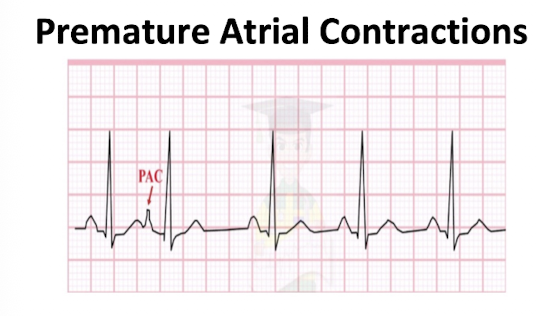
<p>Premature Atrial Contraction:</p><p>NOTICE:</p><ul><li><p>Look for: </p><ul><li><p>Little bump AFTER T wave</p></li><li><p>P wave comes EARLY </p></li><li><p>QRS Normal </p></li></ul></li><li><p>NO 911/NOT EMERGENCY </p><ul><li><p>MONITOR AND CONTINUE AT LOWER INTENSITY </p></li></ul></li></ul><p></p><p></p><p>FLIP</p><p></p>

Premature Atrial Contraction:

NOTICE:

  • Look for:

    • Little bump AFTER T wave

    • P wave comes EARLY

    • QRS Normal

  • NO 911/NOT EMERGENCY

    • MONITOR AND CONTINUE AT LOWER INTENSITY
FLIP

Atrial Tachycardia:

NOTICE:

  • Look for:

    • T and P Overlap (appear only as 1)

  • NO 911/NOT EMERGENCY

    • MONITOR AND CONTINUE AT LOWER INTENSITY

<p>Atrial Tachycardia:</p><p>NOTICE:</p><ul><li><p>Look for:</p><ul><li><p>T and P Overlap (appear only as 1)</p></li></ul></li><li><p>NO 911/NOT EMERGENCY </p><ul><li><p>MONITOR AND CONTINUE AT LOWER INTENSITY </p></li></ul></li></ul><p></p>
26
New cards
<p>Atrial Flutter:</p><p>NOTICE:</p><ul><li><p>Look for:</p><ul><li><p>Sawtooth Pattern in P Wave</p></li><li><p>QRS Normal</p></li></ul></li><li><p>NO 911/NOT EMERGENCY</p><ul><li><p>MONITOR AND CONTINUE AT LOWER INTENSITY</p></li></ul></li></ul><p></p><p>FLIP</p><p></p>

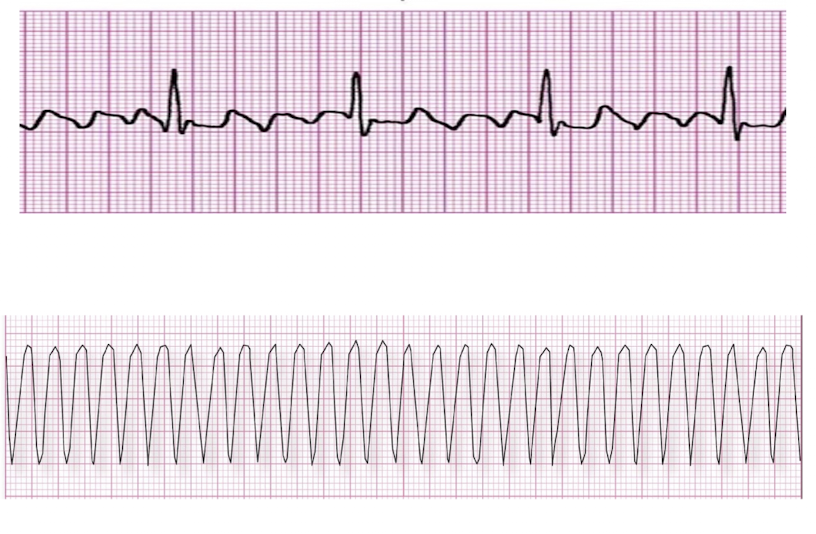
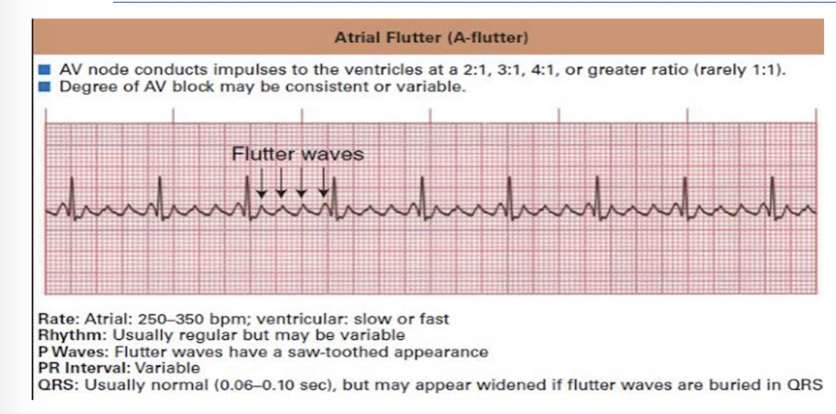
Atrial Flutter:

NOTICE:

  • Look for:

    • Sawtooth Pattern in P Wave

    • QRS Normal

  • NO 911/NOT EMERGENCY

    • MONITOR AND CONTINUE AT LOWER INTENSITY

FLIP

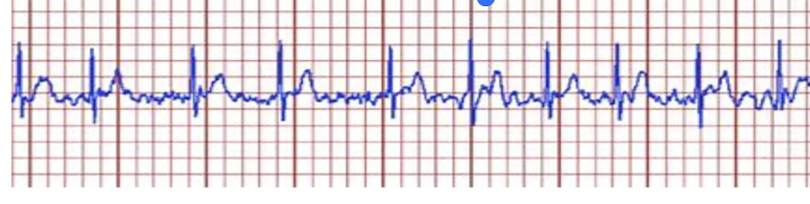
Atrial Fibrillation:

NOTICE:

  • Look for:

    • Quivering P wave

    • QRS Normal

  • NO 911/NOT EMERGENCY

    • Stop Exercise and report to Physician
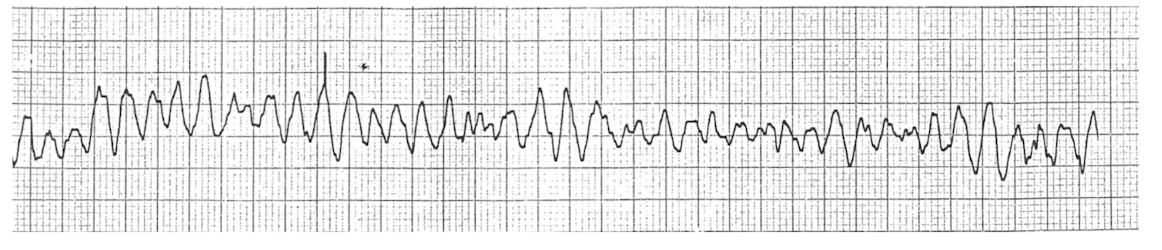
<p>Atrial Fibrillation:</p><p>NOTICE:</p><ul><li><p>Look for:</p><ul><li><p>Quivering P wave</p></li><li><p>QRS Normal</p></li></ul></li><li><p>NO 911/NOT EMERGENCY</p><ul><li><p>Stop Exercise and report to Physician </p></li></ul></li></ul><p></p>
27
New cards
<p>Practice Q 7: </p><p>A physical therapist is ambulating a patient, and they report palpitations, shortness of breath and fatigue. What should be the interpretation and immediate action according on the ECG strip shown below?</p><p>A. Ventricular fibrillation; Call for a defibrillator</p><p>B. Premature ventricular contractions; Take them to their bed and monitor for changes in ECG</p><p>C. Atrial Fibrillation; Stop exercise and report to the physician</p><p>D. 3rd degree heart block; activate emergency</p>

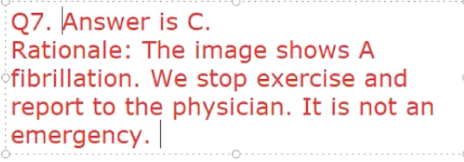
Practice Q 7:

A physical therapist is ambulating a patient, and they report palpitations, shortness of breath and fatigue. What should be the interpretation and immediate action according on the ECG strip shown below?

A. Ventricular fibrillation; Call for a defibrillator

B. Premature ventricular contractions; Take them to their bed and monitor for changes in ECG

C. Atrial Fibrillation; Stop exercise and report to the physician

D. 3rd degree heart block; activate emergency

C. Atrial Fibrillation; Stop exercise and report to the physician
<p>C. Atrial Fibrillation; Stop exercise and report to the physician</p>
28
New cards
<p>Practice Q 8: </p><p>While exercising a patient on the treadmill, the physical therapist notices the electrocardiogram as shown in the image. What should their INITIAL response be?</p><p>A. Continue walking at same intensity</p><p>B. Continue walking at lower intensity</p><p>C. Stop the treatment and monitor ECG for 10 minutes</p><p>D. Activate the emergency system or call 911</p><p></p><p>What is dx?</p>

Practice Q 8:

While exercising a patient on the treadmill, the physical therapist notices the electrocardiogram as shown in the image. What should their INITIAL response be?

A. Continue walking at same intensity

B. Continue walking at lower intensity

C. Stop the treatment and monitor ECG for 10 minutes

D. Activate the emergency system or call 911

What is dx?

D. Activate the emergency system or call 911

Dx: Ventricular Fibrillation

<p>D. Activate the emergency system or call 911</p><p></p><p>Dx: Ventricular Fibrillation </p>
29
New cards
<p>Guess the Strips</p>

Guess the Strips

  • Atrial Flutter

  • V Tach

30
New cards
<p>Premature Ventricular Contracture (PVC):</p><ul><li><p>Heart beat initiated by:</p></li><li><p>Presentation: (2)</p></li><li><p>PVC that occur 3 or more in a row =</p></li></ul><p></p><p></p>

Premature Ventricular Contracture (PVC):

  • Heart beat initiated by:

  • Presentation: (2)

  • PVC that occur 3 or more in a row =

  • Heart beat initiated by Purkinje Fibers

    • Skipped beat or palpitations

  • Characteristics:

    • Ventricle contracts BEFORE the atria: cannot be filled optimally

      • No P, wide bizarre QRS

  • V Tach

<ul><li><p>Heart beat initiated by Purkinje Fibers</p><ul><li><p>Skipped beat or palpitations</p></li></ul></li><li><p>Characteristics:</p><ul><li><p>Ventricle contracts BEFORE the atria: cannot be filled optimally</p><ul><li><p>No P, wide bizarre QRS</p></li></ul></li></ul></li><li><p>V Tach</p></li></ul><p></p>
31
New cards
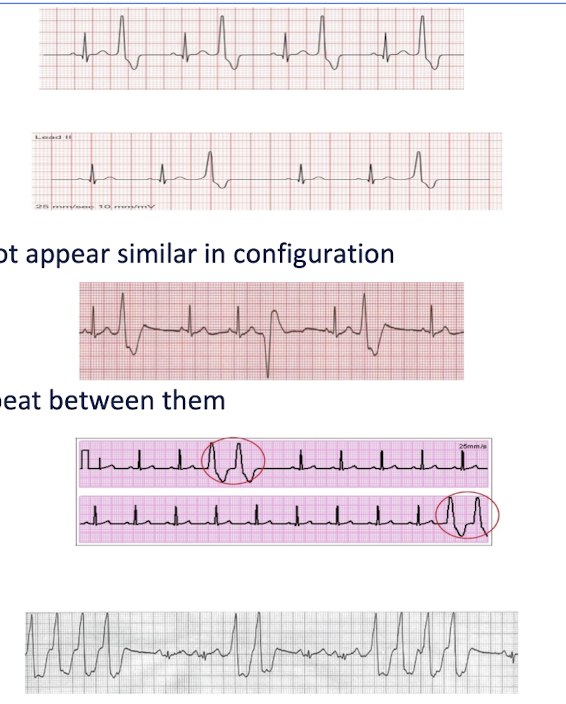
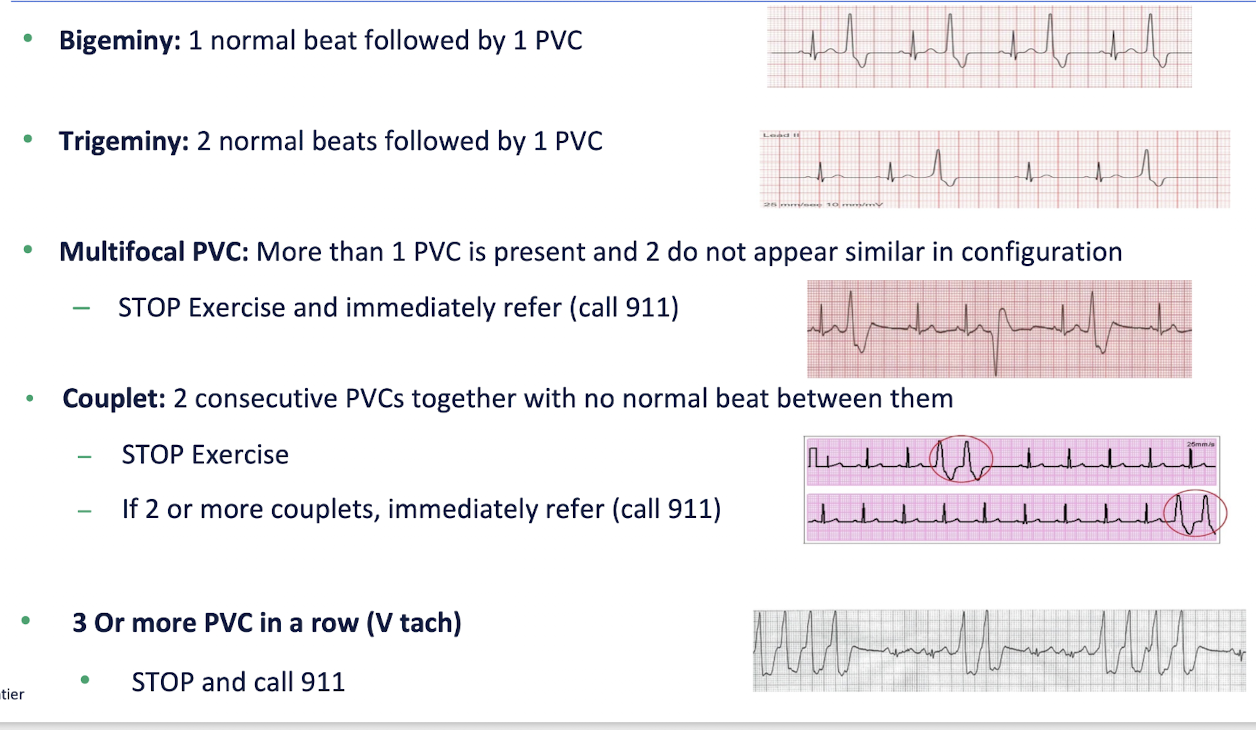
<p>PVC Variations:</p><ul><li><p>Bigeminy =</p></li><li><p>Trigeminy =</p></li><li><p>Multifocal PVC =</p><ul><li><p>What should PT do?</p></li></ul></li><li><p>Couplet =</p><ul><li><p>What should PT do?</p></li><li><p>If 2 or more couplets =</p></li></ul></li><li><p>3 or more PVC in a row =</p><ul><li><p>What should PT do?</p></li></ul></li></ul><p></p>

PVC Variations:

  • Bigeminy =

  • Trigeminy =

  • Multifocal PVC =

    • What should PT do?

  • Couplet =

    • What should PT do?

    • If 2 or more couplets =

  • 3 or more PVC in a row =

    • What should PT do?

  • Bigeminy =

    • 1 normal beat followed by 1 PBC

  • Trigeminy =

    • 2 normal beats followed by 1 PVC

  • Multifocal PVC =

    • More than 1 PVC is present and 2 do not appear in similar configuration

      • STOP exercise and immediately refer (call 911)

  • Couplet =

    • 2 consecutive PVCs together with not normal beat between them

      • STOP Exercise

      • If 2 or more couplets = Immediately refer (call 911)

  • 3 or more PVC in a row = V Tach

    • STOP and call 911

<ul><li><p>Bigeminy =</p><ul><li><p>1 normal beat followed by 1 PBC</p></li></ul></li><li><p>Trigeminy =</p><ul><li><p>2 normal beats followed by 1 PVC</p></li></ul></li><li><p>Multifocal PVC =</p><ul><li><p>More than 1 PVC is present and 2 do not appear in similar configuration</p><ul><li><p>STOP exercise and immediately refer (call 911)</p></li></ul></li></ul></li><li><p>Couplet =</p><ul><li><p>2 consecutive PVCs together with not normal beat between them</p><ul><li><p>STOP Exercise</p></li><li><p>If 2 or more couplets = Immediately refer (call 911)</p></li></ul></li></ul></li><li><p>3 or more PVC in a row = V Tach</p><ul><li><p>STOP and call 911</p></li></ul></li></ul><p></p>
32
New cards

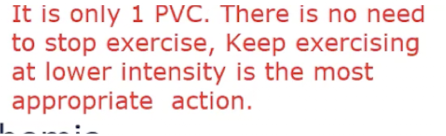
Practice Q 9:

The physical therapist is working with a patient, who is 4 months post myocardial infarction, in a cardiac rehab facility. Upon increasing the workload, the physical therapist observes a unifocal PVC on the patient’s ECG. Which of the following is the MOST APPROPRIATE action by the physical therapist?

A. Continue to exercise and increase the intensity

B. Stop exercise because patient is undergoing ischemia

C. Keep exercising at a lower intensity; consultation with physician is not required here

D. Stop exercise and consult with physician before starting any exercise

C. Keep exercising at a lower intensity; consultation with physician is not required here
<p>C. Keep exercising at a lower intensity; consultation with physician is not required here</p>