Biology 2 Lecture exam 1
 Call Kai
 Learn
Learn Practice Test
 Spaced Repetition
 Match
Match Flashcards
 Knowt Play
1/73

There's no tags or description
Looks like no tags are added yet.
Name | Mastery | Learn | Test | Matching | Spaced | Call with Kai | Chat |
|---|
No analytics yet
Send a link to your students to track their progress
74 Terms
What are the properties of life
Order
Response to stimuli
Reproduction
Growth and Development
Homeostasis
Energy Processing
Adaptation
Regulation
Homeostasis and Regulation
Cells need appropriate conditions, organisms have the ability to maintain internal conditions despite external fluctuations
Producers (Anabolic Energy Processing
Energy from the sun to chemical energy (photosynthesis)
Consumers (Catabolic Energy Processing)
Chemical energy in molecules from food (cellular respiration)
3 Main Domains of Life
Bacteria
Eukarya (Humans)
Archaea
Virus
An infectious agent that can only replicate within a host organism
Capsid
Genetic information inside a protein shell
Science
a way of knowing – systematic study of the natural world
Who wrote down the scientific method
Sir Francis Bacon
The Scientific Method in order
Make Observation
Question
Form a hypothesis that tries to explain the observation
Make a prediction based on the hypothesis
Experiment
Analyze Data/Results
Report your results / Peer Review
Hypothesis
proposed explanation of a natural phenomenon that has to be testable
Variable
A characteristic that is measured
Independent Variable
Treatment controlled by the experimenter (X-axis)
Dependent Variable
Observed result (Y-axis)
Experimental group
receive a certain treatment
Control group
identical to an experimental group, but without exposure to the treatment
Scientific theories are
Generally accepted
Broad, comprehensive
Thoroughly, repeatedly tested and confirmed
Withstands rigorous scrutiny
Explanation for a set of observations and diverse phenomena
Phylogenetic trees
Evolutionary relationships between organisms are shown with branching
diagrams, can be drawn in many ways, rotated at any nodes

Sister Taxa
More closely related to each other than to any other taxon on the tree, Did NOT evolve from each other but from common ancestor

Speciation event
A speciation event marks the moment in evolutionary history when a single lineage divides into separate species.
How are phylogenetic trees made
They are based on analyzing characters (heritable traits) and group organisms based on shared, derived (new) characters
How scientists name species
Follows phylogeny(evolutionary relationships)
Who is the father of taxonomy
Carl Linnaeus
Rules for Binomial Nomenclature
1st name = Genus. Capitalized
• 2nd name = species. Lowercase
• Latin (roots)
• Underlined or italicized
Genus
a group of species that share a set of traits
Trait/Character
an observable characteristic of an organism or species
Taxon
group of organisms that share a unique set of traits
Synapomorphy
shared, derived character state that originated in the most recent common ancestor of a group of organisms.
How to read a phylogenetic tree
Each node (branch point) represents a common ancestor, each taxon or group is united by synapomorphies
Homologous
Similar because of common ancestry
Analogous
Similar because of common function, evolved independently

Rule of simplicity
Parsimony, tree with least amount of steps.
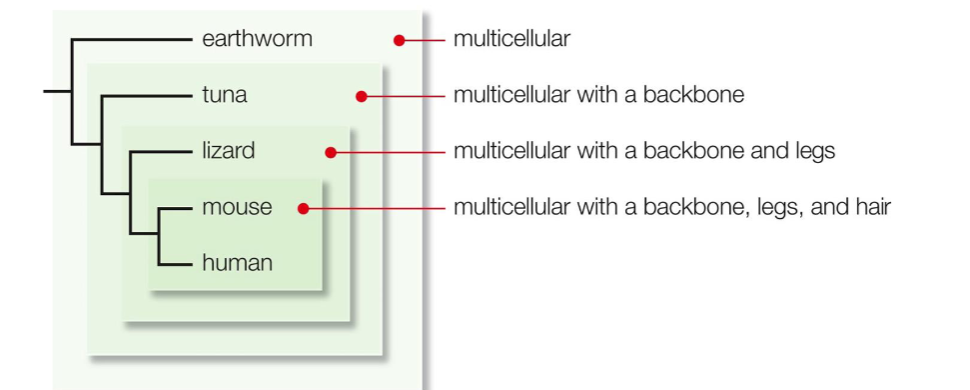
Clades
each of the species that are at the end of branches, A clade is each group in a box
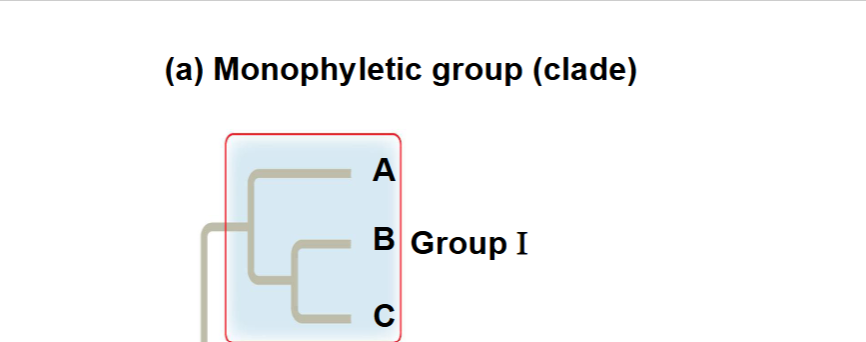
Monophyletic group
Known common ancestor in a clade

Paraphyletic Group
Missing some knowledge on ancestors

Polyphyletic Group
Don’t have a common ancestor, know the least amount
Shape of prokaryotic and chlorplast chromosomes
circular
Shape of Eukaryotic chromosomes
linear
Prokaryotes
No membrane bound organelles, one circular chromosome
Simplest and smallest organism yet globally outweighs all other organisms combined and the most dominant
Prokaryotes
How do most prokaryotes reproduce
Binary Fission (asexual)
What percentage of the sea do prokaryotes make up
90%
Cyanobacteria (Blue-Green Algae)
Not technically algae, only half are actually blue-green
What type of chlorophyll does Cyanobacteria ave
chlorophyll a, oxygen producing photosynthesis
Nitrogen Fixation
Few organisms can turn N2 Into usable nitrogen
What does cyanobacteria use to turn n2 into nitrogen
Heterocysts, responsible for 1/3 of nitrogen fixation in some environments

Algal blooms
Caused by fluctuations in temperature that make bacteria more buoyant or caused by fertilizer
Prochlorophytes
Photosynthetic bacteria,
produces 20% of oxygen in our biosphere,
most abundant marine organism
What type of chlorophyll do Prochlorophytes contain
Chlorophyll a and b

Zygotic meiosis
Zygote → Meiosis → Haploid cells from meiosis become multicellular organism (Gamete) → Gametes come together for fertilization → REPEAT
Mitosis
1 diploid into 2 diploids (46 chromosomes
Meiosis
1 diploid into 4 haploids (each have 23 chromosomes)
Who performs Zygotic meiosis
Fungi, some algae

Gametic meiosis
Similar to zygotic meiosis, but instead of haploid cells it forms gametes
Who performs gametic meiosis
Animals, some protists, and algae

Sporic meiosis or alternation of generation
Zygote → Sporophyte → Meiosis→ Forms spores → Spores turn into Gametophytes → Fertilization → Repeat
Who performs sporic meiosis or AOG
Plants, many algae
Fusion process is what?
Fertilization
What do sporic meiosis form
Spores
Euglenoids
Algae like, Unicellular protist
Mixotrophic
Can obtain energy and carbon from consuming and photosynthesis
Stramenopiles
Diatoms
Golden algae
Brown algae
What do all stramenopiles have in common
All have fucoxanthins
Diatoms
Provides 25% of all carbon fixation, most unicellular or colonial
How do diatoms reproduce
Mainly asexual, to increase size it sexually reproduces
Oogamy
Type of sexual reproduction where gametes differ in size, females bigger than male gametes
Heteromorphic AOG
Reduced gametophyte, Large sporophyte (produces spores), Zoospores
Protist we talked about
Red Algae, Golden Algae, Brown Algae(ectocarpus
Euglenoids
Green Algae
Dinoflagellates
Diatoms
Chlamydomonas
Contractile Vacuole
Fritschiella
Thallus
More protists we talked about
Cladophora
Ulva Lactuca
Acetabularia (mermaids wine glass)
Halimeda
Spirogyra
Organization of life
Atom → Molecule → Organelle → Cell → Tissue → Organ → Organ system → Organism → Population → Community → Ecosystem → Biosphere
What level of organization is considered alive
Cell
Population (One Species)
All members of one species living in the same area
Community (Many Species)
All different populations living and interacting in the same area
Ecosystem (Many species + nonliving environment)
Community + nonliving environment