Scientific Rev to Germany and Italy Unification
 Studied by 0 people
 Call Kai
 Learn
Learn Practice Test
 Spaced Repetition
 Match
Match Flashcards
 Knowt Play
1/31

There's no tags or description
Looks like no tags are added yet.
Name | Mastery | Learn | Test | Matching | Spaced | Call with Kai |
|---|
No study sessions yet.
32 Terms
Absolute monarchs
Made laws without consent, collected heavy taxes, controlled religion & culture, limited freedoms.
Historical events leading to the Enlightenment
Scientific Revolution, abuse by monarchs, spread of literacy & salons, questioning tradition.
John Locke's beliefs
Natural rights: life, liberty, property.
Montesquieu's belief
Separation of powers to prevent abuse.
Rousseau's belief
Social contract, government by consent.
Voltaire's belief
Freedom of speech and religion.
Beccaria's advocacy
Fair legal system, no cruel punishment.
Impact of the Enlightenment on monarchs and reform movements
Inspired reforms, limited power, sparked revolutions.
Causes of the French Revolution
Economic crisis, inequality in Estates system, Enlightenment ideas, weak leadership (Louis XVI).
French Estate system
First Estate: clergy, Second: nobles, Third: commoners (unjustly taxed).
Stage 1 of the French Revolution
National Assembly, Declaration of Rights of Man, storming of Bastille.
Stage 2 of the French Revolution (Reign of Terror)
Robespierre leads executions, extreme measures to protect revolution.
Stage 3 of the French Revolution (Napoleon)
Coup, ends revolution, expands France.
Effects of the French Revolution
End of monarchy, spread of equality/liberty, rise of nationalism, inspired other revolutions.
Nationalism's contribution to Italian and German unification
Pride in language/culture/history, desire for independent nation-states, led to wars/movements.
Otto von Bismarck's unification of Germany
"Blood and Iron" → war & industry, strengthened Prussia, defeated Austria & France, united German states.
Causes of the Haitian Revolution
Brutal slavery, influence of French Revolution, social inequality.
Effects of the Haitian Revolution
Haiti independent (1804), first successful slave revolt, inspired anti-slavery movements.
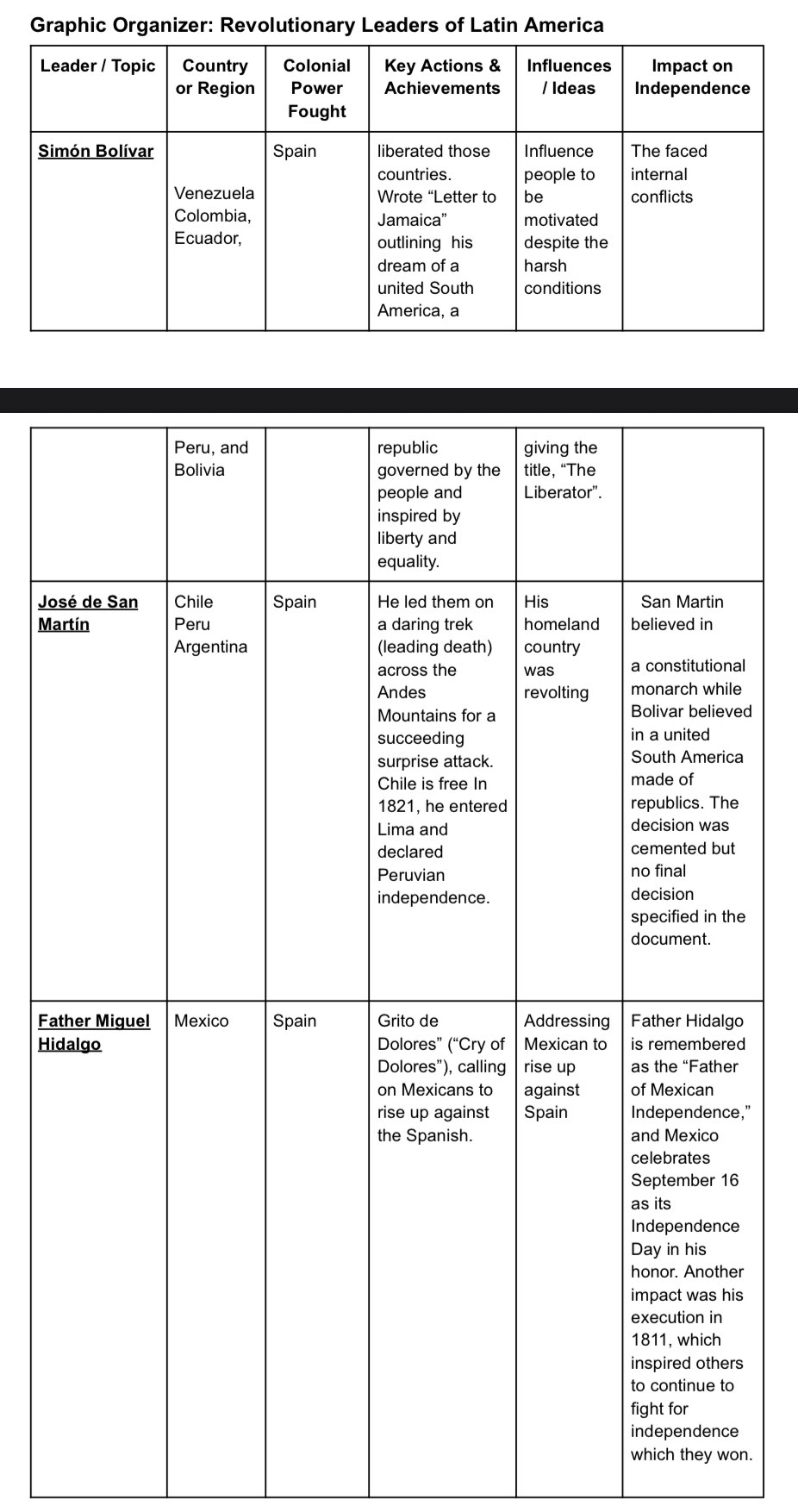
Causes of Latin American independence movements
Enlightenment ideas, exploitation by Spain/Portugal, weakened authority from Napoleon's conquest of Spain.
Effects of Latin American independence movements
New nations, social inequalities remained, spread revolutionary ideas.
Enlightenment influence on revolutions
Ideas of equality, rights, and freedom inspired revolutions and challenged authority.
Turning points in this unit
Scientific Revolution → Enlightenment
French Revolution → spread of ideas inspiring other revolutions.
Cause & effect example 1
Scientific Revolution → Enlightenment → revolutions.
Cause & effect example 2
French Revolution → rise of nationalism → Italian/German unification.
Cause & effect example 3
Haitian Revolution → independent Haiti → inspires anti-slavery movements.
Toussaint Louverture
Led enslaved people to rebel against French control in Saint-Domingue (Haiti).
• Ended slavery and helped write the 1801 Constitution, which made all men free and equal.
• Became governor of the colony and rebuilt the economy with paid labor.
• Was later captured by Napoleon's army and died in prison in France in 1803 — but his leadership helped Haiti win independence in 1804.
Jean-Jacques Dessalines
• Led final battles against the French.
• Declared Haiti's independence on January 1, 1804.
• Became Haiti's first ruler/emperor.
• Known for ending slavery permanently and making Haiti the first Black republic.
Inspired other revolts and freedom movements worldwide.
• Scared slaveholding nations (like the U.S. and Brazil).
• Haiti faced economic isolation and debt from European powers.
Storming or the Bastille
People were angry at King Louis XVI for high taxes and food shortages.
• Rumors said the king planned to attack Paris.
• Citizens wanted weapons and gunpowder stored in the Bastille.
"Soul, Brain, Sword" → Italian Unification
Soul = Mazzini → inspired nationalism, Young Italy
• Brain = Cavour → diplomacy, alliances, weakened Austria in north
• Sword = Garibaldi → led Red Shirts, military victories in south
What were the main effects of Italian unification?
National pride, challenges in balancing regional differences, and building a single Italian identity.
Latin Rev