GenChem 1
 Call Kai
 Learn
Learn Practice Test
 Spaced Repetition
 Match
Match Flashcards
 Knowt Play
1/104

There's no tags or description
Looks like no tags are added yet.
Name | Mastery | Learn | Test | Matching | Spaced | Call with Kai | Chat |
|---|
No analytics yet
Send a link to your students to track their progress
105 Terms
Fusion, Liquefaction, Thawing
Melting (Solid to Liquid)
Recombination, Deionization
Plasma to Gas
Ionization
Gas to Plasma
Extrinsic Property
Dependent properties like length, mass/weight, volume, pressure, entropy, enthalpy, electrical resistance.
Intrinsic Property
Independent properties like density (SpGr), viscosity, velocity, temperature, color.
Law of Conservation of Mass/Matter
Antoine Lavoisier's principle that mass is always constant; matter cannot be created or destroyed.
Law of Definite/Constant Proportions
Joseph Proust's law stating that a given chemical compound always contains its component elements in fixed ratio by mass.
Law of Multiple Proportion – John Dalton
When 2 elements form more than 1 compound, it can be expressed in a fixed whole number (by mass). Ex: CO → 28g/mole, CO₂ → 44g/mole; C = 12g/mole, O = 16g/mole.
Law of combining weights
Proportions by weight when a chemical reaction takes place can be expressed in small integral units. Ex: MgO → 40g/mole (100%); Mg = 24g/mole (60%); O = 16g/mole (40%).
Democritus
Atomos - 'Indivisible'.
John Dalton
Billiard ball; proposed that matter is made up of atoms.
Dalton's Postulates
- Elements are composed of indivisible, indestructible atoms. 2. Atoms alike for a given element (isotopes). 3. Atoms of different elements differ in size, mass & other properties (isobars). 4. Compounds are formed from 2 or more atoms at different elements. 5. Atoms combined in simple numerical ratios to form compounds.
J.J. Thompson
Proposed the Plum Pudding / Raisin bread model; e- in (+) framework.
Ernest Rutherford
Discoverer of proton; Nuclear model from Gold foil / α-scattering experiment; atom is mostly empty, (+) particles in nucleus.
Neil Bohr
Planetary model; mostly used.
Erwin Schrodinger
Quantum/Mechanical model; estimates the probability of finding an e- in certain position (i.e
Proton
(+) ion; Atomic number (basis of electronic configuration); Ernest Rutherford.
Electrons
(-) ion; p+ in uncharged state; negligible weight 1,836x lighter than p+; J.J. Thompson proposed the cathode ray tube; R.A. Millikan measured accurate charge and mass of e-.
Neutrons
No charge; Atomic mass (Nucleon) = p+ + n0; James Chadwick.
p+
Atomic # = 11.
n0
Atomic mass - p+ = 23-11 = 12.
e-
p+ in uncharged state: 11-1 = 10.
P
p = 15.
n
n = 16.
e
e = 18.
Eugene Goldstein
Discovered anode rays.
Electrochemistry
Particle separation based on e⁻.
Anode
Electrode with a positive charge; undergoes oxidation.
Cathode
Electrode with a negative charge; undergoes reduction.
RED CAT ELECT IN
Mnemonic: Reduction happens in cathode where electrons get in.
VILEORA
Valence Increase, Loses e⁻; undergoes oxidation; reducing agent.
VDGEROA
Valence Decrease, Gains e⁻; undergoes reduction; oxidizing agent.
Isotopes
Same p⁺/atomic number/element but differ in atomic mass.
Non-isotopes
e.g., ¹⁹F, ¹²¹Sn, etc.
Isobars
Same atomic mass, differ in elements.
Isomers
Same molecular formula, differ
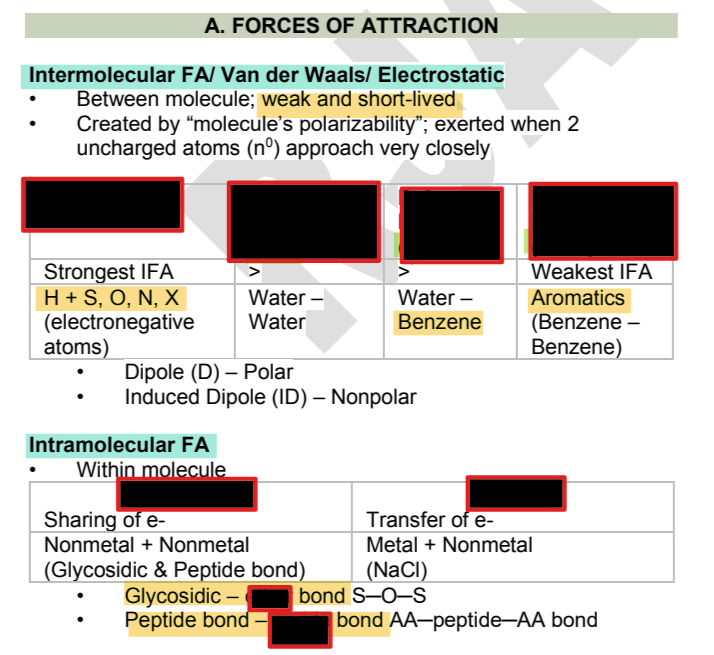
H Bonding
Keesom
Debye
London
Covalent
Ionic
Ether
Amide
Lone pair
Pair of valence electrons that are not shared with another atom in covalent bond
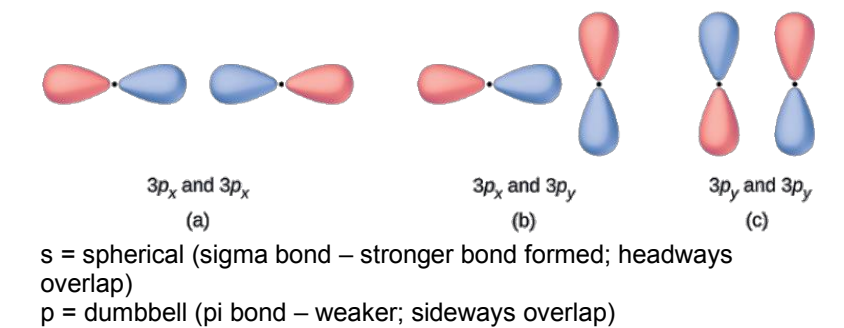
Valence bond theory
States that bonds are formed by sharing of electron from overlapping atomic orbitals (covalent)
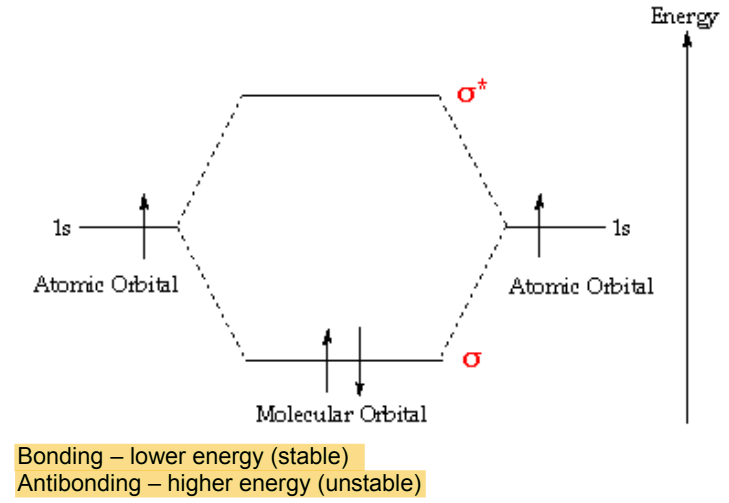
Molecular bond theory
States that bonds are formed from interaction of atomic orbitals from molecular orbitals
Synthesis/ Combination/ Direct Union
A + B → AB
Decomposition/ Analysis
AB → A + B
Complete combustion example
CH₄ + O₂ → CO₂ + H₂O
Incomplete combustion example
CH₄ + O₂ → CO + C(s) + H₂O
Single Displacement
AB + X → AX + B
Double Displacement/ Metathesis/ Exchange
AB + CD → AC + BD
Li CA ba CA na mg Al MN zn Cr fe co CD ni sn PB H2 cu ag hg PT au
F cl br I
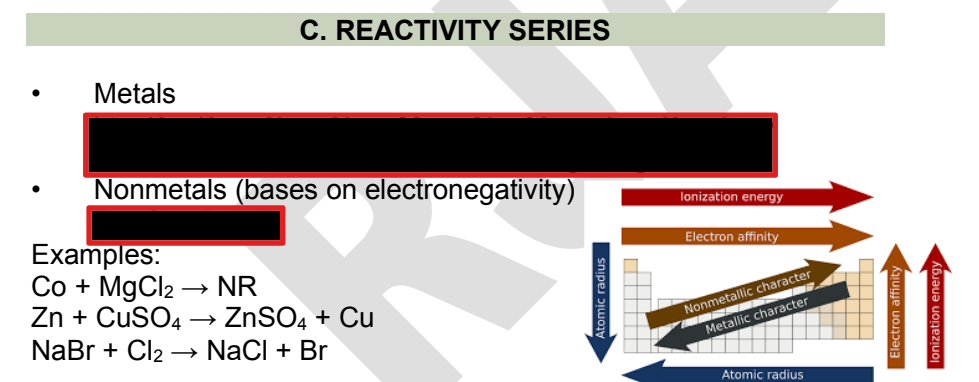
Hg cu
Au
Fe co ni
Bi SB
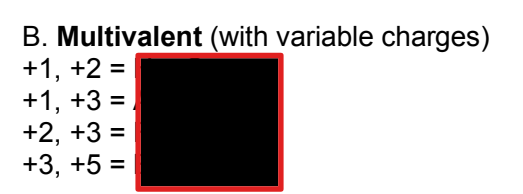
Recall
Answer recall
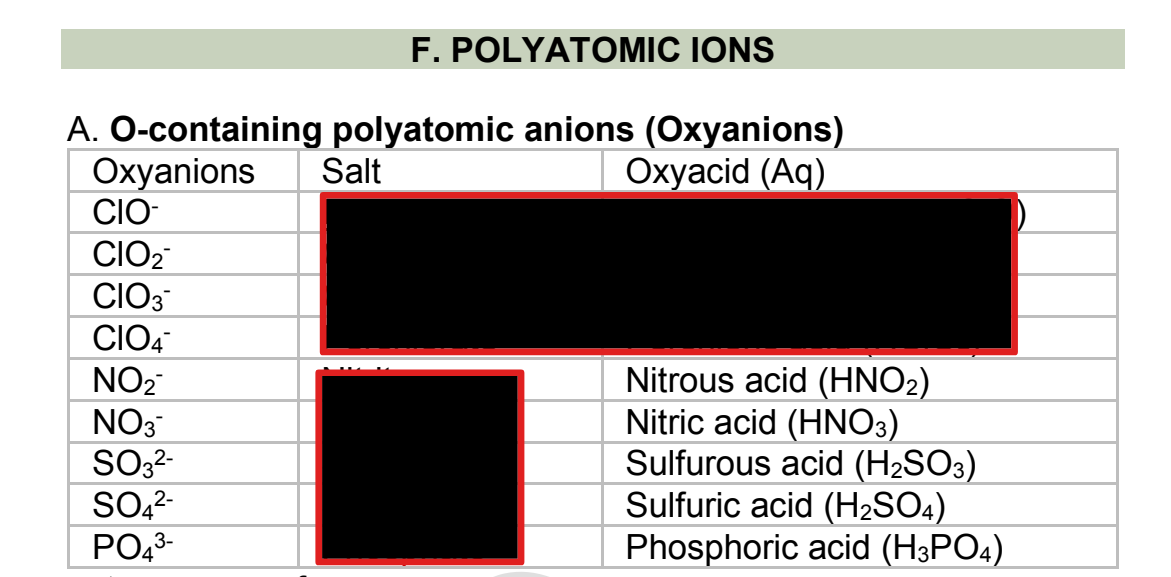
1 mole = 6.022 x 10²³ atoms/ molecules
Avogadro's number
Aufbau principle
Atoms may be built by progressive filling of energy of main energy sub level (i.e., levels of lower energy levels are occupied first
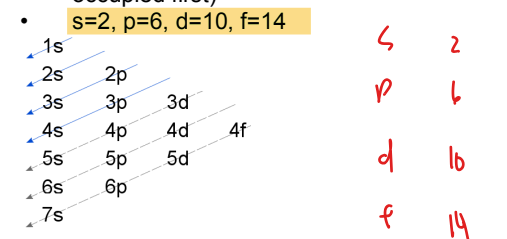
2
10
18
36
54
86
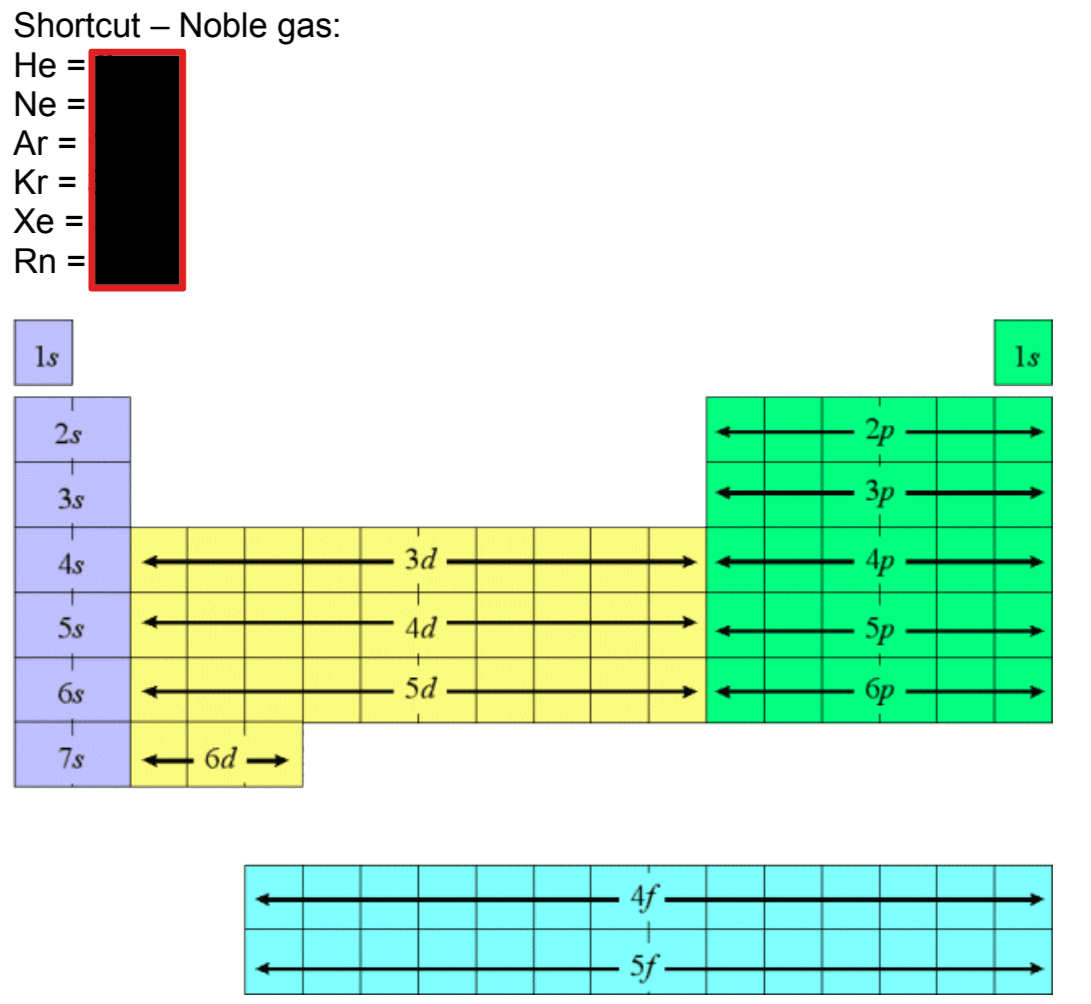
Principal Quantum Number (n)
Main energy level; size of orbital (electron cloud), distance of e⁻ from nucleus. Example: O₂ is 1s² 2s² 2p⁴.
Azimuthal/ Angular Momentum Quantum Number (ℓ)
Angular momentum & shape of orbital; subshell. Values: ℓ = 0 (s: sharp), 1 (p: principle), 2 (d: diffuse), 3 (f: fundamental). Example: O₂ = ℓ = 1.
Magnetic Quantum Number (mℓ)
Orientation of orbital in space. Example: O₂ has mℓ = -1, 0, +1.
Magnetic Spin Quantum Number (ms)
Magnetic moment/Rotation. Values: +½ (clockwise), -½ (counterclockwise). Example: Oxygen has ms = +½.
Pauli’s exclusion theory
No 2 e⁻ will have the same set of quantum numbers ('exclusive').
Heisenberg’s uncertainty theory
Impossible to predict/accurately determine the particle’s velocity (position & momentum).
Hund’s rule
Orbitals are filled up singly before pairing up; most stable arrangement of e⁻ in subshells is the one with greatest no. of parallel spins.
Boyle's/Mariotte
Charle’s
Gay-lussac
Combined gas law
Ideal gas law
Avogadro's law
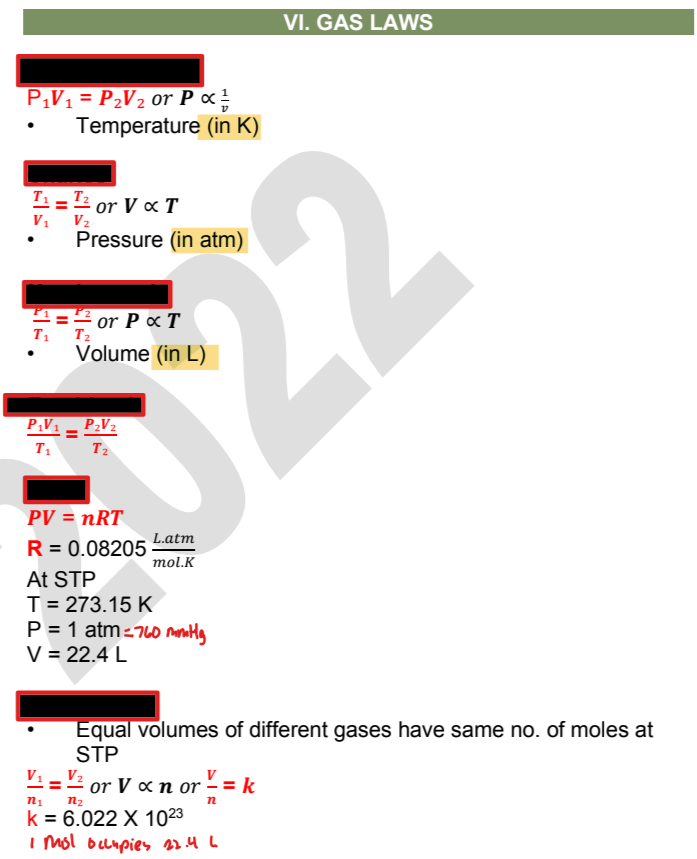
Dalton's Law of Partial Pressures
Total pressure in a mixture (non-interacting gases) is equal to the sum of the partial pressures of each gas. P<em>t=P</em>1+P<em>2+P</em>3.
Graham's Law
Rate of effusion (diffusion) and speed gas are inversely proportional to the square root of their density, given constant temperature and pressure.
Diffusion
Rate at which 2 gases mix.
Effusion
Rate at which gas escapes through a pinhole vacuum.
Fick's 1st Law
Diffusion rate (flux) of liquid or gas is directly proportional to the concentration gradient (from high concentration to low concentration).
Henry's Law of Gas Solubility
Pressure is directly proportional to solubility; decrease in temperature and increase in pressure (e.g., sealed container) allows more CO₂ to be dissolved in water.
Raoult's law
vapor pressure of a solution is dependent on the amount of nonvolatile solute added to solution
Open System
Allows exchange of energy and matter.
Closed System
Allows exchange of energy but not matter.
Isolated System
Does not allow exchange of both energy and matter; referred to as 'Adiabatic Walls'.
Surrounding
Everything outside the system.
State Function
Independent; depends only on initial and final states of the system (e.g., Enthalpy (H), Internal energy (U), Gibbs Free Energy (G), Entropy (S)).
Non-State Function
Dependent; includes Work and Heat.
Zeroth Law
If two systems are in thermal equilibrium respectively with a third system, they must be in thermal equilibrium with each other (a=c, b=c, a=b).
1st LAW: Law of conservation of Energy
Energy is neither created nor destroyed but can be transformed from one form to another.
Enthalpy (H)
H = U, P, V.
Hess' Law
ΔH is independent of reaction/steps that occurred (only the initial and final steps is the basis).
2nd LAW: Law of Entropy
No way but UP. For an isolated system, Total entropy can never decrease
Entropy (ΔS)
Measure of a system's thermal energy per unit temperature; degree of disorderliness or randomness. ΔS = (+) → spontaneous; increase (irreversible) – real case; ΔS = (−) → non-spontaneous; constant (reversible) – ideal case (in a steady state/equilibrium); ΔH → does not predict spontaneity.
3rd LAW
If an object reaches absolute zero temperature (0 K = -273.15 = -459.67 °F), the entropy of a perfect, solid, crystalline substance is zero at absolute 0 temperature.
Reaction Rate
The speed at which a chemical reaction occurs; typically measured by the change in concentration of reactants or products over time.
Rate Law
An equation that relates the reaction rate to the concentrations of the reactants, usually in the form of rate = k [A]^m [B]^n, where k is the rate constant and m and n are the reaction orders.
Collision Theory
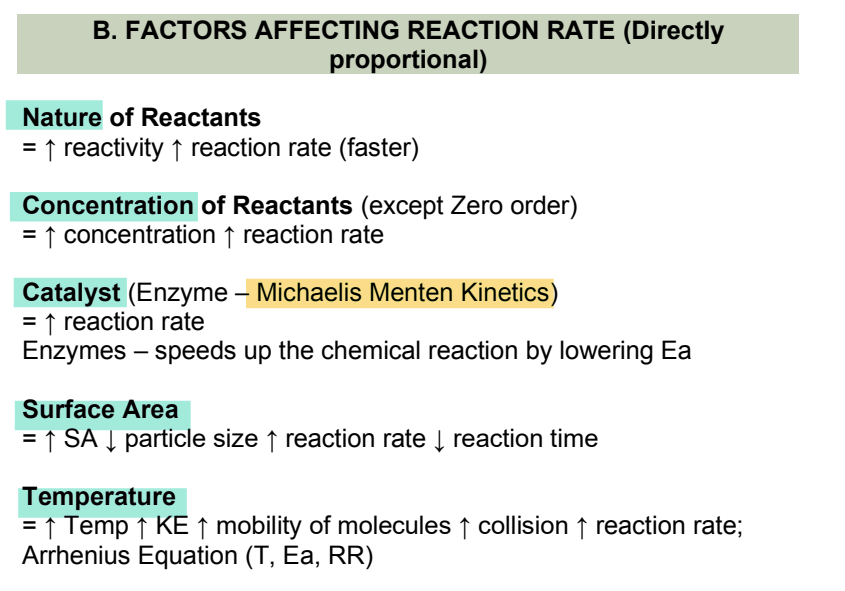
Rate of chemical reaction is proportional to the number of collisions per time. Requirements for effective collision: Proper orientation, Activation energy (Ea) – minimum amount of energy required to initiate chemical reaction.
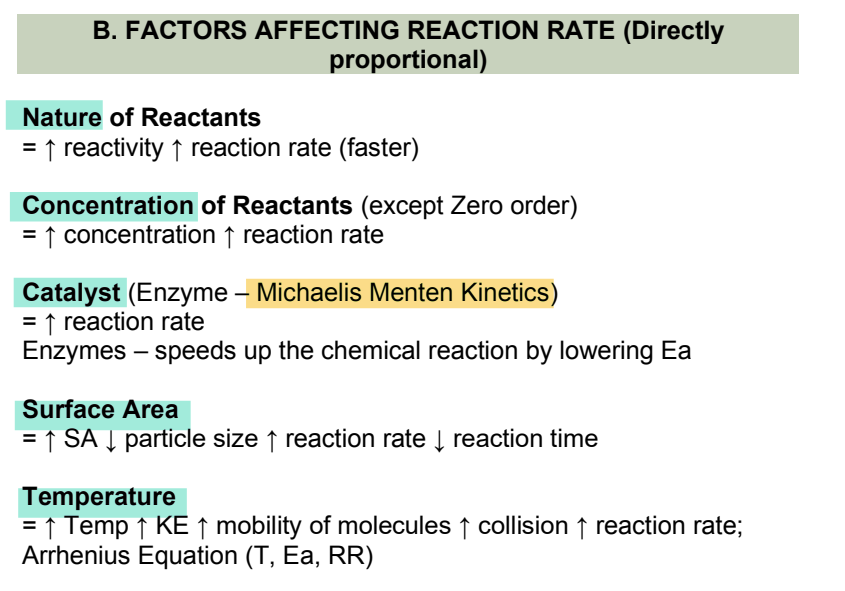
Transition Theory
Formation of Intermediate Complex; rate depends on Ea required to form an intermediate state (where new bonds are formed and old bonds are broken).
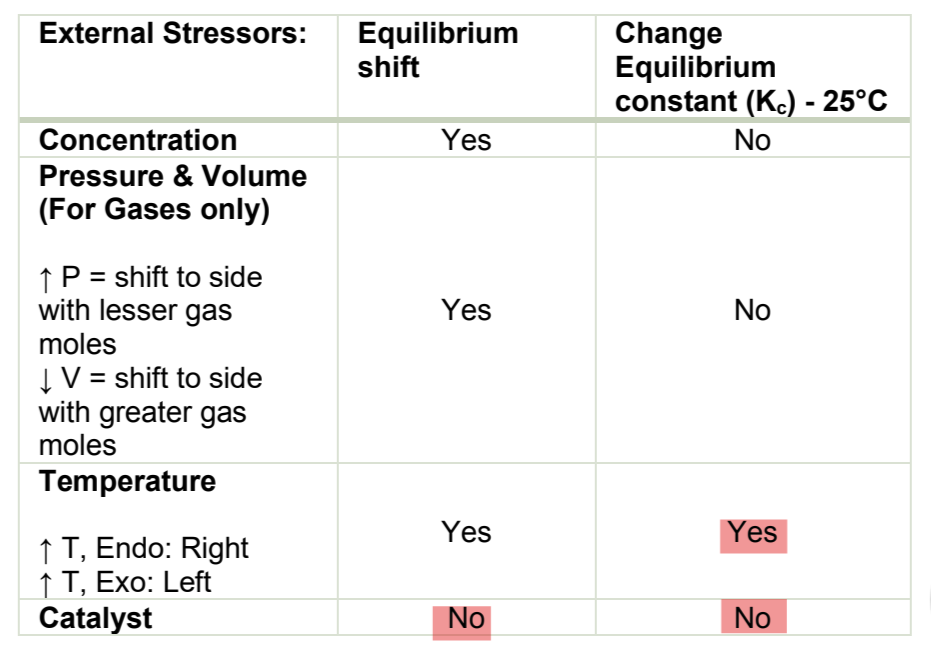
Le chatelier’s principle
If an external stress is applied to a system at equilibrium, the system adjusts in such a way that stress is partially offset as the system reaches new equilibrium
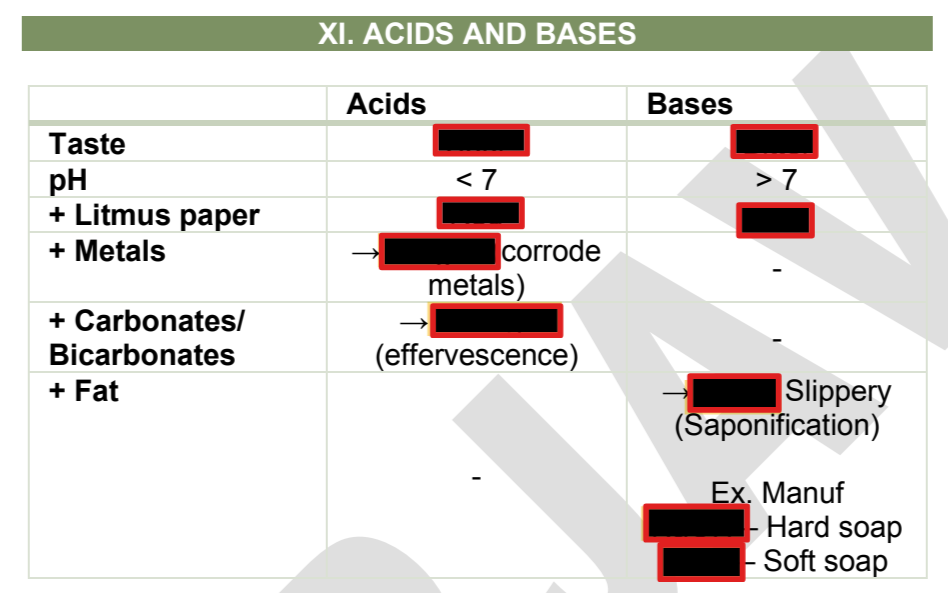
Sour, bitter
Red, blue
H2
CO2
Soap
NaOH
KOH
Recall
Answer recall
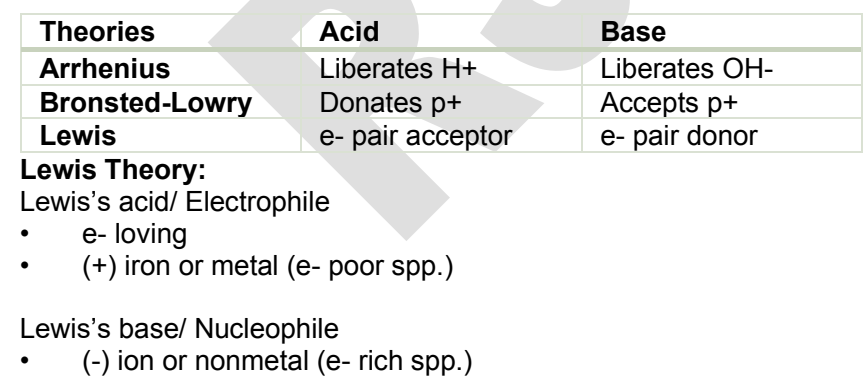
Common Ion Effect
Addition of a compound having an ion in common with the dissolved substance will result in: • Equilibrium shift (either to the left or right) • Suppressed ionization of the dissolved substance (WA or WB) • pH change.
Henderson-Hasselbalch/Buffer Pair Equation
For buffer solutions (WA + CB or WB + CA), the equations are: Weak acids: pH=pK<em>a+extlog[extacid][extsalt] Weak bases: pH=pK</em>b+extlog[extsalt][extbase] *pH = pKa (@ half neutralization point).
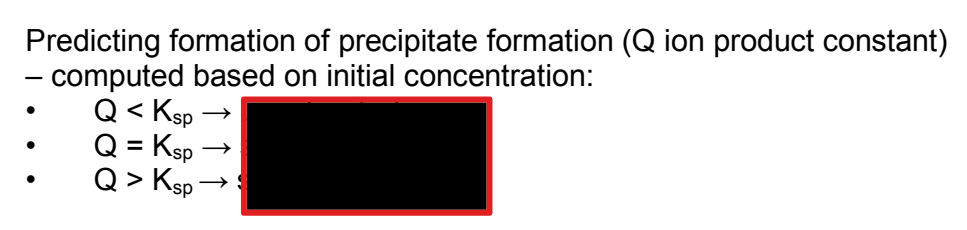
Unsaturated
Saturated
Supersaturated
Noyes Whitney equation
Dissolution rate is directly proportional to the solute surface area, solute concentration at boundary layer, and diffusion coefficient
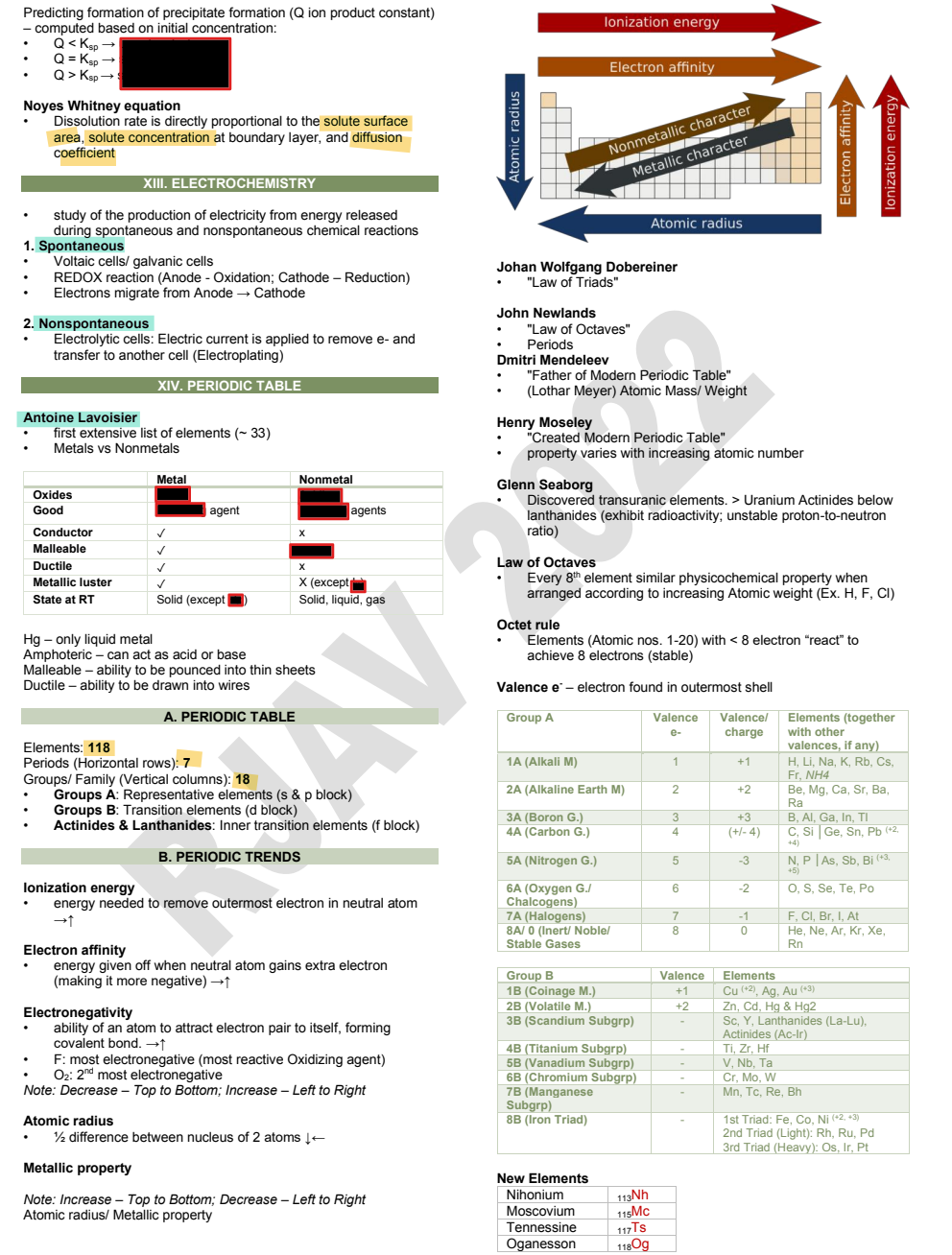
Basic, acidic
Reducing, oxidizing
Brittle
Iodine
Mercury
Antoine Lavoisier
First extensive list of elements (~33), distinguishing between metals and nonmetals.
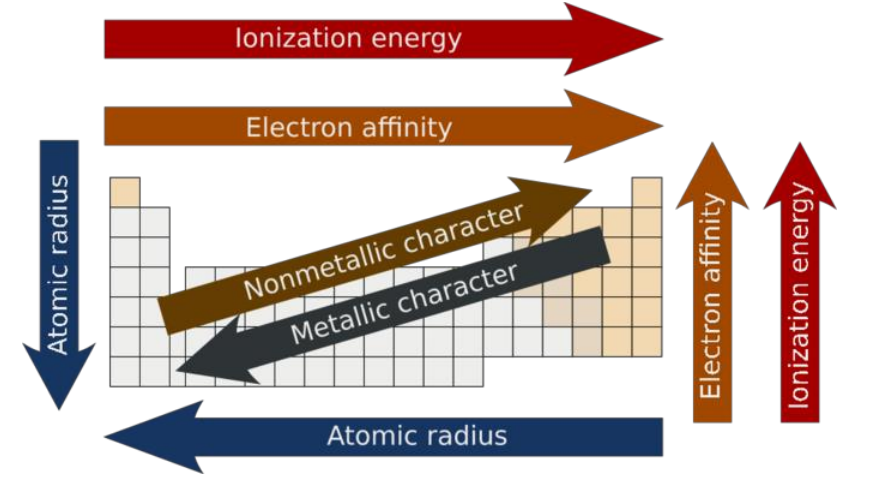
Ionization Energy
Energy needed to remove the outermost electron in a neutral atom; increases across a period (→) and decreases down a group (↓).
Electron Affinity
Energy given when a neutral atom gains an extra electron (making it more negative); increases across a period (→) and decreases down a group (↓).
Electronegativity
Ability of an atom to attract an electron pair to itself during covalent bond formation; increases across a period (→) and decreases down a group (↓).
Atomic Radius
Half the distance between nuclei of 2 atoms; decreases across a period (→) and increases down a group (↓).
Johan Wolfgang Dobereiner
'Law of Triads'.
John Newlands
'Law of Octaves'; considered periods.
Dmitri Mendeleev
'Father of Modern Periodic Table'; Atomic Mass/Weight.