A&P Chapter 2
 Call Kai
 Learn
Learn Practice Test
 Spaced Repetition
 Match
Match Flashcards
 Knowt Play
1/48

There's no tags or description
Looks like no tags are added yet.
Name | Mastery | Learn | Test | Matching | Spaced | Call with Kai | Chat |
|---|
No analytics yet
Send a link to your students to track their progress
49 Terms
Matter
anything that occupies space and has mass (there are three states)
Energy
the ability to do work
Kinetic energy
energy is doing work
Potential energy
energy is inactive or stored
Chemical energy
is stored in chemical bonds of substances
Electrical energy
movement of charged particles
Mechanical energy
energy directly involved in moving matter
Radiant energy
travels in waves
ATP (adenosine triphosphate)
provides energy for all living cells

Elements
fundamental units of matter
Molecule
2 or more atoms of the SAME elements bonded together; all compounds are [ ]
Compound
2 or more atoms of DIFFERENT elements bonded together to form a mole of a compound

Chemical reactions
atoms combine with/dissociate from other atoms
Chemical bonds
energy relationships between electrons of reacting atoms
has the most potential energy
Electrons
Negatively charged particle closest to the nucleus

Nucleus
Almost entire mass of the atom composed of Neutrons and Protons
Ion
result from the loss or gain of electrons

Ionic bond
when electrons are completely transferred from one atom to another
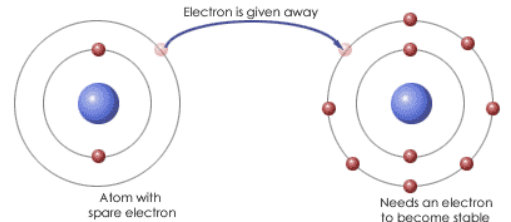

Covalent bond
link where 2 atoms share one pair (or more) of electrons
single [] share one pair of electrons
double [] share two pairs of electrons
![<p>link where 2 atoms share one pair (or more) of electrons</p><ul><li><p>single [] share one pair of electrons</p></li><li><p>double [] share two pairs of electrons</p></li></ul><p></p>](https://assets.knowt.com/user-attachments/746f25ff-9e87-4c6a-9dea-16de3ed2dfa5.png)
Nonpolar Covalent bond
electrons are shared EQUALLY between the atoms of molecule such as CO2
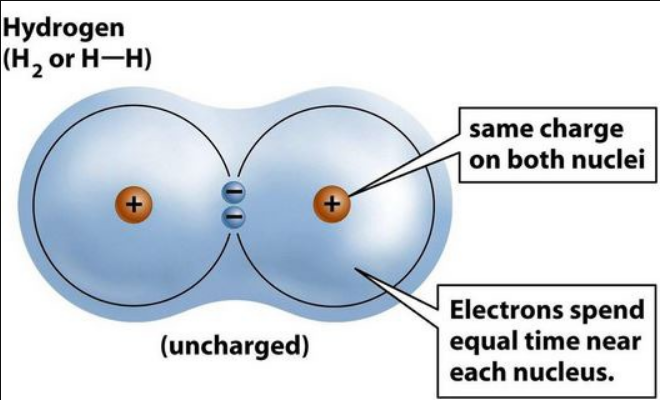
Polar Covalent bond
electrons are NOT shared equally between the atoms of the molecule such as H2O

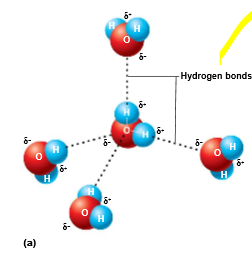
Hydrogen bonds
a hydrogen atom is attracted to negative portion of a polar molecule such as Oxygen
Synthesis reaction
Atoms/molecules combine to form larger, more complex molecules (A + B) → AB

Decomposition reaction
Molecule is broken down in smaller molecules

Exchange Reaction
simultaneous synthesis and decomposition reactions; bonds made and broke

Rate of Chemical Reaction
Affected by temperature, concentration of reactant, particle size

Inorganic compounds
No Carbon; small molecules
Organic compounds
Contain Carbon; large, covalent molecules
Water properties
High heat capacity, polarity/solvent properties, chemical reactivity, cushioning
Electrolytes
ions that conduct electrical currents; all salts are [ ]
Acids
Proton donors, release H+
0-6 on pH scale
Base
Remove protons, take up H+
8-14 on pH scale
Neutralization reaction
exchange reaction where acids and bases react to form water and salt
pH
measures how acidic or basic a liquid is
Polymer
chainlike molecules made of many similar or repeating (monomers)
Monomers
building blocks
Dehydration Synthesis
monomers are joined to form polymers through the removal of water molecules

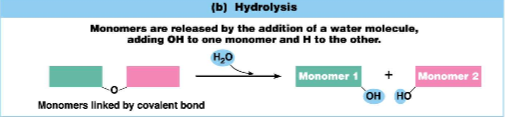
Hydrolysis
polymers are broken down into monomers through the addition of water molecules
Carbohydrates
contains carbon, hydrogen, and oxygen; sugars and starches
Monosaccharides
one simple sugar

Disaccharides
two simple sugars joined by dehydration synthesis

Polysaccharides
long, branching chains of linked simple sugars (monosaccharides)

Lipids
insoluble in water
Triglycerides
neural fats; energy storage; composed of fatty acids and one glycerol molecule
Phospholipids
modified triglycerides; form cell membranes
Steroids
interlocking 4 rings structure i.e. cholesterol, bile salts, vitamin D, and some hormones
Saturated fats
Single covalent bonds between C atoms
Unsaturated fats
One or more double bonds between C atoms