Language Science
 Call Kai
 Learn
Learn Practice Test
 Spaced Repetition
 Match
Match Flashcards
 Knowt Play
1/56

Earn XP
Description and Tags
Quiz 1 Review
Name | Mastery | Learn | Test | Matching | Spaced | Call with Kai | Chat |
|---|
No analytics yet
Send a link to your students to track their progress
57 Terms
Linguistic Competence
Hidden knowledge of language
Linguistic Performance
Observable use of language
Phonetics
Knowledge of speech sounds
Phonology
Knowledge of how speech sounds work together as a system
Morphology
Knowledge of how to create new words and break down words into smaller parts that have a particular meaning or function
Syntax
How words combine to form phrases and sentences (grammatical vs ungrammatical)
Semantics
Ability to determine meaning
Pragmatics
Ability to use context to interpret an utterance’s meaning
Lexicon
Mental dictionary of known words
Mental Grammer
Internalized rules for language use acquired naturally through exposure (language variations)
Descriptive Grammer
What speakers actually do
Prescriptive Grammer
What speakers “should” do
Modality
Tells us how a language is produced and perceived (auditory-vocal or visual gesture)
True or False: Signed language derive from spoken language
False
True or False: Signed languages don’t consist of words at all but rather draw pictures in the air
False: Signed languages are governed by phonological, morphological, and syntactic rules just like spoken languages
True or False: Only one signed language is used across all deaf people
False: More than 150 distinct documented signed languages across the world
Where does speech production begin?
Respiratory System (Lungs, Thoracic/Chest cavity, Diaphragm, Trachea/Windpipe)
Where does speech production happen secondly?
Laryngeal System (Larynx/Voicebox, Vocal Folds)
Where does speech production happen last?
Supralaryngeal (Pharynx/Throat, Nasal cavity, Oral cavity, Articulators)
Voicing
Whether or not a consonant sound is produced with a vocal fold vibration
Place
Where a consonant sound is produced
Bilabial Place
A speech sound made by bringing both lips together
Labiodental Place
A speech sound produced by bringing the lower lip into contact with the upper teeth
Interdental Place
A speech sound produced by placing the tip of the tongue between the upper and lower teeth
Alveolar Place
A speech sound produced by placing the tip of the tongue against or near the alveolar bumpy ridge
Post-Alveolar Place
A speech sound made by the tongue touching behind the alveolar ridge
Palatal Place
A speech sound made by the middle of the tongue touching the hard palate
Velar Place
A speech sound made by the back of the tongue touching the soft palate/velum
Glottal Place
A speech sound produced by the vocal cords and the space between them in the throat

What is 1
alveolar ridge

What is 2
Postalveolar region
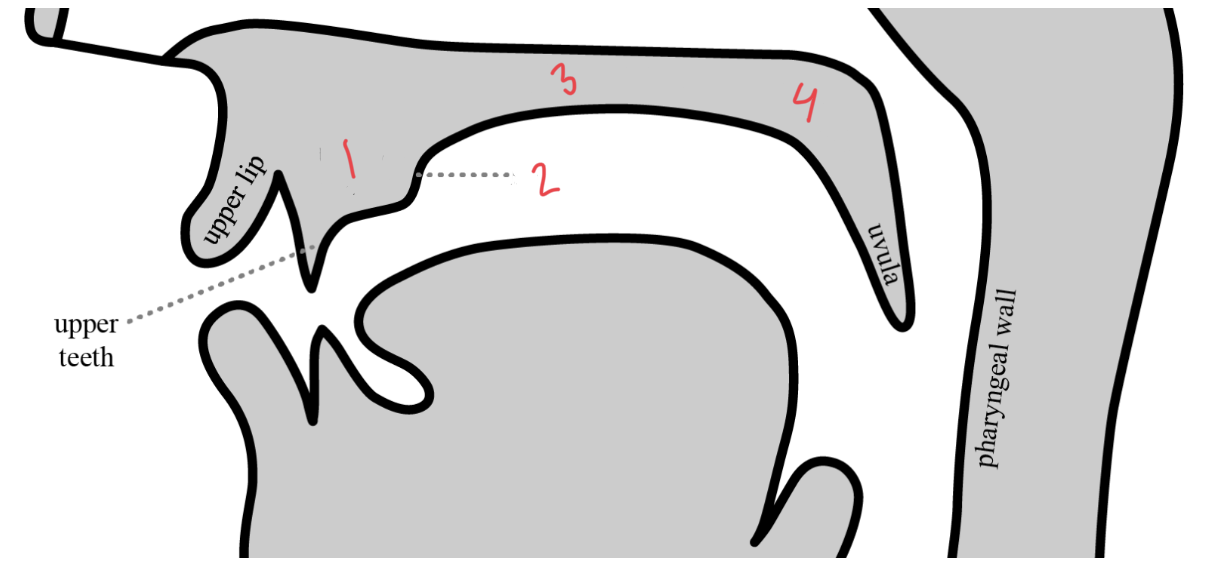
What is 3
Hard palate

What is 4
Velum
Manner
How a consonant sound is produced
Stops Manner
Two articulators come together to form complete constriction (Bilabial, Alveolar, Velar, Glottal)
Plosives
Air pressure is released when constriction is opened
Fricatives Manner
Two articulators come together to form partial constriction/narrowing in vocal tract (Labiodental, Interdental, Alveolar, Palatal, Glottal)
Affricates Manner
Begins as a stop then releases into a partial blockage (palatal)
Nasals Manner
Airstream obstructed in oral cavity by lowering soft palate (velum) and redirect through the nose (bilabial, alveolar, velar)
Glides Manner
Gliding motion of articulators in motion faster then diphthongs
Liquids Manner
Lateral consonant: air passes over sides of tongue
Parameters: Location
Where a sign is made
Parameters: Movement
Vertical/Horizontal, Starting/ending position
Parameters: Handshape
Finger extension/separation/bending, Thumb position
Parameters: Orientation
Direction the palm is facing
Parameters: Non-manual markers
Gestures while signing not made with hands
Phonotactic Constraints
Restrictions on possible combinations of sounds and which sounds can be used where in a word
Natural Classes
A group of sounds in a language that share one or more articulatory or auditory properties to the exclusion of all other sounds in the language
Natural Class: Sibilants
Sounds made with high-pitched, hissing sound quality /s, ʃ, tʃ, z, ʒ, dʒ/
Natural Class: Labials
Sounds produced at the lips /p, f, b, v, m, w, w̥ /
Natural Class: Obstruents
Stops, Fricatives, Affricative
Natural Class: Sonorants (open airflow and continuous voicing)
Nasals, Glides, Liquids
Natural Class: Labial Obstruents
/p, f, b, v/
Natural Class: Labial Sonorants
/m, w, w̥/
Assimilation
A sound becomes more like its neighnors
Dissimilation
Two close or adjacent sounds become less similar
Metathesis
The order of sounds changes; often to make the word easier to pronounce or understand