unit 11
 Call Kai
 Learn
Learn Practice Test
 Spaced Repetition
 Match
Match Flashcards
 Knowt Play
1/235

There's no tags or description
Looks like no tags are added yet.
Name | Mastery | Learn | Test | Matching | Spaced | Call with Kai | Chat |
|---|
No analytics yet
Send a link to your students to track their progress
236 Terms
What is tissue repair
The process by which the body restores the integrity and function of damaged tissue
What two processes does tissue repair involve
Regeneration and Repair/Fibrosis
What is regeneration
Replacement of damaged cells with others of the same characteristics (100% functional tissue)
What percentage of functional tissue is associated with regeneration
100% functional tissue
What is a Repair or Fibrosis?
The replacement of the space occupied by damaged or dead elements by collagenous connective tissue
What does repair or fibrosis replace damaged or dead elements with
Collagenous connective tissue
What does repair or fibrosis produce
SCAR and CYCATRIZATION
Approximately how functional is tissue after repair or fibrosis
90% functional tissue
Both regeneration and repair/fibrosis depend on mechanisms involved in ….. what
cell migration, proliferation and
differentiation, as well as in cell-extracellular matrix (ECM) interaction.
Type of tissue repair depends on what
The tissue affected
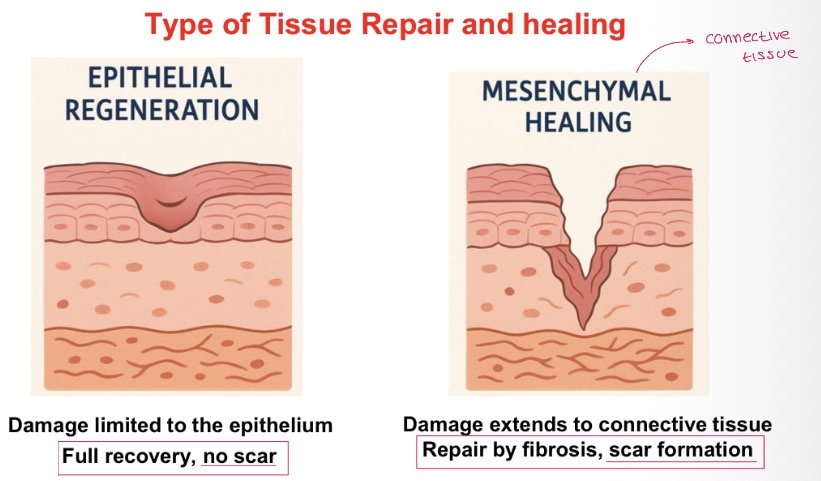
When do epithelial tissues regenerate completely?
If only the epithelium is damaged
Another name for connective tissue
Mesenchymal tissue
How do connective (mesenchymal) tissues heal mainly?
By repair
Connective (mesenchymal) tissue mainly heals by repair and produces what
Fibrous tissue and a possible scar
What happens to the chance of scarring when the injury is deeper
Chance of scarring is greater
What happens when more connective tissue and thus a deeper injury has happened
Greater the chance of scarring
Epithelium = ?
Connective tissue= ?
Regeneration
Repair and scar formation
EPITHELIAL TISSUE
What do epithelial tissues form
Surface layers of organs and the lining of body cavities
EPITHELIAL TISSUE
What are they made of
Closely packed cells
EPITHELIAL TISSUE
What are the different types of epithelial tissue organisation
Simple and stratified
EPITHELIAL TISSUE
Functional
Protection secretion absorption
EPITHELIAL TISSUE
Regenerative capacity - EXAM
high regenerative capacity
EPITHELIAL TISSUE
What does Hight regenerative capacity mean
They can replace damaged cells quickly
CONNECTIVE (MESENCHYMAL) TISSUES
Where is it situated in comparison to epithelial tissue
Bellow
CONNECTIVE (MESENCHYMAL) TISSUES
What does it provide
Structural support and nutritional supply
CONNECTIVE (MESENCHYMAL) TISSUES
What is it composed of
Fibroblasts, collagen fibres and extra cellular matrix
CONNECTIVE (MESENCHYMAL) TISSUES
Function
Structural support and repair
CONNECTIVE (MESENCHYMAL) TISSUES
Regenerative capacity?
Lower regenerative capacity
CONNECTIVE (MESENCHYMAL) TISSUES
What happens because the CT has lose regenerative capacity
Healing occurs by fibrosis (scar formation)
CONNECTIVE (MESENCHYMAL) TISSUES
What is is it described as
Very dynamic tissue

What is stratum básale
Stem cells
What is the role of the Stratum Básale
It contains dividing cells - the stem cells that regenerate the epithelium
Look
Done

Answer
B

Answer
C

Answer
C
Epithelial regeneration
what is epithelial regeneration
a rapid and efficient process driven by high proliferative capacity of basal cells and their close interaction with the underlying connective tissue
Epithelial regeneration
what drives epithelial regeneration
high proliferative capacity of basal cells and their close interaction with underlying connective tissue
Epithelial regeneration
what happens in oral ulcers though epithelial regeneration
complete restoration of the epithelium within a few days, provided the mesenchyme remains intact
Epithelial regeneration
how quickly can the epithelium be completely restored in oral ulcers?
within a few days
Epithelial regeneration
what condition must be met for complete epithelial restoration in oral ulcers
the mesenchyme remains intact
Epithelial regeneration
what happens when damage is limited to the epithelium
full recovers, no scar
Epithelial regeneration
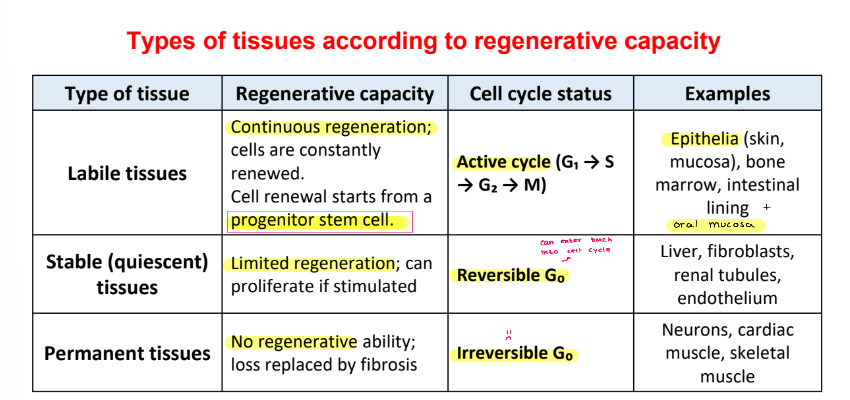
the three tissue are
labile tissues, permanent tissues and stable (quiescent) tissues
tell me which one is the most regenerative (1) and least (3)
labile tissues
stable (quiescent)
permanent tissues
Epithelial regeneration
what is the regenerative capacity of labile tissues and what does it mean
continuous regeneration, cells are constantly renewed
Epithelial regeneration
where does cell renewal start in labile tissues (IMPORTANT)
from progenitor stem cell
Epithelial regeneration
what is the cell cycle status of labile tissues
active cycle
(G1 → S→G2→M)
Epithelial regeneration
what are examples of labile tissues (4)
epithelia (skin, mucosa)
bone marrow
internal lining
oral mucosa
Epithelial regeneration
what is the regenerative capacity of stable (quiescent) tissues - and what can happen if stimulated
limited regeneration
can proliferate if stimulated
Epithelial regeneration
what is the cell cycle status of stable (quiescent) tissues
Reversible G0
Epithelial regeneration
what are examples of stable tissues (4)
liver
fibroblasts
renal tubules
endothelium
Epithelial regeneration
what is the regenerative capacity of permanent tissues, and what is loss replaced by
no regenerative capacity and loss replaced by fibrosis
Epithelial regeneration
what is the cell cycle status of permanent tissues
irreversible G0
Epithelial regeneration
what are examples of permanent tissues
neurons
cardiac muscle
skeletal muscle
READ
done
Epithelial regeneration
what characterises Labile cells (labile tissues)
constant cell activity
Epithelial regeneration
where does cell renewal start in labile cells
from a progenitor stem cell
Epithelial regeneration
what happens after a labile cell cycle is completed
they initiated the next one (G1 to M)
Epithelial regeneration
what tissues have high cell renewal
labile tissues
Epithelial regeneration
what are examples of labile tissues
intestine
skin
Epithelial regeneration
what characterises quiescent cells (stable tissues) - to do with cell cycle stuff
normally reduced cell activity (G0) but upon appropriate stimuli they proliferate (G1)
Epithelial regeneration
in which phase are quiescent cells normally found
G0 phase
Epithelial regeneration
what happens to quiescent cells after appropriate stimuli
they proliferate (G1 phase)
Epithelial regeneration
quiescent cells are wat type of cells and found where?
parenchymal cells of glands
Epithelial regeneration
what are examples of quiescent tissues/cells?
liver, kidney, fibroblasts, smooth muscle cells
Epithelial regeneration
what characterises permanent cells (terminally differentiated cells)
differentiated cells
Epithelial regeneration
do permanent cells have the capacity to initiate a new cell cycle
no capacity to initiate a new cell cycle
Epithelial regeneration
what are examples of permanent cells?
nerve cells, striatal cells, cardiac cells

look
done
Epithelial regeneration
what is the cell cycle
the sequence of events that a cell undergoes to grow, replicate its DNA, and divide into two daughter cells
Epithelial regeneration
name the phases of the cell cycle in order
G1
S
G2
M
G0
Epithelial regeneration
what happens during G1
cell growth and protein syntheses, preparation for DNA replication
Epithelial regeneration
what happens during S phase
DNA synthesis (replication of genetic material)
Epithelial regeneration
what happens during G2 phase
DNA integrity check and preparation for mitosis
Epithelial regeneration
what happens during M phase (mitosis)
nuclear and cytoplasmic division - results in two daughter cells
Epithelial regeneration
what happens during G0
resting phase
cell leaves the cycle temporarily or permanently

look at the placement of the different tissues
done
Epithelial regeneration
there are 4 stages of epithelial regeneration process what are they
epithelial loss and exposure of underlying tissues
cell migration
proliferation
differentiation and maturation
Epithelial regeneration
what is the first phase
epithelial loss and exposure of underlying tissue
Epithelial regeneration
what is the second phase
cell migration
Epithelial regeneration
what is the 3rd phase
proliferation
Epithelial regeneration
what is the 4th and final stage
differentiation and maturation
Epithelial regeneration
what happens during phase 2 - cell migration
basal epithelial cells at the wound margins migrate over the residual basement membrane or fibrin clot
Epithelial regeneration
which cells migrate during epithelial regeneration
basal epithelial cells at the wound margins
Epithelial regeneration
what do basal epithelial cells migrate over during epithelial regeneration
the residual basement membrane or fibrin clot
Epithelial regeneration
what happens during stage 3 - proliferation
epithelial cells re-enter the cell cycle to increase cell numbers
Epithelial regeneration
what happens during stage 4 - differentiation and maturation
epithelial layers are resorted, keratinisation resumes, and the barrier function is re-established
Epithelial regeneration
where are epithelial stem cells located
basal layer
Epithelial regeneration
what does the basement membrane provide
structural support
Epithelial regeneration
what does the basement membrane contain
matrix proteins such as collagen IV and laminin

look
done

Epithelial regeneration
look at the cycle
done
Epithelial regeneration - proliferative capacity and cell cycle
what happens when there is cell injury
growth factors are secreted by damaged and adjacent cells
Epithelial regeneration - proliferative capacity and cell cycle
what do growth factors bind to
the cell surface (rGFs-RFCr)
Epithelial regeneration - proliferative capacity and cell cycle
what happens after growth factors bind to the cell surface
activation of the cytoplasmic protein cascade occurs
Epithelial regeneration - proliferative capacity and cell cycle
what happens after activation of the cytoplasmic protein cascade
induction in the nucleus of transcription factors (TFs)
Epithelial regeneration - proliferative capacity and cell cycle
what do the transcription factors activate
proto-oncogenes (c-myc, p53 and the retinoblastoma gene)
Epithelial regeneration - proliferative capacity and cell cycle
what must be activated for proliferation to begin
the cell cycle
Epithelial regeneration - proliferative capacity and cell cycle
what activated the cell cycle for proliferation
proteins that drive growth and division
Epithelial regeneration - proliferative capacity and cell cycle
why must cell proliferation be regulated
to prevent abnormal growth
Epithelial regeneration - proliferative capacity and cell cycle
place these in the correct order from an injury to cell proliferation
cytoplasmic signalling
growth factors
receptors
injury
new proteins
transcription
cell proliferation
injury
growth factors
receptors
cytoplasmic signalling
transcription
new proteins
cell proliferation