Measurements (Psch 242)
 Call Kai
 Learn
Learn Practice Test
 Spaced Repetition
 Match
Match Flashcards
 Knowt Play
1/27

There's no tags or description
Looks like no tags are added yet.
Name | Mastery | Learn | Test | Matching | Spaced | Call with Kai | Chat |
|---|
No analytics yet
Send a link to your students to track their progress
28 Terms
Objective measurements are not ___ related to the construct you’re interested in
Exclusively
Ex: IQ tests are an indicator of cognitive ability, but also level of education, motivation, test anxiety, and more!
What two methods are good to use for objective measurements? And why?
Both objective and subjective as it is good for establishing validity.
What are two sources of measurement error? And what are they?
Random error-inconsistent measurement procedures/unreliable instruments
Systematic error-measure does not capture construct of interest/contamination (participants aren’t honest)
Define reliability.
How consistent your measure is (absence of random error)
Define test-retest reliability
Consistency over time
Ex: Correlation between scores on test (Time 1) and retest (Time 2)
- Results should be similar if you measure the same thing the same way multiple times
Describe the perfect test-retest reliability.
Measurements don’t change between time 1 and time 2. Each person gives the same answer twice

Describe a fair-retest reliability.
People’s scores change a little from time 1 and time 2 (still similar)
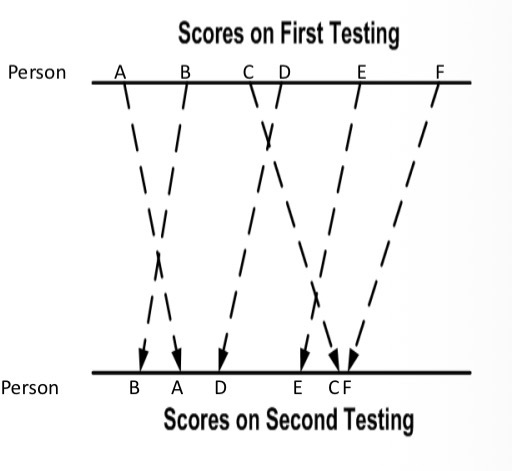
Describe poor test-retest reliability.
People are changing a lot between time 1 and 2 (seemingly no relationship)

Define interrater reliability
Degree of agreement between two independent raters
- Correlation between (at least) two raters’coding
- If two people see the same thing, are they interpreting it in the same way
Define internal consistency reliability.
Degree to which the items of a measure reliably measure the same thing
Correlations between first and second set of questions (split-half)
What is cronbach’s alpha?
Average of all possible split-half correlations
- If two questions are trying to measure they same thing, they should get similar results!
- Ex. “Do you feel anxious?” should get similar answers to “Do you feel nervous?”
When does a measurement have high construct validity?
When it measures what it is supposed to measure.
When does a measure have high convergent validity?
When it is strongly (positively) associated with existing (validated) measures of the same thing.
Discriminant validity
What are two types of criterion validity?
Predictive and criterion validity
What does predictive validity ask?
Does the measure predict construct-relevant behaviors/outcomes?
Ex: The ACT should predict performance in college
- A measure of trait self-control should predict people’s ability to resist temptations
What does criterion validity ask?
Does it match the gold-standard measurement?
Ex: Does your new heart monitor agree with existing heart monitors?
- Does your new short version measure of anxiety give the same results as the complete and validated test?
What is effective range?
The range (low to high) within which a measure gives accurate measurements of the variable (that you’re measuring)
What is the floor effect?
Everyone/almost everyone is at the bottom of a scale
The range at the bottom isn’t sufficient to pick up variation
Ex: • How do you feel about having to walk in heavy rain
without an umbrella on a cold day?
1. Very Positive
2. Positive
3. Slightly positive
4. Neutral This is the floor
What is the ceiling effect?
Everyone/almost everyone is at the top of a scale
The range is insufficient
Ex: How tall are you?
• 4’7 – 5’0 This is the ceiling
• 4’0 – 4’6
• 3’7 – 4’0
• 3’0 – 3’
How can you ensure your measure has the right range?
Look at past studies and pilot test (beta test using a smaller sample to ensure sufficient variation)
Define variable.
Something that can vary
Ex: height, nationality, etc
Define value.
A number representing a certain level of the variable
Ex: Height: 5’7, 6’2, etc…
Define score.
A specific value for a given person or thing.
Ex: my score on the variable “height” is 5’9
What two things should be considered when creating or using a measure?
Properties of numbers
Properties of the thing you’re measuring
What are the properties of numbers?
Some variables have all these properties, others don’t

What are the properties of variables?
They are measured on different scales.
What are categorical variables?