Apex Anesthesia Machine
 Call Kai
 Learn
Learn Practice Test
 Spaced Repetition
 Match
Match Flashcards
 Knowt Play
1/59

There's no tags or description
Looks like no tags are added yet.
Name | Mastery | Learn | Test | Matching | Spaced | Call with Kai | Chat |
|---|
No analytics yet
Send a link to your students to track their progress
60 Terms
Where does each anesthesia-machine pressure system begin and end?
High: cylinder → cylinder regulator
Intermediate: pipeline → flowmeter valves
Low: flowmeter tubes → common gas outlet
Pipeline pressure vs regulated cylinder pressure?
Pipeline: 50 psi
Cylinder after regulator: 45 psi
Higher pipeline pressure makes it the primary source.
What components are in the low-pressure system?
Flowmeter tubes → vaporizers → check valve, if present → common gas outlet
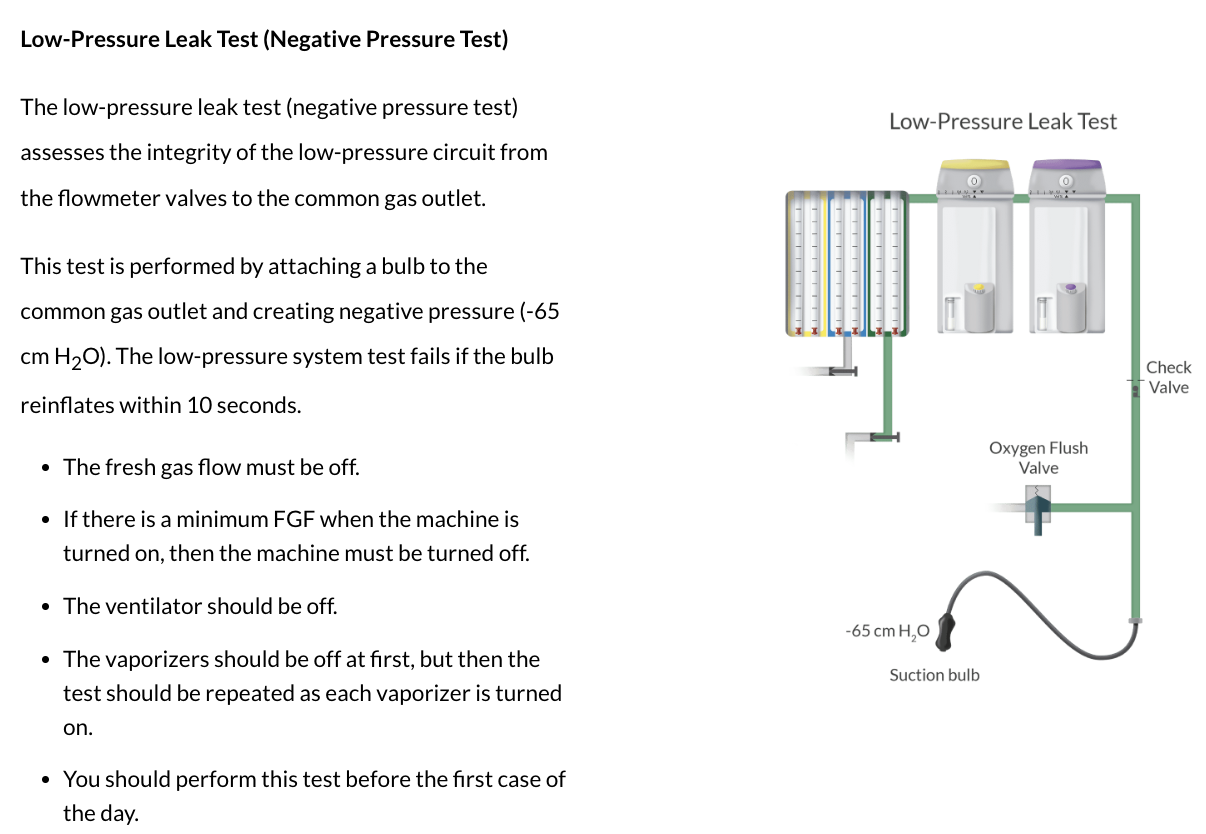
How is the negative-pressure (low-pressure) leak test performed?
Bulb attached to CGO
Create −65 cm H₂O
Bulb stays collapsed for 10 seconds
Reinflation = leak/failure

What must be off during the negative-pressure leak test?
Fresh gas flow
Ventilator
Machine, if it produces minimum flow
Vaporizers initially; then test each one individually

How is the positive/high-pressure leak test performed?
Close APL valve
Pressurize to 30 cm H₂O
Pressure remains constant = pass
Pressure falls = leak
Best test for detecting a vaporizer leak?
Negative-pressure leak test, repeated with each vaporizer turned on individually.
How does a check valve affect the positive-pressure leak test?
A closed check valve prevents pressure from reaching the rest of the low-pressure system, so an upstream leak may be missed.
What signifies a failed-low pressure leak test
bulb reinflates within 10 seconds.
How much negative pressure should be created for a proper negative-pressure test?
-65 cm H2O
What does SPDD mean in the anesthesia machine?
Supply: gases enter the machine
Processing: gases prepared inside machine → CGO
Delivery: breathing circuit brings gases to patient
Disposal: scavenging removes waste gases
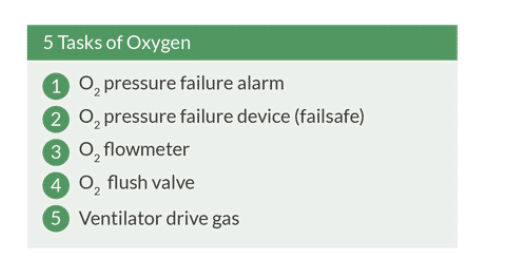
What are the five tasks of oxygen?
O₂ pressure failure alarm
O₂ pressure failure device/failsafe
O₂ flowmeter
O₂ flush valve
Ventilator drive gas
Memory: Alarm → Failsafe → Flowmeter → Flush → Ventilator
PISS vs DISS?
PISS = cylinders: unique pin positions —> More than one washer can bypass PISS.
DISS = hoses/pipelines: unique diameter and threads
What are the PISS pin configurations?
Air = 1, 5
O₂ = 2, 5
N₂O = 3, 5
E-cylinder pressure and capacity
Air: 1,900 psi | 625 L
O₂: 1,900 psi | 660 L
N₂O: 745 psi | 1,590 L
CO₂ is also liquid in its cylinder: 838 psi, 1,590 L.
How do O₂ and N₂O cylinder contents differ?
O₂ = gas: pressure falls proportionally with contents.
N₂O = liquid + gas: pressure stays 745 psi until all liquid is gone.
Determine N₂O contents by weight, not pressure.

How do you calculate O₂ cylinder duration?
Remaining liters = 660 L × gauge pressure ÷ 1,900 psi
Minutes remaining = remaining liters ÷ flow rate
Example: 500 psi at 2 L/min → 174 L → 87 minutes
What must you know about cylinder identification and colors?
Identify the gas by its label—not color.
US: O₂ green, air yellow, N₂O blue
WHO: O₂ white, air black/white, N₂O blue
Essential cylinder-handling rules?
Protect the valve—most delicate part
Store upright and secured
No replacement cylinder → insert yoke plug
MRI → only nonmagnetic cylinder, such as aluminum
Never use more than one washer because it can bypass PISS
What should you do if a cylinder connection hisses?
Tighten the connection
Replace the washer/gasket
Use a different cylinder
Never stack washers.
How are cylinder fires/explosions prevented?
O₂ and N₂O are oxidizers
Fire triad: oxidizer + fuel + ignition
Never oil the valve
Open cylinders slowly
Avoid temperatures above 130°F/57°C
“Cracking” briefly opens the valve to clear debris
What cylinder testing and regulatory facts are important?
Tested at 1.66 × service pressure
Tested every 5 years
5-point star permit = every 10 years
ASTM: machine components/F1850
FDA: pre-use checkout
OSHA: occupational anesthetic exposure
DOT: compressed-gas cylinders
What activates the O₂ pressure-failure device?
O₂ supply pressure <20 psi
Exhausted O₂ source/tank
What does the O₂ pressure-failure device NOT detect?
Pipeline crossover
N₂O accidentally flowing through the O₂ pipeline
FiO₂ below 21%
Leak distal to the flowmeters
Differentiate the two O₂ safety alarms.
Pressure alarm: sounds at 28–30 psi
Failsafe/pneumatic device: reduces or stops N₂O below 20 psi
O₂ analyzer: alarms when FiO₂ <21%
30 = pressure alarm
20 = failsafe
21% = oxygen analyzer
Ohmeda failsafe vs Dräger protection device?
Ohmeda: O₂ <20 psi → completely stops N₂O; all or nothing
Dräger: decreasing O₂ pressure → proportional reduction in N₂O
Detects low-pressure causes:
Depleted O₂ tank
Drop in pipeline pressure
Disconnected O₂ hose
Misses despite possible hypoxia:
O₂-pipeline crossover
Flowmeter leak
Reason: it senses O₂ pressure—not O₂ concentration.
What does the hypoxia-prevention/proportioning device do?
Proportioning device = Hypoxia prevention safety device
Links O₂ and N₂O flow
Limits N₂O to 3× the O₂ flow
Maximum N₂O = 75%
Minimum FiO₂ permitted = 25%

When can the proportioning device still allow a hypoxic mixture?
O₂-pipeline crossover
Leak distal to flowmeter valves
Addition of a third gas
Defective mechanical/pneumatic components

What must I know about the Thorpe-tube flowmeter?
Begins the low-pressure system
Variable-orifice tube: narrow bottom → wider top
Gas flow pushes float up; gravity pulls it down
Ball = read middle
All other floats = read top/widest part

How do flow and Reynolds number relate?
Low flow: laminar → depends on viscosity → Poiseuille
High flow: turbulent → depends on density → Graham
Re < 2,000 = laminar
Re 2,000–4,000 = transitional
Re > 4,000 = turbulent
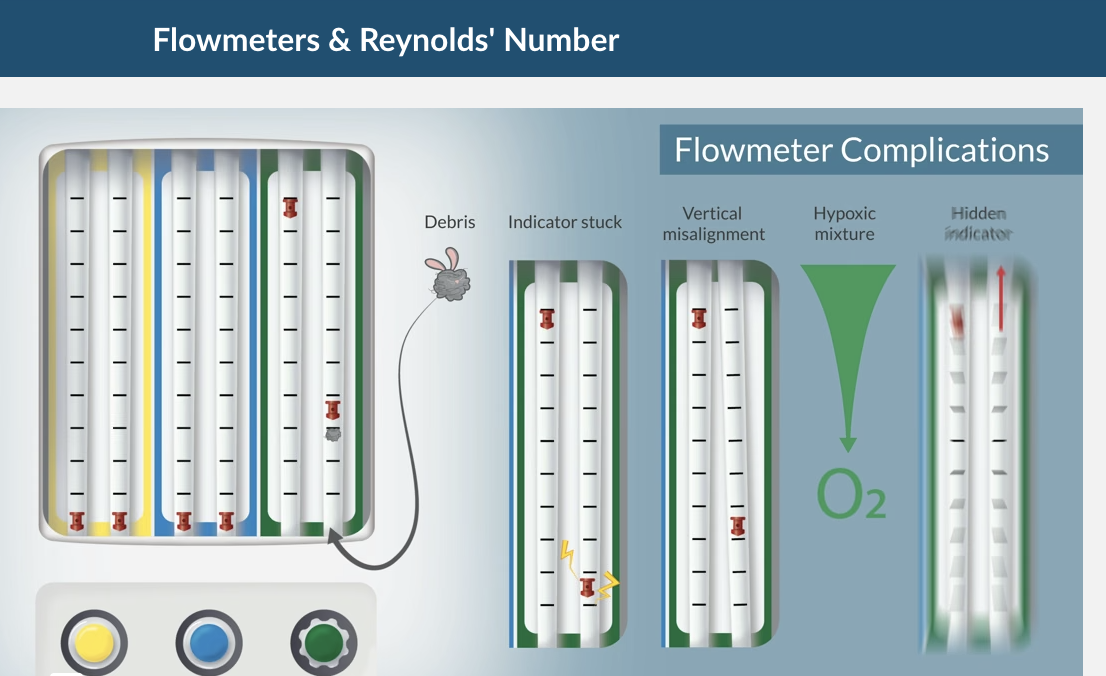
Why is the O₂ flowmeter placed closest to the common gas outlet?
O₂ is downstream/far right on U.S. machines.
A leak in an upstream air or N₂O tube allows that gas to escape while downstream O₂ continues toward the patient.
A leak in the O₂ flowmeter itself can still cause a hypoxic mixture.
Flowmeters are distal to other safety devices; the O₂ analyzer is the final safeguard.
Reynolds numbers
Re <2,000: Laminar flow
Re 2,000–4,000: Transitional flow
Re >4,000: Turbulent flow
Poiseuille’s equation vs Graham’s law
Low flow → laminar → viscosity → Poiseuille
High flow → turbulent → density → Graham
Memory: Low Loves Viscosity; High Has Density.

How do you calculate delivered tidal volume on a flow-coupled anesthesia machine?
look at formula
Convert I:E ratio into inspiratory fraction.
1:1 → 1/2
1:2 → 1/3
1:3 → 1/4
What increases tidal volume in a flow-coupled machine?
↑ Fresh gas flow
↑ Bellows volume/height
Longer inspiration: 1:2 → 1:1
↓ Respiratory rate
What changes decrease delivered tidal volume in a flow-coupled machine?
↑ Respiratory rate
Shorter inspiration: 1:2 → 1:3
↓ Fresh gas flow
↓ Bellows height
Memory: More time, flow, or bellows volume = larger Vₜ.

Circuit compliance
Compliance measures distensibility. During positive-pressure ventilation, some gas expands the circuit instead of reaching the patient.

How do you calculate volume lost to circuit compliance?
look at formula
Variable-bypass vaporizer
Variable bypass
Flow-over
Temperature-compensated
Out-of-circuit
Agent-specific
Tipped vaporizer
Tipping may send liquid agent into the bypass chamber → dangerously increased output.
Treatment:
Drain it.
Set dial to maximum.
Run high FGF for 20–30 minutes, until agent reading reaches zero.
Vaporizer numbers
Vaporizing-chamber gas: 100% saturated
1 mL liquid agent ≈ 200 mL vapor
Flow below 200 mL/min or above 15 L/min may decrease output
Liquid used per hour:
mL/hr=Vol%×FGF (L/min)×3
Pumping effect and leaks
Pumping effect → increased output from gas being forced backward into the vaporizing chamber.
Promoted by PPV/O₂ flush, low FGF, low dial setting, and low liquid level.
Most common cause of vaporizer leak: loose filler cap.
Test for a vaporizer leak with the vaporizer turned on.
What is the “T” setting?
Transport mode—prevents liquid anesthetic from entering the bypass chamber if the vaporizer is tipped during transport/removal.
Most common cause of a vaporizer leak?
Loose filler cap.
How does the vaporizer compensate for cooling?
The temperature-compensating valve changes the ratio of vaporizing-chamber flow to bypass flow to maintain constant output.
variable bypass vaporizer does NOT require recalibration for elevation
Why does desflurane need a special vaporizer?
Low potency: MAC 6.6%
Boiling point: approximately 22°C
Vapor pressure: 3–4× higher than other agents
TEC 6 numbers and function
Heats desflurane to 39°C
Pressurizes it to 2 atmospheres
Injects vapor directly into the FGF
Does not use variable bypass or flow-over
Dual circuit, requires: power
Memory: Des = 39 and 2.

TEC 6 delivers the dialed volume percent, but it does not compensate for atmospheric pressure.
Higher altitude → lower atmospheric pressure → increase dial
Hyperbaric environment → higher pressure → decrease dial
Required dial= (Normal dial×760)/ (Ambient pressure)
Oxygen analyzer
Located in the inspiratory limb
Measures O₂ concentration, not pressure
Final defense against a hypoxic mixture
First device to detect an O₂ pipeline crossover or O₂ flowmeter leak

Analyzer types:
Galvanic
Paramagnetic
closed-circuit anesthesia
O₂ delivery is matched to O₂ consumption.
Average adult O₂ consumption: 250 mL/min
If consumption rises but delivery stays constant → FiO₂ falls
Causes: fever, sepsis, pain, sympathetic stimulation, thyrotoxicosis
Only the oxygen analyzer detects this developing hypoxic mixture
Immediate response to O₂ pipeline failure/crossover
Open the O₂ cylinder
Disconnect the O₂ pipeline
Confirm FiO₂ is increasing on the oxygen analyzer
Why disconnect? Pipeline pressure can prevent cylinder oxygen from entering the machine—even if the pipeline contains the wrong gas.
If FiO₂ does not increase—assume machine malfunction
Ventilate with an Ambu bag
Use an independent O₂ cylinder or room air
Convert to TIVA
Use low flows to conserve cylinder O₂
Avoid the machine’s auxiliary O₂ flowmeter—it may be supplied by the contaminated pipeline
Reconnect only after the pipeline is tested
Memory: Cylinder ON → Pipeline OFF → Verify FiO₂.
O₂ analyzer alarms → assume pipeline crossover until proven otherwise.
Pipeline failure → cylinder ON, pipeline OFF.
Oxygen flush valve
Intermediate-pressure system → breathing circuit
Bypasses flowmeters and vaporizers
Delivers 35–75 L/min at approximately 50 psi
Dilutes volatile anesthetic → possible awareness
Why avoid O₂ flush during inspiration?
During mechanical inspiration, the spill valve is closed. Pressing the flush sends its high flow/pressure toward the patient → barotrauma.
Ventilator spill valve
Inspiration: drive gas compresses bellows and closes spill valve
Expiration: exhaled gas refills bellows; spill valve opens around 2–4 cm H₂O and sends excess gas to scavenging
This pressure creates intrinsic PEEP
Memory: Inspiration = spill shut; expiration = spill excess.
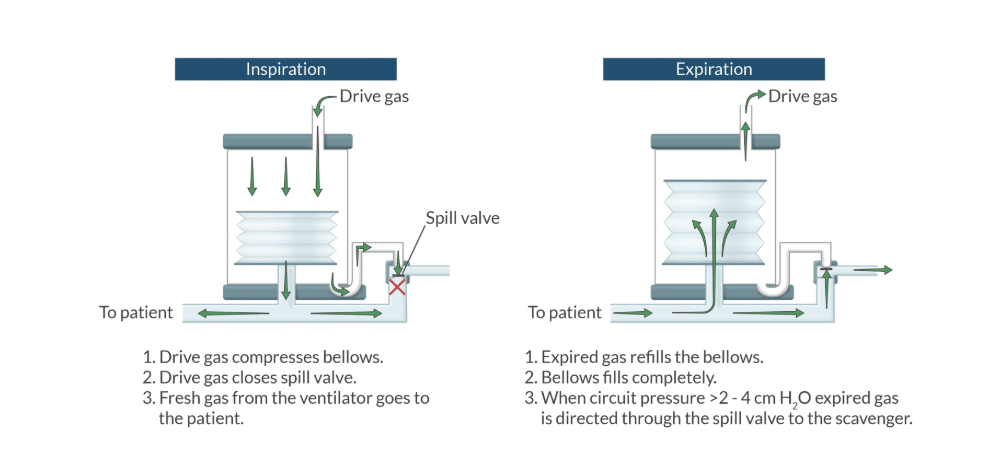
What occurs during inspiration?
Drive gas compresses the bellows
Drive gas closes the spill valve
Fresh gas flows to the patient
O₂ flush during this phase → barotrauma risk

What occurs during expiration?
Drive gas stops/exits
Patient’s expired gas refills the bellows
Once circuit pressure exceeds 2–4 cm H₂O, the spill valve opens
Excess gas flows to the scavenging system